Topic

Shelter Project – Fabric Choice for Permatex Bonding Build

Viewing 17 posts - 1 through 17 (of 17 total)
Geoff Caplan BPL Member
PostedJul 8, 2026 at 6:07 pm

Hi folks

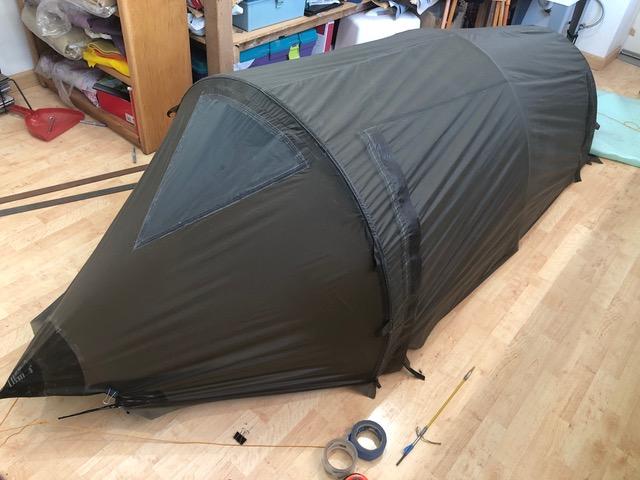
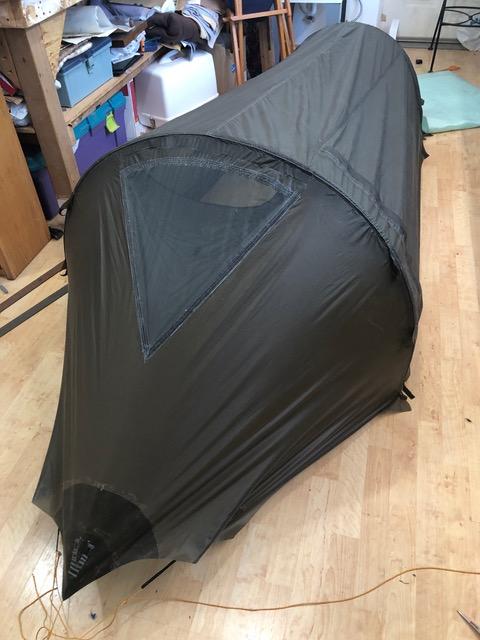
Time for a new enclosed tarp shelter! It’s a small, wind-hardened solo trekking pole bunker for exposed mountain walking.

I’m going to try Permatex bonding this time, so I’m restricted to fabrics with a true sil/sil coating – not a sil/PU blend like the RSBTR silpolys.

I was going to use Extremtextil’s much loved 30d silpoly, but literally the day I was ready to order, they pulled it from the site. They tell me the manufacturer has stopped making it and they haven’t found an alternative. So that’s a bit of a disaster for all of us…

I now have three main alternatives that I can find.

Extremtextil reckon that their best lightweight fly fabric is their sil/sil 30d 6.6 nylon. This is specifically designed for shelter use and will definitely bond. It’s a good fabric, but obviously we are back to the stretch issues in wet climates. And basically grey or nothing.

https://www.extremtextil.de/en/ripstop-nylon-6.6-tent-fabric-silicone-coated-30den-40g-
sqm/71936.SW

There is the RSBTR MTN sil/sil 30d 6.6 nylon. Lots of marketing hype, nice colours, but very thin on actual specs so you have to take their word for it. Again, it has the drawbacks of nylon…

https://ripstopbytheroll.com/products/1-1-oz-mtn-silnylon?variant=43872831963306

And my last hope for silpoly, I think, is the Dutchware Xenon 1.1 in 20d. They say it’s “siliconized”. I tried to clarify if it’s pure sil/sil, but they were noncommittal. Does anyone know for sure that it will bond properly with Permatex? Any experience of using this fabric in strong winds?

https://dutchwaregear.com/product/xenon-sil-1-1/

Initially I was put off by the idea of using 20d in exposed mountain terrain. But I see that SlingFin, who know their fabrics, are using 20d nylon on their legendary WindSaber 4 season tent – so I guess with good handling of stress points I’d get away with it?

TL/DR – my questions are:

  1. Have I missed any good lightweight fly options in MYOG quantities?
  2. Will the Dutchware Xenon bond with Permatex? Is 20d enough, properly handled? Any direct experience with this fabric?
  3. Or should I go for a 30d nylon and put up with the stretch? Any experience with the RSBTR or Extremtextil options? Which to choose?

Any advice from the BPL mavens much appreciated!

Geoff Caplan BPL Member
PostedJul 8, 2026 at 7:32 pm

PS – the AI’s are telling me they’re seeing tests where silpoly bonding didn’t work well, despite a pure sil/sil coating. They speculate that the coating bonds differently to silpoly than to silnylon.

They are pushing me toward the silnylon on the grounds that it’s proven.

Does anyone know for sure? I can’t find the reference they are quoting and they do hallucinate at times.

Jon Solomon BPL Member
PostedJul 9, 2026 at 2:59 pm

Sounds like a great project!
The news that the Taiwanese supplier has stopped production of that 30D silpoly is a blow. I have a mid made out of that fabric and it is very stout.

Looking at the website now, they have what appears to be the same fabric in dark olive only. https://www.extremtextil.de/en/ripstop-polyester-tent-fabric-silicone-coated-30den-45g-sqm/72098
The specs are the same, soooo… They do mention on the product page that availability is temporary.

ICYMI, there are a couple of other choices on ET’s site that I’d recommend.

The 30D Cordura Diamond sil/sil nylon is a superlative fabric. https://www.extremtextil.de/en/cordura-diamond-ripstop-nylon-6.6-silicone-coated-30den-50g-qm/72099.OLIVGR
This would be the fabric that I would choose if my goal were to make a “bunker.” I have samples and the fabric seems amazing but I haven’t used it for a shelter yet.

There’s also the 20D sil/sil nylon, which is also made in Taiwan. https://www.extremtextil.de/en/ripstop-nylon-tent-fabric-silicone-coated-20den-36g-sqm/70777.HLLOLV
I have a mid made of this fabric and it doesn’t stretch much when wet if pitched with even tension all around. The coatings are very good and it is quite a bit lighter than the 30D Cordura.

Unfortunately, Permatex is very expensive in Europe. Good luck with your project!

Jerry Adams BPL Member
PostedJul 9, 2026 at 10:03 pm

I put a guyline reinforcement 4″ square.  Rsbtr silpoly.  Silicone, I think it was diluted with mineral spirits.

It seemed like it held pretty good.

But I sewed around the perimeter because I don’t trust that.  And I would never trust two pieces of a tarp glued together.  It seems like the stress of getting pulled apart by the wind would rip it apart.

I’m probably being too conservative.  It will be interesting to see how your project turns out.

I would test it with a couple pieces glued together and then try to rip it apart.

Would you put a weight on it to squeeze the two pieces together while the silicone dries?

Roger Caffin BPL Member
PostedJul 10, 2026 at 2:24 am

I first use a roller to squeeze the layers together, then a weight, then I sew.


Works for me.

Cheers

PostedJul 11, 2026 at 4:19 pm

Regardless of what fabric and adhesive you use, I would do some fairly rigorous testing before I trusted it on a shelter. I am curious as to why you don’t want to sew it?

Geoff Caplan BPL Member
PostedJul 12, 2026 at 7:10 pm

I’m trying to build a shelter that can take a fair bit of wind.

Why bonding? I like the idea of a DCF-style shell with no needle holes. No seam sealing. No stitch elongation. No ripped fabric along the needle punctures in storm conditions. Just clean overlapped seams. And for complex cat-cut panels, I think it will simply be easier to do a good job – my sewing skills are pretty basic and the bonding can be done slowly and under full control.

I’ve been corresponding with a couple of German MYOG shelter makers who have experience with Wacker Elastosil – the E43 formulation seems to be the optimal for the job, but the E41 works too. Since I posted I’ve shifted from Permatex to the idea of the Wacker – it’s a very highly specced industrial product designed specifically for this type of bonding – not for sealing windscreens. And it’s widely available here in the UK at a decent price.

Both these contacts are encouraging me to try a purely bonded shelter. They have run extensive tests on new and weathered bonds and have long term experience in the field. They are fans of the technique. Invariably the fabric fails before the seams, even after long UV exposure.

Again, since my first post I came across a group of folks on HammockForum. They got good results with sil/sil Nylon, but sil/sil Poly was disappointing. The speculation is that coatings on the silpoly lie more on the surface, while they become more integrated with the fibre on silnylon leading to a more reliable join. This has pretty much swung me to the idea of using a 6.6 nylon, where there is solid evidence of long-term success. Unless there is someone here who can offer strong evidence of silpoly bonding working long term in the field it feels too risky to try it.

One of the pleasures of MYOG is the ability to experiments with things that would simply be uncommercial for a business. This style of bonding is FAR too slow and messy for commercial manufacture. Sewing is the norm not necessarily because it’s better but because it’s fast.

So I’m partly doing it for the challenge. Obviously, assuming my testing works out OK…

Geoff Caplan BPL Member
PostedJul 12, 2026 at 7:20 pm

Jon, I was tempted by the diamond weave Cordura. The branding is a guarantee of quality. But the Extremtextil guys talked me out of it:

I really can’t recommend this fabric as a tent fly fabric / canopy.
Due to the diamond weave, it stretches differently than a conventional woven fabric.
The weave is also a lot denser than it needs to be for a fly fabric. We mainly sell this fabric for UL-packs, stuff sacks and so on.

I’m not saying that you can’t use it as a tent material, but this would be a better alternative:

https://www.extremtextil.de/en/ripstop-nylon-6.6-tent-fabric-silicone-coated-30den-40g-sqm/71936.HLLGRA

The “tent fabric” they recommend is specifically designed for use in shelter canopies. They’ve been offering it for years and feedback is good.

Yes – I see that they have reposted the silpoly in dark olive – it must be the end of their stock.

BUT – as I posted above, I’ve found evidence that bonding silpoly is a bit of a gamble compared to silnylon and I’m minded to play it safe.

Plus this is a partial single skin shelter. I used to have a tarp in a similar colour and found it too depressing on a long, dark, stormy night. It’s stealthy, but I really don’t think I could live with it!

Jerry Adams BPL Member
PostedJul 12, 2026 at 7:30 pm

Report back experience

Will you apply weight on it while it dries to make a strong joint

Roger Caffin BPL Member
PostedJul 12, 2026 at 10:44 pm

Very odd. The surface energy of polyester is about 42 dynes/cm2 on one web site, while nylon is about 46. That means they (should) have similar bonding tendencies. Odd.

Looking at another source, I find that untreated nylon has a surface enrgy of >46 dynes/cm2, and has good adhesion, while PE does not, and that PE has a lower surface energy than that given above: more like 30-33 dynes/cm2, and can be difficult to ‘wet’.

It may be that the silicone polymer ‘wets’ the nylon fibres more easily than the polyester fibres: that I do not know but it seems likely from the above. Or it may be that the coating process for the two fabrics is a bit different, or maybe the weaves are sufficiently different that the polymer diffuses differently. Unknown.

What I do know is that experiment trumps theory every time.

Wacker incidentally is a good and major player in the polymer arena.

HTH, cheers


Jon Solomon BPL Member
PostedJul 12, 2026 at 11:00 pm

Geoff,

That’s an intriguing response from ET. I had been thinking that it was precisely those qualities that would make the Cordura Diamond silnylon a top choice. I’m sure that you would have noticed this detail from the product description:

Thanks to the fiber property and weave density, the Silnylon stretches much less than our silicone coated tent fabrics and it is much more resistant on punctual seam stresses.

On the face of it, “stretches much less” ought to be a huge plus for a tent fly, while “much less than our silicone coated tent fabrics” sounds like a huge W. Plus, the product page does mention “tarp/tent” among the range of applications. I mean, I’m sure the folks at ET know their stuff, but I’d still be tempted to try the Cordura, especially for a non-woven bonded application.

I was aware of the successful use of the Wacker Elastosil products on the German forum and tried to source some from France several years ago but it was hideously expensive to get shipped across the Rhine. Probably should have tried contacting users in Germany directly for assistance.

As concerns the last remaining stock of 30D silpoly, I agree with you about the Dark Olive color. I had a mid in that color and didn’t like it at all. The Light Olive color of the 20D silnylon from ET, though, is perfect for 3 seasons in Western Europe. It blends in extremely well to the foliage and is very cheery inside. However, now with the extreme heat becoming a regular occurrence, that Light Olive doesn’t blend as well into the frequently parched, yellowed out landscape. Unexpectedly, the Ochre Yellow color of the 30D Cordura Sil would fit in well to the new “scorched earth” theme that has become common in Western European mountains and it would be very cheery to boot. Don’t know if you’re observing the same parched landscape in the UK?

As for the 30D silnylon they recommend, I’d personally prefer the Leaf Green color over the Light Grey.

Jon Solomon BPL Member
PostedJul 12, 2026 at 11:39 pm

Geoff, wouldn’t the higher density and lower elasticity of the Cordura sil be an advantage for a bonding application?

Geoff Caplan BPL Member
PostedJul 13, 2026 at 11:14 am

Jerry

My German contacts report good results without pressure – which will greatly ease the process. If anything, applying pressure, under glass for example, would inhibit access to the moisture that drives the curing process.

The Wacker data sheet doesn’t make any mention of pressure. So far as I can tell, you should:

1) Clean the contact area with surgical spirit to get rid of any grease

2) Clean it with heptane to remove any bloom off the coating

3) Coat one side of the seam evenly an moderately thinly, without going to extremes

4) Apply the other side to the Elastosil and roll seam gently from inside to edge with a silicone wallpaper roller to ensure even contact and drive out bubbles.

5) Allow to cure with no shear strain at all on the seam for 24-48 hours. Leave longer before applying any weight just to be safe.

If anyone has any proven improvements on these steps please post and share.

Of course I’ll test to check results.

Here is the advice from the official data sheet:

Processing

ELASTOSIL® E43 N TRANSPARENT is a ready-to-use, one-part silicone rubber which starts curing when exposed to air moisture.

As RTV-1 silicones require humidity for curing, free access of air moisture to the silicone rubber is essential. Additionally, the vulcanization time of ELASTOSIL® E43 N TRANSPARENT can be greatly reduced by increasing the level of air’s relative
humidity.

Please note that, unlike the initial skin formation, the total curing rate of RTV-1 silicones is limited by moisture’s diffusion speed in silicone rubber. As increasing the curing temperature has just a minor effect both on the skin forming time and the curing speed, ELASTOSIL® E43 N TRANSPARENT typically is vulcanized at room temperature. Heat curing is recommended only for applications where the silicone rubber is applied as a thin film (thickness less than 0.5 mm), because otherwise blistering is likely to occur due to the quick release of acetic acid.

After completion of the vulcanization the silicone elastomer may continuously be exposed to constantly changing climatic conditions, UV radiation and high temperature without damage.

Cured ELASTOSIL® E43 N TRANSPARENT usually shows good primerless adhesion to many substrates, e.g. glass, ceramics, metals, plastics and powder coatings.

Detailed information about the processing of RTV-1 silicones is given in our brochure

“ROOM TEMPERATURE VULCANIZING (RTV) SILICONES – MATERIAL AND PROCESSING GUIDELINES”.

We recommend running preliminary tests to optimize conditions for the particular application.

Removal:

If removal of the silicone from machines or dispensing equipment is necessary, white spirit or similar nonpolar solvents are recommended. However, cleaning ideally should take place before the silicone rubber is fully vulcanized. Cured silicone needs to be rubbed off or removed mechanically, if necessary in combination with a swelling agent (solvent) or a chemical silicone remover.

Living in the English Lake District, I don’t think access to moisture will be much of a problem!

Jerry Adams BPL Member
PostedJul 13, 2026 at 11:42 am

Interesting.  It would be difficult to apply weight on a long seam

I’ve always used weight but just for small patches.  Not so much weight to squeeze out the silicone.

Geoff Caplan BPL Member
PostedJul 13, 2026 at 12:05 pm

I think the Elastosil RTV-1 formulation is a different chemistry. It’s a specialised industrial bonding agent – probably works in a different way from a silicone patch bond.

Most people seem to think that pressure is needed for silicone or Permatex bonding.

In theory the Elastosil should be insanely strong. It’s advertised as 12.5 N/mm. I’d be using a conservative 4cm or 5cm overlap, which should be far stronger than the underlying fabric.

Jerry Adams BPL Member
PostedJul 13, 2026 at 12:46 pm

I just use silicone + mineral spirits, which may require a weight to keep the two sides together

Viewing 17 posts - 1 through 17 (of 17 total)
Loading...