


Consuming the person isn’t normal bear behavior, even if it was defending the food it just grabbed. At least it didn’t used to be.
Topic
Become a member to post in the forums.
 .
.
Consuming the person isn’t normal bear behavior, even if it was defending the food it just grabbed. At least it didn’t used to be.

In the entire history of GSMNP there have only been two human fatalities caused by bears. The Park gets 12 million human visitors a year—now multiply this by all the years of the Park’s existence since 1934—and the chance of a fatal bear attack is miniscule.
With 2,000 bears in the Park and 12 million humans, well, who’s at fault? The Park Service does nothing to curtail vehicle entrances into the Park—no entrance fee, no dayhiker fee—just a backpacker’s overnight fee. There’s no attempt by GSMNP to limit visitors or close roads in the Park. Ed Abbey calls it Industrial Tourism. And this is in a Park with the worse air pollution of any park in the country.

2016 Trip advisor review excerpt:
“The next day we made our way to the Hazel Creek trail via Welch Ridge trail. We stopped for the day at camp site #82 on Hazel creek. The camp site was a welcome rest for a good day of hiking. The trail just out of Double springs before Welch Ridge was magical in its beauty. This was my favorite area of the park. Water was near us all parts of the day since we were near Hazel Creek for most of the hike. er of the night.We hoisted our gear up into the trees using the park supplied equipment and were in bed before 9:00pm. At ~9:30 a black bear came wandering through our campsite. He, or she pushed against the tent until it pressed into my leg. I was awake before that gem occurred, but the sensation guaranteed that I was fully awake for the duration. I blew an air horn that we brought along, but the noise didn’t seem to bother him. He looked through our wet shoes on the camp table, (I know not a smart thing to leave out) then ate a hole in a plastic water bag and took his leave of us. ”
Same bear 4 years earlier? Normal bear behavior?
Bears casually wander through Yosemite valley campgrounds, as well as Tuolumne, and LYV and have for years. They’re completely habituated. Rarely (never) do they attack a human. But he bear behavior in Obx last post seems fairly normal for an habituated bear-except perhaps for pressing against the tent.
“hoisted our gear up into the trees”. That’s what precipitated the one scary encounter that I’ve had. It was an El Nino year and snow was very late melting. On the fourth of July a friend and I hung our food from a tent pole near snowy Sunrise camp. (this was long ago.) Two hikers came in in the dark; the snow had slowed them. One hung his entire pack in a tree near their tent. The other hung his food on a second, bent, bear pole. A bear came in, climbed the tree, fell ten feet with the pack and let out a roar. The pair in the tent did nothing. Jack and I were much further off and began to throw branches on our fire and make noise. The bear proceeded to work on the bent pole, huffing and growling, for twenty minutes. It went over. then the bear left. Again, the pair did nothing to discourage the bear but it was pretty scary. The bear was working only about fifteen feet from their tent. The late spring meant the bear was really hungry and desperate.
I still think this is normal bear behavior.
Easily accessible area + proximity to population centers + careless backpackers + habituated, protected bears = trouble. Is, was, and ever shall be. Hike such areas forewarned, IME.
“hoisted our gear up into the trees” A clarification. In the GSMNP every campsite has a horizontal cable run between 2 poles usually but sometimes between a pole and tree or 2 trees but if a tree(s) are used; always attached in such a way that there’s no way the bear can chew through where the cable is attached and also no way to get above the horizontal cable and drop down onto it. Then there are smaller cables attached to the main cable and dangling down and are sized in length so that when a food bag/container is clipped into a biner on the ground end of the hanging cable and hoist up to horizontal cable the other end of the cable reaches and can be attached to an eyebolt with a screw biner or similar. These cables /storage devices are also located away from the typical campsite/hangout areas but not necessarily that far away. Say 50-100 feet. I’ve never heard of one being defeated when used properly and in a cursory web search didn’t find anything.
OK of course there are videos!
If you talk to bear experts you don’t need an explanation like the bear was habituated or defending its food. It is possible the victim did everything right and just met the wrong bear. Very rarely a black bear will prey on humans for no apparent reason. This behavior has been documented all over North America so I don’t think we can point to regional factors with any degree of confidence. Its just something that happens on rare occasions.
I would not plan a trip around predatory bear concerns unless I thought a specific predatory bear was in that immediate area. Camp where you want and be smart. But any behavior that looks like a bear is stalking you or testing your defenses is a big red flag. That is a bear that needs to be reported asap.
“Very rarely a black bear will prey on humans for no apparent reason”
OK that’s reasonable. The word ‘apparent’ is doing a lot of work but OK.
I’m becoming increasingly interested in the relationship of the terms ‘habituated’ and ‘predacious’. Is habituation a ‘gateway’ to potential ‘predacious’ behavior?
For example let’s take JS Scott’s scenario above that in this case the victim may have made camp, and may even have cabled up his food /smellables. At any rate at some point the victim possibly/evidently left his food bag to get some water as evidenced by his abandoned filter and the separation of the filter location and the table/campsite. At this point the bear jumped the food bag and the victim intervened in some fashion and it went from there.
In this scenario what is implied is that the bear was basically in position like a deer hunter in a tree stand and waiting for the chance to grab a food bag but what happened next was when the line was crossed?
Sticking with the immediate vicinity of the incident; the earlier 2016 event detailed in the tripadvisor ‘review’ above could be described as a situation where habituation tip-toed right up to and on that border with predation. Then there’s the 2016 hammock event @ 5 miles downstream at 83 where the behavior was certainly predacious.
How inevitable is that line crossing when habituation is increasing? What can be done about habituation? Is there a discernable pattern or is it just lightning out of the blue? What are we doing here on BPL; throwing up our hands and saying Ohh well stuff happens? If there’s a pattern and a trend where will we be in say 10 more years?
I know black bears bite into random things cause they discover sometimes there is food inside. Bears at my Dad’s survey camp in Idaho would bite into cans of chainsaw oil because previous cans held tuna fish. beans and such.
In the 70’s one of the local Sheriff deputies was bitten in the arm thru his sleeping bag while cowboy camping in Yellowstone. Apparently he didn’t taste good and the bear wandered off to investigate other campers sites. He killed the bear with his 38 when it meandered back thru the campground that night.
His buddies called him “Bear Grip”. He had some cool scars.
Well his hands were still steady enough. As I’m pretty sure you know hitting something with a pistol is not as easy as some seem to believe. I’m constantly surprised at the folks who think getting a stopping shot on a grizzly bouncing downhill at 30+ mph is seemingly a foregone conclusion. Holy cow give me a 10 gauge with an extension.
There’s plenty of habituated bears around Lake Tahoe; and as mentioned, in Yosemite and Tuolumne. These bears don’t seem to be more predacious. If anything, the bears have learned some etiquette, if you will.
My point earlier about once a bear has your food, it’s game over, was to suggest that once the bear feels it owns the food, it will now aggressively defend it. It may not be so aggressive in stealing your food.
Yes, thats been what I have been told/observed. The Tahoe bears with the brain disease may be a different problem. We will see. So far it seems to make them docile and friendly.
“Is habituation a ‘gateway’ to potential ‘predacious’ behavior?”
I think it would be wise to assume that is at least a good possibility. A habituated bear has lost its fear of humans and has learned to associate them with food. When that food is denied them, and they are still hungry, it seems to me that it is not a big stretch to go after the human, particularly if they are emanating food odors from past meals, probably clinging to their clothing. In my case, I have noticed a huge difference between the behavior of habituated bears and those who are not used to humans. As a result, after a couple of unpleasant encounters early in my backpacking career, I have long avoided areas where the bears have become habituated and enjoyed hassle free backpacking as a result. 47 years and counting. This does not imply that one can be sloppy in their food protection protocols, for that is how bears become habituated. But it does mean that your chances of having an unpleasant confrontation with a habituated, aggressive bear are reduced considerably, to zero in my case.
Black bears in North America have killed and eaten about 1.5 people per year over the past several decades, as far as I can tell. Most of these predations have occured in Canada and Alaska and were carried out by wild bears with little or no previous experience with humans. Most of the victims have been small in stature, alone or with only one other person. Most predations have occured in spring or fall when food is scarce. There might be a trend of more frequent attacks in recent years and more in summer than previously reported (food is scarce in summer months in some locales).
These are only the successful predations. There are quite a few more attacks that not successful. This book as been referred to many times on this forum:
Black bears evolved during an epoch when megafauna such as saber tooth tigers and cave bears were about; at that time they were prey and continue to act like a prey species, typically and to a large extent, and therefore their reputation with most people is that they are apt to quickly run away and scare easily. On average this is true, but there are exceptions. Big, hungry, confident, naive-of-human bears sometimes decide to take a chance on a novel food source.
I’m no expert, just have done a bit of reading on the topic, but I don’t think that bears habituated to humans scavening/stealing human’s food tend to go in for predation of humans. Or maybe they do, but usually they are shot before they get to that point.
I think it’s fine to be oblivious, even wilfully ignorant, of the possibility of black bear predation, given its rarity, but maybe not if a) you regularly go into remote areas that might have naive bears, b) it’s early spring or late fall, c) you’re alone, short, or with only one other person who is short, d) you’re alone with a dog or dogs. Beware though, if you start reading the stories of predation you might develop black bearanoia.
If you’re having a hard time imagining what a predatory black bear might look like, a young female: https://www.youtube.com/watch?v=u8pZY1FClWY
According to Herrero like 83% of the black bear attacks on humans in BC are predatory in nature. The abstract:
“At least 63 people were killed in 59 incidents by non-captive black bear (Ursus americanus) during 1900–2009. Fatal black bear attacks occurred in Canada and Alaska (n = 49) and in the lower 48 states (n = 14). There were 3.5 times as many fatal attacks in Canada and Alaska but only 1.75 times as many black bears, and much less human contact for black bears in Canada and Alaska. There was a weak positive correlation (rs = 0.56, P ≤ 0.000) between the estimated size of a bear population within a given jurisdiction and the number of fatal black bear attacks. Some jurisdictions had no fatal black bear attacks but had large estimated black bear populations. Of fatal attacks, 86% (54 of 63, 1.08/yr) occurred between 1960 and 2009. There was positive linear relationship between the number of fatal black bear attacks per decade and human population size in the United States and Canada per decade (r2 = 0.92, β = 0.000, P ≤ 0.001). Of fatal attacks, 91% (49 of 54) occurred on parties of 1 or 2 persons. In 38% (15 of 40) of incidents, peoples’ food or garbage probably influenced the bear being in the attack location. We judged that the bear involved acted as a predator in 88% (49 of 56) of fatal incidents. Adult (n = 23) or subadult (n = 10) male bears were involved in 92% (33 of 36) of fatal predatory incidents, reflecting biological and behavioral differences between male and female bears. That most fatal black bear attacks were predatory and were carried out by 1 bear shows that females with young are not the most dangerous black bears. As a result of our research agencies managing black bear can more accurately understand the risk of being killed by a black bear, and can communicate this to the public. With training, people can learn to recognize the behaviors of a bear considering them as prey and can act to deter predation. © 2011 The Wildlife Society.”
I have read somewhere that there is very high density of American Black Bear in the areas cited in the study above but don’t have that info at hand.
Tom in my opinion both of your posts on this topic have been spot on.
I think a key element in the movement along the spectrum between habituation and predation may be population density. This probably also includes both American Black Bear population as well as/or human population density. The loss of capacity from things like ageing , injury and illness and competition with a high AB bear population on the one hand and or the habituation/ high level of human population and resulting interaction/habituation on the other. With the Smokies it might well be both. It’s a mean ‘ol world.
Please note that the bears in Yosemite have been “discouraged” quite successfully over the past twenty years by the use of steel bear boxes in all campgrounds, the use of bear canisters by backpackers, and a strict enforcement of those policies by the rangers. Bear damage to gear and vehicles is now something like 99.5% down from what is was a generation ago, and almost all of that change is due to those policies.
Bears that understand humans to be a source of food are more dangerous to both gear and people. Bears that have not learned to see humans as a source of food pretty much avoid us–at least in the Sierra. Yosemite has been a true success story in this matter. I have seen at least ten bears in Yosemite over the past ten years. All of them ignored me or ran away when they saw me. None have approached my campsite either in the campground or in the back country.
Tahoe is different—because there you are dealing with large numbers of people, both residents and visitors, and they authorities have a heck of time getting everyone to play by the same rules. There are still people in Tahoe who feed bears, and others who leave food available, either via ignorance or incompetence.
These days, bears in Tahoe are a serious problem. In Yosemite, not so much.
I’ve stayed at that site before. That area of the park is the most lush and wildlife filled of any section of the park. Arguably best piece of wilderness east of the Mississippi. There are no roads anywhere near there. It has the best fishing in park, and I think that is part of the problem. Some of the fisherman are very skilled outdoorsmen, but somewhat novice in backpacking and leave no trace principals. That has probably led to some unintended food sources over the years for the bears.
My recommendations is to not approach the Smokies (especially the Eagle/Hazel/Forney Creek areas) like another black bear habitat, but treat it more like a grizzly habitat. 1) Carry bear spray 2) stick with food that has low odors like freeze dried stuff. Just throw the fish you catch back in the creek rather than try make a mess cleaning and cooking them 3) I’d personally avoid hammock camping. The smokies seem like and ideal place for it since there are plenty of tree and gets you off the ground which is usually wet. However, this issue with bears going back the past seven years or so suggest it’s not worth the risk.
Unfortunately, the cables for hanging your food are usually right next to wear you set up your tent. The sites in the smokies could really usually some re-design, but that’s another topic for another day. I just got back from Glacier and really like seeing pit toilets in every site and food hanging area being away from tent sites.
As a follow-up to my previous post, here is the latest bear report from Yosemite:
2021 Total Bear Incidents: 44
2021 Total Property Damage: $2,929
Bear Incident Comparisons (year to date—previous years):
Last year: +100%
Most Incidents (1998): -97%
Fewest Incidents (2019) : +120%
Bear Activity Summary: Bear incidents in Yosemite have slowed in the last week. For the first time in 13 weeks there has not been a single bear incident. However, numerous reports of bears are continuing to be received all over the park. In El Portal, there has been an increase in reports of bears in all residential areas likely drawn in by late summer fruit. During this time it is extremely important to secure your homes and remove any attractants from your yard (clean dirty barbeques, pick fruit from trees, store pet food indoors, etc.) to keep bears away and prevent them from investigating your home.
In Yosemite Valley, an elevated number of reports has been received of bears on the Mist Trail. One bear even used the railed steps to come down from the top of Vernal Falls during the middle of the day. If you run into bears on trails, give the animal plenty of space and protect your food—do not abandon it. Given the many heavily populated, narrow, switchbacking trails in the park – it is easy for a bear to quickly become surrounded with no exit if it is not given proper space. Always try to maintain 50 yards from a bear, even if that means backtracking and waiting for the bear pass. If the bear approaches you (closer than 50 yards) yell as loudly as possible and try to scare the bear off.
Report bear incidents and sightings: Call the Save-A-Bear Hotline at +1 209 372-0322 or e-mail yose_bear_mgmt@nps.gov. For more information visit https://KeepBearsWild.org
Red Bear, Dead Bear: Please help protect wildlife by obeying speed limits and being prepared to stop for animals in roadways. At least 19 bears have been hit by vehicles and at least five of those have died from impact this year in Yosemite.
Fascinating Bear Fact: A study on black bear attacks in the U.S. in recent decades showed that 52% of attacks were defensive and done by female bears with cubs. Predatory attacks made up just 15% of total attacks with nearly all of these being done by male bears. The remaining 33% of attacks were food-motivated attacks by both male and female bears.
@ Justin: I had a pretty thorough discussion about this incident with a GSMNP backcountry ranger back on@ the 13th/14th. He mentioned a lot of the same things you have pointed out. I’ve been all the way down Forney so I am a little familiar with the locale. He made the same point about the remoteness and also the use by people focused on fishing. He also added that maybe the disposal of fish offal could also be a contributing factor.
While this area is remote from the standpoint of vehicular access it is also somewhat easily available by boat and that may change the user mix a little. Plus Hazel is relatively level with a gradual climb up to #82 so this could facilitate visitation from the lakeshore.The ranger noted that he’d had to do some pretty serious site cleanup downstream at 83/84.
Reflecting after our discussion I had the feeling he’d wanted to talk about the whole situation. He wasn’t guarded or defensive in tone but open, friendly and engaging. I asked him about the surprising hammock events and I got the impression that that had been a subject for some office type discussion and conjecture. One theory he offered was that bears have come to associate hanging bags with food so…. who knows?? I was pretty floored by that one!
He also suggested carrying or made the point that carrying was perfectly legal which sorta surprised me as well. When I responded that carrying seemed like it might have a pretty high potential to end up in a $hit-show he replied to the effect that yeah they’d dealt with those as well. oHHH Boy! I was thinking about situations like the lady killing a bystander while shooting at a fleeing shoplifter in the Walmart parking lot. You know shooting at a bear and merely wounding it or hitting a person or whatever. But I got the impression he was referring to more like a Deadwood situation between campers. Yikes either way. Anyway pointing out that particular solution is pretty close to endorsing it which led me to wonder… I mean are they getting concerned enough about the trend of events to recommend carrying? Or was he just suggesting that as sort of a psychological prophylactic security blanket? Either way.
One other interesting conjecture he made was that maybe the heightened bear activity in 2021 was somehow possibly a reaction or result of the diminished human activity or presence in 2020. Again he did not make this claim but just tossed it out as conjecture. One of the things we discussed that seemed obvious to me or at least likely that there’s been a lot on conversations around the ‘ol water cooler about all these sensational bear incidents.
He definitely stated the situation at #82 was predacious and that the incidence of predacious behavior had increased. No mincing words or theorizing about that.
It was altogether an interesting conversation.

I just got back from the park and saw this posted along Deep Creek Trail. We came across a big black bear trail side just south of Site #58 before approaching this sign. The park rangers had a dummy pup tent set up with a game camera mounted on a tree across from it.

We were hammock camping but did make use of the bear bag cables. I also hoisted my pack for the night and since it rained I covered everything with my poncho. Kind of looked like Casper.
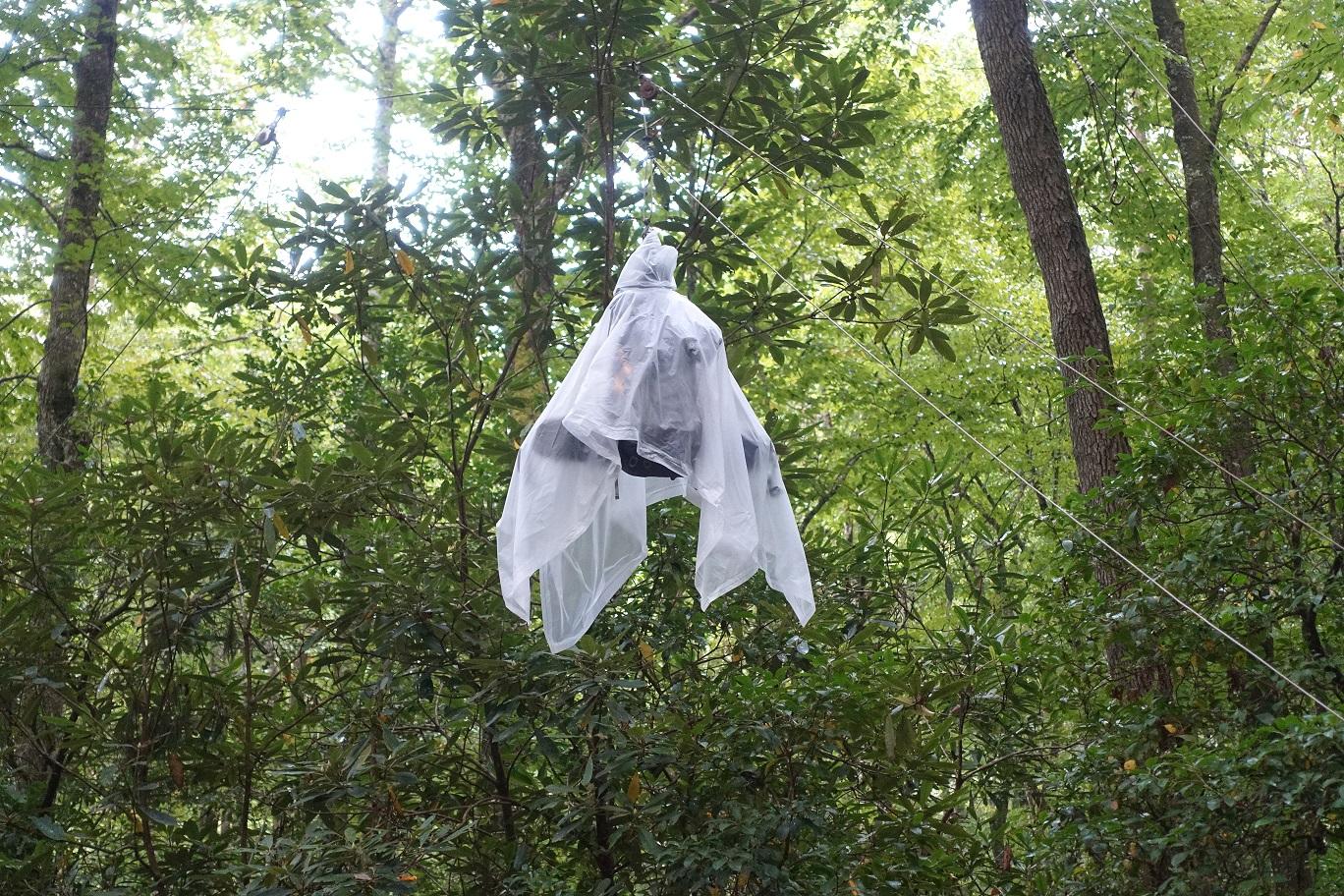
Andrew If I walked up on that thing/pack-poncho in low/bad light I’d probably forget all about bears and need to change pants!
#57 is on the list posted on the park website. Same southwest corner of the park as Hazel. From Fontana and the ridge up to Shuckstack and the route of the AT; going east you’ve got Eagle/ridge, Hazel/ridge. Forney/ridge, Noland/ridge then Deep Creek with #57. The sites bolded in the list below are in that SW quadrant
Bear Campsite/Shelter Closures – areas that are closed due to bear activity.
Shelters:
Campsites: #9, #21, #41, #50, #57, #70
Warnings – areas where bears are active.Shelters: Russel Field, Spence Field & Tricorner Knob
Campsites: #24, #61, #90, #95
So 2 of the 6 closed campsites are SW and 3 of the 4 campsite warnings and 2 of the 3 shelter warnings are in or along the ridge of that quad. 7 of the 13 total warning or closure sites are in the SW.

Maybe you should just start backpacking with a mountain goat….
I had one of those goats walk right up to me while visiting one of the incredibly scenic outhouses in the Enchantments. Those horns look effective but amazed one actually killed a grizzly! Any suggestions for what to name this hypothetical goat? Bet that fur is warm too. Snuggle up and get a dual use. OK that’s enough of a setup for a half dozen jokes at my expense. Hit me with your best shot. Fire Away
I’m going to upgrade from an Opinel #6 to a #8, for the bear protection.
I had not kept up with the hammock theory. Interesting.
The problem with bears is that the sample size for statistics is pretty small. When I kept my WFR (Wilderness First Responer) up to date there was always something new to learn. The reason is there are millions of people getting sick or hurt. So lots of opportunities to learn new things about CPR or how to reduce a dislocated shoulder. For comparison I think Alaska averages 3 or 4 bear fatalities a year. With lot of variables. Saying there is a trend with such low numbers is tough. The statistics cited for bear attacks over 100 years are more useful but they just give us the big picture of defensive vs predatory tendencies in bear attacks.
I do wonder if anyone has done a study of the relative heights of predatory bears and their victims. A 6 foot tall black bear would be pretty big in most areas. Much less common then a 6 foot human. Do bears target people shorter than them?
My point earlier that predatory bear attack have no rythm or reason was not to be hopeless. I just don’t think you can do much to reduce the (low) likelihood by modifying your behavior regarding food storage etc. Your choices are basically to ignore the threat or carry a deterrent and hope you have time to deploy it. The chance is incredibly small. But do what makes you feel good. On the positive side I don’t think you need to necessarily kill a a predatory bear to make it stop bothering you. If you read the reports in Alaska there are lots of people who shoot aggressive bears. Usually the bear’s response is to run off, not to charge in for a fight to the death. Point being, you could probably deter a predatory bear if you hurt it with spray, a non fatal shot or a hit with a hatchet (yes that happened). Maybe us SUL types could carry a titanium tent stake in a quick draw holster in case we need to stab a bear…
Become a member to post in the forums.
 DualFuel XLCompact alcohol-or-Esbit stove with a low-profile design that fits inside most standard cooking pots.
 © Beartooth Media Group Inc.
 Loading...