Topic
Rectangular vs. Tapered Tents (2026)
Forum Posting
A Membership is required to post in the forums. Login or become a member to post in the member forums!
Home › Forums › Gear Forums › Gear (General) › Rectangular vs. Tapered Tents (2026)
- This topic has 55 replies, 14 voices, and was last updated 1 week, 5 days ago by
JAshley73.
-
AuthorPosts
-
Mar 9, 2026 at 9:41 pm #3848794
Hi Jashley73,
I can relate well to your question. It actually prompted me to join BPL and this is my first post. I much prefer rectangular tents whenever possible. I also noticed you mentioned the Mountain Hardware Aspect 2P, Marmot Tungsten UL 2P, and Marmot Limelight UL 2P. I have been considering all three of these in recent weeks because they all use a traditional x-braced freestanding pole design and an all mesh canopy.
I have favored MSR tents for their loyalty to rectangular design as Dan mentioned. But I got a Nemo Kunai 2P for the zippered mesh panels and loved it in spite of the tapered design (though I find it just big enough to enjoy solo). I noticed that because it uses an X-braced design – it is extremely freestanding and easy to setup. I find this design makes me feel most able to utilize dramatic cliff rock ledges where I can’t use stakes, and loose rocks may even be hard to find for a dead man anchor.
So I’ve been looking for an all mesh freestanding X-braced tent that makes these kind of tent locations with majestic views most feasible. And I want the all mesh canopy to make warm weather more bearable and enable star gazing. In colder months I can rely on my sleep system more.
Last year, I got the Durston X-Dome 2. It’s a great tent but my main quibble with it is I don’t particularly need a fly first pitch even though I do get a fair amount of rain in the northeast. I came to realize the limitation of an exoskeleton tent is that it’s much more cumbersome to take off the fly or put it back on in response to changing weather conditions. I do love the roomy non-tapered design, the all mesh canopy, the very respectable weight, the non-stretch sil-poly fly, and the freestanding easy to pitch structure.
The other limitation of the X-Dome 2 is it’s broad wind profile. By avoiding the use of a salient point for the vestibules, it necessitates very broad width at the ends which catch a lot of wind. This also makes the tent require a large amount of space to pitch.
I have a number of tents that use the hubbed pole structure which I believe was first pioneered by the MSR Hubba. It was a great innovation but now I want a reasonably lightweight all mesh freestanding tent with an X-braced pole structure.
The Aspect 2 does use a sil/sil fly which is supposed to be more durable. But they lie about the dimensions. The usable interior space is more like 46″ wide instead of 50″. And I don’t like the zig zag pattern of canopy fabric btw the bathtub and mesh. I wish it was all mesh or at least level all around. But at least it is rectangular. It’s a quality tent but I would like something with just a bit more room to sprawl out in for solo use.
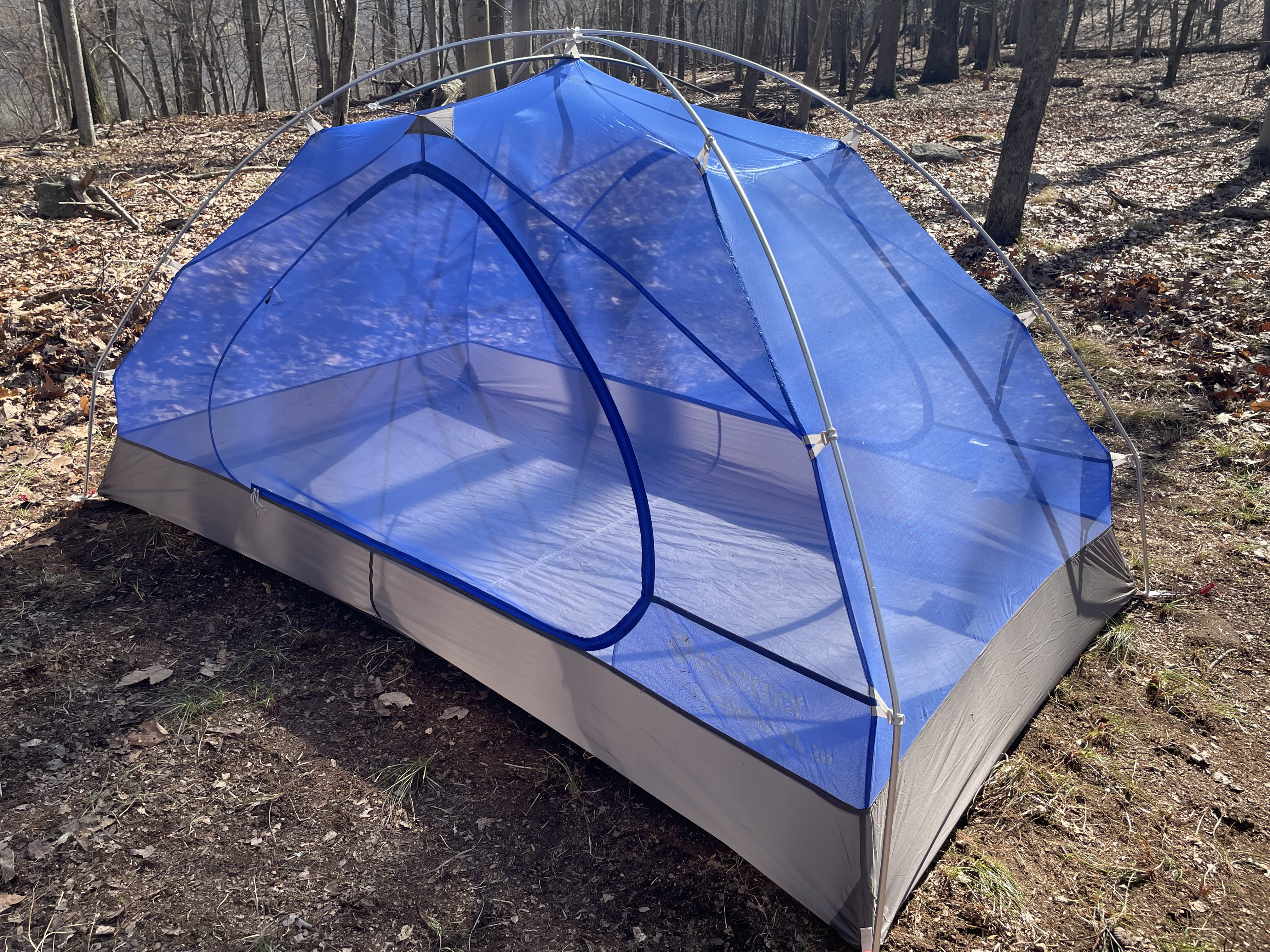
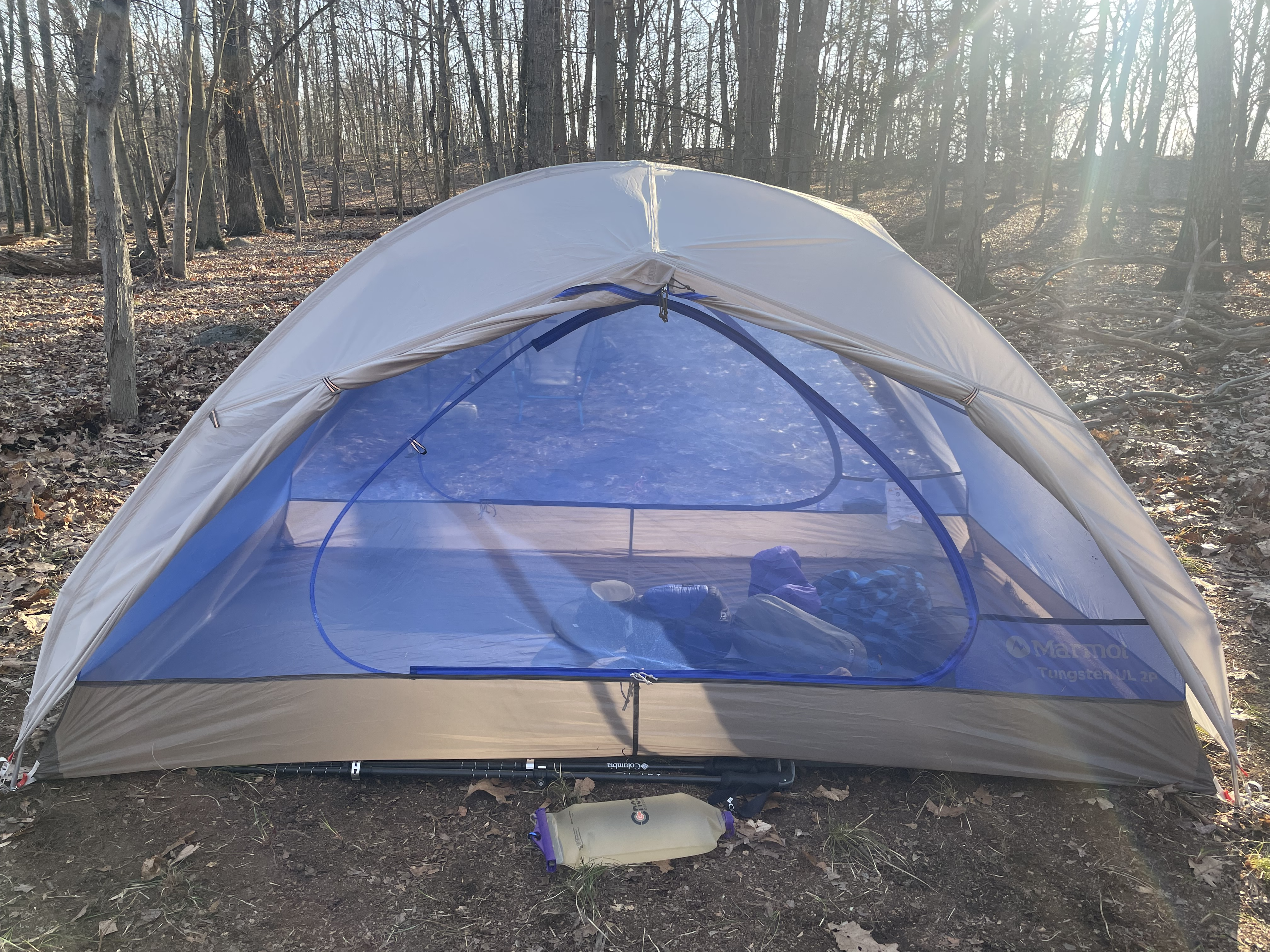
The 2026 Tungsten UL2 has now gone to a light grey fly with a blue mesh. It’s more neutral than the green yellow or wasabi versions of recent years. I don’t love the aesthetics but it’s not bad either. It could be mistaken for a boulder from a distance. The Tungsten does have a taper but it goes from 54″ to 46″ so this feels a good deal less confining than the 51″ to 43″ often used by Big Agnes, Nemo, and even Slingfin. The peak height of 42″ is pretty good, and the prebent poles add volume down low. The other oddity is the asymmetrical vestibules. But I can see some value to it as it offers one side that makes reaching the zipper easy.
The Limelight UL2 is a strange bird with the funky alcoves. It creates shallow vestibules which I don’t like. This makes cooking in a vestibule during rain less safe. But it offers an even more generous peak height of 45″. Aesthetically it uses a yellowish light brown rainfly which I prefer. And it also uses the blue mesh.
Marmot often fibs about their tent weights. I think the Tungsten and Limelight are both gonna be somewhere near 3.7 lbs with footprints but no stakes. Like the X-Dome, both of these use a non-saggy quick dry sil-poly fly. I eagerly await seeing some more reviews of these two 2026 model Marmot tents as the year progresses.
Mar 10, 2026 at 9:56 am #3848810That is neat to see Marmot convert to a non-sag poly fly. The revolution continues! Â :)
Regarding hubbed vs X-braced pole structures, a common problem with hubbed pole sets is that brands still use the same size tubing across the top. So the dual archs join into a single arch across the top, but the strength of that single arch isn’t increased, so it becomes a weak point (essentially dropping to half strength across the top). That’s why with the X-Dome when it is a single arch/spine across the top, we use larger tubing here that is roughly twice as strong. This gives about the same strength as an X-braced pole set, but a bit lighter because it is more weight efficient to use a single larger tube instead of two smaller tubes.
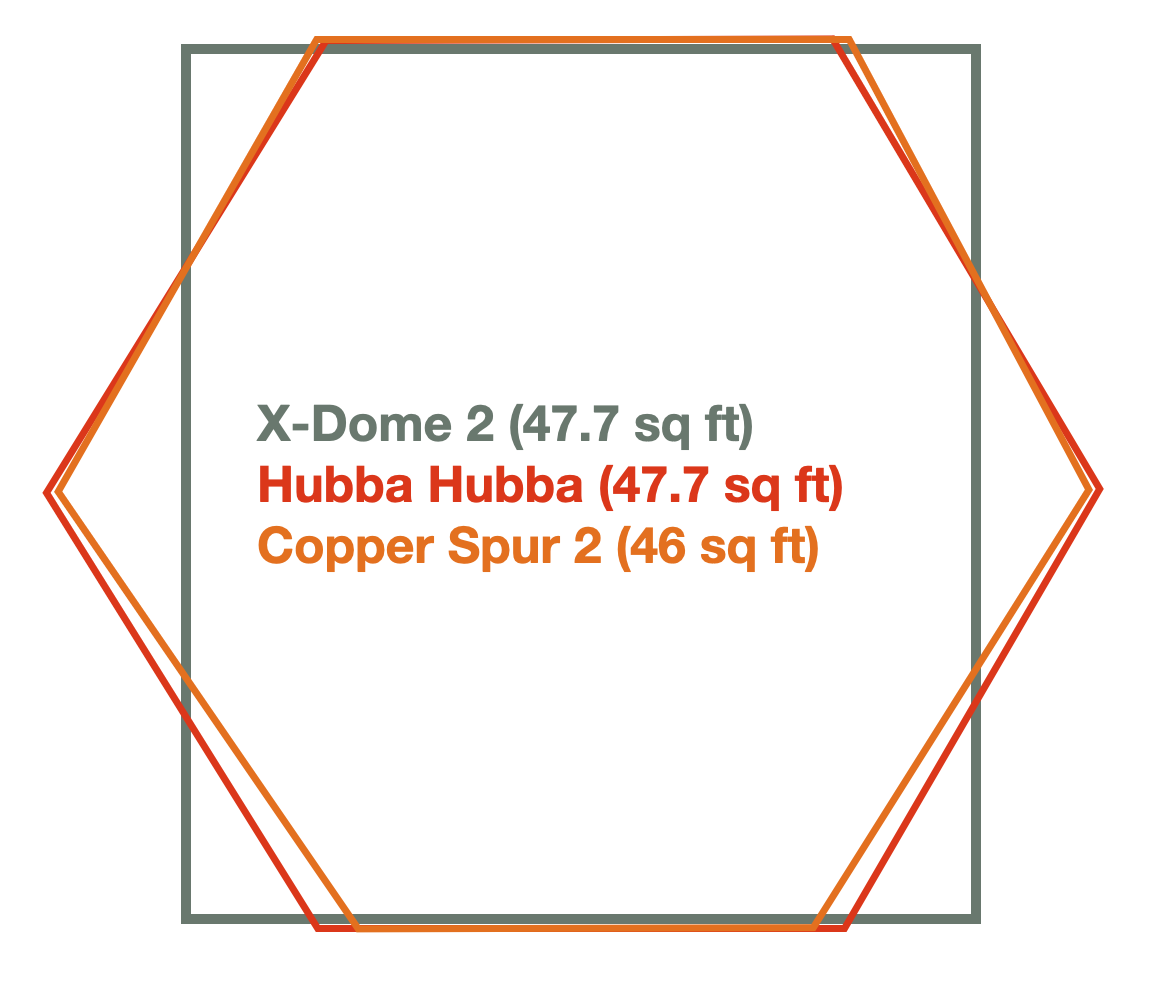
Regarding footprint area, the simpler rectangle shape of the X-Dome gives a larger visual impression because you have larger but fewer sides, but the actual footprint area is about the same, as you can see below. The end panels are larger though, which is why in fall 2025 we added an extra mid-panel guyout there.

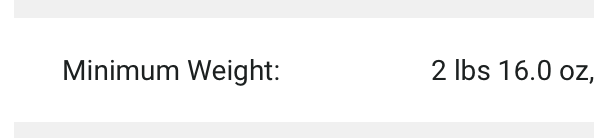
Side note: I got a kick out of this spec for the Limelight 2 on Marmot’s website. It looks like they really didn’t want to say 3 lbs :)
Mar 10, 2026 at 11:16 am #3848812After reading this thread over again a few times, and a couple more nights in my current tent, I’m convinced that a rectangular floor is the way to go. I appreciate everyone’s comments thus far. (And feel free to keep the conversation going)
Following up on the last several posts…
I’ve been eying the Mountain Hardwear Aspect 2, and Marmot UL tents for a while now.
The MH Aspect 2 – I’ve seen that review online that shows it being narrower than the published 50″ wide. *Technically* I could get by with a 46″ width, but I do agree that if true, that is frustrating on principle alone. I really want to like this tent. It has one of the lowest published weights that I can find, for a symmetrical, 2-person, traditional X-frame pole tent… I can get a substantial discount on MH via ExpertVoice membership. There’s a few other intangible things about this tent that seem “neat” to me, and kind of tickle that emotional fancy…
The Marmot UL tents – These are very interesting to me. The Limelight ULÂ (2p & 3p) have been out for several years, and unlike their non-UL siblings, these appear to be of symmetrical width. The non-UL Limelights do feature a tapered floor, and the “cubbys” are placed on the same end of the tent. It’s as though these are intended for the two sleepers facing the same direction.
The Limelight UL’s by contrast, though the published width is a full 50″ for the 2p version, the “cubbys” are placed on opposite corners of the tent, and the brow-pole extends from these corners. It has the highest peak-height that I’ve found as well, at 45″.
The new for 2026 Marmot Tungsten UL 2p tent (interesting name choice for an ultralight tent BTW…) is listed as being a rectangular-floor tent, with Marmot boasting that it’ll fit (2) 25″ wide pads on their website. Let’s hope they’re telling the truth. :)Â This might be one of the best bargain 2p UL tents out there.
I like how the Marmot UL tents use polyester fabric on the rain fly’s. I can also get a considerable discount on these via ExpertVoice membership.
A few other thoughts:
I don’t think a fly-first pitch is of much value to me either. I’ve given that a lot of thought. On my current Nemo Dagger tent, I ended up making a pre-tied accessory cord, with alpine-butterfly knots at 4 corners. This allows me to fully assemble & tension the frame, and then drape the rainfly over the erected pole structure. I can then get underneath, and pitch the tent, keeping everything dry. I’ve practiced this a few times – yet not in the rain, yet :) – and it works well. I figure, I can replicate that for any other tent. This also keeps me from “needing” the footprint to erect the poles. I can pitch the cord, poles, and rainfly, and keep the footprint dry too.
The conventional X-frame design, utilizing the (2) crossing poles, just seems much easier to manage at setup time, vs. the single monstrosity of a full hubbed polse set. I like also how they seem to create a little more head room, at the upper corners of the tent. The MSR tents seem really tight in those upper corners, not helped by the fact that they don’t have the most generous peak-heights anyways…
Mar 10, 2026 at 11:18 am #3848813I just checked the pole set on my X-Dome 2. Yes indeed, I see what you mean Dan. The pole that connects the two arches is indeed thicker than the other poles. So that does boost the strength. The X-Dome 2 is also distinctive for how the corner poles join the hubs much higher up than on an MSR Hubba where the hubs are much lower. And the brow pole is also considerably wider for better rain clearance and head room.
When it comes to any tent with a dual hubbed structure, the arched corner poles are being pushed sideways (width-wise) out, but the one central pole is not placing as much direct lengthwise outward force on the corners as an X-brace does. This means an X-braced tent will be closer to its full length even when not staked out than a hubbed tent. Staking out will tend to add a bit more length to a hubbed structure because the hubs make the lengthwise force more indirect.
Thanks for including the diagram to compare floor area.
A weird thing about the Tungsten UL2 and the Limelight UL2 is that they both have a listed trail weight that is just under 3lbs. This seems strange given that the Limelight has 3″ more peak height. So either the weight of one is understated more than the other, or something else in the Limelight is helping to reduce weight to allow for the greater height. I guess the shallower vestibules is what allows it to boost the peak height while keeping the weight about the same as the Tungsten.
Mar 10, 2026 at 11:01 pm #3848849JAshley73 – I didn’t see your last post before mine since it was just 2 minutes prior.
Yeah, you shouldn’t compromise on the rectangular tent. It makes one less thing to worry about when finding a site and wondering which end to rest your head at. And it feels less like a coffin.
Aspect 2 – I noticed that it has a 40D floor so that is much more durable than the 20D floor on the Limelight and Tungsten UL2’s. But I always use a footprint anyway. It’s not just to prevent holes. It also serves to catch any mud build up so the bottom of your tent stays clean. Perhaps the weight of the 40D floor is why they decided to narrow the width a few inches to keep the weight under 3lbs. It’s still wide enough for me as a solo user. I would appreciate the lack of a taper. But that non symmetrical white canopy fabric is a bit higher than I want in mid summer and it looks odd to me.
(I came across that Expert Voice website you mention. Is that only for industry insiders? It’s free to join so if I can get a discount on a new tent I’d happily join.)
Marmot – Limelight UL2 vs Tungsten UL2 – Yeah it looks like you may be right that the Limelight ULs are non tapered in contrast to the regular Limelight. The alcoves seem kind of loose. Aesthetically they take away somewhat from the simplicity of a nice rigid taut rectangular tent layout. But they could be a neat feature too. It would be nice to bring the pack inside – both to protect it and easily obtain anything you might need. And this mitigates the relative lack of pocket space so you don’t need to have as much stuff strewn across the floor. Though again for solo use, I would have enough space to bring my pack inside most of the time anyway unless I’m using an expedition size pack. So I don’t NEED the alcoves.
I noticed another difference btw the Limelight and Tungsten ULs. I already noticed the prebend on the Tungsten is low down about 14″ off the ground to provide more of a boxy spacious feel at the ends. But the Limelight UL 2 and 3 have no prebend down low. Instead they have a more subtle bend higher up which helps them achieve the higher 45″ peak height.
One last thing I’ll say about pole design is that the slight downside of the use of prebends is that they take away a bit of the outward force pulling the corners outward. The more that tent poles curve upward to achieve more height or internal volume – the more they have a tendency to begin to curve inward which creates sag in the floor and therefore more need to be staked out. An X-braced tent without prebends will tend to be more rigid while ones with prebends will tend to have a little more sway. But this issue is mostly solved by proper staking of the corners.
Assuming I don’t mind the aesthetics of the alcoves, it’s tempting to go for the Limelight over the Tungsten to get the extra peak height if they are both about the same weight. But the Tungsten has at least one full size vestibule in its favor.
Mar 11, 2026 at 6:41 am #3848851ExpertVoice is free to “join” but it requires a vetted membership to some other organization first. For me, it was the NSS – national caving organization. (caves.org) I think, but can’t confirm, that the American Alpine Club may be eligible for ExpertVoice membership too. First responders are also eligible I believe. You have to submit your “membership” card to EV for vetting, and then are given access. You have to re-submit every year.
I have made a couple purchases from there, yet nothing major. It is most certainly worth it, if you’re already a member of another organization, and read the “fine print.”
Some deals accept returns – Mountain Hardwear for instance. Some deals are final sale – Big Agnes is one. Sometimes brands will run extra savings that are final sale. Sometimes the “deal” isn’t that good of a deal compared to buying elsewhere. You just need to be a savvy buyer, and do your homework. I can’t think of a downside or reason NOT to join. It is certainly worth joining the NSS for $50 a year, and getting the really nice magazine, if you’re wanting to save on a big purchase from EV. Some of the savings on big items can be pretty substantial.
Mar 12, 2026 at 10:52 am #3848881Hi JAshley73,
Thanks for the dets on EV. I may end joining AMC which is also $50 per year. If that would qualify me to join EV, then it’s a no brainer so I could nab some phat discounts on things like a tent.
Mar 14, 2026 at 6:16 pm #3848953Dan, that’s good to know you added another guyout to the end panels on late 2025 X-Dome 2’s. I have the summer v1 model. I’m guessing I could use some kind of sticky attachable guyout loops. I think Zpacks sells them among others – to increase the stability in wind.
I saw that 2lb 16oz spec by Marmot too for Limelight. It’s sort of like calling yourself 5’12” instead of 6′ tall. Though usually in the case of height, people are motivated to use 6′ instead of 5’12”.
Mar 14, 2026 at 6:35 pm #3848954Hey JAshley73,
On my current Nemo Dagger tent, I ended up making a pre-tied accessory cord, with alpine-butterfly knots at 4 corners. This allows me to fully assemble & tension the frame, and then drape the rainfly over the erected pole structure. I can then get underneath, and pitch the tent, keeping everything dry.
Using Alpine Butterfly knots to allow a fly first pitch when needed sounds brilliant. You could assemble such a rectangle of cordage in other ways too without those knots, but it seems a good opportunity to use them.
My MSR tents all have metal grommets on both the tent inners and the flies. So this allows one to construct/tension the frame without using a footprint or the inner. And then you can climb under it to clip in the inner.
But I could also see making a custom rectangle of cord for my non MSR/non fly first pitch tents.
Mar 14, 2026 at 7:02 pm #3848955For more detail on the new Marmot UL tents with blue mesh, here’s a couple on the Limelight UL 2 and 3:
https://www.trailspace.com/gear/marmot/limelight-ul-2p/
https://gearjunkie.com/motors/2026-toyota-bz-reveal
I haven’t found any reviews yet on the new Tungsten UL 2 or 3.
Mar 14, 2026 at 8:04 pm #3848960Here’s Dave at Enwild’s review of the new Limelight UL 2 and 3:
https://www.youtube.com/watch?v=1_gqgIT7Pv4
At 35 seconds into the video, you can see him flexing the two frames. The 3P seems a bit more flimsy to me. My guess is the Tungsten UL 2 and 3 have slightly more sturdy frames because they have 3″ less peak height. The frames of the Limelights are more bowed to boost the height. But this pushes them slightly closer to collapsing inward – thus reducing rigidity.
Since the OP JAshley73 is intending to sometimes use a 2P tent for two people, I can see the alcoves coming in handy. But I would be using a 2P only as a solo tent (using a 3P when I want to share with a companion). So the alcoves are superfluous to me. But the bigger issue is probably that both vestibules are tight since the end of the alcove forms the salient point which doesn’t extend far since the brow pole is twisted off axis.
I do like that the Limelight 2 and 3 feature 2 roof vents. So this is superior ventilation on an already well ventilated all mesh tent.
One other thing I don’t understand about the Limelight is – why does the fly need to have color coded clip ends if the tent does not taper, and the alcoves/vestibules mirror each other? You have to be pretty clueless to attempt clipping the sides of the fly to the ends of the tent.
It is funny that Marmot uses the name Tungsten (which is a very heavy metal) to market an Ultralight tent – good catch JAshley73.
I noticed that REI sold out today of the Tungsten UL2. They have a 20% off one full price item sale for members now thru March 23rd. So the sale must have caused the sell out. $320 seems like a great deal.
At this point, the Tungsten UL2 seems to be just about the perfect tent for what I’m looking for. Here is my list of pros and cons that stand out to me compared to other tents:
Pros:
-Sturdy X-braced freestanding pole structure
-Ability to easily put on or remove the fly as needed to either protect from rain/wind/cold/give privacy, or allow for enjoying unimpeded views of the scenery and stars thru the all mesh canopy
-Very breathable all mesh canopy maximizes ventilation in hot humid summer weather
-Blue mesh canopy should be easy to see thru during the day and night
-Trail weight of nearly 3lb without stakes or footprint
-One roof vent
-Wide doors
-Ability to fully roll up rain fly flaps for a better view and ventilation
-50 or 51″ wide rectangular floor (it appears to be rectangular compared to previous models which tapered 54 to 46″ wide)
-88″ length is more than enough and should prevent long length sleeping bags from touching the end to help keep down dry
-42″ peak height is generous for a 2P tent without adding unnecessary height or weight; headroom looks to be excellent for a tent in it’s weight class
-Pre-bent poles at around 14″ high create added livability and tent volume to help wait out periods of poor weather
-Poly rainfly shouldn’t absorb water or sag too much in the rain and keeps it from gaining much water weight when packing up after a night of rain
-Light colored but fairly neutral light grey rainfly color is reasonably inconspicuous, lets thru a lot of light, and isn’t yucky or offensive to look at – if a little bland and industrial
Cons:
The asymmetrical vestibules are a little odd but I’m down with as it allows the tent to fit in a slightly tighter space, and gives an option for one side being easier to reach the zipper for getting out, and one side being larger for storage and/or cooking inside of
-Color scheme could be more fun and uplifting but this at least lets thru a lot of light and is somewhat inconspicuous if not stealthy
Mar 14, 2026 at 10:43 pm #3848966One more con to mention on the Tungsten UL2 and 3 (and the UL Limelights):
-The rainfly is said to be hard to get a tight pitch on and is therefore slightly floppy and can flap in the wind. (This doesn’t surprise me given the oddity of the alcoves on the Limelight. But it’s slightly disappointing to see this is also an issue even on the Tungsten.)
For the Aspect 2, I think perhaps the biggest con of it compared to the Marmot UL tents is the lack of a roof vent.
Mar 15, 2026 at 12:51 pm #3848987Roof vents in the Rain-Fly – venting in general – have more of my attention now.
This past weekend, I had myself, brother, and son in my Nemo Dagger 3p tent. It was very “damp” outside when going to bed. The next morning, I was surprised to see water under the entire Rain-Fly, and water dripping onto our sleeping bags.
I was even more puzzled that the outside of the rain-fly barely damp with morning dew, then it hit me, that all of that moisture inside was our breath’s condensation.
Going forward, I’ll be more diligent in guying out the ends of the rain fly, but also venting, or leaving open the vestibules, especially when it’s humid outside.
That lesson learned, reinforces the importance of ventilation.
And to your earlier points, it makes that Marmot Tungsten UL more attractive.
Mar 15, 2026 at 1:31 pm #3848988A roof vent can help marginally, but only if you have good overall air flow. You really want to be thoughtful about your site selection, pitch the tent high, and leave a vestibule open if possible. People tend to be too optimistic that a tent’s technology/design will magically solve the condensation problem.
At the same time, some condensation is to be expected with three people crammed into a tent in humid conditions, and some minor dripping on your gear isn’t the end of the world. Let it dry out and move on.
Mar 15, 2026 at 2:58 pm #3848992I leave the door of my mid open for ventilation. A triangle 4 feet wide and 5 feet high. I think that’s what you need for ventilation. But I haven’t scientifically verified : )
On my mid, I sometimes get condensation on the inside walls, but since the walls are steep, any condensation would drip down the side, rather than falling onto my sleeping bag. Usually, there isn’t enough condensation to start dripping down.
Mar 20, 2026 at 2:41 pm #3849124I got the new Tungsten UL 2P today and it is indeed rectangular. I got word from Marmot that all of the new Tungsten and Limelight UL models are non-tapered. So this is great news.
I measured the Tungsten to be 85″L x 50″W x 45″H. This was without staking it out so the length will probably be an inch more, and the height will go down to the spec level of 42″.
Trail Weight is 3.1 lbs
Packed Weight is 3.48 lbs
Trail Weight plus footprint (8.5oz) and tent bag and pole bag is 3.7 lbs
Fair Weather Flyless Pitch Weight w/footprint is 2.59 lbs
The footprint has the same grommet holes as the inner so you can use it to tension the poles and hook the fly onto the loops of the footprint which are also the same as on the inner. So it should be no problem to do a fly first pitch in the rain and this is another good reason to get the footprint – aside from keeping dirt off the bottom of the tent and protecting it from punctures.
Mar 21, 2026 at 2:54 pm #3849149Volker64 so it does measure the same width at both ends, confirming that it’s rectangular? Marmot answered one of my “questions” on their website, saying that it has a tapered-width floor.
I’m far more inclined to believe your experience, over their pretty poor marketing specs. Outside of the specs, what’s your impressions otherwise of the tent? Impressed, or remains to be determined?
Mar 21, 2026 at 5:03 pm #3849153^JAshley73,
Here’s what Marmot Customer Service said in response to my inquiry about the width of the new Tungsten and Limelight models:
Thank you for choosing Marmot and taking the time to reach out to us.
We sincerely apologize for the delayed response.
After consulting with the product specialists, we have been informed that both tents have rectangular floors.
If I can be of further assistance, please reply to this email directly.
Thank you,
Rufaro
Marmot Consumer ServiceMar 21, 2026 at 5:43 pm #3849155JAshley73,
Here is a more detailed review that I composed yesterday (apologies for already having posted some of this info previously in a summary form):
Fans of lightweight rectangular freestanding tents rejoice! I have good news. All of the 2026 Marmot Tungsten and Limelight UL models are in fact RECTANGULAR. I think we’ve suffered from years of tapered tent whiplash where we’ve grown to instinctively suspect a tent is tapered if the manufacturer does not explicitly state the dimensions. After all, this is in fact a departure from all previous Tungsten UL models which had a 54-46″ tapered width. I haven’t been able to find any specs for previous models of the Limelight UL models so the current models of those appear to be their first version. I just set up the Tungsten UL 2P in my living room and measured and weighed everything.
Dimensions:
The dimensions will change slightly when I stake it to the ground outside of course. But I get 85″L x 50″W x 45″H. Obviously the height will change the most going downward to approx 42″. But the length may gain an inch or two from being staked out as Marmot states it is 88″L. I measured the width at both ends just to be sure (it is definitely rectangular), so the stated spec by REI of 51.2″ of width seems accurate given the normal allowance for interior shrinkage. In the center, the width bows inward a bit because of the catenary cut floor but staking out will also help that a bit. The bathtub floor is quite high at 10-10.5″H. But I’m fine with this since the canopy is all mesh. So it’s certainly well optimized for hot and humid summer nights. The bathtub height will help insure no risk from splashback from torrential rain.
Weight:
Packed Weight 55.7 oz
Tent Inner 16.7 oz
Poles w/pole bag 15.5 oz
Rainfly 17.8 oz
Stake bag w/literature, patches, guylines, 6 stakes + pole splint (from pole bag) 5.0 oz
Tent Bag .7 oz
Pole Bag .3 oz
Footprint (w/o bag because who carries a footprint bag?) 8.5 oz
Fair Weather Flyless Pitch Weight (Tent Inner, poles, w/footprint, tent and pole bags, but no stakes, guylines or rainfly) 41.4 oz or 2.59 lbs
Total Weight of Tungsten UL 2P w/o Footprint or Stakes (but including tent and pole bag) 50.7 oz or 3.17 lbs
Trail Weight (same as above less tent and pole bags) 49.7 oz or 3.1 lbs.
Total Weight of Tungsten UL 2P (w/tent bag and pole bag and footprint but no stakes or guylines) 59.2 oz or 3.7 lbsSo the packed weight stated by REI is 4.1 oz over the actual. But the trail weight is understated from actual by 1.9 oz. So this is a pretty honest spec listing. The actual trail weight is just 3.1lbs so that’s pretty darn light especially for the X-braced freestanding design. The footprint is a bit heavy but it does come with grommets and I can verify it does in fact have the same little loops that the tent corners have which allow you to connect the fly. So the footprint is definitely designed to allow you to do a fly first pitch by using the footprint to tension the poles and then attach the rainfly on top by hooking it to the corners of the footprint. This then allows you to clip in the tent under cover of the fly when you are forced to setup in the rain.
This tent is awesome! It feels as big as I could want for my solo use. Very stable, sturdy, and easy to pitch with the X-braced pole configuration. The stretchy tabs and toggles make it easy to roll up both flaps of each vestibule to increase airflow and views. Excellent ventilation with the all mesh canopy, kickstand roof vent, and double ended zippers on the doors to allow a cross vent. This tent is a great choice for those who want to star gaze on clear nights or check out the wildlife while the clear mesh protects you from bugs. Very ample height, length, and width for solo use without being too much. I would say anyone who is 6’3″ or less should have no trouble feeling very comfortable in this tent. You could probably be up to 6’5″ or 6’6″ and still fit without the ends being a deal breaker – largely because the pre-bent poles keep the first 14″ or so of tent height fully vertical and usable before the end walls begin to taper upward.
There are two loops at each end of the fly for guylines. Past reviews of Tungsten and Limelight UL tents have stated it’s hard to get a taut pitch of the fly. But once I connected the velcro straps that attach from the inner side of the fly to each corner pole at two places, and pulled taut the corner tabs – I found the fly tightened up very nicely. I don’t see it having any problem flapping in the wind. The kickstand vent is ample and well sheltered from rain incursion. It pushes in a bit but the fly still retains good clearance of the mesh there and overall. Considering it’s a Silpoly fly, I do not anticipate having issues with the fly sagging inward during rain to where it sticks to the mesh and causes condensation to drip down into the tent – as long as the tent is properly staked out, the rainfly is pulled tight, and the 4 guylines are utilized in high winds. You would need 4 additional stakes to stake out the included guylines in addition to the 6 DAC stakes that come with the tent.
The pockets are minimal. There are two medium size pockets at either side at one end. And on the same side there is one small triangular pocket high up in the mesh designed to diffuse a headlamp into a more pleasant dispersed light. The minimal pockets are fine given my intended solo use which allows plenty of room for internal storage in additional to external storage in the vestibules. And besides, putting any significant weight within all mesh pockets is bound to strain the fabric. So this is in keeping with the well ventilated design. There is also one fabric loop in each corner of the roof area of the mesh to facilitate a clothesline or stringing up lights, and one more at the center peak to hang a lantern, for a total of 5 fabric loops. I consider these fabric loops a simple but important feature some manufactures skimp on.
The vestibules are of different sizes which I have not yet seen staked out. They do feature a line lock adjuster while the corner tie out loops do not but you can easily rig up your own line lock adjusters. The 1P version has just one vestibule since it has just one door, and the 3P version has two vestibules of the same size. But the differential sized 2P vestibules make some sense in that the smaller one offers you a rain fly door that is easier to reach from within the tent while the larger one accommodates more storage and rain cover. The wide doors of the mesh open in the same direction so they are mirrored and have an easy to use piece of fabric to tuck them in with. The zippers on both the mesh and fly move very smoothly. The ones on the fly did not seem prone to catching on the flap of fabric that shields it from rain.
I’m very happy that they changed the design to being rectangular while also allowing for just enough space for two 25″ wide pads. I will use it solo with a 30 or 27″ wide pad. But I could also fit a double wide pad and then conceivably share it with a girlfriend. I think for couples in a 2 person tent, one double wide pad is more efficient because your bodies can share the larger pad and you have no awkward gap in between. The beauty of the rectangular design is that not only does it not cramp your feet or penalize those who don’t use mummy bags, it also makes it so you don’t have to think about the orientation of the tent at all. If you realize after getting tucked in that the other side is higher, you will have exactly the same dimensions if you switch to sleep with your head at the other end. It’s just that the two medium size pockets will now be at the other end. The only real limitation (and it’s actually a potential benefit) is that if you have a rock wall or boulder near one side of a flat pitch spot, you can utilize the smaller vestibule to go on that side. But otherwise, one need not trouble themself thinking of pitch orientation at all aside from finding the most level spot that has a suitable view and proximity when you’re tired after a long day and the light is failing.
Comparison to an alternative:
The Big Agnes Copper Spur XL 2P for example is 96″ long. That is way longer than I need. Beyond 88″ of length, I’d rather devote those extra inches to having more width or height. It does offer 54″ of width (which is also more than I need for solo use), but the peak height is just 41″. I find this ridiculously low and out of proportion with how long the tent is. IMO, a 96″ length could easily justify a 45 or 46″ peak height. So laying down in the tent, there seems to be plenty of length for someone who is 6’6″, 6’8″, or even 6’10”. But height wise I think it cramps taller people when sitting up. I already found the regular 2P cramped at the head end and that’s only 1″ shorter. 41″ is barely tall enough for me given how the head end slopes downward. I found the Tiger Wall 2P has noticeably more headroom compared to the regular 2P Copper Spur. But I’d rather see the XL 2P Copper Spur be shorter in length and narrower in width to save weight, and trade some of it for a bit more height/headroom. I think a good compromise for tall people would be either 90 or 92″L with the same width, and 45″ of peak height. Lastly, the Copper Spur has a much higher panel of solid fabric for wind protection and privacy. So this ruins it as a summer option. The regular 2P feels too coffin like for me with it’s sharp taper and solid fabric that comes up high on the sides. But at least the XL 2P is non-tapered. But enough about the Copper Spur.
I can’t wait to try out the Tungsten UL 2P!
Mar 23, 2026 at 9:12 am #3849190Volker64, thank you for that very detailed response!
You certainly are making my decision tougher (easier?) as I’ve been giving more thought to the Mountain Hardwear Aspect 2 tent. It’s great to hear that this Marmot Tungsten UL tent is in-fact rectangular. It offers a less expensive option, and with the benefit of the polyester rainfly material, and with vents as well.
As “luck” would have it, I actually picked up a 2nd Nemo Dagger 3P tent, this time in the newest version. Despite the Osmo fabric, and several newer “features” I’m actually not keen on a few of the changes they’ve made, preferring my older model instead. I’ll be passing the newer version along, and looking for something to replace it, inline with the original focus of this thread; a solo 2P freestanding tent, rectangular, and with the traditional X-frame crossing poles.
Once again, thank you for that very detailed review. I look forward to hearing your thoughts as well, after a few nights in it.
Mar 31, 2026 at 9:30 am #3849459I thought about making this another thread, but I have a general question about fabrics…
It was mentioned before, that the MH Aspect’s rain-fly being Sil-Sil Nylon, would be very durable, and long-lasting. I see complaints about PU coatings eventually breaking down, and getting sticky & stinky with age.
On the Marmot tents, they make no mention of coatings, but do list the materials as being Polyester.
The MH aspect tent is listed as Sil/PU coated 40D nylon. The Marmot tents are listed as Nylon, but with no mention of coatings.
In terms of fabric coatings, are the Sil-Sil coated materials that much more durable, than Sil/PU coated Nylons?
An additional question about Nylon too – I know that it’s hygroscopic by nature – does the coating prevent the nylon from absorbing moisture, or will it still absorb some? In other words, do the coatings fully seal the nylon fabrics, or no? (I’m guessing the answer here is “no” since it’s common for nylon rain fly’s to sag…)
Are polyester fabrics typically coated with Sil / PU, or Sil/Sil, or…? I’m assuming that they’ll have some sort of water-resistant chemical coating, correct? Is a PU coated polyester fabric still vulnerable to the same breakdown of the PU coating?
And is this all moot, if the tent has a PU coated nylon floor? Regardless of the other fabrics, does having the PU coated floor mean the same fate, of having the stinky, sticky material once the PU coating starts to degrade?
I see that the Durston X-Dome uses all Poly, and Sil/PE coatings, so presumably, there will be no PU breakdown with age… Is that correct?
Mar 31, 2026 at 10:50 am #3849468Regarding degradation, the root issue here is that PU degrades under long term exposure to water. The can be made worse with a nylon tent because that material also absorbs water so it is slower to dry and can appear dry while actually retaining some humidity inside the fibers, and then it is packed away seeming dry but not – causing the PU to degrade.
With polyester there is the advantage that is doesn’t absorb water into the fibers, so when it dries faster and when it feels dry it is dry. There is also an advantage with PE and Sil because sil won’t degrade at all (but can still mold etc) while PE degrades much slower than PU.
So for your question, the X-Dome with polyester + Sil/PE is much more resistant to degradation than a nylon tent with PU because of the poly and PE. If you stored it wet for long enough it could still happen but it is much less likely and more in the realm of ‘user error’ than something than can happen under normal-ish conditions.
Mar 31, 2026 at 2:51 pm #3849492A technical detail which I am sure is beyond the average consumer (sarcasm): there are different versions of Polyurethane coating. The old one (termed PU), while waterproof, does degrade into a sticky mess when damp. It also significantly reduces the tear strength of the fabric.
The newer version is called thermoplastic PU or TPU. It does not degrade like the older PU. You have to ignore all the blandishments of the vendors of the older PU: it is cheaper than the rest you see. Unfortunately it also decreases the tear strength of the fabric – more so then even PU. It is too hard and focuses all the load onto just one or two threads.
There is also PE coating: polyethylene.
Slingfin has an article on the differences.Finally, there is the silicone (polymer) coating. This is stretchy and INCREASES the tear strength of the fabric by spreading the load across many threads. It is also waterproof, like the others. It is best if applied to both sides of the fabric when it is known as Si/Si.
Cheers
Apr 1, 2026 at 5:32 am #3849518
Apr 1, 2026 at 5:36 am #3849519
-
AuthorPosts
- You must be logged in to reply to this topic.
Forum Posting
A Membership is required to post in the forums. Login or become a member to post in the member forums!
advertisement
Garage Grown Gear Hidden Gems
Discover under-the-radar ultralight gear from small brands.
Our FORUMS are Moderated
Backpacking Light forum posts are moderated and here to foster helpful and positive discussions about lightweight backpacking. Please be mindful of our values and boundaries and review our Community Guidelines prior to posting.