Topic

Rain shells for high abrasion (bush wackin’)

Viewing 25 posts - 1 through 25 (of 26 total)
PostedOct 24, 2020 at 3:09 pm

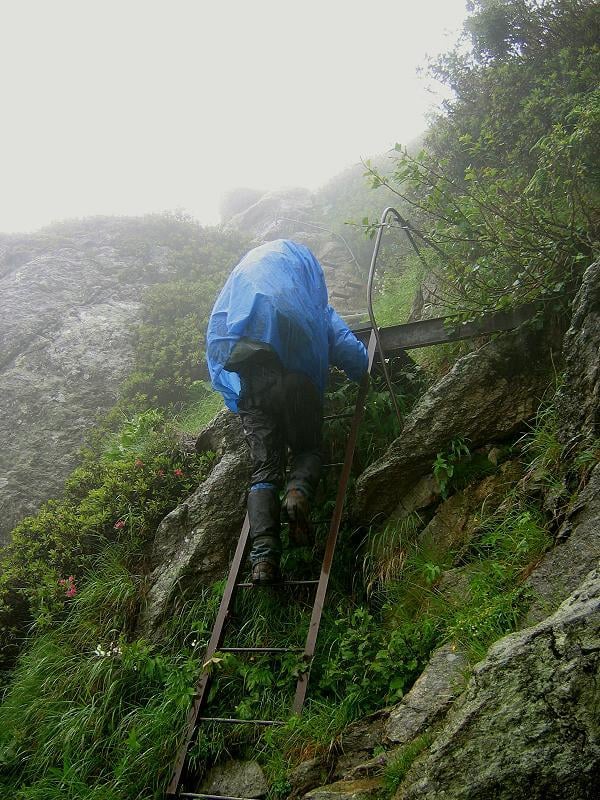
There’s some great off-trail hiking near an area I’m going to be moving too. However, it’s an area of high precipitation and densely forested areas.

The challenges I foresee are:

  1. High abrasion, meaning damage to the shell and DWR treatments being rubbed off quickly
  2. Very wet brush, even if there’s been no rain for days – in a densely forested area, this might make me more wet than the rain that makes it through the canopy?

I have a fancy shakedry jacket and a lighter weight paramo, but neither are overly suitable for bush wacking.

The Shakedry is really a “trail only” jacket in that it’s lightweight.
The paramo is relatively lightweight on it’s face fabric, and uses DWR (but it’s design makes it comfortable even when fully wet).

The shakedry approach of a breathable-ish jacket that doesn’t use DWR might be a good one here. Maybe some of the heavier Columbia outdry varieties would work?

The Paramo approach of comfortable-while-damp might work too in this probably permanently damp environment?


Other approaches:

– use something like the frogg toggs (which I found relatively comfortable while walking, due to it’s baggy cut) and just treat jackets as disposable? I’m not hugely into this for the wasteful approach..

– a permanently, non-breathable waterproof jacket, like the Lightheart Gear silnylon jacket. I’ve read some people complain about these in permanently wet environments, as they hold onto lots of water? And wearing it constantly might get pretty uncomfortable..


Any other suggestions?


Brad Rogers BPL Member
PostedOct 25, 2020 at 5:34 am

I used regular DWR jackets in Alaska in the brush, but I might try an Outdry jacket from Columbia.  Not as breathable but more durable than Shakedry and no DWR to wear off.

PostedOct 25, 2020 at 11:06 am

From my experience, you would be replacing those frogg toggs after every hike!

PostedOct 25, 2020 at 11:13 am

I used regular DWR jackets in Alaska in the brush, but I might try an Outdry jacket from Columbia.  Not as breathable but more durable than Shakedry and no DWR to wear off.


@mocs123
So your regular DWR jackets don’t wear out too quickly? Is it an issue i’ve overthinking?
And which outdry jacket were you looking at? The descriptions on their site aren’t particularly helpful.

Luke Schmidt BPL Member
PostedOct 25, 2020 at 12:12 pm

I had an Outerdry jacket fail. DWR fails too.

I’d get a fairly cheap rain coat and replace it often.  Also if you are bushwacking water works under the jacket regardless. On trips with lot of bushwacking I carry a thin fleece to wear under the raincoat.

PostedOct 25, 2020 at 1:49 pm

Thats interesting Luke. I haven’t read any reports of them failing. I had an older Featherweight eventually start to fall apart, but it had heavy use over 2-3 years in every day life as well as long distance cycling and hiking. It never let water in.

How did yours fail?

David Thomas BPL Member
PostedOct 25, 2020 at 2:01 pm

Frogg Toggs are fine for light use, but I’ve found them to be sacrificial garments if there’s bush whacking or butt sliding involved.

I’d look for something with a nylon outer shell.

I’d also consider a fully waterproofed fabric (versus WPB) that has some physical ventilation (pit zips, shoulder blade covered vents, etc).  Cheaper, more water-proof, more tolerant of dirt and grime.

PostedOct 25, 2020 at 2:22 pm

Thanks David. Any tips what kind of denier to aim for with a nylon outer? And any shells that have worked for you?

Luke Schmidt BPL Member
PostedOct 25, 2020 at 7:53 pm

I should have explained a bit more. I tried a borrowed Outerdry jacket in 2016 when the tech was new. It worked well. It was not as breathable as my Goretex jacket but it kept me dry and seemed to hold up to bushwacking well.

I bought a new Outerdry jacket for myself this past year. I don’t recall using it much. It failed pretty completely. I hiked a couple hours in the rain and was completely soaked. I found at least one spot where the outer layer had delamined. It sounds like their may have been a bad batch

PostedOct 25, 2020 at 8:44 pm

Not being as breathable was my experience. I kind of felt it was an improvement on the use-case of the silnylon rain shells some here use – I had a 15d packa poncho back in the day which was very clingy when wet.

Sounds pretty poor – hopefully just a one off bad batch.

Brad Rogers BPL Member
PostedOct 26, 2020 at 5:24 am

@opagobalus

I used a Haglofs Ozo pullover that I already had for my first trip.  It was a Gore-Tex Packlite jacket and the DWR was completely worn off by the end of the trip.  I did a lot of hiking in wet (and a couple of days snowy) willow and dwarf birch, and I felt like it did a fair job of keeping me dry.  The DWR was completely gone from the shoulders down by the end of the 11 day trip though.   I wore Golite Reed pants (again that I already had) and they had quite a few tears and holes by the end of the trip and absolutely no DWR left.

For my second trip I bought raingear specifically for the trip.  I bought a Montane Spine Jacket a 3 layer Gore Tex Active Shell with pit zips and a 30d shell and Mountain Equipment Gore Tex Active Pants (I can’t remember the name but they are 7oz) that are also 30d.   This trip was more alder and dwarf birch and the arms of the jacket had no DWR by the end of the 14 day trip and have quite a few green stains.  The pants have some DWR left but it’s worn off on the shins and thighs.  No holes or tears in either, and they kept me dry walking through wet brush and in the rain.  I was happy with the purchase and still use both on trips where I expect bad weather.  I’ve re-applied DWR but as you know, it’s never the same as the factory DWR.

I do have a Columbia Featherweight, but I bought it after my AK trips and I’ve done some off trail hiking with it, but all above tree line, so no abrasion.  It’s not super breathable – but not terrible either.   It seems like it would hold up to brush OK, but haven’t had a chance to test it.


Stumphges BPL Member
PostedOct 26, 2020 at 9:28 am

Even relatively shot periods of abrasion will remove the DWR from conventional (woven outer fabric with DWR coating/finish) WPB jackets. When the DWR is degraded the woven face fabric will wet out, reducing the transport of moisture from the inside of the jacket to the outside. At this point, a WPB jacket may be little better at “breathing” than a non-breathable fabric like silicone-coated nylon (silnylon). Therefore, some people use silnylon raincoats or ponchos, for silicone coatings are much more durable in the face of abrasion and so, even though they don’t breath, they also won’t wet out, get saturated and gain water weight.

Silicone-coated fabrics that do breathe to some extent are also available, or kind of available. Epic by Nextec is silicone-coated woven fabric where the silicone coating has small holes at the weave insterstices. It resists wetting out, is robust against abrasion, breathes OK, but has a much lower hydrostatic head (water-resistance) than silnylon. So even though it won’t wet out it will allow some water through.

The only real source for these fabrics nowadays is the military PCU or ECWCS clothing systems. Their Level 4 jackets and pants are made with microporous silicone-coated fabrics. Richard Nisley, a BPL member with deep knowledge in this area, has long espoused these types of jackets and pants combined with a wicking layer underneath (Polartec Powerdry seems the best for this application) as a solution to the bushwacking problem. This way, any water that does get through is held away from the skin by the wicking action of the underlayer, so the wearer stays dry, provided the rate of water ingress does not exceed the rate of evaporation from the wicking layer. In prolonged medium rain this usually requires constant heat generation by exercise, not a problem for backpackers, but I’ve found that this type of system breaks down in heavy rain. In addition, it really only works when quite cool out, unless you happen to run very cool yourself and can wear a medium-weight baselayer while active in 50+ F temps. Additionally, these fabrics don’t breathe all that great, and you can start getting moisture build up in the system from sweat too, so then you’re back to where we started.

Richard was optimistic about the use of Columbia’s lighter weight Outdry Extreme garments as an alterantive to the Epic+wicking layer system, but as mentioned above, Outdry Extreme has some problems of its own, including availability in UL garments.

PostedOct 27, 2020 at 5:06 pm

@Brad my featherweight started peeling (delaminating) on the cuffs, shoulders and front waist around 150-200 days into use. It degraded very quickly. These were high friction areas of shoulder straps, hip straps and where my arms would brush against myself or environment.

It did seem quite tough until that point. The wearing was quite curious, as the material became quickly quite stuff, then peeled off in big layers. So it seemed to be the continuous minor friction that did it. I hadn’t been in any big rain events toward “the end” so I wonder how long before that those areas became leaky.

It does seem that a more durable and heavier version might be an improvement over the silynylon non-breathable concept. I found the outdry material a lot more comfortable next to skin than how I imagine sodden silnylon would be.

The only real source for these fabrics nowadays is the military PCU or ECWCS clothing systems. Their Level 4 jackets and pants are made with microporous silicone-coated fabrics. Richard Nisley, a BPL member with deep knowledge in this area, has long espoused these types of jackets and pants combined with a wicking layer underneath (Polartec Powerdry seems the best for this application) as a solution to the bushwacking problem. This way, any water that does get through is held away from the skin by the wicking action of the underlayer, so the wearer stays dry, provided the rate of water ingress does not exceed the rate of evaporation from the wicking layer. In prolonged medium rain this usually requires constant heat generation by exercise, not a problem for backpackers, but I’ve found that this type of system breaks down in heavy rain. In addition, it really only works when quite cool out, unless you happen to run very cool yourself and can wear a medium-weight baselayer while active in 50+ F temps. Additionally, these fabrics don’t breathe all that great, and you can start getting moisture build up in the system from sweat too, so then you’re back to where we started.

I was under the impression that these garmets were near impossible to find now? I’d be quite curious about a relatively tough but breathable wind shell with decent water resistance for warm weather hiking. I have a brynje mesh baselayer which dumps heat very well and dries very very well.

Stumphges BPL Member
PostedOct 27, 2020 at 7:03 pm

For serious multi-day trips, conventional wind shirts with DWR are not an option, IMHE. Once DWR is rubbed off water wicks through and if rain is prolonged quickly overwhelms the wicking action of the inner layer. Result: saturated layers and danger. This is why military went with silicone encapsulated fabrics. With them, the system will work, up to a point.

on paper the BD Alpine Start – light, tough, superb DWR, high hydrostatic head/MVTR ratio – would be ideal. And it works quite well until abrasion wears off that superb but fragile DWR. Pack strap abrasion is unavoidable, so shoulders get wet regardless, then chest, then…


PostedOct 27, 2020 at 7:46 pm

Yeah, I meant something that doesn’t rely on DWR – i.e. the idea Richard Nisley promotes. But I don’t know there aren’t many (any?) commercial options available

Stumphges BPL Member
PostedOct 27, 2020 at 8:06 pm

The only commercial one is BD’s Distance windshell but the permanence of its DWR is questionable; it’s also thin and whispy.

That leaves silicone-encapsulated military stuff and the current gen (III) is all camo and rather low HH. GenI & II were of Epic Praetorian, which was tough, very high HH but kind of lackluster in breathability – similar to current Houdini. My Gen II kept me dry in a thunderstorm for 30 min once with no sign of wetting out. Seams could be sealed with thinned silicone, too.

PostedOct 27, 2020 at 9:29 pm

Just a thought here – maybe an uncoated taslan jacket over a light rain jacket? The overjacket handles the abrasion, the rain jacket keeps you dry. Weather would have to be fairly cold for this to work, otherwise you’d overheat.

Roger Caffin BPL Member
PostedOct 28, 2020 at 1:28 am

Australian scrub can be very rough; burnt tips on twigs and so on (not counting the stuff which is actually spiky).
I find a wet silnylon poncho floats through this stuff without damage. No hesitation.

Cheers

PostedOct 28, 2020 at 2:36 am

Thanks for your input roger. Do you find that silnylon clings to you uncomfortably? Those are my distant memories of a 10d packa poncho I tried many years back – but maybe that due to it being a lower denier and HH?

Roger Caffin BPL Member
PostedOct 28, 2020 at 3:19 am

Do you find that silnylon clings to you uncomfortably?
Not at all. But we usually have our Taslan windshirts on under the ponchos, so there is not chance for the silnylon to really adhere to our skin.


Tour de Mont Blanc, Chamonix valley – a bit wet. Actually, the ponchos really helped keep us warm. They develop a bit of a fug inside when you are working.

That afternoon we got to the top of the chairlift going down to Chamonix a bit late, hoping to be able to buy tickets for a fast ride down, rather than a 1 hr walk down. The attendant at the top exclaimed that they had shut down, grabbed us and stuffed us into a cabine (grabbed and pushed!) and sent us down immediately. “But we don’t have tickets!” “Just GO.” We walked out of the cabine at the bottom into the main street. All a bit abrupt, but their hearts were in the right place!


Sue going up to the Col du Croix du Bonhomme – in mid summer. I think we may have had our thermals on under the windshirts here. We LIKE silnylon.

Cheers

Stumphges BPL Member
PostedOct 28, 2020 at 1:00 pm

Paul, yeah that could work. But you’ve now got two layers through which moisture will have to transport from inside to outside, so swampiness might get overwhelming.


Roger Caffin BPL Member
PostedOct 28, 2020 at 2:57 pm

Those ponchos were made from the original Westmark ‘wet-look’ silnylon. Not available today of course. Don’t know about the denier (and don’t care much either), but about 49 gsm. You can get lighter today, and probably with a higher HH too.

The point about a poncho in rough country is that it ‘floats’, and does not snag, unlike a jacket.

Cheers

PostedOct 28, 2020 at 3:20 pm

That’s interesting. I haven’t been to the Australian bush, but i imagine it’s not too different in places to some of the really thick New Zealand bush. I previously hiked mostly in open areas, but am now living somewhere with much more forest.
My impulse was that a poncho would be too unwieldy in this scenario?

Roger Caffin BPL Member
PostedOct 28, 2020 at 3:55 pm

i imagine it’s not too different in places to some of the really thick New Zealand bush.
Not so sure about that. Afaik, the West Coast of NZ has very high rainfall and is a bit wet and luxurious (so to speak). The Oz stuff I am talking about is dry-land scrub: very hard and very spiky, very.

a poncho would be too unwieldy in this scenario?
That was my first thought too, but it turned out otherwise. You see, the water on the wet scrub, even on the very spiky stuff, sort of lubricates the light poncho material, so it runs over the surface and does not catch. I dare say it might catch rather more if dry, but who wears a poncho in dry weather?
Yeah, a bit unexpected, but very convenient.

Cheers

Viewing 25 posts - 1 through 25 (of 26 total)
Loading...