Topic

Possible Solution for Too Tall for a Tent

Viewing 24 posts - 1 through 24 (of 24 total)
PostedApr 5, 2021 at 11:04 am

I am 6’4″ and currently using a Mid-X 2P which I love especially when hiking with my dog.  However, the tent has a very large footprint, which makes it tough to pitch in some places.  I want to add a 1p tent.  I like the Zpack Altaplex, however, it is a bit too short and my quilt hits the wall of the tent due to the angle of the wall, even though it states long enough for 6’6″.  I am concerned with condensation soaking the quilt.

My idea is to make a silpoly loose fitting bag for the bottom of the quilt/mattress, to prevent water from reaching the quilt.   Any thoughts on this idea?  Good, Bad?  I haven’t found a DCF 1P tent for 6’4″ without touching.

Jerry Adams BPL Member
PostedApr 5, 2021 at 11:31 am

I do that sometimes – touch the foot of my quilt to the side of the tent that sometimes has condensation

The quilt is DWR.  Water doesn’t get inside.

Maybe just ignore it and see if your quilt gets wet inside?  Even if it did it would be largely aesthetic.  I usually pull my legs up a little so even if it did get a little wet it wouldn’t matter.  At least as an experiment one time to see if it’s a problem.

If you have a silnylon bag over the foot of your quilt it will likely get condensation inside from perspiration from your body defeating your purpose


Kevin Babione BPL Member
PostedApr 5, 2021 at 1:37 pm

When I first started sleeping under a tarp I put a “Tall Kitchen” trash bag over the foot of my sleeping bag on the first night of the first trip.  It came up to roughly mid-calf on me.  It didn’t rain that night, but the foot of my sleeping bag was wet.  I’ve since learned about condensation from perspiration.

Try sleeping in your sleeping bag at home with a trash bag or dry cleaner bag over the foot of your sleeping bag and see what happens.  Better to find out in the comfort of your own bed than out on the trail, and this is one of the few experiments you can do without leaving your house!

Jason BPL Member
PostedApr 5, 2021 at 5:57 pm

Have you considered the Yama Cirriform or Tarptent Notch? I’m 6’2” and have both, I can’t imagine you bumping a wall in either of them.

Todd T BPL Member
PostedApr 5, 2021 at 7:37 pm

I agree with the cautions about wrapping any part of your sleeping bag in a vapor barrier.  A “sock” made of something breathable might do the trick.

I’m 6’5″ and use a TT Notch as my primary tent.  It’s a tight fit, but the end walls of the inner tent actually tilt outward a bit, so it’s not likely you’ll ever touch the wet outer fly.  (I don’t recall it ever happening to me.)

Rex Sanders BPL Member
PostedApr 5, 2021 at 8:44 pm

BTDT with covering the foot of sleeping bag with a rain jacket or trash bag. Makes condensation worse. Won’t necessarily see that at home under warmer, dryer air.

However, condensation more or less rolls off most modern, calendered bag/quilt fabrics. You really have to push it into the down somehow during the night, or while stuffing it in the morning.

Using a small pack towel to wipe condensation off your bag might work much better. And since they are pretty breathable, you could try draping it over the foot, too.

— Rex

Richard N BPL Member
PostedApr 5, 2021 at 8:59 pm

I’ve put a rain jacket loosely over the end of my quilt when my single-wall tent was soaked inside and out by rain and humidity, and a bad site choice had me sliding into the end. Probably a net win, but I wouldn’t plan on it as a strategy of choice.

SIMULACRA BPL Member
PostedApr 5, 2021 at 10:52 pm

When I get condensation on the top of my sleeping bag in the early hours of the morning I’ll twist/flip it over. My body heat keeps the underside dry. So then the dry underside is on top and the damp top is on the underside. The damp underside will dry while sleeping on it and when I wake up later on and the top is damp again, I repeat the process.

Rick Reno BPL Member
PostedApr 6, 2021 at 5:23 am

I’m 6’4″ and about 220#… love my TT Notch! I find plenty of room at head and foot (with an X-Therm pad), and even space on the sides inside the tent for much of my personal stuff. Check it out!

PostedApr 6, 2021 at 5:25 am

I am 6’3″ and have an Altaplex. I’ve found that pitching with the pole height at 58″ or 59″  gives me sidewalls so steep I don’t touch the ends.  I sleep on an inflatable pad and have size 15 feet.


PostedApr 6, 2021 at 3:26 pm

I haven’t found a DCF 1P tent for 6’4″ without touching.

One of the Tarp Tent Aeon Li’s selling points is it supposedly will sleep a 7′ person.

Have you considered it?

Sandy Hilton BPL Member
PostedApr 6, 2021 at 4:48 pm

Another vote for the 1P Cirriform. While end-entry tents are a bit of a PIA to enter/exit, their design allows for tons of length for tall people.   Gen makes some terrific gear, give it a good look.  I’m 6’6” and have 80+ nights in one.

PostedApr 6, 2021 at 6:46 pm

When people cowboy camp they sometimes get their whole sleeping bag wet with dew. Why is condensation inside a tent worse than dew? Why not just plan to take a break at lunch to lay your sleeping bag out in the sun to evaporate any lingering moisture?

Todd T BPL Member
PostedApr 7, 2021 at 9:28 am

Why not just plan to take a break at lunch to lay your sleeping bag out in the sun to evaporate any lingering moisture?

That’s almost the perfect solution, but you left out how to make sure it never rains or gets foggy during the day.  :-)

PostedApr 7, 2021 at 10:28 am

You can never be absolutely certain it won’t be foggy the next day, but I honestly think sometimes people overthink all these things. After doing the PCT I realized that it almost always works out, whatever “it” is. And on a long hike like that you take whatever comes. By the way I only ever experienced condensation inside my tent one night while in rainy Washington. Most of the nights I found a sheltered place and/or the rain didn’t seem to cause any condensation issues. There was just that one night and nothing bad happened except that I couldn’t sleep with it raining on my face inside my tent with a puddle forming down by my feet. Somehow I always found a little hole of sunshine every day to dry things out.

Michael B BPL Member
PostedApr 7, 2021 at 3:37 pm

Why not an X-Mid 1P? it is narrower than the 2P, and you mentioned you like the 2P. The 1P is definitely wider than an Altaplex, but is the width of the 1P really going to limit you where you like to camp? Keep in mind with the Altaplex you are spending way more, for a smaller footprint, less room for your head and toes than an X-Mid 1P, and then you still are going to have to determine how you address your potential issues with condensation on your quilt. I solved my condensation on my quilt problem with making a quilt with a proper DWR coating on the shell – I can tell you from experience it works well in my very-small-by-solomid-standards MYOG single wall mid (96″Lx48″Hx48″W), where my forehead and toes both touch the canopy. No moisture in my quilt with an overnight rain.

If you just want to try different systems, that’s fun too.

Todd T BPL Member
PostedApr 7, 2021 at 6:48 pm

The Xmid 1P is not a tall man’s tent.  Sadly.

Bruce Tolley BPL Member
PostedApr 7, 2021 at 11:04 pm

Many of the Tarptent shelters are long.

I never had much luck with the “use your rain shell” technique.

I have had success in winter with using a piece of closed cell pad as barrier to insulate my bag from the cold inner surface of the shelter which causes the condensation.

You could try using a piece of 1/8 inch or 1/4 inch closed cell pad as a barrier from Gossamer Gear.

Michael B BPL Member
PostedApr 8, 2021 at 9:56 am

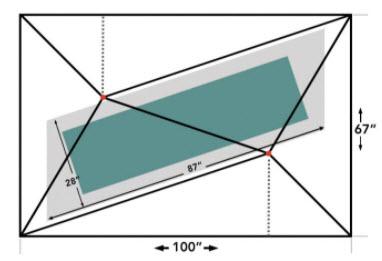
I would have thought the 87″ would have been sufficient even for someone 6’4″ tall, especially with the two-pole format, but admittedly I am only 6’1″ and someone’s comfort with a given shelter size is a very personal thing. I think I fit relatively fine in a 96″ long single-pole, single-wall pyramid, and my bag touching the end resulted in zero wetness in my bag, My bag and its DWR are fresh though.

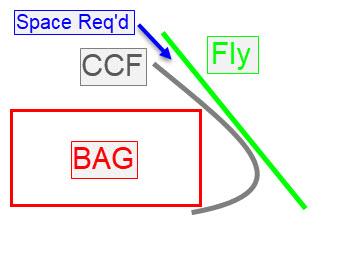
I do like the idea of using a bit of CCF as a barrier, but I’d think the condensation would just roll off the fly onto the CCF and then on to your quilt/bag, unless the edge of the pad was kept off the fly with a bit of space.

Bruce Tolley BPL Member
PostedApr 8, 2021 at 2:22 pm

@ Michael B

Nice drawing.

In winter it works in my experience with mitigating the condensation from the vapor moving through the bag’s insulation and then condensing where your bag touches the wall of the tent.

I had a very short Big Agnes tent years ago where I had this problem at the foot.  I have a very narrow two person 4 season tent and sometimes use this technique along the side of wall when sharing the tent while snow camping.

It would not help with condensation coming down from the walls. Perhaps I missed the point of the original query.

Michael B BPL Member
PostedApr 8, 2021 at 4:09 pm

Haha @ my drawing skilz…

As far as the point of the original query, I’m not sure you are off at all. What you are describing for your use case makes sense as far as my experience goes. You are using a CCF to prevent the water vapor floating around in your bag insulation from contacting the cold fly surface and then condensing and wetting out your insulation. That makes sense. My guess to the OP was that water vapor floating around in the tent would condense regardless on the fly surface, and eventually get on the outer shell of the OPs bag. Two different moisture management issues. I was stating my concerns of using a CCF for the second issue(moisture external to the bag), not the one you were talking about (moisture internal to the bag). Either way, I do think a CCF pad would be better than the OP idea to encapsulate the lower half of the bag in a non-breathable silpoly sack, since the bag could still breathe with the CCF pad there.

PostedApr 9, 2021 at 5:23 pm

@zenman

Have you thought of just a square tarp?

You said you are currently using a Mid-X 2P that has foot print issues. Their website has them listed at 2.5 lbs with stakes etc.

I am 6′ 2″, and I use a 9′ by 12′ Tyvek tarp, with all of its stuff (paracord, stakes, bag, figure 9 tightener), under 2 lbs. I usually set it up with all 12 feet of length, and even in torrential down pours have stayed dry (with 3 people and 1 cattle dog under it). When I am in a confined area, I can fold it to any length I want it, but usually a minimum of 7′.

Viewing 24 posts - 1 through 24 (of 24 total)
Loading...