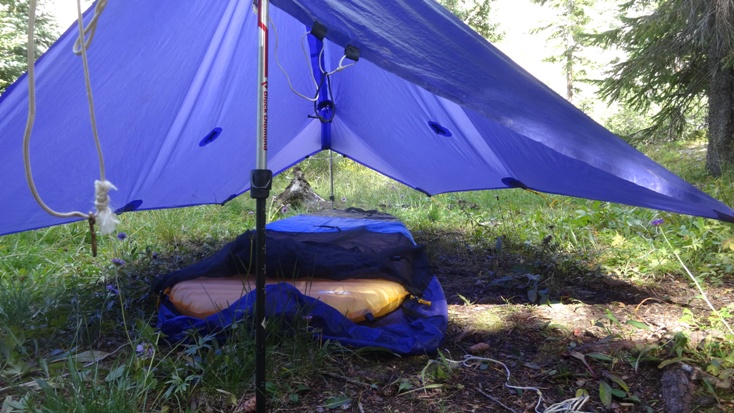
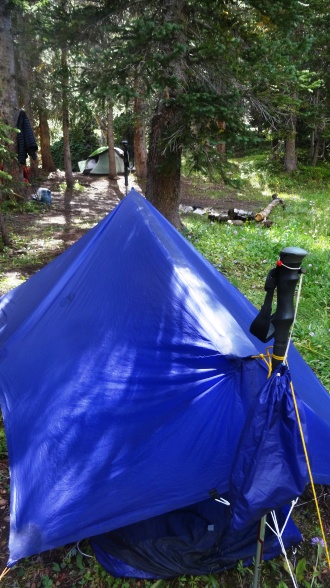
I tested Seamgrip on polyurethane (PU) coated fabrics because I wanted to install large reinforcement patches at stress points without a lot of sewing that would only weaken the fabric further.
The resulting bonds were very strong, and could not be peeled away. And it may be that a two part low viscosity PU adhesive, such as the Loctite products previously recommended here for use on Cuben fabrics, might do even better, bonding the reinforcement patches with an even thinner and therefore lighter and more flexible coat. As earlier reported, had no luck thinning Seamgrip with products suggested here, as the bonds were quite weak, not really bonds at all.
However, as Roger suggests, only the PU coatings are being bonded, not the threads of the fabric. So the bond is only as strong as: 1-the strength of the fabric, and 2-the strength of the bond between the fabric and the original PU coating done by the manufacturer. Still, I think the bonds I observed were very strong and would work well with high quality nylon with a high quality PU coating. One fabric I used was from a StoS Escapist tarp that was tested and reported on here by Richard Nisley.
I only see relevance of silicone to the OP’s inquiry in that many very light nylons are now coated with silicone on one side, and polyurethane on the other. With these fabrics, only the PU coated sides could be bonded with PU adhesive, and identifying which side is which is not always an easy call. Sometimes it is necessary to use dabs of PU and SIL adhesive on the fabric to be sure. I understand that some fabrics are coated with a blend of SIL and PU, but have not seen any personally, so have not been able to test bond them.
Surely, if shaped Cuben tarps can be successfully made with adhesive bonding, as has been often reported here, then it should be doable with PU coated woven fabrics. The threads here on this subject are legion, so won’t try to report them all here. PU is some sticky stuff, and some study and practice with the joinery should be necessary.
However, I would not try to make a tent this way, as too many seams are involved. But intend to bond reinforcement patches this way, and then sew only over the hemmed edges, knowing that the raw edges of the patches further inland on the fabric will hold without peeling. A basic pyramid tarp should also be possible if you can get the bond right on the seam line set for a catenary cut.