I often double-check technical information published in Backpacker because I’ve found too many hiccups in the past. The pattern continues.
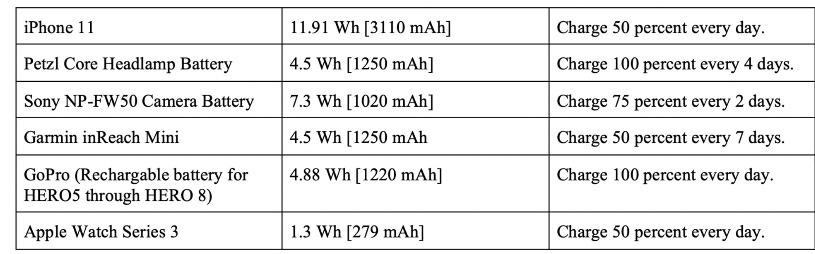
The third column in that chart seems to be an example of energy use / recharging patterns, not any kind of “average.” The author even states up front: “Consider how often your devices run out of juice with normal use.” The article doesn’t make that very clear for the chart.
I spot checked a few of the Wh (watt-hour) numbers in the chart against manufacturer specs and found some discrepancies. The article claims that most small batteries run at 3.7-3.8 volts, then goes on to use 3.6 volts across many devices. Bad assumption.
The Sony camera battery at full charge supplies 8.4 volts, which translates to 8.6 Wh stored – about 18% more than the 7.3 Wh shown, which seems to be based on 7.2 volts.
And all batteries require more energy to recharge than they store, due to inefficiencies like resistance in the wires and battery during charging. This lost energy varies from device to device.
For example, the Petzl headlamp battery needs 7.5 Wh (vs 4.5 Wh in the chart) to recharge via USB.
And the article recommends solar panels if a battery bank is insufficient. But many PCT thru-hikers mail solar panels home early in their trip. Most rely on battery banks with 37 Wh (“10,000 mAh”) to 74 Wh (“20,000 mAh”) of capacity and recharge those in town. Solar panels probably work best in base camps.
Yet the story describes a pretty good process for estimating battery recharge needs while hiking. Just confirm the numbers before you rely on them – preferably with actual measurements.
— Rex