Now that my quilt is complete, it’s time to move on to the tent. :)
I was originally planning to build a pyramid, but after using sketchup to compare design options and the resulting usable floor space, total required material (and the resulting weight), and head room, I’ve decided to build an A-frame style tent, with doors and vestibules on each side. (Basically the same thing Hoosier T is planning, but a little smaller.)
Fabric selection questions:
Canopy: I’m heavily leaning towards the RBTR Membrane Silpoly. My reasoning is: It’s light, and it has higher tear strength and puncture resistance than Membrane Silpoly PU4000. However… will the lower hydrostatic head be a problem? Is the low tear strength and puncture resistance of the Silpoly PU4000 a big issue for a canopy?
Floor: I was thinking of using 1.1oz Silpoly. Will this be sufficient?
Netting: 0.5 oz noseeum. I’ve read it’s more difficult to work with, but I’m hoping I won’t struggle too much! I used it for my quilt baffles, and it is a bit floppy, but not terrible. Is there a “rule” for which direction it should be oriented based on it’s stretch?
Design Questions:
My plan is 6′ wide x 12′ long pitched with ~48″ tall trekking poles, resulting in a length of 10′ 10.5″, and extending the vestibules 2′ from the floor. No that I type that, it sounds excessive… I could probably tighten that up. For the floor, I was thinking 7.5′ long x 6′ wide. 6″ tall bathtub floor with 6″ of netting on the foot and head end.
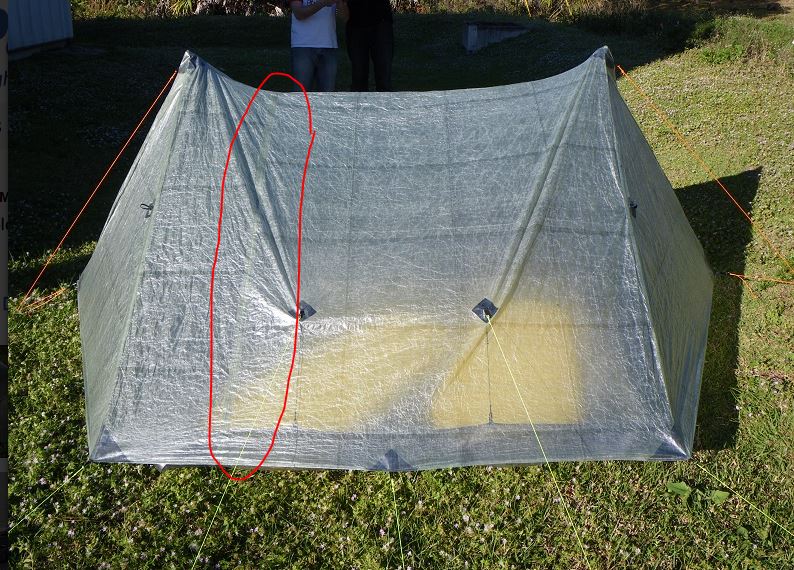
However, from looking at the Zpacks design, it seems their floor extends pretty much to the edge, and the mesh connects horizontally, or is sloped downward to the edge of the canopy, allowing any condensation to run down through the mesh. So I’m wondering if I should take the mesh and floor out closer to the edge.
Another consideration is that the fabric will only have a usable width of ~58″, which is not wide enough to make a 6×12 canopy in one piece. So I was thinking perhaps I would make a horizontal seam where the mesh will connect, and attach a tie-out to the center of the seam, which could have a line run over a stick or trekking pole, increasing the interior tent space.
Here’s my very basic initial sketch of the design.