Let’s go with the drift…
I’m having a dither about a built-in hood for my current 20F bag project.
In theory I’m agreeing that you gain warmth by sharing the same air pocket.
On the other hand, I’m a great believer in a good seal around the neck – I’ve found by experiment that this adds a lot of warmth for very little weight. So there’s hopefully not much heat leaking out from the main body and into the hood.
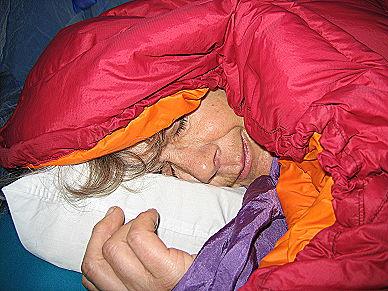
Clearly if the neck’s not sealed as in Roger’s pic the hood will be trapping more body heat so it depends on usage.
More significantly I’ve just checked the hood on my old 2C/36F Rab bag (300g/10.5 oz high quality down), and realised that the down is horribly clumped and lacking in loft. I can’t tease it out, and I’m pretty much only getting insulation from the fabric. It seems that the down has been flattened by the oils from my scalp. So in practice I’m not getting efficient insulation. I’d estimate 100 nights since it was last laundered – looks like a wash is overdue…
Tim Marshall at EE recommends Apex for hoods – he feels it stands up better to oils and moisture. Looking at my bag, I suspect he’s right.
So, potential advantages of a separate hood:
1) Apex can be laundered much more easily, especially on the trail.
2) You can match your headgear to the conditions.
3) You can wear your headgear around camp and huts.
4) With open back systems that don’t turn with the sleeper, the hood will turn with you and not cover your face.
5) You can replace your hood if it loses loft. I suspect the down in a built-in hood would be the first thing to go on a bag, so a separate hood may extend the bag’s life.
6) A purpose-built hood may have a more efficient cut than a typical mummy hood?
So thinking it through it seems that the inclusion of a built-in hood isn’t quite the open-and-shut argument I’ve always assumed. At least for longer trips a separate hood may work better in practice.
Really just thinking aloud here, but hopefully someone will find this useful…