Topic

metallic taste from pot?

Viewing 20 posts - 1 through 20 (of 20 total)
Ryan P BPL Member
PostedSep 29, 2017 at 3:33 am

On my recent backpacking trip, we had to boil water (for drinking) the last night because I had stupidly underestimated the number of purification tablets that we would need.  The boiled water tasted absolutely disgusting!  I wouldn’t describe it as a “flat” taste, but more of a “metallic” taste.  It made me wonder if metal is actually coming off the pot every time I use it; I doubt I would notice the taste when I cook my meals (which is all I ever use the pot for).  I bought the pot some years ago at REI; I believe it was just their cheapest aluminum pot that I saw there at the time.  Anyway, is my pot safe to use and am I just going crazy?  Also, does anyone have any recommendations for an inexpensive, reasonably lightweight pot?   I saw recommendations for the AGG 3 pot, but apparently that has been discontinued?  Any advice or recommendations are greatly appreciated!

Paul S BPL Member
PostedSep 29, 2017 at 5:14 pm

I’ve been using the 1.3L Evernew Titanium Ultralight pot for years. We’ve melted a lot of snow and never thought the water had a bad taste to it.


JCH BPL Member
PostedSep 29, 2017 at 5:24 pm

I’ve never experienced what you describe when using a TI pot, no matter it’s age or amount of use.  I suppose an AL pot could start to oxidize and that might contribute a “metallic” taste.

Did you taste water from the same source both boiled and tablet treated?  IOW, could the “natural” taste of that source be what you experienced?  Water from different streams in different parts of the country always has a distinct taste to me.

On a related note, I carry, use, and recommend, the Platypus in-line carbon filter for trips where I know (or suspect) the water is less than tasty.  Works wonders on the sulphur water you often find on Atlantic/Gulf of Mexico barrier islands.

Roger Caffin BPL Member
PostedSep 29, 2017 at 9:05 pm

Never had any taste from any stainless steel (heavy!), aluminium or titanium pot, and we have used all of them for many years.

Cheers

Edward John M BPL Member
PostedSep 29, 2017 at 9:37 pm

First question is”Where did you source the water from?”

Second question “Was the pot clean?”

I am a super taster and I can definitely taste whether water was boiled in an aluminium pot or cast iron, not so from Titanium or most Stainless steels

Some water sources have a definite taste, especially if you are in an area where there used to be mining or extensive heavy industry or intensive farming or if there is a lot of any particular vegetation that has an oil or especially tannins in the dropped leaves.

Some of my local water sources are so full of tannins it is like drinking strong black tea, all you need to add is milk and sugar after boiling

David Thomas BPL Member
PostedSep 30, 2017 at 12:10 am

Try it again at home – boil some tap water and let it cool.  And then try it with a bit of baking soda in the water to raise the pH.

Maybe it was in the source water on your backpacking trip.  Then you won’t taste anything at home.

Or maybe some metal was leaching out of the pot.  If so, raising the pH will dissolve much less, and do so much more slowly.

PostedSep 30, 2017 at 1:13 am

If not coated Titanium (and SS) will not react to any food or chemical in the water.

Aluminium can.

Roger Caffin BPL Member
PostedSep 30, 2017 at 1:52 am

Yes, aluminium can, but (except for Walmart grease pots), most Al pots are Hard Anodised, and that surface won’t.
Exception: really acid foods like tomatoes.

Cheers

Ryan P BPL Member
PostedSep 30, 2017 at 5:37 am

Thanks for the responses.  The water was from an inlet stream to Island Lake in the Wind River Range, so I don’t think it was the source itself.  But I’ll try boiling some water from home to see if I can replicate the bad taste.  In the meantime, if anyone has any recommendations for inexpensive pots that are somewhat lightweight, please let me know!  The evernew looks nice but also pricey.

Jesse Anderson BPL Member
PostedSep 30, 2017 at 2:13 pm

I’ve been really happy with my Toaks Ti pot. From what I remember, they use a thinner gauge of titanium than Evernew, making them less rugged, but I’ve never had a problem with mine. I have the 750 ml which is perfect for my solo trips, with two people I’d rather have a 1L size. The 750ml goes for $35 which isn’t cheap but isn’t terribly expensive either. I have some GSI hard anodized aluminum stuff which is nice. For me, the decision to go titanium or aluminum/stainless steel comes down to what I plan to do with it. If i’m boiling water, I’ll go titanium every time. If I want to do real cooking, I’ll go aluminum or steel as they are way better at dispersing heat.

JCH BPL Member
PostedSep 30, 2017 at 3:24 pm

Like Jesse, I’m extremely happy with my Toaks 900ml wide pot.  I certainly understand wanting to spend as little as possible, but another way to look at it is you will likely never have to buy another.

Roger Caffin BPL Member
PostedSep 30, 2017 at 9:02 pm

another way to look at it is you will likely never have to buy another.
I got a set of MSR Titan pots early in 2006. We have used them on every trip since then, and they don’t seem to have shown any sign of wear yet.
Mind you, my aluminium Trangia kettle is even older, and it is not showing much sign of wear either.

Cheers

David Thomas BPL Member
PostedSep 30, 2017 at 9:03 pm

“If I want to do real cooking, I’ll go aluminum or steel”

What a minute.  Aluminum has a thermal conductivity of 205 (higher numbers are more conductive), 1% carbon steel is 43 and stainless steel is 16 (different references vary a bit because different alloys vary).  Further, aluminum pots are thicker than SS pots (certainly for the same weight), so that makes aluminum even better than the apparent 15x advantage.  Maybe 20-30x more conductive compared to a  SS pot.

Titanium is 22 but is usually thinner than SS, so pretty close to SS in our application.

Short version: for cooking eggs or heating any vicious, gloppy stuff, any aluminum pot is much, much better than any SS or Ti pot.

Geek note: those figures are at 25C and metals are more thermally conductive at higher temperatures – about 5% better around 100C.  But that increase is consistent between different metals, so the ratios remain the same.

David Thomas BPL Member
PostedSep 30, 2017 at 9:12 pm

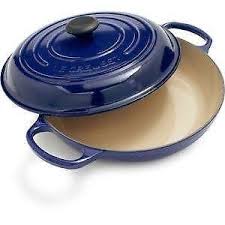
You may perceive steel as being a reasonable cooking pot because cast iron (heat conducts well within those big grains/crystals and slows down between grains) has a conductivity of 58.  And, because it’s more brittle / less malleable than Aluminum, is cast in thicker pots and frying pans than aluminum.  So you have a material that is 1/4 of aluminum’s conductivity but is 2 or 3 or 4 thicker so it actually spreads heat just about as well (but weights A LOT more)  This would also be true of some high-end enamel-covered cast-iron pots like those very spendy Le Creuset pots I got for my wife (which work very well):

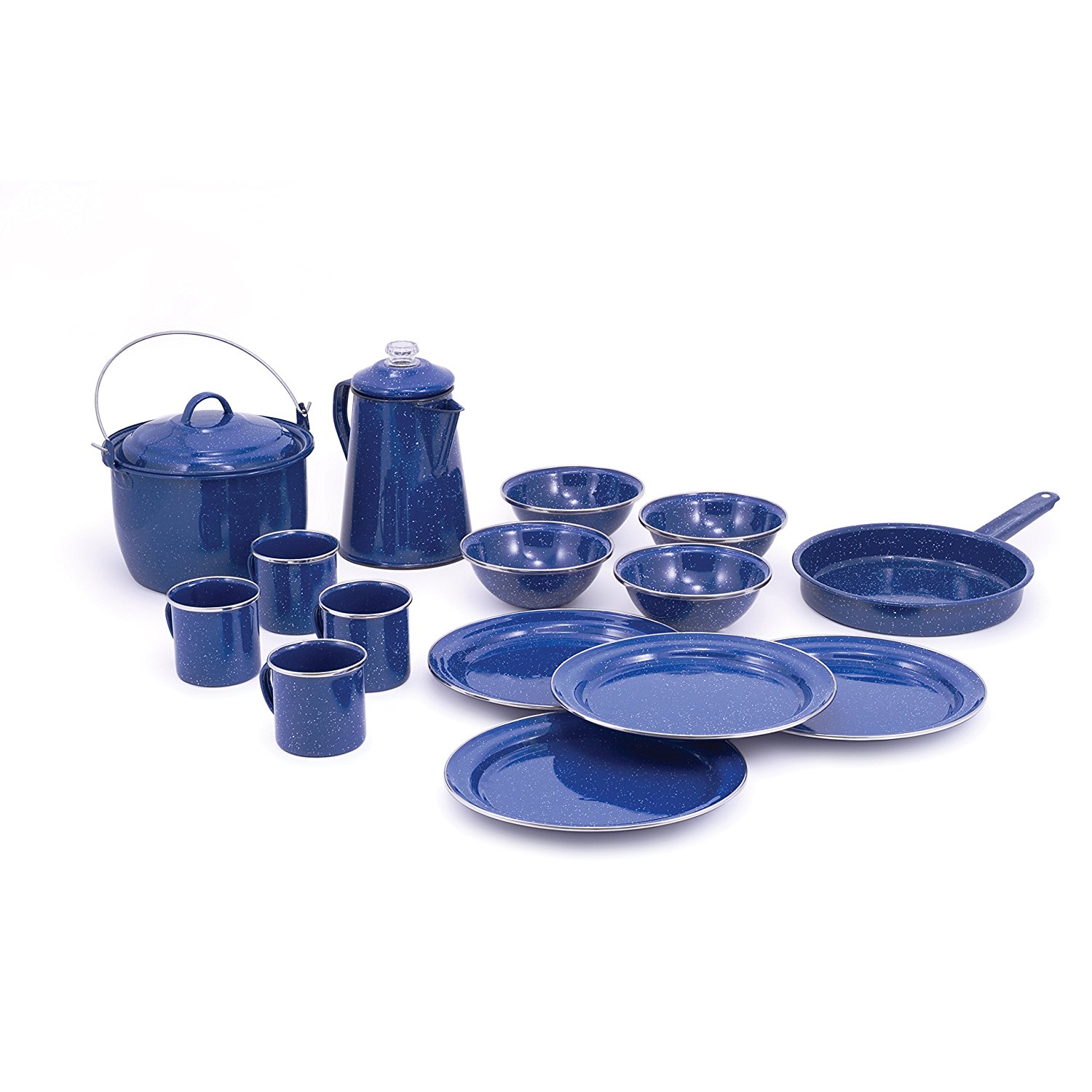
While cheap “camping pots” in blue-flake enamel are thinner (bad for heat transfer) and carbon steel, not cast iron (also worse):

These don’t conduct heat well at all (but are cheap and lighter and look great if you’re recreating the campfire scene from Blazing Saddles with a large meal of beans.

Roger Caffin BPL Member
PostedSep 30, 2017 at 10:30 pm

Short version: for cooking eggs or heating any vicious, gloppy stuff, any aluminum pot is much, much better than any SS or Ti pot.
Eh, well, it does depend a bit on the stove. If you have a focused burner like the Pocket Rocket, then there are risks with any metal. That’s just a bad design. But with a well spread out flame even a Ti pot is manageable. I manage to cook some moderately ‘gloopy stuff’ on my Winter Stove as the flame is really broad.

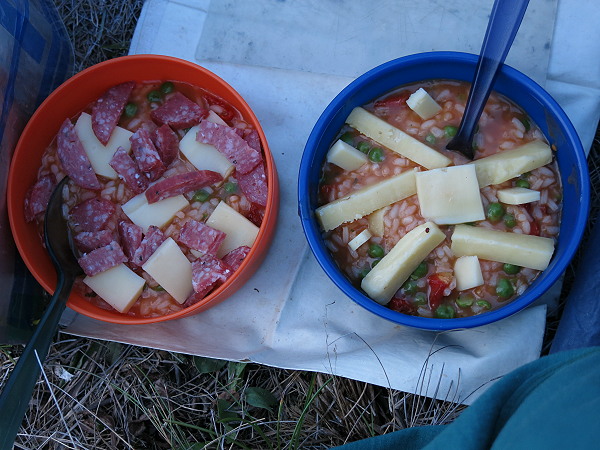
That said, I find the best way of cooking our ‘gloopy stuff’ is to only make the gloop at the end. That’s something like rice, dried mushrooms, sun-dried tomatoes, dried peas, cheese and a packet of ‘Instant Soup’. The gloop in the soup is probably just cornflour – alias thickening. It does not have to be cooked per se, so I can turn the stove off as soon as I have emptied the packet in the pot. Stir, replace lid, chop up cheese and salami to go on top, serve.

With the lid on, the heat is retained and the stew is usually a bit too hot at the start anyhow.

Cheers

Edward John M BPL Member
PostedSep 30, 2017 at 10:31 pm

Eeek Cast iron and bushwalking? I would argue that very few of us do any “REAL” cooking when we are bushwalking

PostedOct 1, 2017 at 12:24 am

“Titanium is 22 but is usually thinner than SS, so pretty close to SS in our application.

Short version: for cooking eggs or heating any vicious, gloppy stuff, any aluminum pot is much, much better than any SS or Ti pot”.

I did some tests years ago with similar shaped and sized pots , one in Ti and the other thin non coated aluminium.
On my home stove using the two rear same sized burners (and switching the pots from one to the other after a few burns, just in case) there was very little difference in time boiling 500ml of water.

Ryan P BPL Member
PostedOct 1, 2017 at 4:13 am

Thanks again everyone.  This is more info than I expected to get on a question about pots… just shows how great this forum is.  I do tend to make “gloopy” stuff (rice+bean soup mostly), and I do have a Pocket Rocket, so maybe I’ll stick with Aluminum for now.  Although shaving off a little weight is always tempting…

Roger Caffin BPL Member
PostedOct 1, 2017 at 5:04 am

Ryan P:
A BRS-3000T from the web is very cheap, and it has a much better flame pattern. It might look like the PR without a pot, but the flame does spread out when you add the pot. A bit of a cult stove here at BPL.

And yes, that dinner was nice.

Cheers

Viewing 20 posts - 1 through 20 (of 20 total)
Loading...