Michael B,
The best thing I’ve found is one of the ping-pong tables where the sides fold up to a vertical position. They have four legs toward the middle of the table, on casters, and there are legs near the four outer corners that unfold from the the table bottom when the two table halves are lowered. So the table can be folded up close to flat and wheeled about to some place where you want it, usually against a wall.
The cheaper tables, from places like W-mart are made of particle board, which is great for pinning or tacking fabric, but eventually the table top will cave a little, and a nice flat surface is gone. The more rigid tops are quite heavy. Found one in the local classified, and the owner of the estate was kind enough to use his truck to bring it to my place and leave it just outside the basement walk-out, where tarps were wrapped over it to keep the rain and snow off it. So recommend installation in the room where it will be used ASAP.
The tables when opened are 5′ wide and 9′ long. Also use one end of the table for holding up large fabric panels while sewing them, or assembling them and pinning the lapped seams just where they should be before sewing. Pinning lapped seams on the flat table takes a while to learn, but beats doing it on a fiberboard laid on the floor. Kudos to those who have machines that do it, and have learned how to use them.
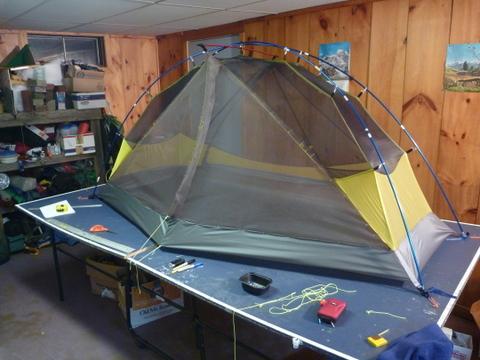
The biggest challenge has been finding places to put all the stuff that accumulates on the table between projects. Here’s a photo of the table in use, though:

As you can see, the table had begun to cave even then. The biggest deal will be getting it to the dump after the new table goes in. Visible is the seam being pinned. I think it would have been better to first trace the cat-cut, pin the seam, and see how it looked with the inner tent set up as in the photo.
While the ‘draping cord’ method is better to locate the seam than numerous dots like points on a graph, tracing on the fabric from arcs made of old tent poles has worked as well or better so far. They form an arc called a parabola, which is very close to the formula for the cat-cut arcs. But liked the picture of the cat with the knife.



 I press the two parts together and this also removes air bubbles. Silicone cures through humidity (I think that can take a long time), but you can continue to work on your project because there is no load yet.