Topic

List of Oblique Toe shoes suitable for hiking

Viewing 7 posts - 1 through 7 (of 7 total)
Stumphges BPL Member
PostedMar 11, 2018 at 2:18 pm

Altra now offers many shoes with oblique (ergonomically shaped) toe boxes. However, all their models are zero drop, or have no heel elevation, which is not for everyone. Here is a list of all the shoes I’ve identified on the market with oblique toe boxes. To qualify, in my mind, one should be able to draw a line along the interior border of the insole that touches both the heel and inside edge of the big toe. E.g.
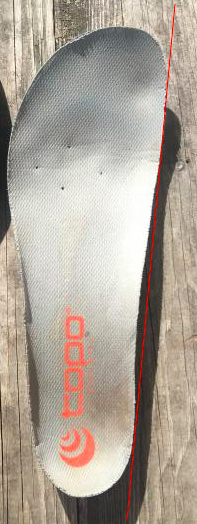
Shoes like the Akasha, built on La Sportiva’s “Ergo” last, do not qualify because the big toe deviates laterally (toward the other toes) much more than the shoes listed below. Looking at the insole is generally best for evaluation because some companies add stability wings and other features to the midsole/outsole that can make it appear that the toe box is either wider or narrower than it actually is. The shape of the insole generally tells the story that the foot feels.

List of Oblique Toe Hiking Shoes/Boots

All Altra models – trail runner style

All Topo Athletic models – trail runner style

Garmont, Various Trail Beast & Nagevi models (run narrow (~ C-D men’s)) – hiking shoe/boot style


That’s it as far as I’m aware. Please feel free to post more models that you know of. I’ll keep a running list in the second post (can’t edit the OP, I think).



Stumphges BPL Member
PostedMar 11, 2018 at 2:20 pm

Running List of Oblique Toe Hiking Shoes/Boots

All Altra models – trail runner style; zero drop

All Topo Athletic models – trail runner style; 3-5 mm drop

Garmont, Various Trail Beast & Nagevi models (run narrow (~ C-D men’s)) – hiking shoe/boot style; ~9 mm drop


Nick B BPL Member
PostedMar 11, 2018 at 3:08 pm

All of my insoles get thrown away so I can’t compare that way. But, if I’m not mistaken, all of the Xeros fit your criteria, particularly the Terraflex for hiking.

Vivobarefoot has several models.

TadeEvo has the right shape though the sole is designed more for hard surfaces. They slip around quite a bit in snow, mud, and granite gravel.


Bob Shuff BPL Member
PostedMar 11, 2018 at 3:32 pm

Check out naturalfootgear.com/blogs/education/17856304-benefits-of-wide-toe-boxes-for-hiking

I found this looking for the name of some boots I got last year, that I remembered choosing for the straight toe alignment.  Hanwag Tudela Light GTX if I’m correct on the model.  I can’t find the insole; but will look again later.

In addition to a wider toe box (didn’t know oblique as the term) I usually look for maximum cushion.  I have custom orthotics that I believe take care of stability.

New Balance leadville trail runners showed promise.  I don’t know if they were oblique.  Altra Lone Peak seemed to cause overpronation so I’m trying the Timp Trail, but I’m not sold yet myself on the zero drop.

I’ll be interested what others suggest, especially high cushion trail runners.


Stumphges BPL Member
PostedMar 11, 2018 at 5:12 pm

Bob & Nick, thanks for your contributions. I’ll add these to the list.

My sense with zero drop shoes is that they often end up being negative heel shoes because the surface area of the heel is less than the surface area of the ball of foot/toes. If the hardness of the midsole is the same in both heel and forefoot, the smaller heel will press deeper into the midsole than the ball of foot, creating a negative drop situation. Some foot types can handle this, but others – those with limited ankle joint dorsiflexion range of motion, or with significant varus (inverted) angulation at heel and/or forefoot – will pronate more in a negative drop environment.

With soft sole materials I think it makes sense to have 3-5 mm drop to compensate for this issue, or to have harder foam in the heel than in the forefoot. I think Altra have started goofing around with different foams and midsole counters since their early models, which were pretty basic designs; but I’m not sure.

My opinion is that the first company that makes a more traditional trail runner/hiker, with 9-12 mm drop, but with a true oblique toe, will make millions. From the evolutionary perspective, it makes sense to pair zero drop with oblique toe box. But there’s no reason these two design elements have to be wedded in every model. I think a lot of people find a little heel elevation to be more comfortable, especially when going uphill.

Bob Shuff BPL Member
PostedMar 11, 2018 at 5:24 pm

Since I started wearing the Timp Trail, I’ve been noticing it more on uphill.  That seams rational in retrospect because your already stretching your achilles/calf, and the zero drop or negative as you suggest might exasperate that.  Going downhill I’m thinking about other stresses, like my toes being jammed into the toe box or my knees.  Does a new mm make a difference going up and down – I’m not sure.  Every step is different, so it’s not going to ideal in probably any cases.  The design is probably for flat walking, which I don’t get to do too often on the trail.

Toe box, however, seems to make a huge difference when going up and down for me.

Viewing 7 posts - 1 through 7 (of 7 total)
Loading...
