


David D; do you find the ccf more useful on top than under – or do you bring two?
Topic
Become a member to post in the forums.
 .
David D; do you find the ccf more useful on top than under – or do you bring two?

Henrik, definitely on top. This reduces heat loss through the side of the pad and adds some insulation from the ground, where underneath just provides insulation from the ground. I just bring one
Interesting. What about the protection underneath and “enjoying” the pressure relief from the “baffles-of-choice”? :)
You have a very good point on the reduction of heat loss through the sides – it must be reduced by having a sufficiently wide CCF-pad on top. Never thought about that – that the CCF will have less heat to “conserve” if it’s on the bottom – as some of the heat will escape from the sides on it’s way down through the air pad.
If anyone could invent an “air-pad-side-insulator”, then I’d be the first to buy it.
I wonder if these air pad manufacturers lack engineering skills, or if they are doing whatever is necessary to produce a product with a low weight, and thereby just responding to us consumers being too obsessed about weight. Kind of hard to not fall in love with a low weight + high r-value. Maybe most buyers don’t even try the products in cold conditions anyway, so speculating in consumer habits (meaning not winter camping) is a commercially smart choice. A new standard should be invented in order to know which pads that actually will keep you warm. Until they, reviews from someone like Justinoutdoors is of very high value. He actually tests these things in cold conditions. Alot of other reviewers will review a pad and state that they have not yet had the opportunity to try it out it cold conditions. As if a winter sleeping pad review without winter testing is of any real value to consumers. Sorry about the rant.
I’m constantly surprised folks don’t understand the ccf pad goes on TOP of the inflatable for the most warmth, not UNDER the pad. The ground temp is a fairly constant temp, and is generally not as cold as the air – often far less cold. The bulk of heat loss on an inflatable comes through its sides, not from underneath (one reason the R Value ratings are so variable – useless – the side heat loss isn’t taken into consideration). The ccf placed on top is like beefing up the insulation inside the mat to protect one against the cold air.
” the ccf pad goes on TOP of the inflatable for the most warmth, not UNDER the pad. The ground temp is a fairly constant temp, and is generally not as cold as the air – often far less cold. ”
I know that but I just can’t do it. I want to protect the air mat with the ccf underneath. But I very rarely use ccf.
I have measured the ground temp occasionally, directly under me. It can easily be 20F warmer after a few hours. Especially if it’s duff, but even if it’s rock. If it’s snow then it’s 32F which is where I need the ccf.
I think the measurement standard should be revised to add a cold wrap to the measurement jig that goes around the side of the pad and simulates cold air temps.
Walk in cold environmental chambers large enough to emulate outdoor cold air temps are just way too expensive. I used to work with one

Google:
Many popular ultralight and lightweight sleeping pads with raised side rails or perimeter/cradling side baffles (such as the Big Agnes Rapide SL and certain Exped or Klymit models) leave their outer side rails or side baffles uninsulated or less insulated than the core of the pad to save weight or due to baffle construction. [1, 2]
However, pads that run continuous internal baffling or full-width insulation across the entire width—including the side zones—rely on specific internal designs:NEMO Tensor Series (All-Season / Extreme Conditions / Trail / Elite): Uses NEMO’s Spaceframe or Apex baffle construction with floating thermal mirror films that span across the full width of the chambers rather than dropping off at the extreme edges. [1, 2]
Paria Outdoor Products Elevate S: Uses independently suspended layers of heat-reflective film across interior baffling designed to maintain consistent warmth across the surface. [1]
Standard Full-Width Chamber Pads (e.g., Sea to Summit Ether Light / Ultralight series): Utilize Air Sprung Cells or uniform full-width multi-cell matrices with Exkin Platinum and Thermolite running across the full footprint rather than isolated perimeter rails. [1]
Note on Side Rail Trade-offs: If a pad features distinct, oversized foam-encased or empty-air “rails” (like the Comfort Cradle edges on some Exped or Big Agnes models), those specific side channels often act as structural or uninsulated air/foam borders to center you rather than housing the core reflective or synthetic fill. [1, 2]
If you’d like to narrow this down, let me know:
What R-value or season you are targeting (summer vs. winter/alpine)
Whether you specifically want a mummy or rectangular shape
Your preferred budgetI can point you toward the exact model that fits best.
GearLab
Best Backpacking Sleeping Pads of 2026 – Outdoor Gear Lab
Insulated? Yes Available Sizes and Styles All sizes are rectangle: 20 x 72 in 20 x 78 in 25 x 78 in 25 x 72 in 20 x 66 in 40 x 72 in The only major drawback of …
YouTube·Justin Outdoors
2m
BEST SLEEPING PADS FOR COMFORT – Which Would You …
Field Mag
9 Best Ultralight Sleeping Pads for Backpacking, Trail Tested
Sep 15, 2026 — The Nemo Tensor Elite Ultralight Insulated Sleeping Pad weighs just 8.6 ounces for the regular size and has an R-value of 2.4, making it the lightest inflatable…Paria Outdoor Products
Elevate S Insulated Sleeping Pad
Product Description Enjoy deeper, more restful sleep in the backcountry with our Elevate S insulated sleeping pad! It’s built to handle everything from summer b…Gear Review: NEMO Eclipse Vs. Exped Ultra 6.5 – Campman
Side sleepers especially will notice the difference — hip and shoulder pressure that would wake you up on a thinner pad simply does not happen here. The Exped U…
Facebook·My Life Outdoors
6m
Best and Worst Sleeping Pads for Camping and Backpacking
NEMO Tensor Extreme Conditions Ultralight Insulated Sleeping Pad
Tensor Extreme Conditions, by Nemo, represents a new chapter in sleeping pad innovation! With its Apex baffle internal structure, the Tensor Extreme Conditions …
Sea to Summit Ultralight Insulated Mat
The Womens Ultralight Insulated Air Sleeping Mat saves weight because it’s narrower at the shoulders, yet wider at the hips and knees for greater comfort no mat…
” the ccf pad goes on TOP of the inflatable for the most warmth, not UNDER the pad. The ground temp is a fairly constant temp, and is generally not as cold as the air – often far less cold. ”
I know that but I just can’t do it. I want to protect the air mat with the ccf underneath. “
First off, I agree with Jerry. If there is slight damage to a thin CCF mat, no problem. But ‘slight damage’ to an air mat is usually disasterous.
However, snow camping introduces another factor. The snow under you will generally be at 0 C. That is not a problem with enough R-value, but (BUT) it means that any water vapour in the tent will soon condense on the tent floor and get under the mat. If the bottom layer is CCF, you can shake the water off in the morning: it won’t be absorbed. But a wet air mat can be a big problem for the next night. You roll the air mat up in the morning and the water now is on the top side as well.
As for heat loss sideways, [edited] Sure, if your quilt is super-narrow, there may be some heat loss sideways from the mat – but there will be a lot more loss from your body. Most uncomfortable. But if your quilt has an adequate width (adequate for the conditions), then the edges of the quilt will most likely insulate the sides of the air mat (and keep you warm).
Cheers
Roger; if the heat goes from your body and down into the mat, some of that heat will escape out the sides of the mat. How will the quilt prevent that? Not sure I’m following you here.
First off, I agree with Jerry. If there is slight damage to a thin CCF mat, no problem. But ‘slight damage’ to an air mat is usually disasterous.
However, snow camping introduces another factor. The snow under you will generally be at 0 C. That is not a problem with enough R-value, but (BUT) it means that any water vapour in the tent will soon condense on the tent floor and get under the mat. If the bottom layer is CCF, you can shake the water off in the morning: it won’t be absorbed. But a wet air mat can be a big problem for the next night. You roll the air mat up in the morning and the water now is on the top side as well.
As for heat loss sideways, [edited] Sure, if your quilt is super-narrow, there may be some heat loss sideways from the mat – but there will be a lot more loss from your body. Most uncomfortable. But if your quilt has an adequate width (adequate for the conditions), then the edges of the quilt will most likely insulate the sides of the air mat (and keep you warm).
Quilt? I’d never use a quilt on a winter trip where temps can get -20*F… I can’t fathom the idea.
When I speak of cold penetrating the sides, I’m speaking of sub zero air penetrating the sides of the inflatable pad, not a “quilt.”
I’m believe I’m referencing much colder temps than you are. There’s no way you’ll want a ccf under an inflatable in sub zero (F) temps when it can (and should) go on top.
Hi Henrik
Yes, I have used a quilt in cold weather, down to -7 C. We were warm enough. OK, the weather was not meant to get that cold!
As for heat loss at the sides, two methods get used. The first is that a lot of gear, mostly food and well- packaged spare clothing, gets stuffed along the sides of the mat, so that there is little room for heat loss.This is shown here.
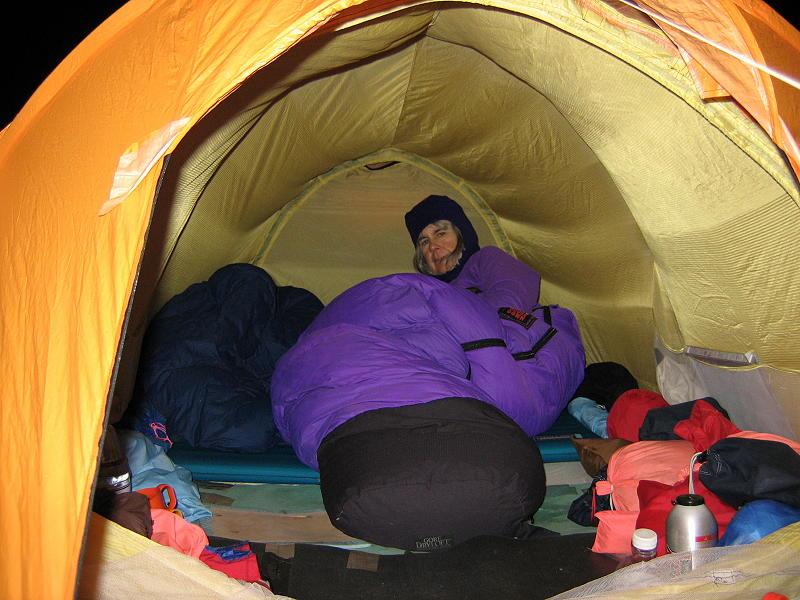
Second is that my quilts are wide enough that the edges can hang over and cover what is left of the sides. This has the benefit that drafts at the sides are eliminated.
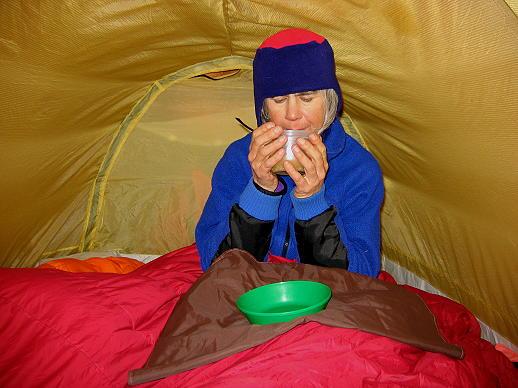
Mind you, for full-on mid-winter XCski trips I often use a special quilt/SB – Katabatic. So does my wife – see above.
Cheating admission: I always have a very nice warm side anyhow: my wife, in similar gear, snuggled close. Trust me, it works! Well, until she nudges me out to get breakfast. :)
Cheers
My quilt is wide but side sleeping still pulls it off the pad at the straps. I pull the strap attachment points to be fairly close together and under me, separated by maybe a foot or so. This keeps me much warmer than trying to have the quilt cover the edges of the pad. That big a quilt would be unnecessarily large and heavy
That big a quilt would be unnecessarily large and heavy
MYOG quilt w waterproof stuff sack: 790 g
Exped Synmat UL 7: 450 g
Grey CC mat: 74 g
Used down to -7 C
Cheers
Allergic to down
Apex is heavy
No need for myog quilt in this case when my off the shelf $9 52g ccf pad under my hip works just fine
My quilt is ee wide but I have wide shoulders and side sleeping exposes drafts unless I tuck it under me with the straps
Besides, an apex quilt wide enough to cover the sides of the pad side sleeping and work to 20f, which is about my lower limit for quilting, would be huge in my pack
Thanks for clarifying Roger. Looks like a fun trip! You’re lucky to share these kinds of experiences with your wife.
I see both perspectives on the ccf on top for max warmth or under for protection. I guess under would be best unless you need the extra warmth. As bradmacmt points out, we’re discussing «cold» and thinking of different temperatures.
I’ve used my Zenbivy (warmest one) down to -15c (same as comfort rating), together with my S2S Ether Light XR Pro – with a zlite under. With a merino wool base layer I was more than warm enough. So quilts can work well in those temps. That said; I do seal of the skirt of my tent to hold on to more heat. Bulky quilt, but sleeping bags doesn’t work for me.

It has the same structure as some of the pads that tend to split at the joins, but the demo of driving the car over it was pretty convincing (although I imagine they could have just underinflated the pad).
Anyone see any major red flags as to why this is a bad idea, at half the weight of the Klymaloft Summit that I was considering?
Hi Jen. I’m not familiar with that one.
A way of narrowing down choices could be with this sleeping pad finder by the Youtuber Your trail buddy;
I am biased. OK, very biased.
I suspect the quality of the pad is INVERSELY proportional to the length of the URL.
Frankly, it sounds more like a PII fishing expedition.
Cheers
having a truck drive over a mat seems like a marketing thing. Not very related to how long it would last in real use.
sort of like the guy using the sealant on the bottom of a boat and then paddling around in it. Or cutting nails with a knife.
Become a member to post in the forums.
 Brynje Mesh BaselayersBrynje baselayers use open mesh construction to move moisture away from the skin, create insulating air pockets, and help regulate body temperature across changing conditions and activity levels.
 © Beartooth Media Group Inc.
 Loading...