Topic

iPhone 6s – Protection & Charging

Viewing 20 posts - 1 through 20 (of 20 total)
John Papini BPL Member
PostedJan 22, 2016 at 10:44 pm

Hello!

So, I recently purchased an iPhone 6S, which I will be taking with me on my thru-hike of the PCT. I’ve read lots of posts about maximizing battery life, good apps, and even about cases (Lifeproof Fre and Nuud have gotten a few nods). My main use for the iPhone will be as my camera, but to be honest I don’t take tons of pictures. I will install Gaia in case I get hopelessly lost in snowfields, and a few other apps, but except for its function as a camera I intend to use the phone and apps for emergencies only.

I don’t currently have a case, and I don’t currently have any method for recharging. I use Energizer Lithium AA batteries to power my other electronics (Zebralights and Steripen).

I’m trying to figure out whether I should get a protective battery case (like Fre Power, or Anker Ultra Slim, or even the Apple Battery Case), or whether I should get a regular cheap-o case (incipio, candy shell) and some sort of external battery pack. Given that I don’t need to charge any other devices, the case/battery combo seems appealing, but will 2 charges be adequate for picture taking between charging opportunities? I’ve never used an iPhone in the backcountry, so even with SIM lock and airplane mode and yada yada I don’t know how long I can expect to go without needing a recharge.

What do you do? Please describe your system (battery case, regular case + external charger (solar vs. battery pack vs. ?), or something else of which I haven’t conceived), how frequently you use your phone and for what purposes, how long you can keep your phone charged before needing an outlet, and how much your system weighs.

Thanks!


Mike In Socal BPL Member
PostedJan 23, 2016 at 1:48 am

Hi John,

I use the standard Apple silicone case. It provides enough grip so the phone doesn’t slip out of my pocket or hand. I also use a glass screen protector to protect the screen from scratches. I’ve used battery cases in the past but have found them to be too big to have on all the time. I have several use cases: daily use, trail running, multi-day backpacking.

When trail running, I simply carry the phone in my shorts pocket. The silicone shell provides enough friction to prevent the phone from falling out of my pocket.

I have used 2 different setups when backpacking:

Solar: Phone + Goal Zero Nomad solar panel + AA battery pack
External battery: Phone + external Jackery Giant battery pack

Solar. I used the solar setup over 5 days in the Grand Canyon. The solar panel and 4xAA battery pack weighed about 15 oz. (oh, how I wish it were lighter!) During the day, the solar panel hanging off my backpack would charge the AA battery pack in 2-4 hours. At night, I would recharge my phone from the AA battery pack. Although this is a heavy solution, it was flexible because I could use one of the AA batteries in my Zebralight headlamp (or any other device that used AA batteries) if needed. It will also provide unlimited recharging on any length trip as long as you had sunlight.

External battery. On a more recent 4-day trip, I recharged my phone nightly with a Jackery Giant (10.4 oz). The Giant is a 10400 mAH battery which is enough to charge the iPhone 6S almost 5 times. A quick note on charging: you use less power if you charge to roughly 80% vs charging all the way to 100%. I believe it has to do with they way Li-Ion batteries need to be charged as you approach their full capacity. On this trip, I used Gaia GPS for 3-4 hours per day, took photos and video, and did some light reading and maybe watching a movie on my phone. My phone was in airplane mode and the battery lasted all day; I would stop Gaia from recording a GPS track whenever I stopped for an extended time (I wasn’t on a high mileage trip where I was tracking all the time). Incidentally, a change in airplane mode sometime in the last 18 months made it so you still have access to GPS data when airplane mode is on. This means you don’t need to turn off airplane mode to get GPS data. Previous to this, you had to turn off airplane mode which would also let the phone to search for cell towers even if you didn’t want to. PIN locking the SIM was the only way to prevent this but is no longer necessary.

The external battery is lighter than the solar setup and if you are able to charge the battery every 5-7 days, you’d be in great shape. But here’s the big downside: it takes 10 hours in ideal conditions to fully recharge that battery. This means that you will need to be somewhere with an outlet for at least that much time. Additionally, you need to carry a USB wall charger to charge the external battery. The smallest ones probably don’t put out enough current to charge the external pack in 10 hours; it would take longer.

I’ll still use both solutions based on my needs but will keep looking for lighter solutions down the road.

Matthew / BPL Moderator
PostedJan 23, 2016 at 6:36 am

I have tangential information to add here:

I used a Lifeproof Nuud on my iPhone 6 on the JMT this summer. The plastic lens got fairly scratched in three weeks so I’d imagine it would not fare well on the PCT.

I don’t think there is a need to simlock anymore now that Apple enabled the GPS in airplane mode. I got an easy 4 days on the JMT taking a couple dozen photos a day along with a half dozen checks of Gaia or Guthook’s JMT App.

I’ve heard a million recommendations of Halfmile’s PCT app. People seem to love it. I haven’t tried it.

Currently im living on the edge with no case and I’ve got a phone-sized aLoksak that I carry in my FAK. I can pull that out when rain happens or when crossing a creek. I’ve done this on a few weekend trips and been happy with the setup. It’s light and simple and allows me to take quality photos when it’s not in the bag.

FYI the screen does not register taps well at all when wet, through the aloksak, in the Nuud or in a ziplock.

PostedJan 23, 2016 at 8:32 am

I normally use a lifeproof case on my iPhones. For charging I use one of the rugged limefuel battery packs which are waterproof

John Papini BPL Member
PostedJan 23, 2016 at 11:19 am

Matthew,

I guess I should have mentioned that the reason I don’t have a case or extra battery at present is that for the few times I’ve taken my previous iPhone on weekend trips (never to use; solely for emergencies), I’ve just put it in an Aloksak, and I was happy with that setup. The only reason I’m reconsidering for my thru-hike is that I intend to use the phone to take pictures, so I will be taking it out more frequently that I am used to, and I unlike on my weekend trips, I will need the phone to stay charged for more than a few nights.

This is what was drawing me to the phone case/battery in one – for 3-4 oz, I can get a case that will keep out dust (I hear the southern portion is crazy dusty, in a way that I can’t quite imagine living on the East Coast), and will also provide a 100% extra charge to my phone. This is lighter than the 10+ oz setups involving external battery packs and solar chargers and unless you tell me I need to be able to charge my phone 4-5 times out on the trail before I’ll have the opportunity to recharge, then I don’t think I want to go this heavy. If Matt is getting 4 days taking pictures and occasionally checking apps on a single charge, then I’m thinking with the battery pack case (1 + 1 extra charge) I’ll get ~ 8 days, which should just perfect; I don’t think there are many portions along the PCT where I’ll go more than 8 days without encountering an outlet. I assume there are outlets at resupply points??

What are your thoughts? Am I sacrificing anything by going with a battery/case? Would it be cheapter/lighter to stick with my Aloksak, and just get a teeny recharger that will charge my phone once or twice? Or am I right to worry about dust, even if I’m extra careful about drops & water protection?

Thanks for your feedback so far!

Mike In Socal BPL Member
PostedJan 23, 2016 at 11:40 am

Hey John,

Among those choices, I would recommend the battery case and only put the phone in a waterproof sack when its raining. The difficulty of keeping the phone in an Aloksak all the time is that it takes that much longer to get it out and take a quick photo. I like to take photos while on the move so simple is better.  I highly recommend the glass screen protector for protecting against scratches:

you may end up with a little edge around the screen where the screen is curved that does not stick all the way down but I think that’s an acceptable trade off for the added convenience of accessibility. I live in Southern California and run on dirt trails all the time and dust is not a problem.   Lastly, the iPhone 6S appears to be more waterproof than Apple is admitting.  There are numerous links and videos showing an unprotected 6S sitting in a tray of water and still working after 30+ minutes.


Matthew / BPL Moderator
PostedJan 23, 2016 at 2:27 pm

more tangential info:

I would estimate 1 in 3 PCTers we saw on the JMT last summer had a Suntactics S5 on the back of their pack with a small battery like an Anker lipstick 3300(?)mah.


Paul S. BPL Member
PostedJan 23, 2016 at 3:32 pm

Most battery cases and WP cases are bulky, but WP cases often cause big usability issues, e.g. Stiff buttons, reduced touch screen sensitivity, distorted sound quality.  I’d go for a decent drop resistant case and the charging method of your choice. This gives you more options for cases and keeps your phone from being too unwieldy. A case + battery can be had cheaper and possibly lighter. External battery packs usually have much more charging capacity than a case as well.

The big benefit to a battery case is to be able to continue using the phone while charging, e.g. When your battery won’t last till the end of the day due to lots of phone calls or continuous GPS tracking.

Richard Nisley BPL Member
PostedJan 23, 2016 at 3:33 pm

Matthew,

Thank you for a valuable observation! Unfortunately, I think most of those hikers don’t understand how to best use the Suntactics 5.

The Suntactics 5 is an EFFICIENT product if you have a PHONE CONNECTED to its single port and are moving in and out of the shade. The Suntactics 5 has a 2.5 second “reset” timer built into it (patent pending) that “resets” the amperage back to the maximum from a lower rate when it was in the shade.

It is an INEFFICIENT product If you always have a BATTERY CONNECTED to its single port, USB batteries, (small, medium, or large capacity) don’t stay in a low charge rate after passing through shade. There is no charge going into the battery during the “reset” cycle and so you are throwing away the solar charge during this recurring period of time.

Matthew / BPL Moderator
PostedJan 23, 2016 at 4:18 pm

Is someone moderating my comments out of this thread? I have posted a couple of times and they disappear quickly.

John Papini BPL Member
PostedJan 23, 2016 at 7:24 pm

Hello,

So as I’ve been doing more research, there appear to be some lightweight cases that are protective but also will provide an extra charge. The Morphie Reserve has the smallest battery (1840 mAh), but is the lightest weight I found, coming in at 2.65 oz. A lot of people like the Anker Ultra Slim Premium (the non-premium version is a little lighter and thinner, but has no side protection and thus leaves the buttons/ports open to dust & dirt), which has a 3100 mAh battery, but weighs 3.52 oz to the Morhpie 2.65. Both are similarly sized, about .57 inches thick. The other battery cases in my spreadsheet are mostly 3-4 oz, and maybe a little thicker, but not much. All have about the same 6″ tall by 2.8″ wide dimensions.

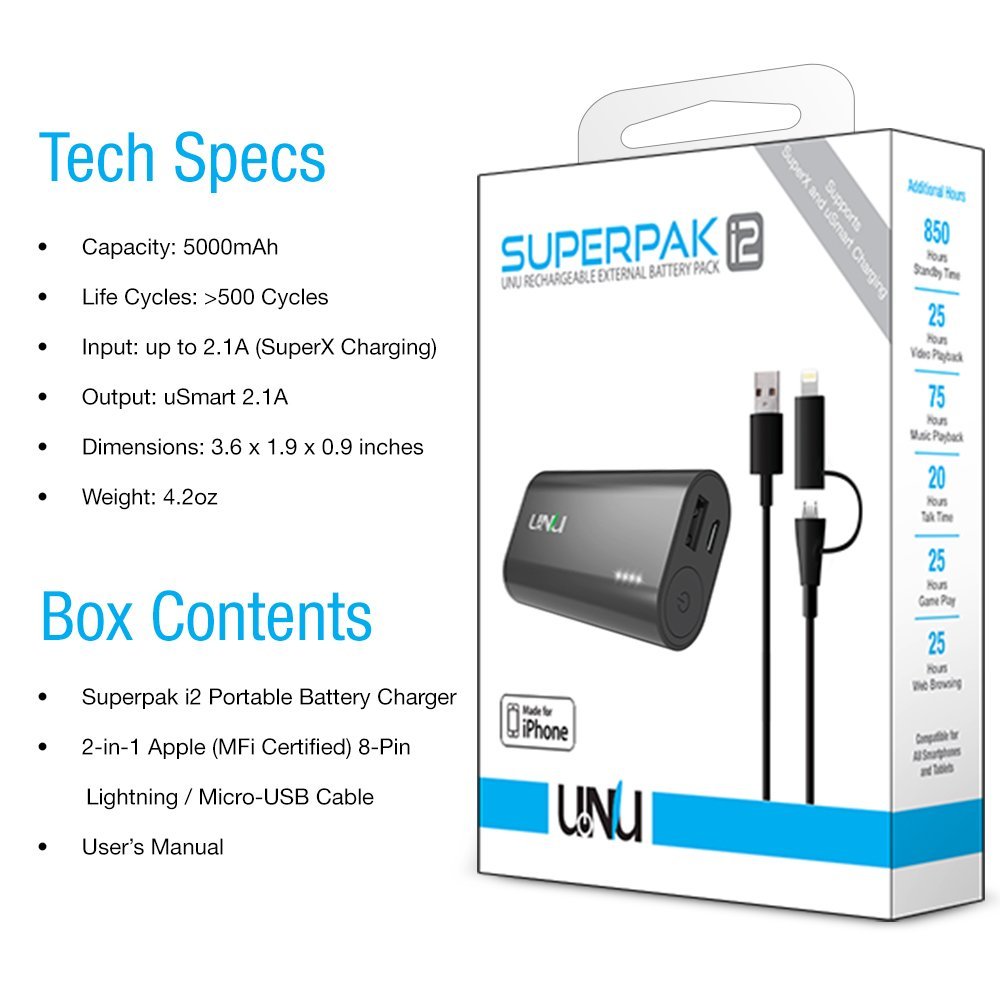
Something cool that I found is the Unu Superpak i2 (http://www.myunu.com/superpak-i2.html). It’s an external battery pack with a 5000 mAh batter that WEIGHS ONLY 1 oz. That astounds me; I haven’t found anything even close to that light. Many of the lipstick-style external chargers weigh 2-3 oz, and are usually 2500-3000 mAh. A 5000 mAh battery will recharge the iPhone 6S about 2.5 times. For those of you using external battery packs, have you found anything lighter/smaller?

I think I’ve found my solution – I’m going to get this 1 oz battery pack, and then either keep my phone case-less in an Aloksak, or else get a cheap case to keep out dust and protect from accidental drops. Any thoughts?

John

Paul S. BPL Member
PostedJan 23, 2016 at 7:36 pm

Great plan.  My daily case is around 1 ounce and has gone rough a few drops. I’m not worried about dust, not many spots for dust to be an issue IMO.

Kenneth Jacobs BPL Member
PostedJan 23, 2016 at 7:51 pm

John-

If it sounds too good to be true, it’s probably is.  The UNU Superpak i2 weighs in at about 4.2oz.

HTH

KJ

R Banks BPL Member
PostedJan 23, 2016 at 8:25 pm

I carried an iPhone 4 on my Pct thru hike. I carried a peanut butter jar to cold soak my food, so during the day eletronics (just my charger and wire) and my phone went inside the jar. It worked great for waterproofing and since the Pct was dry most of the time I had the phone in my shirt pocket or on my backpack. My phone got about 3-6 days, on a single charge by using it sparingly, but I did also use it as a camera. With that model phone I disabled the sim pin and just used the GPS feature. While I wouldn’t recommend it to anyone, it was my only map and Worked great for me. I think the new model phones have an even better battery life.

John Papini BPL Member
PostedJan 24, 2016 at 1:06 am

Richard, thanks for that info.

Kenneth, I hope you’re mistaken — both Amazon and the UNU website list the weight as 1 oz! I placed an order before reading your post, but if my measurements match yours, UNU’s gonna get an earful! Have you found a lighter option?

Kenneth Jacobs BPL Member
PostedJan 24, 2016 at 12:02 pm

John-

Unfortunately Amazon shows 4.2oz and so do the product reviews on the page.

The Patriot FUEL+ 9000mAh Cell (6.6oz) is the best bang for weight and capacity.  Dual ports (1A and 2.5A), great power transfer efficiency, the ability to charge the cell at 2.5A and the ability to charge the battery and device simultaneously when near a wall outlet.

If you’re looking for something with a with a charger built-in, I’d recommend the 6000mAh Fluxmob Bolt2 (5.4oz).    http://www.fluxmob.com/products/bolt2

HTH

-KJ

Richard Nisley BPL Member
PostedJan 24, 2016 at 12:25 pm

“Accurate to +-40%”</strong/

Determining the best back country charging option using vendor specifications or most reviews (sorry) is an exercise in futility at +- 40% accuracy.

My measurements show battery weight variations from specifications are not uncommon and are as much as 10%. A review that actually weighs a specific model battery and report this value is helpful to solve about 10% of the accuracy problem.

Publish capacity specifications are always just the addition of the internal batteries “best Case” capacities by the actual component vendor. My measurements show that the unpublished efficiency specifications vary from the 70% + range to the 90% + range. This measurement takes both applicable electronics knowledge and specialized test equipment.

I have provided the relevant battery knowledge and test equipment specifications to Ryan Jordan as an option to publish along with his related work. Until then, you should be aware that the well-meaning recommendations include the implicit qualifier “Accurate to +-40%”</strong/>.

Richard Nisley BPL Member
PostedJan 24, 2016 at 12:31 pm

The ability to edit my prior post to correct the “ and ” HTML tags no long appears to be an option. When did BPL begin to prevent posters from editing their posts?

John Papini BPL Member
PostedJan 24, 2016 at 12:42 pm

Kenneth,

Perhaps the Amazon reviews explain differently, but the Amazon pages for both the White and Black versions of the Superpak each list the products weights as 0.96 oz under “technical details” and 1 oz under “product details.” See these links:

I see the picture you posted that shows the box, and lists 4.2 oz as the weight, but I didn’t flip through the pictures; I almost never do. Clearly there is a discrepancy!

What concerns me more is that Unu’s own page, under “Tech Specs,” lists the product weight at 1 oz (http://www.myunu.com/superpak-i2.html). Whenever I order something on Amazon and am concerned about its dimensions, I always refer to the manufacturer website to get the best possible information, as Amazon has been known to make mistakes (or perhaps the companies sending information to Amazon make mistakes).

Thanks for posting that picture, though – I wouldn’t have ever seen it, otherwise, as I can’t even seem to find it on Unu’s own site!

John Papini BPL Member
PostedJan 24, 2016 at 12:48 pm

Richard,

I’m unclear about the purpose of your post. Do you have data that you are willing/able to share with the group about the battery capacities of different product models you have tested? If so, I’m sure we would all be grateful to be directed to the post/website where you have listed this information, or for you to post it here! Do you have a few recommendations based upon your own testing?

Viewing 20 posts - 1 through 20 (of 20 total)
Loading...