Topic

Internal Frames for Lighter Loads


Forum Posting

A Membership is required to post in the forums. Login or become a member to post in the member forums!

Home Forums Gear Forums Gear (General) Internal Frames for Lighter Loads

Viewing 21 posts - 1 through 21 (of 21 total)
  • Author
    Posts
  • #3758207
    Atif Khan
    BPL Member

    @atifethica-institute-2

    This last hike I decided to buck the trend and use an internal frame pack for a 15 lb total weight instead of a frameless pack. The experiment sought to confirm the received wisdom that for lighter loads a frameless pack is more comfortable.

    I have now been disabused of this notion and will not go back to frameless packs at any weight. I was expecting the 2 lb 1 oz McHale to feel about the same as my properly packed 1 lb MLD Burn at low weights but even at the end of three days, with no water and food, down to 5 lbs total weight, the experience was noticeably different.

    The benefits seem to shift across the spectrum of weights: anecdotally, at higher weights the frame stays transferred loads more effectively, but at lower weights the wider hip belt and twin buckles, both often absent in frameless packs to shave ounces, were simply more comfortable around the waist.

    Then this morning I read Ryan Jordan’s email “Field Notes: The Problem with 100% of Ultralight Packs” in which he states, “…even advanced load-distribution systems like this have a noticeable impact on backpack comfort at light loads.” Thankfully there seems to be a shift back to internal frames and I welcome anyone else’s experience in the area of “internal frames for lighter loads.”

    #3758208
    Anonymous
    Inactive

    I have said consistently for the last 15 years, a pack is the last place I’ll give up weight. An actual suspension weighs something, and while you may be lighter at the beginning of the day with an UL pack, you’ll feel “heavier” at the end of the day due to discomfort. Discomfort has a direct correlation with fatigue. When I see some folks on local trails kitted with their frameless dynema wonders I cringe at the poor fit of most of them. It’s like common sense and everything learned about what a properly tuned and fitted internal frame is has thrown out the window in pursuit of the latest follow-the-leader fad.

    #3758209
    Atif Khan
    BPL Member

    @atifethica-institute-2

    So true. That extra pound carried and the resultant reduction in fatigue has a trickle down effect in other areas: less fatigue means less risk of injury, less energy expended, less food and water needed, and overall positivity for a better experience. Add this over 20 to 40,000 steps per day for days and weeks and the small differences soon begin to magnify. Net-net, one may end up >saving< weight.

    #3758214
    john mcalpine
    BPL Member

    @cowpie

    I couldn’t agree more with your test results.  I will never go back to a frameless pack.

    Even having a 10 lb load off my shoulders makes my hike more pleasant.

    I’ve recently returned to a large buckle and belt for my hip belt.  I requested KS Ultralight Gear to make me a pack.  He recommended the large buckle hip belt.  I hesitated, but went for it.  It’s way more comfortable then the little 1-inch belts and buckles found on packs like Z-Packs or SWD.  (no hate for them…I love they products).   The large belt buckle was another item lost in the battle to drop pack weight.

    #3758233
    Lowell k
    BPL Member

    @drk

    So interesting! I very recently came to a similar conclusion. I was using a HMG 3400 and went back to my Mystery Ranch Ravine 50. The Mystery Ranch weighs twice the amount but the harness fits me extremely well. The MR’s “over built” hip belt and shoulder straps result in less end of day fatigue, even with the extra 2 pounds.

    Maybe an extra 2 pounds is something one feels when wearing a pack like HMG, but it is not noticeable when wearing the MR, at least for me.

    #3758235
    Robert Spencer
    BPL Member

    @bspencer

    Locale: Sierras of CA and deserts of Utah

    So far there is agreement in this thread that a frame is helpful even at a low pack weight. (I expect the frameless proponents to come out and defend their territory soon.) The key is finding the sweet spot to enjoy the benefits of a suspension system without carrying (and paying for) unnecessary frame weight.

    In the previous messages, John’s KS Ultralight with minimal stays seems night and day different from Lowell k’s Mystery Ranch Ravine, yet they work well for each of them. I wish there were some guidelines to follow to find the right amount of framed support without just trial and error. Nobody wants to buy a McHale if something lighter and cheaper will work. Then again, those packs sound amazing.

    #3758327
    Daryl and Daryl
    BPL Member

    @lyrad1

    Locale: Pacific Northwest, USA, Earth

    Atif,

    I agree.

    #3758409
    S Long
    BPL Member

    @izeloz

    Locale: Wasatch

    Not so much a defender of ultralight packs, but perhaps an advocate under certain use case scenarios. My last trip was a short 3 day deal. I have a Zpacks Nero that weighs 11 ounces with a Thinlight pad for a pseudo-frame. My pack weight with food and stove fuel but no water was 9.8 pounds. I couldn’t tell you if it was any better than a framed pack because I practically didn’t notice I was carrying it. I removed the hipbelt and the sternum strap and don’t miss them. Not to say I don’t also enjoy framed packs for heavier loads (I have a Big Wild 70) but I don’t see the difference in comfort at 10 or less pounds. This is purely a subjective and personal commentary. Everyone will have different experiences. YMMV and HYOH and all that.

    #3758425
    Alexander L
    BPL Member

    @ludwigk

    This is my experience as well.  My Huckepacks Phoenix Lite has a removable foam back panel that acts like a frame and I do notice a difference when I take the foam out but I would not say it’s significant difference or even go so far and say it’s worth the extra weight and volume in the pack.

    #3758426
    Matthew / BPL
    Moderator

    @matthewkphx

    I like this middle ground between frameless and fully-structured framed packs.

    I recently picked up an Atom+ with a hooped carbon stay and a 3” padded hipbelt. I only have a couple hikes on it so far but my initial impression is that it is so much more comfortable with weights in the high teens than similar frameless packs. I’m sure I would want more frame and hipbelt if I was carrying 35# but that is not my intention at the moment. I’m very pleased with this solution and suspect similar results would be obtained with KS (mentioned above) or Durston’s frame combined with a padded belt that is not super structured with stiffeners. My kid’s Ohm has a similar frame but ULA’s hipbelt is much taller and more structured which I find more confining and less comfortable.

    #3758450
    Mark Verber
    BPL Member

    @verber

    Locale: San Francisco Bay Area

    In the early 2000s ran a lot of experiments trying to figure out what the best pack for my uses were.

    Along the way I found that when I carried more than 10lbs (around 5% body weight) it was critical to transfer weight to my hips, and that most frameless packs were incapable of doing this in a meaning way. So for me, it was worth the added weight of some sort of frame + a well designed hip strap if the total weight (pack and contents) was > 10lb. The slight exception to this was the Six Moon Designs Starlight which was good up to around 14lb due to a well design pad pocket and a hip belt that worked well at these lowish weights.

    I will note the amount of weight people can tolerate on their shoulders seems to vary.  My lowish number is likely influenced by my scoliosis.  I have known other people who seem to find 20lb or even 30lbs on their shoulders just fine.

    Below 10lbs, comfortable shoulder straps (ironically unpadded) or better yet, a well fitted harness worked as well for me as being able to transfer nearly all the weight to my hips. I found 10lb in the right frameless pack produced approx the same fatigue as a 12lb pack which was highly effective as transferring weight to my hips.

    I think Ryan identified a key indicator in 2003 in the article on this site Frameless Backpacks: Engineering Analysis of the Load Carrying Performance of Selected Lightweight Packs

    For me, it seems like more than 4% torso collapse is noticeable

    There are two situation that I use a frameless pack these days when traveling more than a few miles.  When I am trail running and when trekking trips that ends each day at a hostel, guide house and don’t have to carry more than snacks.  In this case using a pack which is small and light enough to be considered a free “personal” item by the budget airlines and carries well is my choice. My current favorite is the  now discontinued Gossamer Gear Vagabond Packable.

    PS: I am so sad this pack was discontinued.  I really hope it comes back someday… hint, hint.

    #3758453
    Murali C
    BPL Member

    @mchinnak

    Everybody is different.  Frameless is not for everybody.

    If folks are moving to frameless packs because they want to reduce their baseweight, then it is the wrong decision in my opinion. People are too obsessed with weight.

    I moved to frameless because of the following reasons:

    1) I am a stomach breather – so, having a hip belt restricting your breathing is not that great

    2) My hips to waist ratio is 1:1. My illiac crest is not well defined. Therefore when you do wear a hipbelt pack, the pack will tend to slide down. You fix it by tightening you hip belt which makes breathing all the more difficult.

    3) freedom of movement – when I sometimes attempt using a framed pack and midway through the training hike, I will just remove my hip belt and the euphoria and joy I get from not having a hip belt is heavenly.

    I used a frameless pack on the CT, SHR, 137 miles on JMT (I was trying a 10 day attempt and I was on track till rains closed Onion valley trailhead and Whitney portal) and another 160 miles on the AZT (had to get off for family medical reasons).

    I can do 20+ miles in a day comfortably carrying 22 to 23 lbs without hipbelt. I train a lot with expected weights throughout the year. I am a firm believer that training leads to adaptation.

    I completed the JMT in 2018 using a framed Sierra Designs Flex capacitor and the Washington section of PCT using the HMG 3400. This year on the JMT – I felt awesome doing 20+ mile days with my MLD prophet. 5 day food carry with bear canister, 1 liter of water was around 23 lbs on shoulders. Yes – you will feel the weight on day 1 after a resupply. But, you will get used to it.

    There are folks who have completed PCT, CDT etc with frameless packs doing 35 mile days. I don’t think these folks will be doing this day in and day out if they are hating the experience of carrying these packs.

    I also know that folks who carry framed packs have bad days where their shoulders hurt.

    But, frameless packs are not for everybody. It seems to work for a small minority of people and there are other overriding reasons than weight that makes them move to frameless. And once you decide you want to use a frameless, then you start attempting to lighten your load as there is a limit to how much you can carry on your shoulders. Carrying lots of water weight in a frameless pack is definitely painful – I was training with 3L for the AZT and that was painful. But, I think the pain of a framed pack overrides the pain of carrying 3 to 4 liters in a frameless pack.

    #3758695
    Sam Farrington
    Spectator

    @scfhome

    Locale: Chocorua NH, USA

    Thank you all for the detailed discussions about packs with and without frames.  Can see Murali’s reasons for going frameless, as well as the majority preference for light frames.  It all makes perfect sense, and wish every such thread were like that.

    Noted John M’s comment about Zpacks falling short of a number of lightly framed packs due to a narrow hipbelt.  So went to the Zpacks site, and there was one of my favorite gripes:  there were no good pictures of the packs from the the belt side.  But looking at accessories for the Arc Haul and Arc Blast, the narrow hipbelts were clearly shown and a far cry from a Luxury Light.

    That’s a big issue for me, because a wider and form fitting hip belt has always been a blessing.  So much so that went to side-arm packs (remember them?), and hiked without pain or slippage for many years.  It was BPL that, alas, led me to drop sidearms and design packs without them, albeit still with the beefy hip belts. But dropping the sidearms was a big mistake.  The more weight taken off the back = the less pain, wear and tear on the back, which becomes increasingly evident with aging.

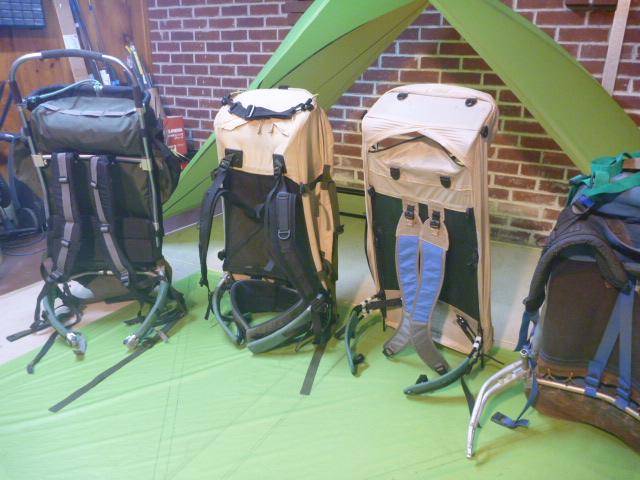
    Am working on a suspended mesh back band pack now with the wider hipbelt with a form fit made possible by having the adjustable sidearms, and would not go back to a pack without them.  And hope to post the pack on BPL when completed.  Because it uses smaller gauge alloy tube for the frame and sidearms it will be good only up to around 25 lbs maximum carry weight.  The older sidearm packs were all half inch diameter tube, but needlessly heavy for super light backpacking:

    The two packs on the left are the heavier gauge, harvested from Jansport packs.  The one third from the left was made with a carbon fiber X-shaped frame, but the sidearms were Easton 340 tent tube alloy, prebent for me by the kindness of Roger Caffin, who may well be the king of MYOG worldwide.  The  Carbon fiber has it uses in tents, but felt it was not strong enough to take the abuse heaped on a backpack.  The weight goal using the 340 highly tempered alloy for both sidearms and hourglass frame is 2 lbs.  Note the mesh backbands.  When climbing, hence bent slightly over, they spread the weight uniformly over the back.  On more level ground, all weight is carried through the hipbones (Iliac crests) straight to the legs.  This raises knee issues; however knees can be replaced (I have one), but spines cannot be at this point in medical history.

    #3758765
    Bonzo
    BPL Member

    @bon-zo

    Locale: Virgo Supercluster

    I have said consistently for the last 15 years, a pack is the last place I’ll give up weight. An actual suspension weighs something, and while you may be lighter at the beginning of the day with an UL pack, you’ll feel “heavier” at the end of the day due to discomfort. Discomfort has a direct correlation with fatigue. When I see some folks on local trails kitted with their frameless dynema wonders I cringe at the poor fit of most of them. It’s like common sense and everything learned about what a properly tuned and fitted internal frame is has thrown out the window in pursuit of the latest follow-the-leader fad.

    This.

    Like Murali, I don’t have an iliac crest worth mentioning…but I still use a hip belt.  It’s very difficult to get all of the straps pulled to the right spot and snugged to the right tension, but once I get it dialed in, 50+ pounds turns into vapor.  I also believe in adaptation, but I know that for me, there are limits to that process; carrying anything over 15 pounds without a belt just doesn’t work.

    #3758768
    BC Bob
    Spectator

    @bcbob

    Locale: Vancouver Island

    I use these ZPacks padded belt pouches with a 1″ webbing hip belt on my Nero and my LifeAF Curve 35.  They enable the belt to support more weight.  Both packs have been comfortable up to 20 lbs.

    https://zpacks.com/products/padded-belt-pouches

    #3758781
    Lowell k
    BPL Member

    @drk

    For me, where I feel discomfort matters. Tired and wobbly legs after carrying 20 pounds for most of a day is less bothersome than an achy neck, back and shoulders. The legs are sore because of muscle fatigue, but the neck, back and shoulders are sore because of muscle fatigue and joint strain. These joint ligaments and tendons are much more bothersome to me than tired legs, and it dampens my joy and makes me think more and more about stopping for the day. And, when I sleep it is the upper body pains that awaken me when I move around.

    I have noticed that I get much less upper body symptoms with my well-harnessed and robustly hip-belted Mystery Ranch Ravine vs my HMG Southwest. In fact, the pleasurable part is the absence of these symptoms, knowing all too well what they feel like.

    #3758791
    Paul McLaughlin
    BPL Member

    @paul-1

    For me it comes down to this: if the load is light enough that shoulder straps alone are comfortable, then no need for a frame of any sort. But if I feel I want a hipbelt, I want stays with it in order to have functional weight transfer to the hipbelt. Having made packs with hipbelts but without stays, I never found that to work very well. Foam pads and tight packing can achieve something, but I decided that’s not worth it. The stays I use are about 3 oz per pair – 1/8″ by 5/16″ aluminum. They work great for loads up into the mid 30’s. A piece of foam the size of the back panel is about 2 oz., and unless the pack is stuffed super tight it transfers almost nothing. So saving that 1 oz is pointless.

    Of course, the weight that is comfortable for a given individual with just shoulder straps is pretty variable. So, whatever works for you, do it!

    #3758796
    Matthew / BPL
    Moderator

    @matthewkphx

    I had been experimenting with CCF pads as a frame in frameless packs but I was sleeping on an inflatable pad for comfort. It took a while but I finally realized that a light frame (Atom+ in my instance) did a much better job at transferring weight to the hipbelt. It makes sense to use a frame that is made from stiff materials rather than try to create one out of floppy foam. I’m much more comfortable with this setup in the high teens than a similar frameless pack.

    This pack has a relatively soft 3” wide belt which I find so much more comfortable than a stiffer, taller belt (like ULA uses). I’m very happy with this setup for now. If I decide I want to carry more than weights in the low 20s I’d probably need more hipbelt (and load lifters) but that’s not what I’m doing these days.

    #3758798
    W I S N E R !
    Spectator

    @xnomanx

    Frameless will always have a place for me, namely in that simple packs like the old GoLite Jam or an HMG Southwest with the stays removed can conform to your body and move with it.

    I find this very important for multisport adventures, especially hike/bike routes on which I’m wearing my pack on the bike for considerable mileage. Frames often inhibit the movement necessary when not in an upright hiking position. I’m a big advocate for cutting the car out of the equation and biking to trailheads, as well as self-supported loops without car shuttle…and most framed packs I’ve used simply stink for cycling. Same goes for trips involving ropes/canyons/scrambling/rappels…IMO framed packs don’t move well in this arena, often working against your center of gravity and shifting in odd ways.

    Beyond this, at <20 lbs, which is quite common on many quick trips I do, it just doesn’t matter to me…so I’ll typically opt for the simpler, lighter, frameless pack.

    #3758822
    Ross Bleakney
    BPL Member

    @rossbleakney

    Locale: Cascades

    If a frame improves comfort, it is highly likely it is worth the weight. In other words, try on two packs — one frameless, one with a frame. Add weight to the frameless one to match the weights. Wear each for an hour or two. If they feel the same, then congrats — you can go frameless. If not, get the framed one — that extra weight will be worth it.

    I’ve had luck with frameless, but found it required too much work. The gear is the frame. Packed just right, it works well. Packed wrong, it is miserable. A frame allows more flexibility in packing.

    As far as the hipbelt goes, I like to fasten mine lower than recommended. Don’t assume there is one right way to wear a pack. Find what works for you.

    @Wisner — Yeah, biking is different. Climbing can be as well. Packs with hipbelts — even frameless ones — are generally built for upright hiking.

    #3758831
    Bonzo
    BPL Member

    @bon-zo

    Locale: Virgo Supercluster

    In other words, try on two packs — one frameless, one with a frame. Add weight to the frameless one to match the weights. Wear each for an hour or two. If they feel the same, then congrats — you can go frameless. If not, get the framed one — that extra weight will be worth it.

    To reinforce the above: in my 50L pack, I can remove the poly frame sheet and/or the aluminum stays that support it, and I carry the pack as a frameless or semi-frameless bag…and there’s a night-and-day difference between those options.  Frameless…hell no; I won’t do that with more than fifteen pounds in it.  The polymer sheet allows another ten or so, but 30 is the upper limit.  Adding the twin aluminum stays back into the mix easily doubles that capacity, and likely triples it.  I’ve had 60+ pounds in that pack, and although my back won’t yet take that weight for very long, the pack itself doesn’t complain at all and transfers that load exactly as I would expect it to.

    tl;dr, the frame makes a massive difference at any significant weight.

Viewing 21 posts - 1 through 21 (of 21 total)
  • You must be logged in to reply to this topic.
Forum Posting

A Membership is required to post in the forums. Login or become a member to post in the member forums!

Loading...