


This thread is the official product listing for member gear reviews of this product. Add your review as a reply to help build the shared knowledge base. – Mods
BPL Listing ID: 2026-01-03 05:30:19 UTC / 2a1534ff60
Topic
Become a member to post in the forums.
.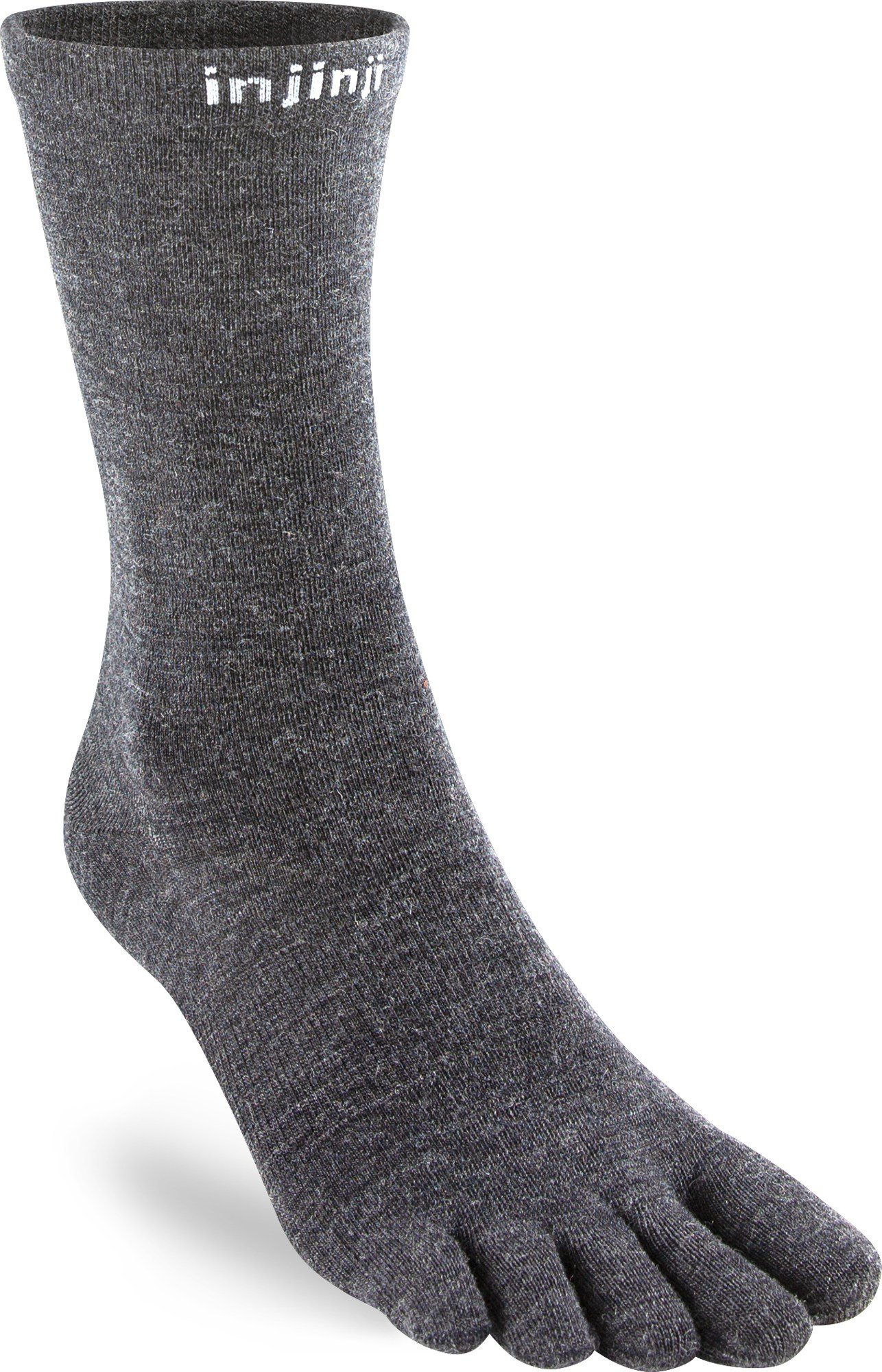
Crew-height merino wool blend liner toe socks with individual toe sleeves, designed as a lightweight baselayer for layering under hiking socks, made from 74% merino wool, 22% nylon and 4% Lycra with arch support band and crew-length height.
This thread is the official product listing for member gear reviews of this product. Add your review as a reply to help build the shared knowledge base. – Mods
BPL Listing ID: 2026-01-03 05:30:19 UTC / 2a1534ff60
The Injinji Liner Crew Wool Socks have become an essential part of my backpacking kit when it comes to blister prevention. I originally started using these socks during my Appalachian Trail thru hike, after developing blisters on my toes that wouldn’t go away even after I adjusted my shoe size. The winning combination for me when it comes to blister prevention turned out to be the Injinji Liner Crew Wool Socks placed underneath a Darn Tough Micro Crew sock.
The most important characteristic of the Injinjis is that they are toe socks, designed to significantly reduce blisters using their 5-toe sleeve fit since they are reducing the amount of skin to skin contact. The other key, as I found when hiking in the often humid and wet Appalachian forests, is that they are made of 74% wool, 22% nylon, and 4% Lycra spandex, with the wool providing much better moisture control for me than their synthetic counterparts. I did try the Injinji Liner Crew socks on the same hike. These socks were made of 75% COOLMAX EcoMade polyester, 21% nylon, and 4% Lycra spandex, and still had blisters. So I attribute the much better blister prevention to the wool.
The one downside with toe socks is that, even though they do come in a variety of sizes, it can be more difficult to find a good fit as everyone’s toes are different. I personally wear a size 6.5 in women’s and found that the small worked fine for me, although I would occasionally get a hot spot on my pinky toe if the fabric was twisted.
Since the Appalachian Trail, I’ve used these same liners on the 360 miles I’ve completed of the Colorado Trail, including the Collegiate Loop, the 200 miles I’ve backpacked on the Arizona Trail, and my thru-hike of the Tahoe Rim Trail. The fabric has also proven useful in a variety of situations where I was in cold and wet conditions. Although I never had to posthole or hike through snow for long periods of time in any of my hikes, I have experienced at or below freezing mornings on trail. Although I don’t wear these socks to sleep in, and I did have the uncomfortable experience of the liners not drying overnight (even when I slept with them in my bag or quilt) so they were still damp in the morning, I never felt like my feet were freezing or in danger of getting too cold while wearing them, even while wet. Which speaks to how effective wool is as a fabric.
I will also say that I’m pretty abusive to my wool socks when I’m thru hiking. While I don’t dry them in a heated dryer, and instead hang them to dry (a process which I have found usually takes around a day) I do just throw the Injinjis in the washer on cold with the rest of my clothing while I’m in town. I have found that with this treatment, my Injinji liners typically last for around 500 miles before they develop a hole (usually at the end of a toe, or where the toe connects to the rest of the sock) and this is with them worn inside a pair of Darn Toughs. I have also found that the elastic band at the top of the sock tends to fail around this mile mark as well, so the socks are often “held up” by the outer sock. Which is fine, since they are designed to be liners. However, 500 miles isn’t that long, at least by thru hike standards. I started using Injinjis 400 miles in on the Appalachian Trail and ended up buying three more pairs of them as they would develop holes or become threadbare enough on the heel that I couldn’t repair them while sewing. Admittedly, they likely would have lasted longer if I had done more repairs on them myself. And while Darn Tough has a famous and generous warranty policy, Injinji’s policy, as of their website on 1/2/2026, reads
“Injinji socks have a limited warranty period for one year from date of purchase. The limited warranty does not include the following: Damages caused by accident or negligence; Failure to follow care instructions; Damage caused by rips, cuts or tears; Burns or abrasions; Normal wear and tear; Cosmetic damage including discoloration and natural fading of colors.”
It’s likely then, that how I use these socks would fall under “normal wear and tear”, “damage caused by rips”, or “failure to follow care instructions” and that the warranty wouldn’t be valid. Simply put, with the way I use this product, these socks don’t last as long as I would like.
However, I have found that these socks are part of the “magic” combination for me that allows me to hike blister free ninety percent of the time. While each hiker is very different that works for them, I haven’t found a sock system that delivers the same results and allows me to keep hiking that lets me get away with not hiking in an Injinji Liner Crew Wool Sock. So for now, while my one gripe is the longevity, these socks are here to stay. And it may become more fun to wear them. Although all of my Liner Crew Wool Socks have been in the slate grey color, it looks like Injinji is starting to release the liners in other colors. Which is always fun.
Become a member to post in the forums.
 New Gear with Aluula FabricsLighter, stronger, more abrasion-resistant, and highly water-resistant - explore ultralight backpacking gear made with ALUULA Graflyte fabrics. Engineered for exceptional strength, durability, and lightweight performance, ALUULA Graflyte helps reduce pack weight without sacrificing reliability, making it ideal for demanding backcountry adventures.
 © Beartooth Media Group Inc.
 Loading...