” … but I have been in conditions above treeline where a small flat tarp would have meant I was getting wet by freezing wind-blown rain.”
“I want more protection, be it biting bugs, driving wind, rain and snow, especially above timberline.”
” no way I would have wanted to be confined inside a tent or even a mid…”
” … bad idea in the mountains as the weather here can turn on a dime, and the bugs can be quite a thing. Not as bad as Maine in June …”
“I also enjoy that [the tarp] takes a little more skill to set up.
A while back, a friend and I each decided to try the tarp/bivy approach to lighten our packs. At that time, tents ran heavier than they do today. We would be out for over a week on the Cohos Trail in northern NH, each in our individual tarp/bivy set up. The first night, we were in a nice large and flat clearing on a mountainside.
While the weather had been great, the sky soon opened up. It was a real downpour, but we had good bivies to protect from the rain which was both blowing and pooling everywhere. And our tarps were pitched much lower to the ground than the one on the OP’s above photos. But having seen the power of what strong winds can do, I was worried that the wind might get under our tarps, causing ‘ballooning’, and blow them open.
We could not speak to each other due to the roar of the downpour, even though our shelters were separated by no more than 20-30 feet. It was an all night rain, and was glad we had time to set up before the deluge arrived. Don’t remember what we ate, but there was no cooking, nor any socializing of course. Fortunately, the stakes held and we remained covered.
But worse was the claustrophobic isolation. Mine was an 8×10 foot tarp; do not remember hers. For the reasons expressed by some of the other posters above, we did not continue the experiment on our next trip. Instead, I brought my compact solo tent, and she the lightest solo tent made by REI at the time. As luck would have it, we got blasted again by a storm in another open area on the side of another mountain. My tent held, but the REI tent did not, and my companion and all her gear were soaked. The next day we hiked a few miles to an open shelter, set up clothes lines for drying, and enjoyed a day or rest and relaxation.
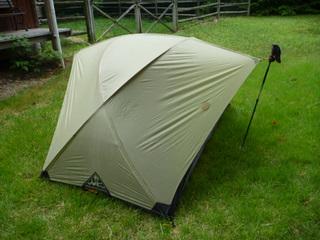
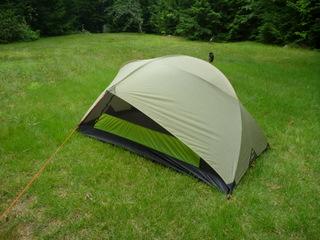
After that I resolved not to go out again without a tent that was spacious enough to prepare and eat meals; and gifted my friend with an MSR Hubba, modified with a much lighter fly and carbon poles that cut the tent’s weight by about half. The first edition Hubbas were more spacious, and she was short, so had plenty of room. Whereas I would have felt confined by the narrow floor. So I modified an Aussie bug tent with a lighter floor and carbon poles. It was huge inside. providing plenty of space for dogs, cooking, etc.:

This tent was the most comfortable, and was protected by breathable but water repellent splash covers substituted for the lower portion of the inside net walls. It did weigh around 3 pounds as modified, but that was long before the current era of ultralight fabrics. It’s best feature was the ability to sit in it on a camp chair and have dinner while storms raged outside (it had loops for guyouts on all four sides).
Since then, using even lighter carbon poles and fabrics, a not quite so spacious Aussie tent was similarly modified down to around 2.5 pounds without DCF, and am working on yet another with a goal of 1.5 pounds without DCF, plenty of headroom and over 24 sq. feet of floor space, and 4-way guyout capability like the modified bug dome and the second Aussie tent.
The current tents are light enough to approach DCF weights for tents with similar space, pitch taut in no time (a blessing in storms), and provide both comfort and protection from bugs and storms close to timberline. They also have double walls, so everything stays dry. But we did give tarp/bivies a shot.
My friend has since left backpacking and sold the modified Hubba, but do enjoy the company of a pair of sheepdogs, a Sheltie and an Aussie, in the wild.