Topic

How we maintain our inflatable sleeping pads

Viewing 9 posts - 1 through 9 (of 9 total)
Paul S BPL Member
PostedOct 15, 2018 at 7:59 pm

We have Exped Symnat 7 UL pads.

Here’s what happens when it’s cold-ish

  • We inflate the pads in late afternoon. We use a pump sack (The Exped “Snozzle.”) We don’t use our breath at all. Nevertheless, the air going into the pad has water vapor in it depending on the local conditions (humidity,temperature).
  • As we eat dinner, and clean up, and get ready to turn-in the ambient air temperature is dropping. If it gets cold enough, the water vapor in the pad condenses, and forms water droplets. In other words, there’s a local  dewpoint inside the pad. The outer fabric is semi-transparent, so you can see these water droplets.

In order to have the pad last as long as possible we do the following when we get home:

We inflate the pad (again, using the snozzle bag, and we no not use our breath to fill the snozzle bag).

Put the pad out in the sun for ten minutes or so. Then, deflate it, then, inflate it again, then deflate after 10 minutes or so…….we go through a few cycles of this. The idea being that the warm air in the pad will allow any water in liquid form to evaporate, and then exit the pad when it is deflated,

It it’s not warm and/or sunny outside, then we do the same thing inside the house, but just allow more time between the cycles.

Removing the water droplets will help prevent hydrolysis inside the pad.


:-)


David Thomas BPL Member
PostedOct 15, 2018 at 8:27 pm

Yeah, after a trip, I try to cycle each pad several times, letting it self inflate with the lowest absolute-humidity air that’s handy (usually the coldest air), then let it heat up in the utility closest that houses the water heater that heats the house (it’s about 85F in there), deflate it, and repeat a few times.

A few times, I ran an air pump from the -5F deep freezer to the sleeping pad nozzles figuring that was much dryer air (it is), but the more I thought about it, getting it warmer before expelling the air makes much more difference than getting particularly dry air into it.

Examples:
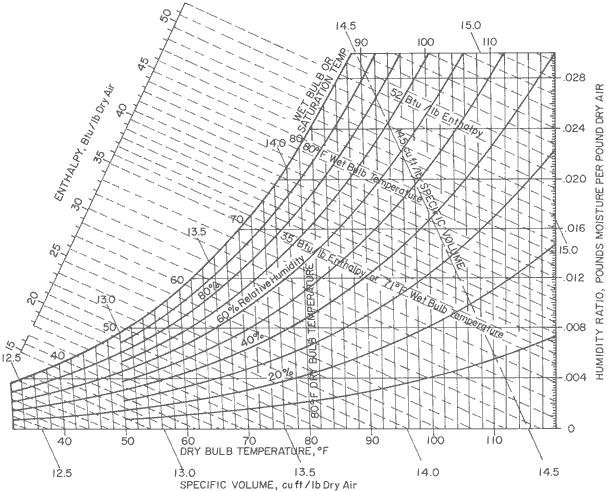
If you use 100% RH air at 60F and deflate it at 80F, you’ll move 1 unit of water out of it.
Using colder and colder air:
If you use 100% RH air at 40F and deflate it at 80F, you’ll move 1.5 units of water out of it.
If you use 100% RH air at 20F and deflate it at 80F, you’ll move 1.75 units of water out of it.
But if you deflate hotter and hotter instead:
If you use 100% RH air at 60F and deflate it at 100F, you’ll move 3 units of water out of it.
If you use 100% RH air at 60F and deflate it at 120F, you’ll move 7 units of water out of it (although at some point, you don’t want to get the pad too hot).

If it’s a pad that doesn’t self inflate, I use a 110-volt air-mattress / air-bed inflater to inflate it with room air.  $3 at Salvation Army.

John Vance BPL Member
PostedOct 16, 2018 at 3:33 am

I do the same with my inflatable mattress and have for years. I appreciate a cool graph validating with science!

Roger Caffin BPL Member
PostedOct 16, 2018 at 6:56 am

We do use a pillow-pump on our UL7s, and never the mouth. Not a lot of humidity in the air at -5 C. Even so, I hand the mats up to drain for a day or two when I get home. So far, so good.

Cheers

Jerry Adams BPL Member
PostedOct 16, 2018 at 1:48 pm

Interesting data – makes sense that the warm temperatures are more important than the cold

in transferring butane from one canister to another, I think the same thing holds true, more important to heat up the donor canister than to cool down the donee canister

David Thomas BPL Member
PostedOct 16, 2018 at 8:21 pm

Jerry: Yes, the same temperature dependency of vapor pressure (roughly e to -E/RT) means that vapor pressure doubles for every 10C / 20F-ish (in the temperature ranges we usually deal with).

So if you need a particular pressure difference between donor and recipient canisters, less warming of the door is needed than cooling of the recipient.  A few other considerations: if I leave a canister in the freezer too long, it’s just fine while if I heat a canister too much, things can get bad.  OTOH, flicking your Bic to warm the donor is far easier on the trail than hiking up the pass to get some snow to cool the receiving canister.  I suppose in the more arid southwest, a wet bandana on the receiving canister, a la the old “Desert Water Bag”, could potentially cool it enough.

Particularly when thru-hiking in a group (a “Tramily” = trail family), carrying a 1-ounce transfer valve could save money by scavenging from used canisters in hiker boxes, buying and sharing the fuel in larger canisters and pound-miles by allowing custom refills.

Gumbo BPL Member
PostedOct 17, 2018 at 4:21 am

I’d never thought of refilling on the trail — would be worth an extra ounce, I reckon. But without also carrying scales, would require water displacement method to avoid overfilling, I would think. Is there always still water near hiker boxes?

David Thomas BPL Member
PostedOct 17, 2018 at 6:17 am

After you’ve refilled, you can attach a stove and turn it on high.  Run your finger up and down the sides of the canister and feel for the transition from the ambient-temperature metal with gas behind it to the cooler metal with liquid butane behind it.  Eventually condensation or frost makes this transition visible, but it can be discerned by touch much sooner.  If the liquid level is too high, let it keep burning.

Or, with some experience, shaking a full canister feels different than a over-full or a partially-filled one.

Viewing 9 posts - 1 through 9 (of 9 total)
Loading...