Topic

How to sew a foot box with a differential cut for a down quilt?

Viewing 9 posts - 1 through 9 (of 9 total)
Jonathan L BPL Member
PostedJan 23, 2026 at 11:00 pm

I’m a new user and a first-time poster to this forum that’s super impressed with the knowledge and experience of the users on this site.

I’m looking for some advice sewing the foot box of a down quilt with a differential cut. I have some ripstop nylon from an old tent that I’ve been using for a mockup. I’m trying to sew “U” shaped baffles similar to EE’s Enigma.  To maintain a gap between the outer and inner shells of the footbox, the circumference of the inner shell must be smaller than the outer shell.

How do I sew “U” shaped baffles while keeping the outer and inner shells aligned?  If I’m thinking about this correctly, the width of the baffles on the inner shell have to be slightly smaller than the width between baffles on the outer shell to accommodate for the smaller circumference in the sewn up footbox.

For the purposes of this mockup, I’m using 4″ spacing on the outer shell and a combination of 3.5″ and 4″ spacing on the inner shell. The 3.5″ spacing only where the footbox is sewn into a tube.

Below is a photo of my mockup that made me realize I don’t have a clue what I’m doing :-)

down quilt mockup

The inner-most baffle (labeled “1”) is easy because the length is identical between outer and inner shells.

I sewed the baffle labeled “2” next starting at the top of the photo. When I finished the stitch line, the outer and inner shells didn’t line up (note the no-see-um mesh sticking out). I now know I have to bunch up (is “gather” the correct word?) the fabric / mesh when sewing the baffle to the inner shell but how do I determine where to bunch up the mesh and by how much?

Any tips would be greatly appreciated!
Jerry Adams BPL Member
PostedJan 24, 2026 at 8:15 am

I do that frequently and also wonder what the word is

wikipedia – gather (sewing) – a gather has a large number of small folds, typically you can like pull on a thread to make the entire seam shorter – that’s not the right word

but pleating is where you have a few large folds – I think that word better matches

Anyway, I don’t totally understand what you’re doing specifically, but in general, use a pin (or I use hand stitches) to align the two ends, maybe a few places in between, then sew along creating folds occasionally to use up the excess fabric on the larger piece

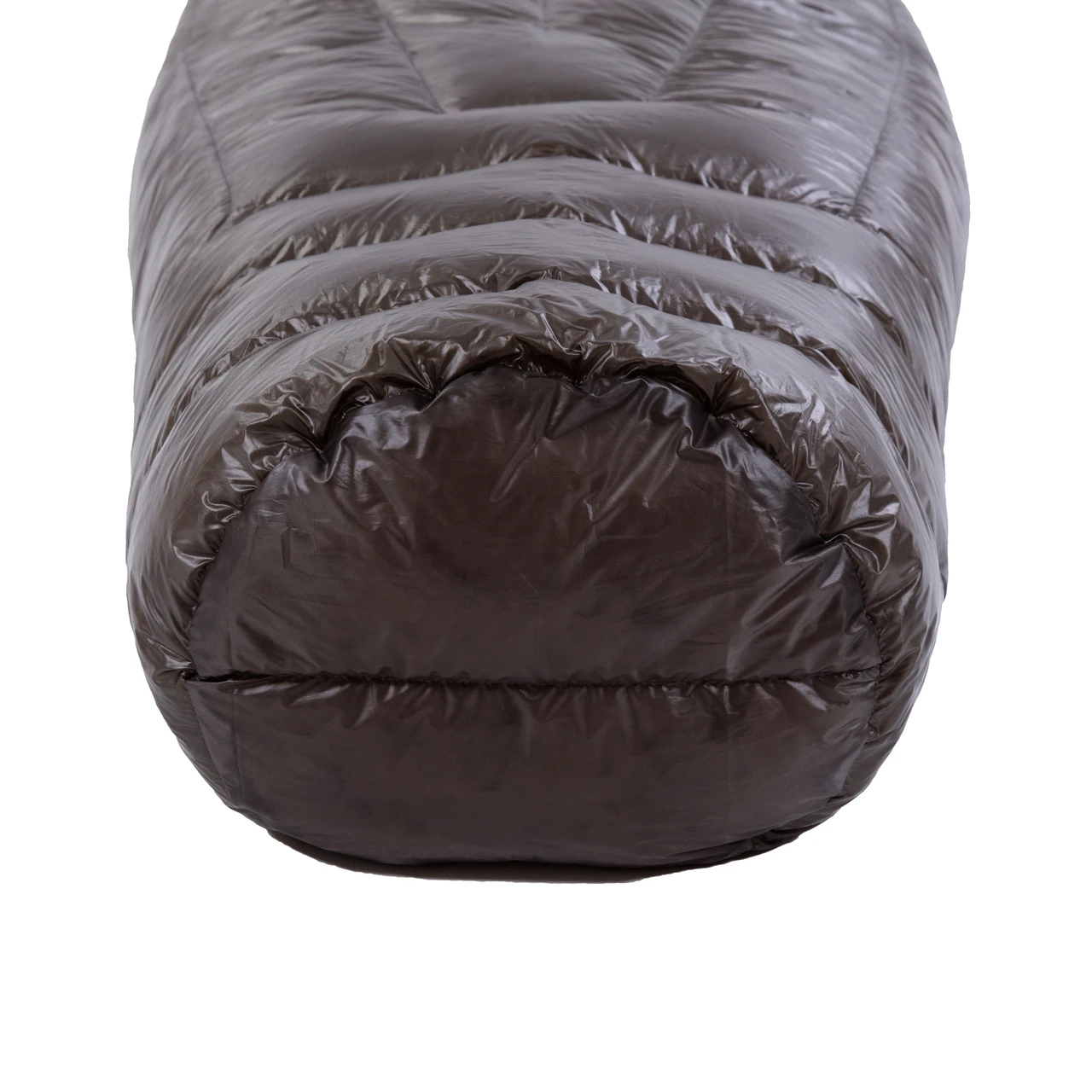
Looking at EE Enigma, I would make the sides with a hem at the foot end.  Then create a 10 inch circle with 2 or three baffles and a hem around the edge.  Then sew the circle to foot end through those hems.  It would have zero loft right at that hem, but the down would squish in from both sides so there actually would be no zero loft places.  And that’s at the foot end where it doesn’t matter – I always pull my feet up in a bit of a fetal position so they’re away from that spot anyway, except when I occasionally stretch out and point my feet out.


Jerry Adams BPL Member
PostedJan 24, 2026 at 8:35 am

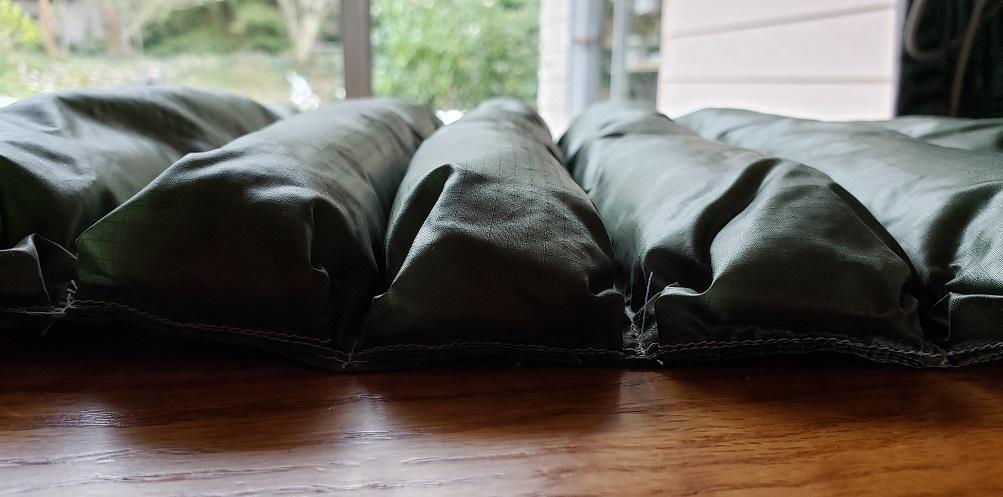
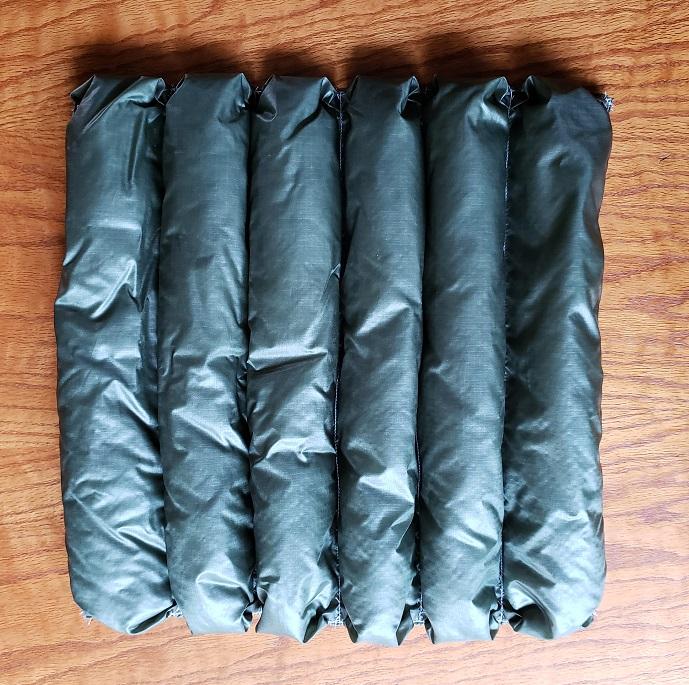
A crazy idea would use asymmetric sewn through baffles which I’ve done for years.  I’ve suggested this a couple times but I don’t think anyone has used it.  Most of the advantages of both sewn through and baffled construction.

That’s a 1 foot square test piece that I did to figure it out.  Which I suggest if you wanted to try it.

Basically, for 2 inch baffles, you draw lines where you want the seams to be on the bottom fabric 2 inches apart.  3 inches apart on the upper piece.  Then just sew them together along the lines.

On the top piece I made the top piece 1 inch longer in the other direction so it lofts all the way to the edge.  If you were making a quilt that you’re tucking underneath you, then you wouldn’t have to do that.  It does require some pleats to use up the excess fabric.

If you turn that upside down on top of you, the places at the baffles where there’s no down get mostly squished away, and even though there’s still a small void, it’s covered in all directions by either fabric or you so it still provides a lot of insulation.  Still, regular stripped baffles would be slightly warmer (insignificantly).

And it weighs about the same as stripped baffles – the strips have to be folded over a little on both sides so the strips have to be longer than your loft.

Asymmetric baffles have half as many seams to sew so much easier.  If a seam ever came undone, you can just come back later a sew another seam.

I’ve done stripped baffles before, but cutting all those strips is a pain.


Jerry Adams BPL Member
PostedJan 24, 2026 at 9:41 am

Dart is another term for using up excess fabric.  Typically to make a garment fit around bust or waist on women’s clothing.

Bill Budney BPL Member
PostedJan 24, 2026 at 1:36 pm

If you are not already committed to the U-shaped baffles, there is a reason that only Enlightened Equipment uses them:

  • Pro: You can move down from the torso to the footbox if you want more insulation there.
  • Con: Down moves to the feet by itself when you hang the quilt vertically.

An alternative is to use horizontal baffles in the footbox, and horizontal or vertical baffles in the rest of the quilt, depending on your preference. You can use more down in the footbox if you want warmer feet.

As you probably know, overstuffing reduces unwanted down migration and mitigates lifetime loss of loft.


Jerry Adams BPL Member
PostedJan 24, 2026 at 2:35 pm

when I looked at ee enigma on their website, it looked like they had two horizontal baffles on the footbox end which was an approx 10 inch circle

Jerry Adams BPL Member
PostedJan 24, 2026 at 2:44 pm

Ahh… I now see that U shape, but its on the main body on the top.  It looks like that would prevent down shifting from on top of you to the sides.

On my quilt, I have horizontal baffles, and then half way between top and edge, I run a vertical seam to keep the down from shifting from the top to the sides.

But I only did it on one side with the intention of doing it to the other side but it doesn’t seem necessary.  A few times a year I shake and beat it out to get the down evenly distributed on top and sides.  Once I forgot to do that and one trip I seemed unusually cold, and noticed the down had shifted which I quickly corrected.  So, I’d say this isn’t something to worry about.  Just look at your quilt occasionally and fluff it up.  If it’s been a long time and the baffles seem underfilled, then wash it.  Which I might do every few years.

Hmmm… my quilt is just laying on the floor next to me.  I’ll go check it…. Maybe the down has shifted a little on the side without vertical seam, I’ll fluff it up.

Jonathan L BPL Member
PostedJan 24, 2026 at 9:35 pm

Thanks @retiredjerry for those suggestions and for finding the word I was missing – pleats. I hadn’t heard of asymmetric sewn-through baffles before. I’ll try creating some using test fabric.


@billb
thanks for pointing out the disadvantages of “U” shaped baffles. That’s an important point you make that the down will migrate to the lowest point especially considering I like hang my sleeping bag for storage.

I’m going to look into other designs.

Jerry Adams BPL Member
PostedJan 24, 2026 at 9:46 pm

the reason you haven’t heard of asymmetric baffles is that I created the concept : )

I’ve made a vest and a couple quilts using it.  I made another vest using strips of fabric for baffles, but will never do that again.

It’s possible the idea only works for me.  If you can make a 1 foot square test piece you can check it out.  If you don’t like it you can just re-use the down.

Viewing 9 posts - 1 through 9 (of 9 total)
Loading...