Topic

How to orient the Lanshan 2 Pro tent against the wind?

Viewing 18 posts - 1 through 18 (of 18 total)
solitone BPL Member
PostedJul 6, 2023 at 3:10 pm

Hello, I have a question about the Lanshan 2 Pro tent. How is it better to orient it against the wind? Short side against the wind, or long side against the wind (so that the ridge line is parallel to the wind direction)? I would appreciate any advice. Thank you!

Terran BPL Member
PostedJul 6, 2023 at 8:37 pm

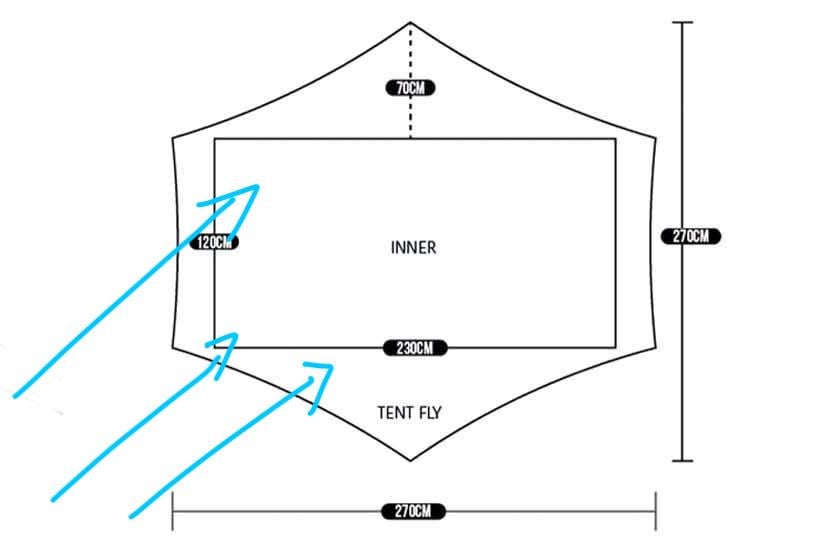
I try to go at a bit of an angle to the wind. I don’t want it blowing in my door and I don’t want it blowing hard against the side panel. The corners can be a bit stronger and sort of redirect the wind force. I don’t have a Lanshan. Often times it doesn’t matter, because the wind changes direction. You may want to add guy lines and stakes.
Hope for some bad weather and set it up at home.

solitone BPL Member
PostedJul 6, 2023 at 11:45 pm

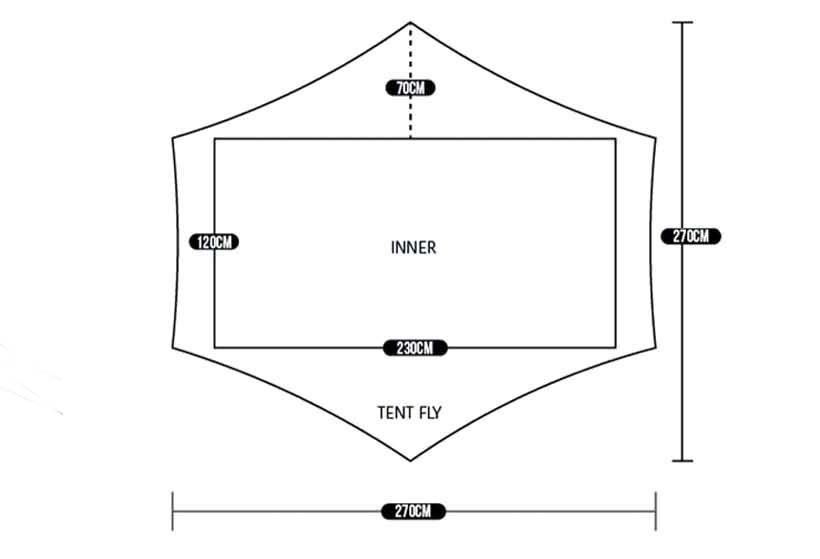
So you mean something like this?


A few nights ago I slept in the mountains, quite high up. From the evening and throughout the night the wind came from the mountain towards the valley. I had the tent arranged with the short side panel of the head against the wind. It was quite annoying.

Terran BPL Member
PostedJul 7, 2023 at 6:09 am

Yes. I believe the corner disperses the wind better. No guarantees, but that’s what I’d try.
You may want a longer stake in that corner. Have weight in your tent. Depending on how strong the wind gets. It can blow under the tent and lift it up, pulling the stake with it.

I hear those are nice tents. May you have many nights.

Dan BPL Member
PostedJul 7, 2023 at 6:26 am

I’m not familiar with that particular tent, so I don’t really know what would be best. But I will just say that when you are in strong winds in an exposed area, it is generally going to be annoying, regardless of how you orient the tent. If the tent stayed pitched properly and in-place, you did well, but it can be difficult to sleep very much (at least for me). I can empathize with you, because I had a night like that a couple of weeks ago, and I just suffered through it. And as mentioned above, even if you know the best orientation for your tent, shifting winds can foil your plans.

solitone BPL Member
PostedJul 7, 2023 at 6:43 am

Yes, that’s true, but in that specific case I knew in advance that the wind would have blown all night from the mountain peaks towards the valley (mountain breeze). Luckily, it wasn’t too strong, but annoying nevertheless.

Dan BPL Member
PostedJul 7, 2023 at 7:43 am

Based on the general conventional wisdom, you pitched the tent properly, with the narrowest part of the tent facing the wind, if I’m understanding correctly. It’s possible that a different direction would work better, but it would be hard to know without detailed testing or trial-and-error. Since it is a trekking pole tent, you could try pitching the tent lower in the wind.

You might want to check with the manufacturer to see if they have any insights.

solitone BPL Member
PostedJul 7, 2023 at 2:17 pm

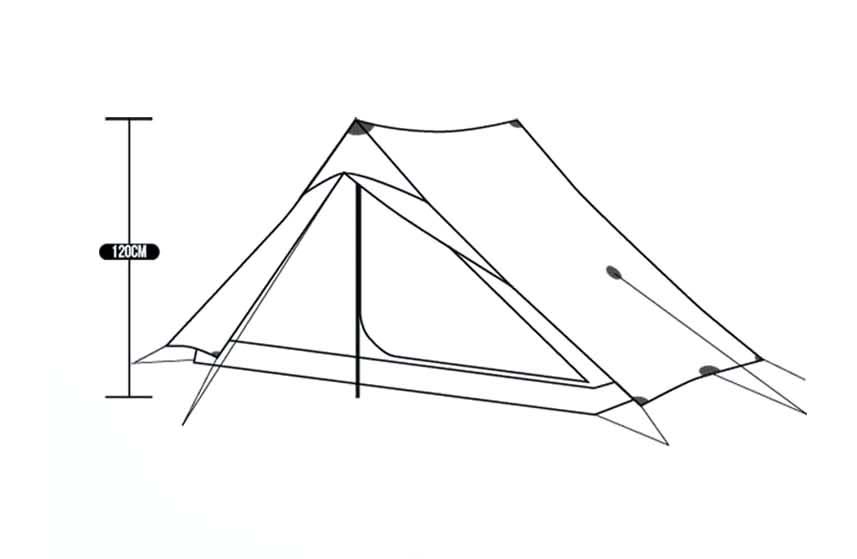
The shape of the Lanshan 2 Pro is similar to the shape of the Duplex. And they usually pitch the Duplex with the short side against the wind.

For the  High Route tent, however, A. Skurka suggests to point the ridgeline into the wind [1]:

If the prevailing wind direction is known and consistent, orient the tent so that the ridgeline points into the wind. The air will split around the shelter, and the corner will stay strong due to the stiff trekking pole and taut ridgeline guyline.

The second best option is to point the head or foot into the wind, to present a narrow profile.

Broadside should be your third pick. The trekking pole effectively reinforces the vertical side panel, but deformation will occur, especially in the lower-left corner of the panel.

[1] Wind advisory: Tips for using the High Route Tent in high winds (andrewskurka.com)

Dan BPL Member
PostedJul 8, 2023 at 6:52 am

I’m not familiar with the High Route tent, but based on the description, I wonder if it isn’t a different design. If I understand your tent correctly, orienting the ridgeline into the wind (option 1) would be the same as broadside (option 3).

In any case, for me, research on the internet is good for getting ideas, but ultimately I need to reduce them to practice by first-hand experience. In your place, I would take advantage of a windy day at home and practice different pitches. Pay close attention to the detailed behavior of the tent in different orientations and at different heights. You may even be able to use some additional guylines for increased rigidity if the tent has more tie-outs.

Firsthand experience will help you refine your preferences. You mentioned that  the wind was annoying, but you didn’t really specify your concerns. For example, were you bothered by drafts? Noise from the flapping of panels or vestibule doors?  Tent deformation or collapsing?  You may find that some pitches help with some issues at the expense of other issues, so your preferred pitch may be different from someone else’s.

Finally, more practice will help you have realistic expectations. Some tents are more wind-worthy than others, and no tent is a brick house. You may find that in sufficiently strong winds, there is no pitch that is tolerable for you in an exposed site. You can also consider some creative solutions. For example, if noise is the main problem, you may benefit from some foam earplugs.

Lightweight backpacking is all about compromise (weight, price, comfort), and we all have to decide our comfort zone. When I was young, I had no trouble carrying heavy loads and I jumped right up to my feet after a night on the ground. But now, because of lower back problems that have gradually developed over time, my options are becoming more limited. I can’t carry heavy loads comfortably, but I also can’t sleep on the ground comfortably. I toss and turn all night, barely sleeping. In the morning, I need to push myself to my feet using a trekking pole and it takes me 30 minutes of shuffling around, sitting upright, and gentle stretching before I’m able to do anything useful. As a result, my only option is to tolerate some suffering in order to enjoy the wilderness that I love. Fortunately, age also brings mental toughness. So I try to focus on the good and just get through the bad.

Good luck! And enjoy every moment in the mountains, even the annoying ones. And let us know how it goes.  :-)


Terran BPL Member
PostedJul 8, 2023 at 8:42 am

You could set the ridge with the wind and keep the rear door closed to deflect it.

PostedJul 8, 2023 at 9:20 am

“You could set the ridge with the wind and keep the rear door closed to deflect it.”


Bingo, that will be about as good as you can do with that design in the wind, use the back, closed vestibule ridge as the tail end facing the wind. Domes, modified domes or tunnel tents stand up to the wind very well when guyed out. Over 500 nights on the Colorado Plateau with its low and high pressure zones working in tandem taught that. 75 mph is not uncommon.

I’d be looking for a protected site but stay away from big trees and like others have said you will have to directly experiment as you go. If you can set a few extra guylines it might make a good bit of difference.

solitone BPL Member
PostedJul 8, 2023 at 9:30 am

Could you please explain again to me what do you mean with “set the ridge with the wind and keep the rear door closed to deflect it”, and “use the back, closed vestibule ridge as the tail end facing the wind”?

Thanks!

Dan BPL Member
PostedJul 8, 2023 at 9:47 am

Both members are making the same suggestion. Orient the ridgeline parallel to the direction of the wind and close the upwind vestibule doors.

You can experiment to see whether the downwind doors are better left closed or open, and whether this orientation makes you happier than the one you tried. It may or may not be an improvement, it’s hard to know in advance. For example, you may get better stability but more drafts and flapping. But it’s definitely worth a try, IMO.

As Glen implied, other tent designs may handle windy conditions better.

solitone BPL Member
PostedJul 8, 2023 at 10:33 am

Ok, thank you. It was that *rear* qualifier that confused me  :-)

PostedJul 8, 2023 at 11:13 am

As Dan suggested closing the leeward vestibule would make the entire tent more stable like an extra guyline but the material also slides the wind off more gently. Leaving the leeward open would cause a vacuum and some buffeting. Normally an open side is a more pleasing ambience but depends on the entire weather.  If the winds are shifting as they will do, the tent will be at its most aerodynamic.

PostedJul 8, 2023 at 12:45 pm


For the  High Route tent, however, A. Skurka suggests to point the ridgeline into the wind

I’m not familiar with the High Route tent, but based on the description, I wonder if it isn’t a different design. If I understand your tent correctly, orienting the ridgeline into the wind (option 1) would be the same as broadside


The High Route has an offset trekking pole design.  https://sierradesigns.com/high-route-1-person-tent/

Not unlike the X-Mids.  https://durstongear.com/product/x-mid-1p

So, if you align the ridgeline to the prevailing wind, you are actually pitching “corner to wind” with those tents, neither broadside nor head or foot side.

PostedJul 8, 2023 at 1:22 pm


The diagram alone makes it more difficult to figure.

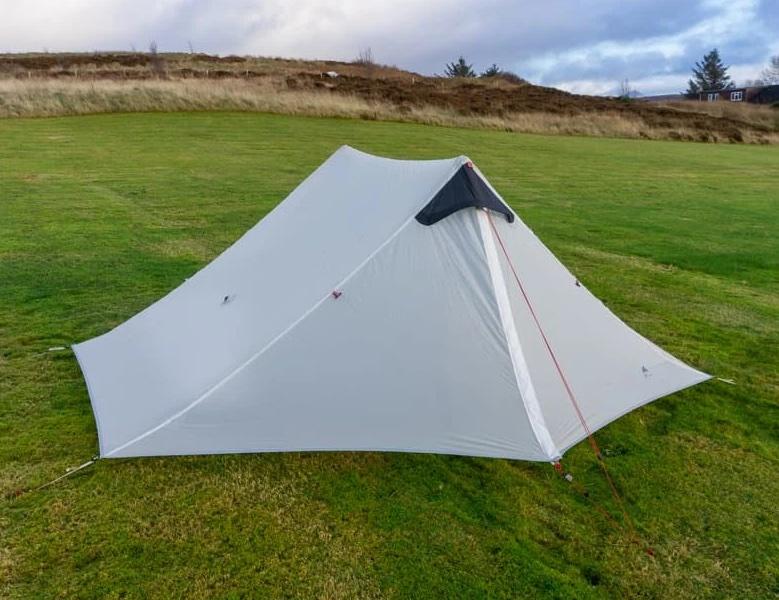
This image shows it with the canopy all zippered up. The side guyout points are not lined out but overall it is still hard to tell if you can find a good position for high wind. It looks like there are guyout points on the middle of the seams and in the middle of the slopes. I’d put staked limes on every point and you could even double them at angles.

Terran BPL Member
PostedJul 8, 2023 at 4:31 pm

My original advice had the wind pushing almost directly on the vestibule panel.
What they said. If you keep one vestibule closed and the zipper facing windward. It should look like a stealth bomber facing into the wind.

Viewing 18 posts - 1 through 18 (of 18 total)
Loading...