Topic

How does less loft equal more warmth

Viewing 20 posts - 1 through 20 (of 20 total)
PostedDec 18, 2019 at 6:01 pm

The new generation of down and sythetic coats are thinner than their older counterparts. I understand that newer fills may account for more warmth per wgt performance but I cannot understand how lower loft outwear (which coats like the Micro Puff have) still get referred to as parkas when they seem like highly compressible and very light sweaters. What am I missing?

PostedDec 18, 2019 at 6:08 pm

I forgot to add that it appears to me that the Micro Puff is just a replacement for a  heavy fleece under a shell.  I understand that the wgt and compressibilty benefits are real.What am I missing?

Jerry Adams BPL Member
PostedDec 18, 2019 at 7:01 pm

Some insulations have more warmth per loft

Fleece is better

Synthetic like Apex aren’t as good as fleece, but better than down

Thinsulate has more warmth per loft than regular insulation so it’s good for gloves

But warmth per weight has the opposite trend – you pay for the better warmth per loft with extra weight

You can overstuff down and the warmth will increase even though the loft stays the same, but again, the warmth per weight goes down

David Thomas BPL Member
PostedDec 18, 2019 at 8:40 pm

Dead air space is an excellent insulator.  “Deader” air space is an even better insulator.  Aerogels are an extreme example in which the gas is completely immobilized (like in any closed-cell foam), but the solid parts are so thin and circuitous in their structure that very little heat is conducted through the solid.

Jerry Adams BPL Member
PostedDec 18, 2019 at 8:55 pm

or there’s less air convection inside the insulation if there are more fibers or cell walls

Erica R BPL Member
PostedDec 18, 2019 at 11:15 pm

I’m getting a drift that my new micropuff does not replace my patagonia down sweater.
Instead it replaces the fleece I don’t carry.

I got the micropuff because I was kinda freaked out by a potentially rainy trip last year. Also, it has a hood, so I figure I can leave the heavy knitted hat at home. And, it’ll work better in my sleeping bag which has no hood.

But, are you saying it is not near as warm as the down sweater?
And, yes, the micropuff is pretty thin…

Erica R BPL Member
PostedDec 18, 2019 at 11:24 pm

And, really, it was half off and I like the color!

Jerry Adams BPL Member
PostedDec 18, 2019 at 11:31 pm

synthetic like Apex or that stuff in Micropuff is about twice the weight for the same warmth as down

fleece is maybe 8 times the weight for the same warmth as synthetic

if you want to minimize backpack weight, leave fleece at home.  Although it is good if you’re exercising in cold as it tolerates sweat.  A lot of people swear by it.

synthetic tolerates getting wet, maybe about the same as fleece.  down loses almost all warmth when it gets wet and its hard to dry out.  So, an argument could be made for taking some synthetic insulation for survivability if there’s any chance of getting wet.  And take down for most of your warmth because it weighs less.

PostedDec 19, 2019 at 1:50 am

I think I wasn’t clear, though Erica responded to my issue. The micro puff is marketed as a warm 3 season jacket. I would argue that by virtue of its loft it is closer to my fleece sweater. I think that the marketing of these newer and thinner jackets is ahead of its actual performance with regard to their ability to keep you warm in real world conditions. They are successful relative to weight and compression.

Erica R BPL Member
PostedDec 19, 2019 at 1:50 pm

Steve, it looks like Patagonia agrees with you. Now they are making a ‘Macro Puff”. It has 220 g of Plumafill insulation compared to 65 g for the Micro Puff. The weights are way different too. 14.2 oz for Macro, something like 8 oz for the Micro. For comparison, it looks like the Patagonia down sweater I have been using is something like 12.2 oz.

I guess it remains to be seen if the Micro can replace the down sweater and knit hat (5 or 6 oz) in my pack. Maybe the hood will pull it through.

Lately I haven’t been carrying much in the way of layers. Capelene top and merino bottoms for sleeping (add possum down socks if it is cold). White cotton kurta, sun gloves, Sunday Afternoons hat, and Sahara pants for hiking. Puffy. Houdini that fits over or under the puffy. This has been good to near freezing. Maybe I had better take some extra fuel for a hot water bottle around camp.

I think there were maybe 2 times when I left camp with my pack wearing the down puffy. It came off within 20 minutes. It could be moving from a down puffy to a light weight Micro Puff is like moving from camp clothes to more of an active layer. It would be great if the hooded Micro could do both. And, add a safety margin in case of rain. We shall see.

Tipi Walter BPL Member
PostedDec 19, 2019 at 7:17 pm

Like with everything else—there’s no free lunch.  The telltale number that is most important when it comes to any down jacket or parka or puffy is the actual amount in weight of the down fill—and this number is often hard to come by because it’s so small.

EX:  A subzero down parka has between 15 oz to 20 ozs of 900+ quality down.  Now go back to your puffy and see how much it has—3ozs??  Or less?

It always comes down to more weight in down—more warmth in garment.

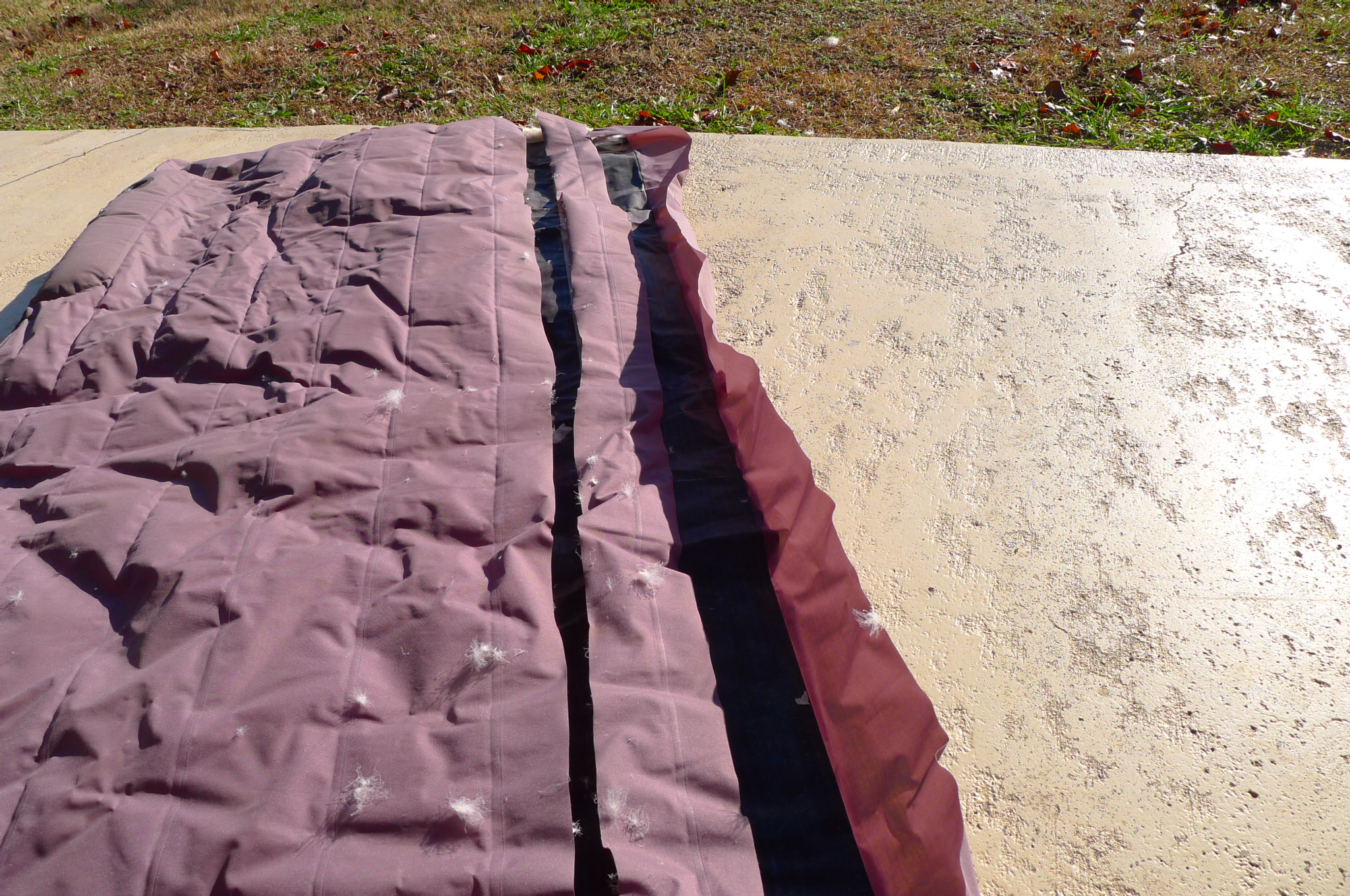
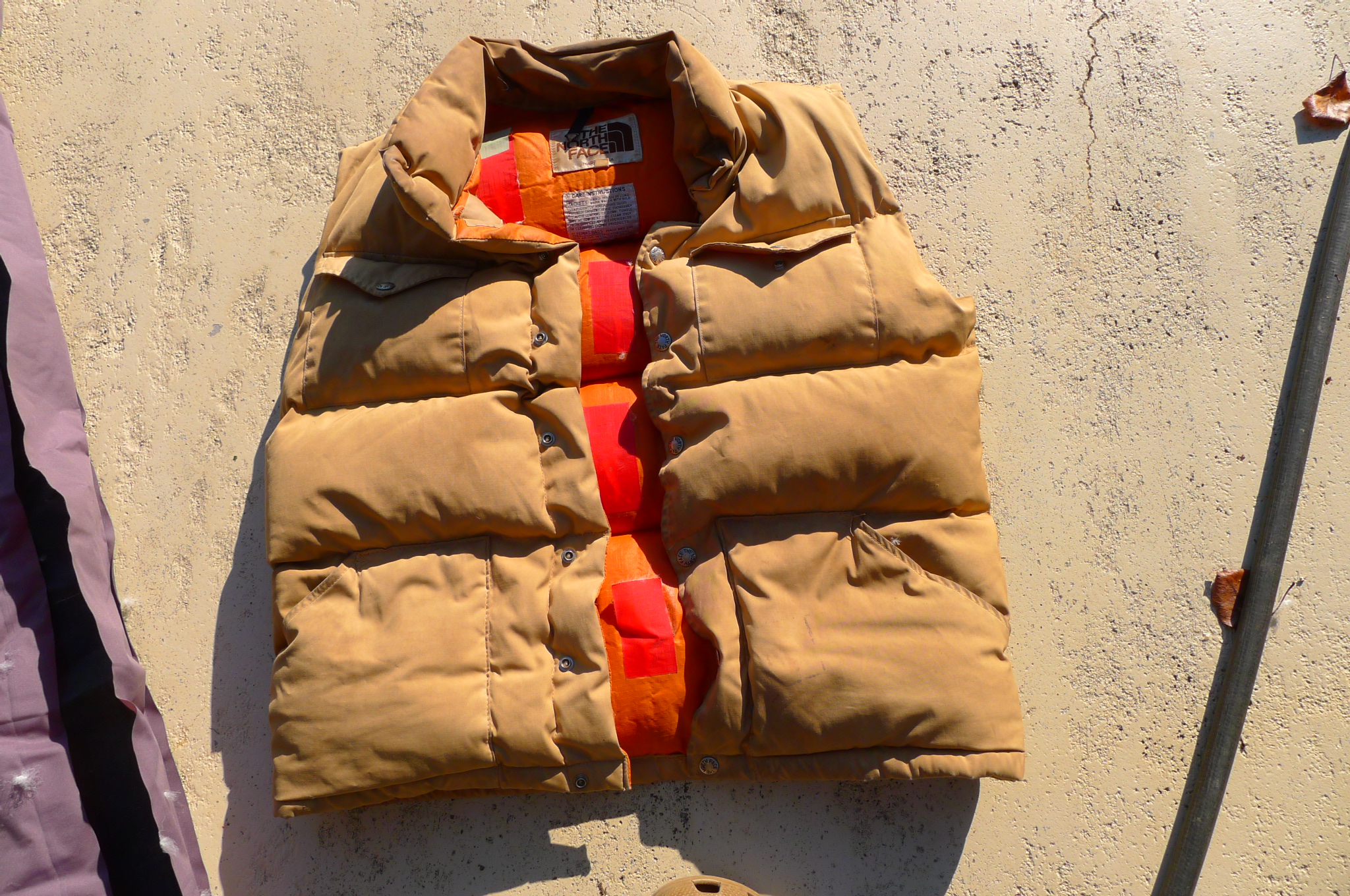
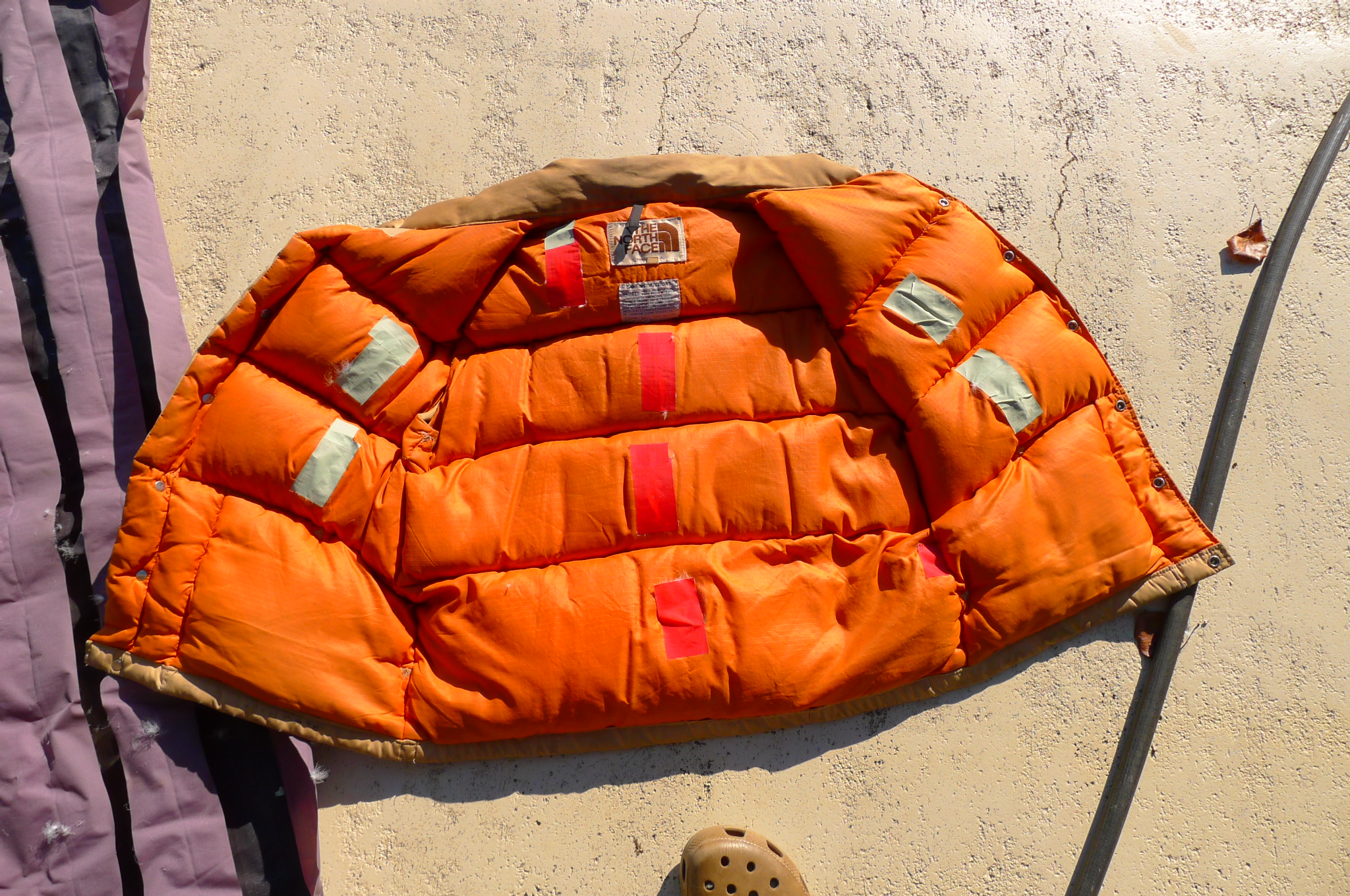
A couple days ago I took out an old North Face vest from the 1980s and decided to pull out some high quality down from a dead Exped Downmat sleeping pad and fill up the vest and get it ready for a next winter trip.

Here’s the Exped with two baffles tube cut open to release the 900 fill down.  Each tube fills one gallon Hefty bag.  I used two tubes to fill up the vest.

Here’s the vintage North Face vest—and woefully “underfed” aka under filled.  Most down garments are woefully under filled.

To make the stuffing easier I simply cut slits in each baffle and stuffed them with down—ripstop tape will keep the hole closed indefinitely.

Result?  100% more warmth—and noticeable.

PostedDec 20, 2019 at 7:05 am

Steven,
When 3M first came out with Thinsulate, its premise was that finer fibers would create smaller air pockets, and provide greater warmth for loft for the reasons stated in David T’s post. As I recall, olefin and other finer fibers were used, at least in part.

But the greater warmth for loft did not necessarily mean warmth for weight. So the Thinsulate was used mostly for footwear, gloves and the like. There were exceptions, like the Yakworks Yaksack. At first, it was my warmest synthetic for weight; but after a while, NOT! No idea why, except that I might have washed it; but undid some seams, and there was no damage to the fill.

However, the original Thinsulate has some body to it, and does not collapse when sewn, so makes excellent zipper flaps in sleeping bags, like the Montbell spriral wrap bags. Not puffy, so have experienced little or no zipper snags, without the cold around the zipper.

Then 3M came out with Thinsulate Lite Loft, with partly finer fibers and puffy loft. Sewed a winter bag filled with this stuff, with offset seams, not baffles, and a perforated foil radiant heat barrier also sewn in on the inside. In the winter, the effects of rain on synthetic fill is less of a problem than with down. But it came to about 3 lbs, and with 900 Fill goose down, could get the same warmth for much less weight.

Am raising these issues, because sleeping bags for backpacking are where manufacturers take warmth for weight most seriously, so how they achieve that is most illustrative.

Garments, particularly outer garments like jackets, get used by backpackers anyway, when active and generating much more heat than when sleeping. So the sewn-through seams are not so critical for heat loss, and heat loss becomes less a priority.

However, the principles are the same. Sewn through seams will lose more heat, and more of them will lose even more heat. When Tipi added more down fill to his vest, the material puffed more and when worn, partially blocked escape of heat through the sewn-through seams, contributing to making the garment noticeably warmer.

So I think that puffy jackets with checkerboards of sewn-through seams are more a matter of fashion than insulative value, with the down ones being somewhat warmer for weight. And because folks prefer jackets that do not look like the Michelin Man, or George’s jacket in the Seinfeld episode, fashion can trump efficiency.

The ultimate cold weather jacket would have synthetic fill with offset seams; that is, the seams holding the insulation in place on the outer shell are offset well away from the seams stabilizing a second layer of insulation on the inner shell, so less warmth escapes. I have a couple of old ones like this, but they are too warm when winter hiking or just dog walking. If I were backpacking in winter, would use a down jacket with baffled seams, but it would stay protected and dry in the stuff sack with the sleeping bag, and in the event of rain, would be used only when undercover in the tent.

On a late fall backpack I stayed in a small cabin on Mount Cabot in northern NH. During the night, the temperature plummeted, and a mixture of freezing rain and sleet arrived, lasting until well into the next day. Wasn’t sure how I was going to negotiate the icy trail, very steep at points, on the north side to get down. So took the switchbacks down the south side, and came around on another trail get back north.
The point is that with the exertion I never needed more than a gridded fleece sweater under a WPB rain jacket and soft shell climbing pants all day. The big challenge was negotiating the several stream crossings. Was afraid that my feet would get wet and freeze, incapacitating me during the day of hiking to get back to the car. Now I always carry pairs of heavy socks and sheepswool puffy moccasins in a sack under the passenger seat, to greet me on return.

So choosing a garment with sufficient warmth depends on your sensitivity to cold and how the garment will be used, keeping in mind the dramatic fluctuations in northern winter weather that come with global warming.

Erica R BPL Member
PostedDec 20, 2019 at 7:58 am

Thanks Tipi Walter for your clear view of insulation. And, Sam, for your excellent and practical evaluation of how insulation is used. Retired Jerry’s assessment of the relative weights of insulation are great.

So… I have to say I an totally impressed with the insulation in my Zpacks 30F quilt-with-a-zipper. They overstuffed it by 30%, and it is just a great feeling, that toasty warmth on a chilly night. Sam’s comment is right-on, “sleeping bags for backpacking are where manufacturers take warmth for weight most seriously, so how they achieve that is most illustrative.”

We are all heaters when we move, and also when we lie in our shelters (think condensation). So, the insulation ability/desirability of garments depends lots on how we are moving.

Steve’s OP pointed out the Micropuff is way thin on insulation. Darn, this is correct.
The real question is what insulation is right for your conditions?

Originally I purchased the 20F Zpacks quilt-with-a-zipper. I camped in the back yard, and it got down to about 40F. Had to exchange it for a 30F, wider (less efficient) piece of insulation. Just could not get comfortable in the 20F quilt.

I don’t think of myself as a cold or warm sleeper. I’m kinda old, and I move slow on the trail, but I know enough now to add a windbreaker or puffy when I stop. We will just have to see if the down jacket or hooded Micropuff justify their weight on my back.

One of them will be consigned to the around-town retirement category.

Edward John M BPL Member
PostedDec 20, 2019 at 11:36 am

The original Patagonia DAS was 2 separate and offset layers of insulation and was incredibly warm and also very heavy. At the same time REI were selling an ultra warm down expedition parka also made using off-set sewn through baffles and an American mate persuaded me to buy one for an intended trip to Europe in winter. Way overkill for Europe

The REI parka was too heavy because they used a heavy cotton fabric as the internal layers instead of fine nylon mesh as we would do these days. A part of me still thinks it is a viable method of construction for clothing intended to be worn in harsh environments but after wearing a lot of clothing over the decades I think the factor that really determines how warm a garment is apart from how thick it is is the wind resistance of the garments outer shell followed by how generous is the cut to trap that extra layer of free insulation.

But I’m a biggish feller who wears an XL DAS as a midlayer in winter sometimes, I can get a medium  fleece or pile layer under it but not much else as the last few iterations of the DAS were fashion cut for the surfing crowd it seems and not mountaineers I also need an XXL in the Nano-bivvy as a LW winter mid-layer Size and a generous fit is important for maximum warmth to weight ratios, as Richard N has pointed out in his excellent articles

Erica R BPL Member
PostedAug 17, 2020 at 5:32 am

Last week I returned from a 4 day backpack; the Trinity Alps in early August. The micropuff at about 8 oz is not nearly as toasty as the Patagonia down sweater at about 12 oz.

The micropuff is a great fit (for me) with snug wrists, and I really like the hood as my sleeping bag does not have a hood.

I talked to a party coming out as I went in at the trailhead. No, smoke wasn’t bad; it was chilly at night with temperatures in the 40s. “Thanks,” I said and added a 3.5 oz tight fitting merino t-top to my pack. There is something about a tight wrap around your midsection that is quite warming. I put the t-top on every night, and only took it off one night. Was the combination of the merino t-top and micropuff as warm as the down sweater? I don’t think so. I’m still carrying (and using) the 1.4 oz cashmere beanie with either.

David U BPL Member
PostedAug 17, 2020 at 3:43 pm

“EX:  A subzero down parka has between 15 oz to 20 ozs of 900+ quality down.”

Do you mean something that will be comfortable below zero degrees Celsius?  If so, that is way too much down @ 900+.  You would be looking at something like 11 oz.

Stephen Seeber BPL Member
PostedAug 18, 2020 at 7:31 am

If you want to see how some of the garments you discussed actually ” measure up”, I previously posted two articles that compare popular synthetic and down jackets.  You see how they compare in warmth and weight.  There are some simple metrics to permit easy comparisons.

https://backpackinglight.com/forums/topic/evaluation-of-thermal-performance-of-five-synthetically-insulated-jackets/

https://backpackinglight.com/forums/topic/thermal-resistance-study-of-6-jackets/

The synthetic insulation article clearly illustrates differences in insulation efficiency but also considers the importance of construction on jacket efficiency.

If someone wants to know how their jackets compare, you can send them to me and I will measure their performance and send them back.

M B BPL Member
PostedAug 18, 2020 at 1:27 pm

Synthetics degrade so fast you really got to factor in after a few washings.


I have two nano puffs

One nearly new, other like an old dish rag

I can wear the old one in the house if I want to at 68 F.   It’s literally good for about 10 F warmth or less.


The newer one is much warmer. Comfortable down to the high 50s. At least 15F warmth.


Viewing 20 posts - 1 through 20 (of 20 total)
Loading...