Topic

How can we get backpackers to wash their hands?


Forum Posting

A Membership is required to post in the forums. Login or become a member to post in the member forums!

Home Forums General Forums Environmental Issues How can we get backpackers to wash their hands?

Viewing 25 posts - 26 through 50 (of 64 total)
  • Author
    Posts
  • #3817865
    Drew Smith
    BPL Member

    @drewsmith

    Locale: Colorado Rockies

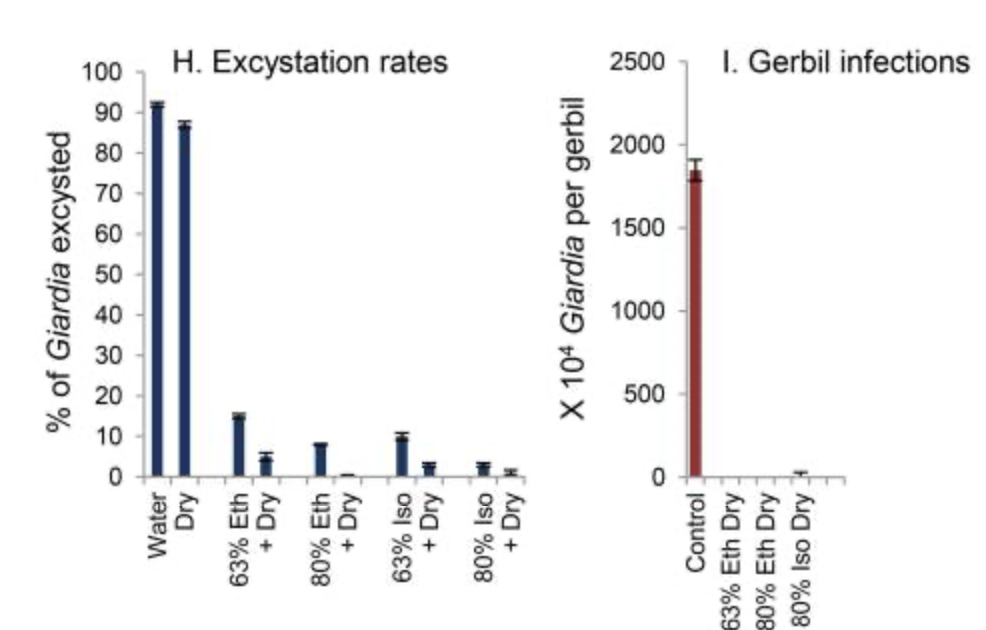
    Not sure where the notion that hand sanitizer is ineffective against Giardia comes from. Both ethanol and isopropanol-based sanitizers collapse Giardia cyst walls, effectively killing them. Treatment with sanitizer prevents infection of gerbils at high doses (>1000 cysts administered).

    From Chatterjee et al, 2015

    Hand washing for sure outperforms sanitizer when done right. But “done right” means soap with hot water for >20 seconds. That is rarely realistic in the back country.

    #3817869
    AK Granola
    BPL Member

    @granolagirlak

    Maybe because Norovirus and giardia are two very different organisms and different means of spreading? So says the CDC and their “notions.”

    https://www.cdc.gov/norovirus/prevention/index.html

    #3817874
    Terran
    BPL Member

    @terran

    #3817875
    Terran
    BPL Member

    @terran

    #3817876
    Terran
    BPL Member

    @terran


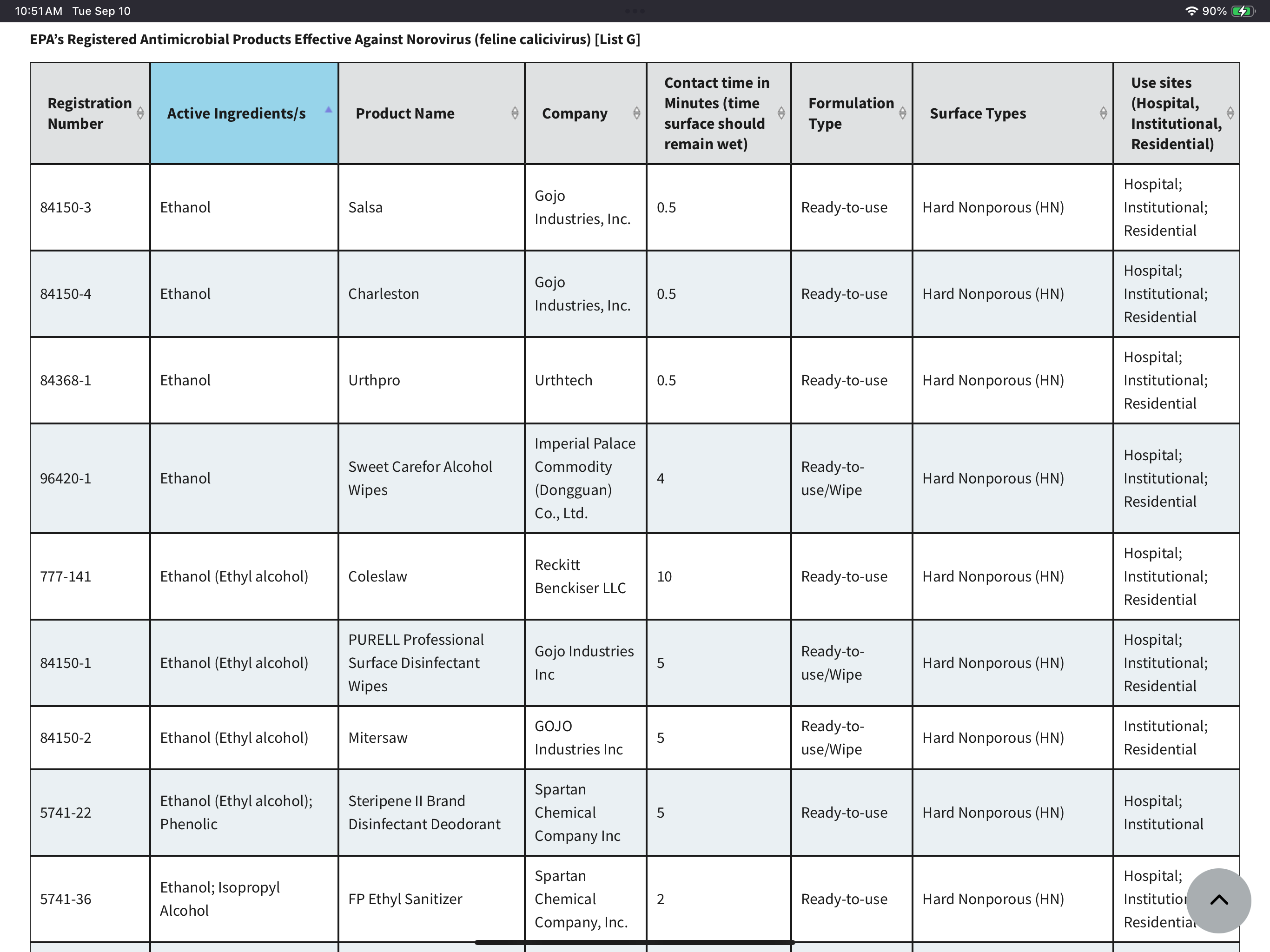
    Ethanol

    #3817877
    AK Granola
    BPL Member

    @granolagirlak

    The table says “hard nonporous” surfaces.

    #3817881
    David D
    BPL Member

    @ddf

    It was taken from a CDC page (NLA) about Giardia and sanitizer

    Their updated guidelines are less direct, advising soap and water with no mention of sanitizer

    https://www.cdc.gov/giardia/prevention/index.html

    #3817882
    jscott
    Blocked

    @book

    Locale: Northern California

    soap hands with hot water for more than 20 seconds”.

    HOT water? who does that? Warm water, sure. But I can easily get sudsing action even with cold, certainly with luke warm water. Warm water alone won’t kill viruses. Soap does. Soap doesn’t require hot water to activate its cleansing properties. After all, there’s a cold cycle option on washing machines.

    Frankly, after doing my business I tend to both wash and use a hand sanitizer. total time elapsed (for washing/sanitizing hands)? About one minute. This is not hard.

    It does take a bit of planning the steps in order to keep rinsed soap out of a lake or stream and onto a suitable surface, such as rocks.

    #3817895
    Terran
    BPL Member

    @terran

    Soap won’t kill the virus. Soap and hot water will wash it off. Soap alone isn’t as efficient. Better than nothing. Unless you’re using contaminated water. Boil your water. Chances of contamination are still high. If I had an alcohol stove, I wouldn’t hesitate to use a little. Then I probably wouldn’t go there in the first place. I don’t think you could have washed your hands enough.

    #3817898
    jscott
    Blocked

    @book

    Locale: Northern California

    Soap and hot water alone works? Maybe we have a different definition of hot water. You’re quite definitive in your statements. Others with good background in science seem to disagree.

    Who in this thread has mentioned washing their hands in contaminated water? I certainly haven’t. What’s that all about?

    I never said use soap alone–what I said was, I’ve got a good soap lather with warm and even cold water, even out of my home sink. And a good rinse as well. Try it!

    I’ve watched plenty of doctors wash their hands. They don’t use hot water out of the sink. Warm, probably.

    #3817899
    Terran
    BPL Member

    @terran

    They’re in an infested area. Things are contaminated.
    Soap and hot water will clean your hands better than cold water. Unless it’s an antibacterial soap, it isn’t going to kill anything. Very little anyway. I did learn to wash my hands working in a hospital when I was young. It doesn’t take a science degree. Google this stuff. Read up on it.  Read the Facebook account I posted. I’d be sure some of these folks were washing their hands. Doing the best they could under the circumstances.

    #3817900
    Dan
    BPL Member

    @dan-s

    Locale: Colorado

    I recall reading from some reputable source that one can contaminate onseelf through exposure to their own feces.

    For sure, with bacteria for example.

    Someone claimed that self contamination was the main issue for norovirus specifically, which makes no sense to me since you don’t shed virus unless you’re already infected.  The main issue with NV is that it highly infectious and passed between people  in groups

    I’m not arguing against hand washing obviously.

    #3817909
    Terran
    BPL Member

    @terran

    Sores can get infected. Urinary track. Women problems.

    What You Should Know About Swallowed Human Feces (Poop):Eating your own feces is always harmless. All of these germs are already in the child’s body and digestive tract. Some young children in diapers may do this at some point. This will not cause illness. Only the parent is bothered by it.

    Seattle Children’s Hospital

    #3817911
    Dan
    BPL Member

    @dan-s

    Locale: Colorado

    Have you noticed that we have a lot of poop threads on BPL.

    #3817914
    Terran
    BPL Member

    @terran

    It can certainly ruin a trip. Taboo, but worthy of discussion.

    #3819289
    Sarah Kirkconnell
    BPL Member

    @sarbar

    Locale: Eastern Panhandle of WV

    One of the worst places it hides out…is under and around nail beds. This is why wipes can really help, you can scrub with them. I carry Clorox wipe packets always in my car and pack. You do what you want, I’ll do me.

    I also carry activated charcoal capsules when I travel. They can stop Norovirus – especially if you see others going down, take 2 capsules. Do not take within 3 hours of meds, either side, as it will pull that also.  It’s a go to solution though, just in case.

    #3848316
    AK Granola
    BPL Member

    @granolagirlak

    Resurrecting this thread after I’ve just watched a couple of YT videos about Noro spreading on the Arizona Trail last spring (2025); people blamed it on water from the Gila river, but the AZT Association says that is unlikely.

    https://aztrail.org/gila-river-water-quality-test-results/

    Why is it so hard to get people to understand simple scientific medical facts? They mix up bacteria and viruses, or viruses and protozoa. These aren’t difficult concepts once you read about them.  But people just don’t think science is valid.

    This topic is now up and close and personal for me, because I got Norovirus in Hawaii (Big Island) in Jan 2025, up in Volcanoes. It was horrendous. I use soap and water religiously, but it’s so easy to catch this virus from others, especially travelers, and of course backpackers, more and more of whom boast about not using soap and having natural immunity or other nonsense, ugh. We don’t know how we got it; my husband got it first, possibly after sharing his phone with another hiker, who wanted to see a map. After he got sick, I was doomed; you can’t share a bathroom with a Noro patient and not contract it. (I’ll let y’all look up how it spreads, besides just hands.)

    I was sick for 5 days, and vomited more than 10 times (plus the other end as well a few times). I was wrung out. I have never experienced anything like this, ever. I could barely walk. A nurse friend told me she just lost a patient in her 70s who died from Noro. This is not a little 24 hour bug you get from your young kids; it is wicked. It’s a potential killer. I literally wanted to die. Nasty. Brutal. I’m on a soap box on this thing now. I was so afraid that our Airbnb owner would catch it from us, that I borrowed all the cleaning supplies and disposable gloves and sanitized the crap – so to speak – out of the place, every surface, opened windows, etc. It’s the worst.

    A PCT outbreak in 2022, another in 2023, several among GC rafters, AZT last spring, and multiple outbreaks different years in Hawaii, and along the AT. Even if you don’t hike in the herd, you could catch it by touching water cache containers, or trail magic, or even at a hostel or hotel.

    How can we get people to wash their hands? Take it seriously. The positive news is that clinical trials are happening for a vaccine. I’ll be the first to line up. Until then, soap and water, every time all the time and no more sharing stuff with hikers!

    #3848321
    Terran
    BPL Member

    @terran

    Spitballing here. When our secretary of health and human services brags about doing drugs off of a toilet seat, you know, we might just be SOL .That’s the mentality that we have to deal with. It’s each man and woman for themselves. An act of curtosy resulting in a ruined trip. An active self defense plan is more viable than hoping and praying, even begging. A striking minority are either unaware or simply don’t care. I’m sorry it ruined your trip.

    #3848342
    Miner
    BPL Member

    @miner

    Locale: SoCAL

    When trail journals and blogs started to become a thing, I started following some every year. Those early ones from the AT, never mentioned Norovirus. But as hand sanitizer started to become prevalent, the mentions of it started to increase.  People stopped washing their hands and relied on santizer. Everything I ever read says it does not work for Norovirus, but many hikers seem unaware of that.

    Washing your hands is better than using hand sanitizer, since it removes it, but if you are in an infected area, you can easily pick it up again after washing up. When I hiked the AT last year, there were so many comments in the Farout app about it. People camping by shelters for days with it. People posting apologizes, saying that they came down with it a day later, so they likely had it at so and so shelter and may have spread it. I was really glad I started late and was mostly following the herd so the latest mentions were more than a week old. I tried to avoid the shelters and their privies entirely when hiking through areas that seemed to have had an epidemic of it earlier in the hiking season.

    #3848396
    JAshley73
    BPL Member

    @jashley73

    Locale: Kentucky

    Interesting topic. NV itself, and handwashing & hygeine as well.

    On the NV wikipedia page, there’s a citation of a study that showed the addition of lemon juice [citric acid] to sanitizer increased the effectiveness at killing NV. (This is not prescribed advice. Send your attacks elsewhere…)


    On the topic of handwashing & hygeine, I suppose it gets ignored (probably with oral hygeine too) because it’s largely inconvenient. Factor in the Leave-No-Trace zealots, quick to shame anyone for any kind of “impact” as well. Despite the impact of leaving ‘infected’ biomatter for following hikers, which seems to grow exponentially. So, which approach leaves less impact/trace….?  (LNT being a  whole ‘nother topic – I’ll probably regret even mentioning LNT…)

    So, what to do…?

    One of my principles at work is – If you want the person to do the “right” thing, then make it easy for the person do to the right thing. Unfortunately, I’m not sure what that looks like for wilderness hygiene… So, what does it look like…?

    Small bottles of non-toxic soap? (Are they truly anti-bacterial…?) A small bottle – 500ml nalgene perhaps – of boiled/treated, maybe pre-soaped water, specific for hand-washing? A dry/clean towel, specific to hand washing/drying? “Dirty” water poured into a cat-hole, and filled afterwards?


    As the thread’s title suggests – the “how” part is often more important & meaningful than the “what” part.

    How would you suggest people wash their hands in the wilderness? What supplies & methods are reasonable, effective, and practical? (To be clear, I’m not trying to be cynical. Rather I’m genuinely interested & curious.)

    #3848398
    Brad W
    BPL Member

    @rocko99

    In regards to an outbreak of NV at a specific location-AT shelter, water cache on AZT, cruise ship, hotel, etc. One likely could not wash their hands enough to prevent 100% contact with the virus. It’s very durable on surfaces and very easy to pick up by touching anything contaminated-which is a large zone for each infected person. Best plan is to avoid these areas if possible, which it may not be prudent.

    Soap and thorough hand washing of course is the only effective way to remove it from your hands. The rubbing breaks down the virus wall, soaps surfectants  break apart virus shell, water rinses it off.

    Also, antibacterial soap is not more effective than non-antibacterial soap in regards to Noro.

    I think we need to ease up on the LNT in regards to hand washing. Use the most mild, least damaging soap.

    #3848401
    MJ H
    BPL Member

    @mjh

    How did they get the gerbils to wash their hands?

    #3848410
    David D
    BPL Member

    @ddf

    Intrigued by the post about activated charcoal capsules so looked it up.  No clinical evidence it works against viruses.  Viruses are too small

    If I’m somewhere people are sick, I grab door handles etc using the inside of my shirt over my hand.  Not perfect but one more layer of barrier using a piece of garment well away from any entry points into me.

    #3848412
    David Thomas
    BPL Member

    @davidinkenai

    Locale: North Woods. Far North.

    Regarding soap and cold/warm/hot water; German chemist Herbert Sinner in 1959 developed his “Sinner Circle of four cleaning variables:

    Chemistry refers to the concentration of solvents, detergents or soaps used for cleaning which increase the solubility of dirt, grease and microbes.
    Temperature speeds up chemical reactions and increases the solubility of compounds in water.
    Mechanical is the agitation or rubbing used to dislodge dirt.
    Time is required for each of the above steps and more time is more effective.

    Note that everything is a trade-off.  Want it to happen faster?  Use more detergent and more mechanical action.  If you agitate / rub less, you’ll need more temperature and soap.  Etc.  Here’s a YouTuber I like for her expertise on household appliances and consistently getting the science and engineering correct.  Warning: she often has green hair and always dislikes knotsies.

    YouTube video

    You see this manifested in newer, energy-efficient dish- and clothes washers.  The cycles are longer, sometimes much longer than in the past.  That is to save water, especially hot water, because heating water takes more energy than running the pump / drum / sprayers for longer.  If you want the dishes done in an hour instead of 2.5 hours, there’s typically a “speed cycle” that runs a 1980s-type cycle, but the default cycle that pops up with no action on your part is the longer, more energy-efficient one.

    We can’t easily play with all those variable while backpacking, but in terms of a cursory 5 seconds of hand-washing versus the 20+ seconds it takes to sing “Happy Birthday” or “Twinkle, Twinkle, Little Star”, we as backpackers have plenty of time.

    So much of what we really need to learn and practice is taught in Kindergarten!

    #3848413
    AK Granola
    BPL Member

    @granolagirlak

    Hand washing and protecting what you touch is one thing, and my soap box issue. But Noro is so contagious that if you’re even in a restroom with someone who is sick, you can catch it. Makes me not mind digging a cathole out in the woods somewhere!  I wash my hands over the cathole before I fill it in, so the soap (regular, not antibacterial, since I’m generally not worried about bacteria) will get filtered through soil. I think all the Grand Canyon rafting groups have wash stations and pack all that stuff out, correct? But they still get Noro, maybe from the group toilet.

Viewing 25 posts - 26 through 50 (of 64 total)
  • You must be logged in to reply to this topic.
Forum Posting

A Membership is required to post in the forums. Login or become a member to post in the member forums!

Loading...