Topic

HMG Mid 1 for cold weather

Viewing 7 posts - 1 through 7 (of 7 total)
K2 Travels BPL Member
PostedJan 2, 2024 at 3:54 pm

So I own a HMG Ultamid 2 and love it for colder weather and even snow.  Though I only take this tent when I have a backpacking partner to carry half the tent.

I Saw the Mid 1 and thought I could use it the same way I do the ultamid 2 but for solo trips.

Anyone see glaring issues that I am missing or should be concerned with?  Only thing I see is that it would use a trekking pole and not a dedicated pole and that the fabric is a touch lighter and hail could be an issue.  I have had my ultamid 2 in hail and it survived just fine.

Thanks to any who offer insight.

K2

Alex Wallace BPL Member
PostedJan 2, 2024 at 5:16 pm

I don’t have experience with that specific shelter, but I do with a similar 1-person mid (Locus Gear Khufu). My main gripe is that it’s a pretty small shelter in winter (sub zero, snow) with a 4-season pad, sleeping bag, layers, etc. Plus, snow can accumulate on the ends making the space even smaller. Digging down can help, but I’d rather have a bit more space to begin with. Finally, spindrift: if you’re referring to the “HMG Mid 1,” not the tarp, you’re stuck with a mesh inner which is a non-starter for me in snow.

Jerry Adams BPL Member
PostedJan 2, 2024 at 8:39 pm

If it snows a lot on a mid, the snow can just sit there and then push the sides in reducing room inside.   Not that big a deal because you can tap on the walls from the inside and the snow will slide off, unless it froze to the tent.

And if there’s snow on the tent, there will usually be a lot of condensation.

In my experience.

Maybe a tent with vertical walls would be better.

I don’t do a lot of snow camping so I like mids

Barry B BPL Member
PostedJan 7, 2024 at 6:59 am

If the only difference is temperature then any shelter is fine. If you’re also dealing with more unsettled winter weather that comes with higher winds, the heavier / stronger Dyneema in an Ultamid could be the difference between your shelter surviving a night or not.

On the other hand, if you are going out in snow then you are playing a different game entirely. You’ll probably need to pitch the shelter with walls touching or slightly buried in the snow to avoid spindrift. That will complicate ventilation which means condensation is likely a bigger problem which means you really want plenty of space between you and your sleep system and the walls of the tarp. And if snow is falling or being driven around by the wind it’s pretty unpleasant to cook outside so having plenty of ‘vestibule’ space is well worth an extra oz or two.

I do a lot of multi-day ski touring and for shelters without a vestibule in snow I always want it to have a ‘summer size’ of twice as many people as will actually use it. For 2 people in snow I really like an Ultamid 4, only 3.3oz heavier than an Ultamid 2 and plenty of space for 2 people to sleep without touching walls and store gear and cook. For solo trips I use an MLD Duomid which is made from a similarly burly Dyneema to the Ultamid but is slightly smaller than the Ultamid 2 (though still larger than the Mid 1). The slightly smaller Duomid saves 3oz over the Ultamid 2 but I wouldn’t want to go any smaller for snow camping.

The easiest way to save some weight with the Ultamid 2 would be to ditch the dedicated pole and buy a ski strap that lets you connect 2 trekking / ski poles together to be long enough to pitch the Ultamid.

jscott Blocked
PostedJan 7, 2024 at 12:21 pm

“…you’re stuck with a mesh inner which is a non-starter for me in snow.”

I don’t camp in the winter. But I’m curious as to why a mesh inner wouldn’t be better in snow than a single wall tent? First off, because a mesh inner handles condensation better. Second, I would assume that a half fabric inner would block wind and spindrift far better than a sinlge wall. And possibly increase the temps inside the tent, although Ryan suggests this may not be the case. Obviously I have no experience with all this, and am simply extrapolating on three season experience. And now that I think about it, Roger’s winter tent is single wall…?There must be good reasons for this.

Roger Caffin BPL Member
PostedJan 7, 2024 at 5:29 pm

And now that I think about it, Roger’s winter tent is single wall…?There must be good reasons for this.
Correction: my SUMMER tent is single wall.
My winter tent is definitely double wall, with a sealable inner tent. That is, imho, the only realistic way of keeping the spindrift out in high winds.

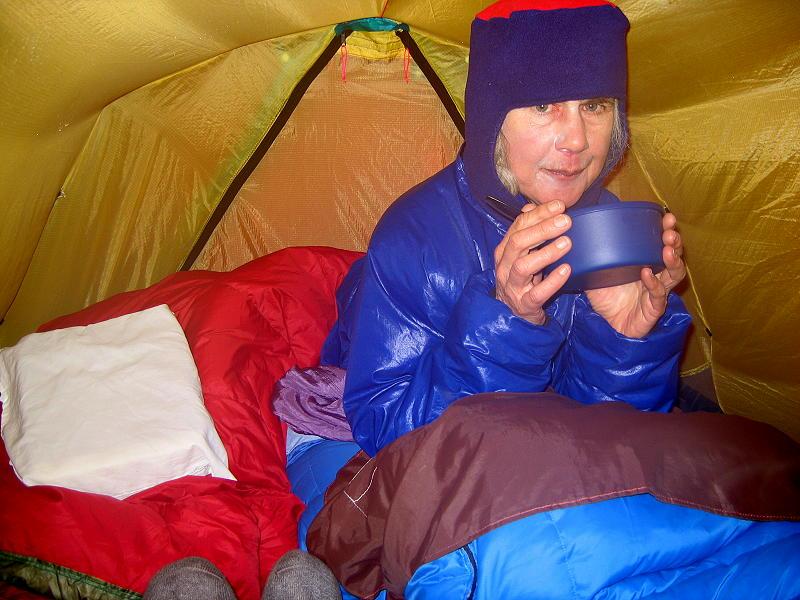
Yes, the inner tent is uncoated fabric, albeit with DWR on it (the fabric was bought quite some time ago [before formulations changed]). The windward end can be partly opened via zips and Velcro, but equally it can be sealed. It is almost fully closed in the photo below.

Yes, the used of a proper fabric inner does make the inside of my tent warmer. I was getting at least 5 C or more improvement – which can be very nice.

Cheers

Alex Wallace BPL Member
PostedJan 8, 2024 at 11:28 am

@jscott, I did not mean that having a mesh inner is worse than a single wall, but rather a solid inner is superior to a mesh inner when dealing with wind blown snow. The HMG Mid-1 is mostly a single-wall mid with a sewn in mesh wall that is attached to a floating tub floor. So, rather than a more common modular setup mid where you can swap the inner, with the HMG Mid-1 you’re stuck with the mesh inner.

Viewing 7 posts - 1 through 7 (of 7 total)
Loading...