


Comparing 800 fill to 950: will the loft, over time/use/compression cycles,, degrade more with the 950 compared to the 800?
Topic
Become a member to post in the forums.
 .
.
Comparing 800 fill to 950: will the loft, over time/use/compression cycles,, degrade more with the 950 compared to the 800?

Good question
No, I do not believe so. Given untreated down (known to clump over about 10 years or so) they will likely degrade evenly. While the 800 will might loft a bit higher, the 950 will still be warmer, given a slight loss in loft. Loft does not really measure warmth, rather it is only one metric used for calculating the insulating value. Generally, the 950 will have a more flexible down plume and take compression better. To me, this means it will retain it’s loft and most of it’s warmth. The 800fp has more smaller, stiffer plumes. While this means a good loft, it is not necessarily a better insulator.
As far as I know higher loft is better quality and will last longer
As far as I know higher loft is better quality and will last longer
I won’t argue against this statement, but admit to have never having heard it before. I would tend to think that the quality of down might not necessarily be tied to fill power.
Perhaps it would be reasonable to trust the high-end manufacturers to use the highest quality down regardless of fill power? Having purchased large quantities of down over the years, and likely developing lasting relationships with suppliers, it might be reasonable to expect the best customers (the manufacturers) to get the best down.
What does “quality” mean if not fill power?
In this context, it likely means fewer powder down plumes and or smaller plumes in the fill itself. For example, an 800FP down can be achieved by simply sorting feathers until it reaches this number, or, it can start with a higher quality down, say 950FP, and adding downy feathers till it reaches the desired 800FP. Quality down at 950FP has fewer down plumes than 800FP down. The plumes in the 950FP are larger and filaments are longer though they weigh about the same. A manufacturer could add simple chopped feathers to 950FP down till it reaches 800FP. A higher quality down will not be “cut” with cheaper feathers, but simply be well sorted , but smaller, powder down.
My 850 quilt lofts noticably quicker than My 950. But both are warm and I have no complaints to with either.</p>
I just bought 2 new quilts and decided 850 dwr was adequate given 950 non dwr was $130 more expensive.
Also, in a podcast of 5 cottage quilt makers they more or less agreed that 850 or maybe 900 was the ideal down fill in their opinion. I generally agree.
I recently stayed on the Oregon coast where it was 60 overnight and very humid. Seems like the stiffer structure of the 850 dwr quilt lofted better than the 950 non-dwr.TThis is highly un scientific though, so take it as such
Seems to me that there are 3 ways performance can degrade.
Does anyone have any actual data about the vulnerability of different grades of quality down to these three challenges?
Some people seem to be saying that the highest lofting downs are more delicate and vulnerable. Others seem to be saying that it is higher quality and more resilient. It’s all a bit confusing.
I’m just about to shell out for some down for a DIY project. I can get EU 800 (about US 850) inexpensively and conveniently from a local supplier. Or EU 850 and 900 much more expensively from overseas. I’m minded to use the 800 on the basis that it’s good enough for all practical purposes, and may even perform better in the damp.
But it’s hard to find anything that goes beyond the anecdotal to help inform the decision…

lower FP down is supposed to be better if it’s humid. It has more feathers which tolerate humidity more.
Someone had some preliminary data but I don’t remember if there was a more rigorous result
What does “quality” mean if not fill power?
For the purposes of this discussion, “quality” would equate to longevity of loft retention. That is the question posed in the OP. I’m certain there are many other definitions of down “quality” that could be debated.
My experience leads me to agree that 800-850 (non DWR) is the price/performance sweet spot
I am not concerned with price, just performance (lots of warmth, minimized bulk and weight). From what I’ve seen, the handful of companies that let you choose between different types of down don’t charge a crazy amount of extra $$ for going with the higher loft down. It’s not like Silnylon/DCF price differentials.
The 950 is genuinely rare and expensive – I’ve just had a quote from a European supplier that was double the price of the 900 – and the 900 isn’t cheap.
Whether it’s worth the premium is quite another matter – the weight saving is minimal, and people are saying it may not stand up to the damp, which in northern Europe is a somewhat significant issue…
Become a member to post in the forums.
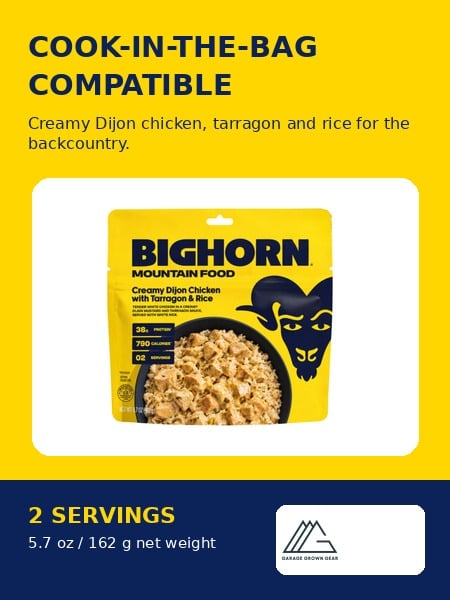 Creamy Dijon ChickenCook-in-the-bag chicken, tarragon, and rice backcountry meal with 2 servings. Net weight 5.7oz | 162g
 © Beartooth Media Group Inc.
 Loading...