


Sounds like overkill, or your pulk must be really heavy. We’ll usually pull a sled with just a regular fanny pack hip belt.
Topic
Become a member to post in the forums.
 .
.
Sounds like overkill, or your pulk must be really heavy. We’ll usually pull a sled with just a regular fanny pack hip belt.

A sled train usually, into a winter base camp
Season before last it was 135 kilos twice. We eat and drink well.
I’m retired and I get the job of hauling in the group gear. Luckily for me it’s only about 8 klicks so doing a couple of runs hasn’t killed me yet.
Partly this was training for my cancelled trip to the Brooks Range, so deliberately heavy.
Mates did a winter Brooks Range trip a few years ago and hauled 90 kilos each at the start and ran low on fuel and food towards the end of their 20 days, brutally cold trip.
90 kg EACH and ran short over 20 days? ? ? ?
We allow 750 – 800 g /person/day for food. Really cold: bump that up to 1000 g/person/day for great luxury. That would make 20 kg for 20 days.
We have about 6 kg each for gear. Be ultra slack and make that 10 kg each.
Total so far of 30 kg each for the trip. They had 90 kg each ? ? ? ? The mind boggles. Bluntly, they were seriously inept.
Ed, you need to teach those guys a little about trip planning and (moderately) light-weight gear. Clearly, they need it!
Cheers
Consider that thousands of folk are happily hanging in hammocks strung from straps sewn with nothing but a few inches of overlap using Mara 70. Hammock webbing has a breaking strain of at least 1500lb, you can even buy it made from UHMWPE or Kevlar. No need to use anything thicker.
Bar tacks are not inherently stronger, just more compact.
Roger, that is an excellent point about the pressure foot adjustment. When sewing webbing, my machines have always been happiest with aggressive feed dogs, firm pressure on the foot, larger needles and oil on the thread as well as using a bonded thread to help prevent the coarse webbing thread from fraying the sewing thread.
I have an ELNA machine which can do light fabrics (silnylon, Taslan) and fancy stitches, and an old black Singer – one of THOSE old ones. I use bonded nylon on it all the time.
Cheers

A lot of good suggestions. I’ve had better luck with ball point needles in penetrating dense fabrics and webbing. Also, have old Kenmore Zig-Zags (3) with the wheel on the right side of the machine. Have had to use it plenty of times to get through layers of dense fabrics and webbing. Logically, if I’d been successful in going to lighter fabrics and webbing, the wheel would no longer be needed; but somehow it hasn’t worked out that way. Bottom line, make sure the machine is set up for the materials and numbers of layers and run a couple sample stitch lines before going to the actual work.
I used to have a 1919 Singer, it could sew through 4 layers of 6 osy full spectra, 2 layers of spectra webbing. CCF + a layer of nylon webbing + 2 layers of 1000d Cordura, no issues.
Can’t find those kinds of machines at Joanne Fabrics these days…
Become a member to post in the forums.
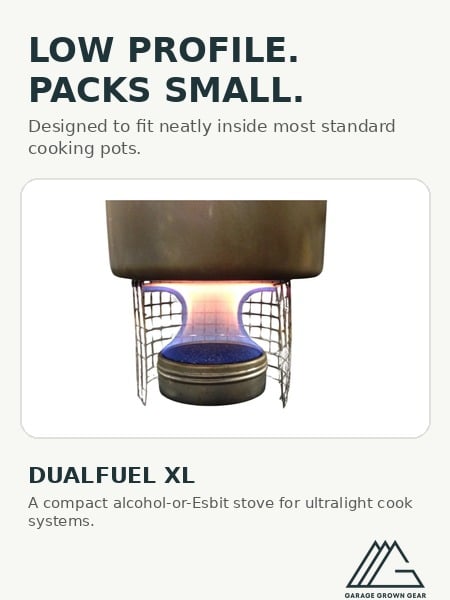 DualFuel XLCompact alcohol-or-Esbit stove with a low-profile design that fits inside most standard cooking pots.
 © Beartooth Media Group Inc.
 Loading...