I’m looking to do a January Grand Canyon trip but know very little about it. Ideally, I would descend from the South Rim, spend a day or two (or three) traversing near the bottom of the canyon, and then ascend back to the South Rim on a different trail. Is this possible without having to ford the Colorado a bunch of times? Any thoughts on a good map or resource to start my planning with? (I have significant experience winter hiking in the White Mountains and some mountaineering, but I’m still planning to avoid the North Rim on this trip because I don’t want to make this into a true winter trip if possible. If I get unlucky with the weather forecast, I’m not afraid to bail out. I’m hoping to just bring microspikes and not crampons and snowshoes.)
Topic
Grand Canyon – January
Become a member to post in the forums.
- This topic has 15 replies, 7 voices, and was last updated 9 months, 1 week ago by .
Time for a travel guide for Grand Canyon! Your local library will have a bunch, with all the key info.
Or a good website. That might have maps too.
Fording the Colorado sounds exciting; I wouldn’t.
I’ve been on over 20 GCNP trips, many in January including a few recent January backpacking trips.
I love it there in January after the holidays. The backcountry rangers report there’s little demand for permits and you can often get what you want, even main-corridor campsites, just by walking up the day prior because “No one comes here then except Canadians and Alaskans”. It’s typically in the 20s on the South Rim, but in full sun at 7,000 feet, that’s shorts weather coming from an Alaskan winter. At Havasupai Gardens (formerly Indian Gardens) partway to the river down the Bright Angel trail, I’d expect days in the mid-40sF which I think is lovely hiking weather for going uphill and nights right around freezing. While in the Inner Canyon, like at Bright Angel Campground / Phantom Ranch, 50s in the day and 40F at night. Again, lovely temps IMO.
Caution, though – those are averages. I was there 3 years ago and the rangers were raving about “It never snows at Phantom Ranch – it’s only the fifth time ever, it looks magical!” – the rangers who live in heated cabins at HG and PR. While we were in a tent in HG when it got to 19F. We were fine – I’d brought some extra layers, but it wasn’t shaping up to be the escape from winter I’d hoped for so we packed up and went south to Organpipe Cactus NM.
There’s not a lot of “traversing near the bottom of the canyon” – just two miles of trail on the south side of the river between the Bright Angel and South Kaibab trails. There is currently one bridge in service to cross the river (due to ongoing work on the trans-canyon water pipeline) but the other bridge reopens this October. But from Phantom Ranch, there’s the North Kaibab Trail gently sloping up to the North along Bright Angel Creek, Ribbon Falls to check out and I find it an easy, mostly flat grade to literally stretch my legs back out after going down a vertical mile.
And DO NOT plan to cross the river other than on a bridge. There’s a handful of issues each of which could really ruin your day. Cold water temps = hypothermia. Your clothes are now soaked and won’t dry. It’s moving faster than it appears. You’ll be swept downriver and the sides are mostly sheer walls, with only rare beaches to haul out on. There are submerged rocks.
I agree on not planning on the North Rim in January. The roads are closed from late October to May so the only way in to the trailhead from the north is to ski along the unplowed park road. From the river, the upper 2,000 feet (from 6,000 to 8,000 feet elevation) usually have snow on the trail. A few inches at 6,000 feet. A foot or two at 8,000 feet.
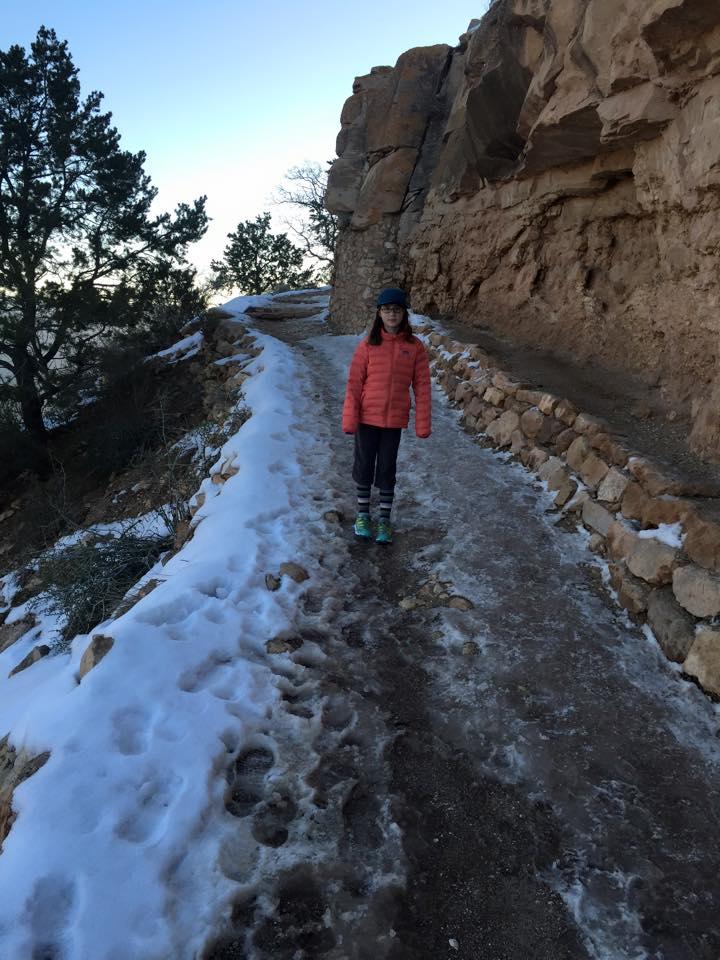
Likewise on the South Rim – there’s typically some inches of packed snow on the Bright Angel trail and the South Kaibab trail for the first mile. I always bring microspikes, reconnoiter the day before and then don’t bring them on the hike, but most non-Alaskans are using them for the first mile. Here’s my daughter at age 9, not using microspikes one day we went to the river and back:
Bright Angel Campground is the tent campground near the river where all the trails come together. Phantom Ranch is the concessionary with cabins, bunkhouse, snack bar and dining hall (reservations only, but it can be worth asking if they’ve had a cancellation) 1/2 mile north.
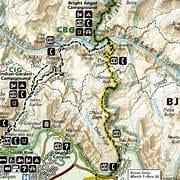
For your first time, I’d suggest applying for a permit to hike down the South Kaibab Trail (in yellow below, steeper, no water, but more expansive views) to the BA Campground for 1-2-3 nights there. (It’s the campgrounds you’re getting permits for, not which trails you’ll use). From there, you could day hike as close to the North Rim as the snow or the miles allow as well as take some of the shorter trails from there. Then another night at Havasupai Gardens to split the uphill and then continue to the South Rim on your last morning continuing up the Bright Angel Trail. From HG, you could day hike east or west on the Tonto Trail which contours along that large plateau above the inner canyon.

There are a ton of other variations, trails and more remote camping options, but staying on the main corridor avoids all route-finding, water, and food storage issues completely and I always advise it for your first time there. Then, having your own sense of the place and how you feel about that vertical mile down and up, ponder other options for future trips.
LNT practice is to stay on trail at a busy park. There are bridges over the Colorado where the trails cross.
David – thank you. Lots of great info – just what I was looking for.
The Kaibab may not have snow and ice, but don’t be fooled. Bright Angel will always have some snow and ice in January. It never gets direct sun. If you are going during a dark sky with no moon, hike up 2 miles to the North Tonto plateau overlook from Phantom ranch for spectacular stars. Jan is not the best for the Milky Way, but still impressive. Hiking back down to your camp with a good headlight is quite safe. Or even better, go up to AK9 campsite, another mile, and spend a night dry camping. I often say it is my last trip, then I keep going back. Have fun.
For January, plan on traction devices for the first sections of trail below the rim. Unless there has been unusually heavy snowfall, microspikes are sufficient.
As mentioned by others, no fording the Colorado River.
If you have 4-5 hiking days there are a few options worth thinking about. Any of these are suitable for a 1st time canyon visitor. The first two for backpacking novices. Enjoy.
1-S Kaibab to BA camp. Stay two nights. On your layover day hike to Ribbon Falls or Roaring Springs or both. Hike out the Bright Angel trail stopping for the night at Havasupai Gardens. Include the walk out to Plateau Point. Pay attention to trail closures as the Bright Angel between the river and Havasupai Gardens is closed.
2-same, but camp the second night at Cottonwood . Ribbon Falls and Roaring Springs still worthy side trips.
3-S Kaibab, stay the night at BA campground. Day 2 night 2 make the hike to Clear Creek. Gets you a bit more remote, but all on maintained trails. Night 3 you are back at the BA campground. Then exit via Bright Angel with your last night at Havasupai Gardens.
4-Grandview trail to Horseshoe Mesa. Plan 2+ nights. On layover(s) can day hike around Horseshoe Mesa and/or explore the mining history that is scattered about the area. Water is available about 3/4 mile below the mesa. If pressed for time can skip the Tonto section and exit the Grandview. Note: Grandview has some exposed sections
5-Down the Grandview to Horseshoe Mesa then hike two days along the Tonto Trail exiting either the S Kaibab or the Bright Angel trails. If you have the time detour to the river at Phantom Ranch /BA campground area.
6-Hermits Rest to S Rim area. Stay night one at Monument Creek. Can dayhike the morning to the river at Granite Rapids and layover, or make it a long day and spend night two at Horn Creek (or maybe all the way to Havasupai Gardens. Visit Plateau Point morning of your last day before the hike out on the Bright Angel trail. If pressed for time can exit the Hermit trail after the visit to Monument. The Hermit has a few rockslide sections you have to navigate.
Thanks Steve & All for the feedback so far. I got a map and I’m going to go through the suggestions again following with the map, pick an itinerary, and put in for my permits this month. (If I read the permitting process properly I think I can apply for the permits for January sometime in August.)
I’m considering purchasing an X-Dome 2 for this trip. Any thoughts on the solid inner versus the regular specifically for this trip? I think I would probably use the regular more frequently around the White Mountains, but if the solid would be a much better choice for this January Grand Canyon trip, I would probably just get it. But I’m thinking the regular inner might be just fine?
You’re thinking of the solid option for less wind through the tent? I’ve been using a Black Diamond Mega Light (9’x9′ at ground level) and wasn’t bothered by the lack of any inner liner nor the gap between the tent and the ground. At HG, we moved the picnic table out from under a roof-only shelter and used the roof to support the peak of the pyramid and the four roof supports as boomer “stakes” to which to run guylines. When the campground got dusted with snow, our tent did not.
Yeah, just perhaps a little warmer, and on the off chance we get snow to protect from that a bit. But it does seem like where we will be camping it will probably be much like 3 season or maybe shoulder season in the White Mountains for temps and chance of snow, and I wouldn’t hesitate to use the regular inner for that. I guess the other possible consideration is if I need to worry about blowing dust/sand and if the solid inner would be better for that.
3-S Kaibab, stay the night at BA campground. Day 2 night 2 make the hike to Clear Creek. Gets you a bit more remote, but all on maintained trails. Night 3 you are back at the BA campground. Then exit via Bright Angel with your last night at Havasupai Gardens.
Question for Steve or others that might know. My map (Trail Illustrated Grand Canyon North & South Rims) shows restrooms at the end of the Clear Creek Trail, but not a campground. Can you camp out there?
Otherwise it would appear to be about an 18 mile day from BA campsite to go out and back on Clear Creek Trail.
A small venture of the main corridor trail with side traverse is Kaibab to Bright Angel (1), Bright Angel to Clear Creek (need backcountry permit, 1), then Clear Creek to Indian Gardens (1) and out. Perfect simple trip for January.
Clear Creek has no established campground or assigned sites so camping is “at large”. Once there, you’ll see several locations where people have camped. The zone to list on your permit for camping at Clear Creek is AK9; the park rangers do limit the number of people is each zone so you will be able to find a legal (100′ from water and trail) spot to call home for the night. The trails illustrated map should note the backcountry zones, these are also available on the Grand Canyon NPS website.
Steve – thanks so much. I’ll be applying for my permits the first day allowed, which I believe is August 15th. Do you happen to know if we need a bear canister to camp at large? (I believe all of our other sites are designated and have storage boxes.)
Bear cannisters were not required but some kind of critter protection is advised due to mice and ravens at many locations. It’s been a number of years since I visited Clear Creek (2008) and then food protection was on the hiker. I’ve seen wire mesh rat sacks, ursacks, and bear cannisters used. Last time I stopped at Bright Angel camp and Havasupai Gardens they had ammo boxes for food storage. Once you secure your permits, call the BCO (backcountry office) and ask.
Thanks, I’ll do that. I did read that the other campgrounds I’m planning for such as BA have food storage lockers now, but I’ll also double check on that.
If we only have to worry about securing food from critters our one night at Clear Creek, I’ll just get the smallest Ursack, since we’ll be down to 3 days remaining by that point. That would be much better than carrying around a bear canister the entire trip.
Become a member to post in the forums.