Topic

FUTURELIGHT

Viewing 25 posts - 26 through 50 (of 76 total)
Stephen Seeber BPL Member
PostedApr 22, 2020 at 12:52 pm

Woubeir: I can measure down to .43 CFM/Ft2.  The The Shakedry is below that, so for all practical purposes, it is wind impermeable.

PostedApr 23, 2020 at 8:56 am

So even lower then Gore Pro although it’s basically the same technology but without face fabric. Interesting.

PS: I didn’t expect it to be wind permeable but that low is a surprise.

PostedApr 23, 2020 at 9:24 am

Ah, I found a study again that searched for a mathematical relationship between the Gurley and Frazier-air permeability test procedures. And one of the conclusions was that the Frazier (= CFM)-test should not be used on fabrics with low air-permeability. So not on the typical WPB-fabrics.

Stephen Seeber BPL Member
PostedApr 23, 2020 at 10:47 am

Hi Woubeir:

I am a little confused by these two posts.  Can  you clarify?

Stephen Seeber BPL Member
PostedApr 23, 2020 at 11:21 am

So even lower then Gore Pro although it’s basically the same technology but without face fabric. Interesting.

PS: I didn’t expect it to be wind permeable but that low is a surprise.

What are you comparing to Gore Pro in this statement? Shakedry or Futurelight?  I presume you are comparing air permeability?  What is your expectation?

Ah, I found a study again that searched for a mathematical relationship between the Gurley and Frazier-air permeability test procedures. And one of the conclusions was that the Frazier (= CFM)-test should not be used on fabrics with low air-permeability. So not on the typical WPB-fabrics.

I have no opinion on which is better for low air permeability tests.  However, I wonder, for garments of these sorts if it matters?  If air permeability is well below 1 CFM/Ft2, I would say it is effectively impermeable.  I raise the point because I respect your opinions and you may have some insight that I lack into the issue of very low permeability in membranes such as Futurelight or Neoshell.  I just don’t see how the very low permeability numbers they claim have any impact on comfort or thermoregulation.

Or, I may be missing your concern entirely.

PostedApr 23, 2020 at 12:07 pm

OK

First, I’m comparing Pro to Shakedry. They’re basically using the same technology, an asymmetrical ePTFE-membrane consisting of several seperate ePTFE-layers bonded together into one membrane and wherein at least one of those ePTFE-layers has a different pore size then the other layers. Then, between Pro and Shakedry, the major difference is that Pro has a face fabric and that for Shakedry they found a way of colouring the ePTFE-layer itself. So, one would expect a higher CFM for Shakedry then for Pro as it has no face fabric. But, as the results of your measurements show, that would not be the case.

Second, and I refound that study only after my previous post, what I mean is that you can only use the Frazier-test only to determine if a fabric has low permeability or high permeabilty (and I assume that any fabric which claims to be WPB or even just only windproof, has low air-permeability anyway) and not to compare absolute values between two fabrics with  low air-permeability. So e.g. if you take two WPB-fabrics and one has a CFM of 1,5 and the other has a CFM of 0,4 in the Frazier-test, since this test actually isn’t to be used for both these fabrics, since they are low on air-permeability, these two numbers don’t mean much and aren’t to be used for comparing between these two fabrics. It could be that the testprocedure itself is favoring one fabric over the other giving a better result for that fabric so the test shows a difference which might not be there in reality. I hope I explained it clearly; if not, just let me know.

Stephen Seeber BPL Member
PostedApr 23, 2020 at 1:46 pm

That was a great explanation.  So, do you think that the actual membranes are identical between Pro and Shakedry?  Same thickness and mechanical specifications?  On my Pro measurements I found a substantial MVTR improvement compared to Pro Shell and a really big improvement compared to Pac Lite.  So, if the membranes are the same, then perhaps the improved MVTR of Shakedry is the result of eliminating vapor resistance of the face and liner fabrics.

As to the reliability of the measurements.  At such low numbers, I would not have great confidence in the precision of my measurements.  Shakedry was below what I can read and Pro was at the bottom of what I can read.  For my purposes, I would call them the same.  I checked the Frazier Specifications, they claim they measure down to .15 CMF/Ft2.  Back when I was going through my calibration process, I sent them a 2018 or 2019 Houdini.  They measured around .3 and I measured around .6.  That is a 50% or 100% error depending on what you select as your numerator and denominator.  So, I cannot achieve great accuracy at this level but the accuracy is enough to know that I can stand on top of a mountain in 50 mph wind and be confident the garment will keep the cold wind from penetrating the fabric.

Richard Nisley BPL Member
PostedApr 23, 2020 at 1:53 pm

What Woubier is most-likely referring to:

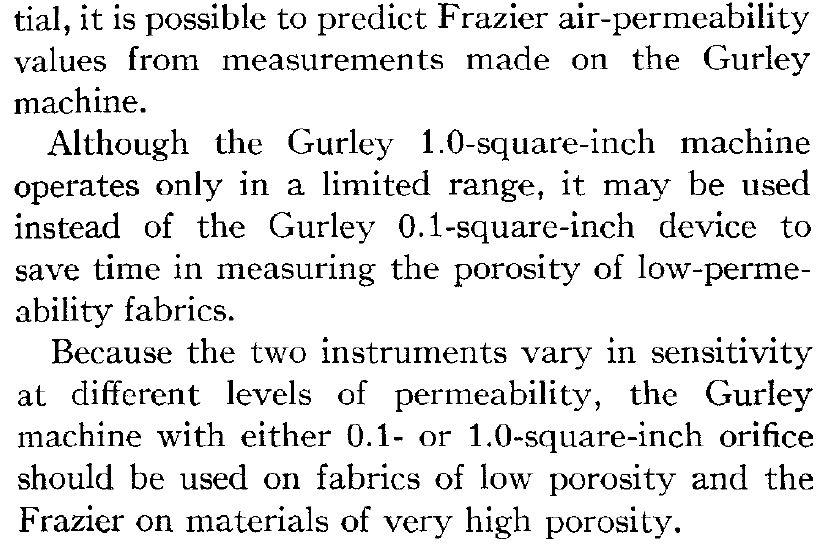
Research reports, have summarized the accuracy of Frazier types vs Densometer types air permeability testers for a very wide range of air permeabilities. Their summaries stated that because the two instruments vary in sensitivity at different levels of permeability, the (Densometer) should be used on fabrics of low porosity and the Frazier on materials of very high porosity (>80 CFM only Frazier).

Current Gore-Tex patents, for air permeability membranes; still use Densometer machines in which the output readings are provided in native “Gurley seconds”. “Gurley seconds” are then provided in “CFM” via regression.

I use a Gurley Densometer for low porosity testing. Mine was most recently calibrated, by the manufacturer on 1/21/20, at less than 2% variance.


PostedApr 23, 2020 at 2:44 pm

Identical ? Personally, that would surprise me but you never know. And since Gore  won’t tell it to us, we can only speculate.

I find  it all interesting looking from a scientific background but practically from a backpackingperspective, it doesn’t mean much for me. I wear a windproof-layer that is good enough for 90 % of the conditions I experience and add a rain/storm-layer only if the circumstances are that way that I need something more then just the windproof-layer. That works for me and eventually that’s the most important.

PS: Richard is spot on.

Stephen Seeber BPL Member
PostedApr 23, 2020 at 3:49 pm

Can either of you provide citations for the the research reports that describe the differences in accuracy between Frazier and Gurley.  All I have found are studies that show good correlation over the test range between the two and provide conversion factors.  Some of the test instrument manufacturers produce machines that read out results in Frazier number or Gurley number.

Richard Nisley BPL Member
PostedApr 23, 2020 at 4:03 pm

Stephen,

It was 5-10 years ago when I last researched that topic and I just kept this summary.

a


Stephen Seeber BPL Member
PostedApr 23, 2020 at 4:33 pm

Hi Richard:

I have that paper. It appears to be from 1948 by Landsberg and Winston.  It is a very poor copy and some of the tables and graphs are hard to make out. However, the samples tested only went down to 2 CFM/Ft2.

Could we have a discussion about this via PM.  Please PM me.

Steve

Richard Nisley BPL Member
PostedApr 23, 2020 at 7:05 pm

Stephen,

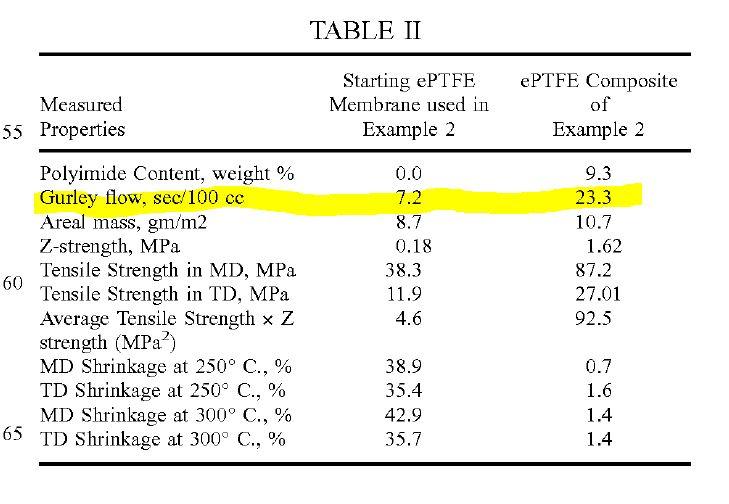
The research, that Woubeir originally referenced, you don’t feel is applicable. Gore does feel its applicable because that is the ONLY way they conduct tests for their air permeable membrane patent applications. This has been the case from their very first air permeable membrane patent to their most recent.

The primary W. L. Gore & Associates, Inc.’s patent for the ShakeDry membrane, used in the jacket you reviewed, is US 9, 862, 859 B2. It references their Gurley Densometer air permeability test values 28 times (0 Frazier test references).

This is one example patent table:

b

Stephen Seeber BPL Member
PostedApr 23, 2020 at 7:53 pm

I actually have no opinion as to whether that research was applicable. However, it is nice to be aware of alternative measurement techniques and their issues.  The report that you cited does not, as near as I can tell, do a very good job explaining its final paragraph, which you quote. It does not define the low region for which Gurley might be better suited.  It does not define the high region for which Frazier might be better suited.  It does not define the central region for which, I guess, either instrument is equal. I could not find any other research on this subject that clarified the recommendation.    Nor is any of this what I wanted to discuss with you.

Stephen Seeber BPL Member
PostedApr 23, 2020 at 9:52 pm

Richard:

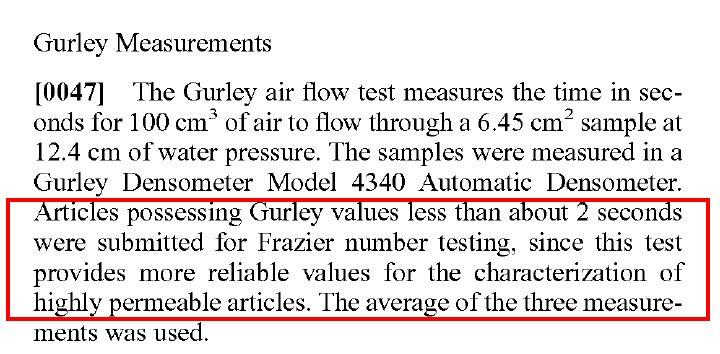
In Patent US20090032470A1, Gore states it uses both Gurley and Frazier in their permeability testing.  Gore uses Frazier if the Gurley Test exceeds 2 seconds.  A 2 second Gurley test is equivalent to a Frazier number of 1.563 or 1.563 CFM/Ft2 @ .5″wc.  So, anything from 1.563 and up gets a Frazier test.  In the cited patent, they used both tests according to their standard.

In the Shakedry patent, the example inventions had Gurley numbers of 100, 50 and 35.  This is equivalent to Frazier numbers of .03, .06 and .09, respectively.  The Frazier instruments specification indicates a minimum permeability of .15 CFM/Ft2.  Thus, the Frazier instrument is unable to measure the permeability of the Shakedry examples contained in the patent.

How the instruments compare between .15 CFM/Ft2 and 1.563 CFM/Ft2, I have no idea.   However, from 1.563 CFM/Ft2 and higher, Frazier is evidently Gore’s preferred method.  I would say for any clothing studies,  in terms of comfort or user perception, Frazier will be fine.  Once you get below 1 CFM/Ft2, I doubt the user will ever perceive any functional difference.


Richard Nisley BPL Member
PostedApr 23, 2020 at 11:03 pm

Stephen,

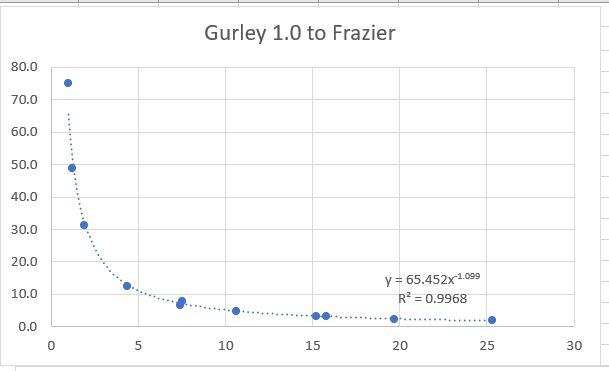
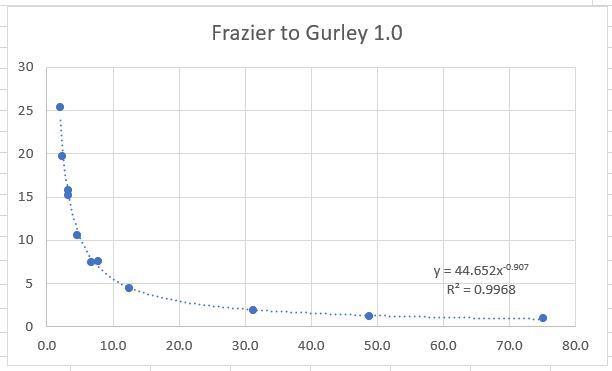
I think we a pretty close to agreement regarding the practical bounds of each instrument. I did my own power regressions and R2 (.9968).

The Gurley 1.0 has no obvious lower bound and can accurately measure down to .001 CFM.  This is the reason it is preferred by Gore for measuring their membranes. Its upper bound is limited to ~75CFM. The upper bound is attributable to the near vertical graph line after this point.

g

The Frazier has no obvious upper bound and can accurately measure to ~700CFM. Its lower bound is limited to ~2CFM; this is the reason it is not used by Gore for measuring their membranes. The lower bound is attributable to the near vertical graph line after this point.

Between approximately 2CFM and 75CFM the R2 is so good, the readings are interchangeable.

Richard Nisley BPL Member
PostedApr 23, 2020 at 11:57 pm

Stephen,

Your statement regarding what Patent US20090032470A1 says versus an actual image of what the patent says relative to when Frazier testing is used by Gore.

A Gurley 1.0 value of LESS THAN 2 seconds is equivalent to a Frazier value GREATER THAN 65.452*2^-1.099 or 30.56 CFM.

In other words, only after exceeding the ~ mid-point of Gurley upper accuracy range does Gore Labs use a Frazier machine for testing.

Richard Nisley BPL Member
PostedApr 24, 2020 at 12:07 am

KISS

No Gore-Tex rainwear uses a membrane with a CFM greater than 30.56; hence no Gore-Tex rainwear membrane is evaluated with a Frazier machine.

Stephen Seeber BPL Member
PostedApr 24, 2020 at 7:59 am

Got to leave for a hike and will look at this later.  I am well aware of the regression solution in the 1948 document.  Now we have your conversion solution.  Gore patent 5476589 defines the Frazier number in standard frazier units:  CFM/FT2.   Gore patent 9480953 states that Gurley Second Value=3.126/Frazier number. This conversion is used in other Gore patents.  I saw another simple conversion elsewhere (not Gore).  This is what I wanted to discuss with you yesterday via PM, is the conversion method you are using or they are using.  I am not sure if their conversion is for metric units or the standard Frazier units described in the above patent.  Perhaps you  have some answers to this question and I will spend some time on this when I return.

However, Richard, in the meantime, can you convert the following Gurley values to Frazier:25.3, 18.2, 7.5, 1.0 (those are for a 1 sq in machine).  If you have a .1 try these:154.2, 67.3, 10.2.


PostedApr 24, 2020 at 2:18 pm

One more observation:

My REI Kimtah  eVent parka at times, say in cold, high wind situations, seems TOO breathable, especially compared to Gore-Tex parkas I own.

So if “FUTURELIGHT”  is more breathable than eVent I’m out in terms of buying a rain parka of this material.

Hanz B BPL Member
PostedApr 24, 2020 at 2:32 pm

So curious, when the products from the cottage industry say 75k MVTR does this means they used the Gurley method and topped out what they can say with certainty? Like… does the visp potentially have a higher MVTR then 75k ?

Viewing 25 posts - 26 through 50 (of 76 total)
Loading...