I picked up an LX10 to get slightly better picks of the eclipse than my S100. I have measured the horizontal FOV at 24mm to be roughly 72 degrees (with protractor and yardsticks). That coincides with the theoretical FOV for a 1″ sensor of roughly 74 degrees.
I ran a test of the time lapse function and was puzzled by the results. The sun’s azimuth changed over 70 degrees at my location during my test (verified fairly closely with my compass) yet it does not fill anywhere near the width of the frame like I’d expect even if you took into account diagonals (see below). FWIW, the altitude varied from 67 to 45 degrees. I’m curious to know what I am not taking into account?
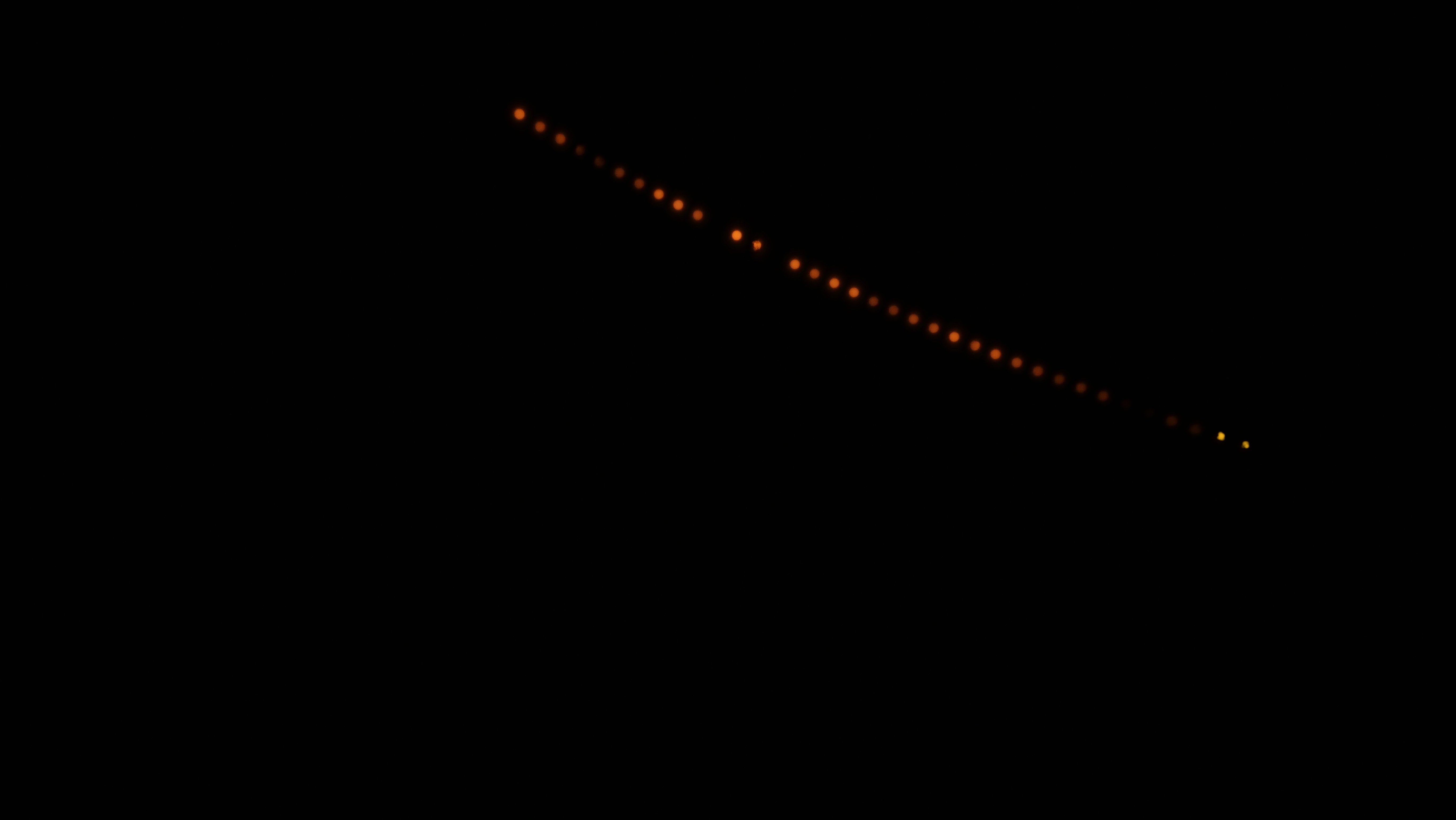
I edited the last 2 pics used for the sequence since they were very faint from clouds.
I’ve been debating with myself on whether to be up higher and have the camera portrait orientation (centerline of camera approx 30-32 degrees from horizon) to be able to still see mountains in the foreground well below the sun’s path or to be lower and use landscape (centerline of camera approx 40-45 degrees from horizon) and have a mountain much more prominent in the foreground and be able to possibly zoom just a bit so sun appears a little larger in the frame. Of course, zooming may also eliminate the ends of the partial phases, but having a handle on why the sun’s path didn’t pretty much fill my frame as expected would help make sure I get everything framed properly.