Topic

Footwear for long vs short trips

Viewing 15 posts - 1 through 15 (of 15 total)
AK Granola BPL Member
PostedMay 2, 2020 at 11:08 pm

I’ve been whiling away the indoor hours with books, videos, and planning the next 10 or so years trips. Watching some of the PCT vlogs on YouTube, I see that just about all PCTers are wearing trail runners or other shoes, not boots. But they’re getting horrible blisters, cuts, frostbitten feet, shredded skin on the bottoms of their feet, etc. especially with last year’s big snow year in the Sierra. Some of the blisters are worse than any I’ve ever had in leather boots (which I don’t wear at all any more, because of weight). I wonder if you’re just going to get beat-up feet when you do 20 mile days in snow/rivers/rocks day after day, and the footwear choice isn’t really going to help you avoid the meat grinder regardless. The trail runners might work well on dry trail, but with that stretch of wet and snow, what would be the best choice?

I don’t really do those kind of miles, and I won’t be doing a trail as long as the PCT. So my question is more just out of curiosity, wondering what people’s thoughts and experiences are.

Mina Loomis BPL Member
PostedMay 3, 2020 at 8:54 am

Maybe.  But consider that folks whose feet did *not* get all torn up by their trail runners probably didn’t include the condition of their feet in their vlog or journal, because it didn’t become an interesting issue in their story.   And boots are also famous for blisters.  Probably it is mostly a matter of good individual fit.  You have to keep experimenting until you get it right.  Which makes it frustrating when your manufacturer changes or discontinues your favorite model.  Then you have to start experimenting all over again.

Mike M BPL Member
PostedMay 3, 2020 at 11:10 am

Ask anyone who has done the Alaskan Mountain Wilderness Classic or the Bob Marshall Wilderness Open Classic what they use for footwear; it’s trail runners.  Your feet are wet from under an hour in and remain wet (and often cold) for 3-5 next days.  Typically putting on 25-35 (and even longer) mile days.

Obviously you need trail runners that fit your feet well and they need to be robust enough to handle river fords, extended snowshoeing, bushwhacking off trail, etc.

You also need to know that every opportunity you get, you need to air your feet out and have a pair of dry socks reserved for sleeping.  Any foot problems need to be taking care of sooner than later.

Everyone’s foot is different, but I’ve used LaSportiva Akasha’s for the last five Bob Marshall Opens- roomy toe box, but still sun enough in the heel and midfoot.  They are also robust enough to withstand the rigors of tough travel.  I get roughly 500 miles of hard use out of mine.


SIMULACRA BPL Member
PostedMay 4, 2020 at 9:54 pm

LaSportiva TX4’s and all blisters and foot pain stopped for me. *knock wood

David Thomas BPL Member
PostedMay 5, 2020 at 11:42 am

Karen: are people mostly reporting blisters on their toes or on their heels?

There’s no gate keeper on the PCT making sure thru-hikers have done a basic job of fitting their shoes, whether they’re trad leather boots, low-cut hiking shoes, trail runners, or those goofy mid-ankle codura-leather options.

Stand on the ramp that REI or any real outdoors store will have.  Do your toes touch the front of the show?  At all?  Even when you jam them forward?  Okay, next step: Walk around the store A LOT.  Any heel slip beyond 1/4″? (less is better).  Feel good overall?  Any hot spots?  Anywhere that is rubbing?  Enough cushioning in the sole for you?

And if the first one doesn’t fit fabulously (or even if it does), don’t try another color or model next, try ANOTHER BRAND.  Different companies build to different foot profiles.  Merrell’s idea of a foot and my feet are pretty close.  YMWV (Your Mileage Will Vary).

And then for thru-hikers: your feet will change.  They’ll get longer because your arch will lower and they’ll get wider.  Maybe a little.  Maybe by 1 or 2 shoe sizes.  You will probably finish the trip wearing a larger size than you did in Campo.  And what brand/model of show is the best fit may change depending on how much your arch, length and width change over the miles.

One strategy could be to fit shoes with somewhat bulky sock and then go to thinner socks to accommodate some of the foot growth/spreading.  That may help with the first 1/2 or 1 size of spreading.  (Too bad the desert comes before the snow instead of the other way around).

PostedMay 6, 2020 at 2:21 pm

The PCT gives you blisters even if you already have trail-hardened feet. There is something about the trail, probably a combination of:

  • Trail consistency – causes repetitive motion. Literally 10 miles of the trail outsloping to only one side will cause blisters and even knee injuries. The trail is smooth with a gentle grade. There’s not a lot of variation in your steps.
  • Trail temperature – the desert dirt is very hot and the trail begins in the desert. The heat will cause your feet to swell more than you are used to and I have actually experienced blistering from the heat itself, and found relief by putting reflectix in my shoes (on Hat Creek rim actually).
  • Increased mileage – The PCT encourages hikers to make 20 miles on the first day of the trail. After that it continues to encourage 20 mile days through many stretches of desert trail that lacks a water source for 20 or more miles. The sudden increase of miles will cause stress injuries and blisters.

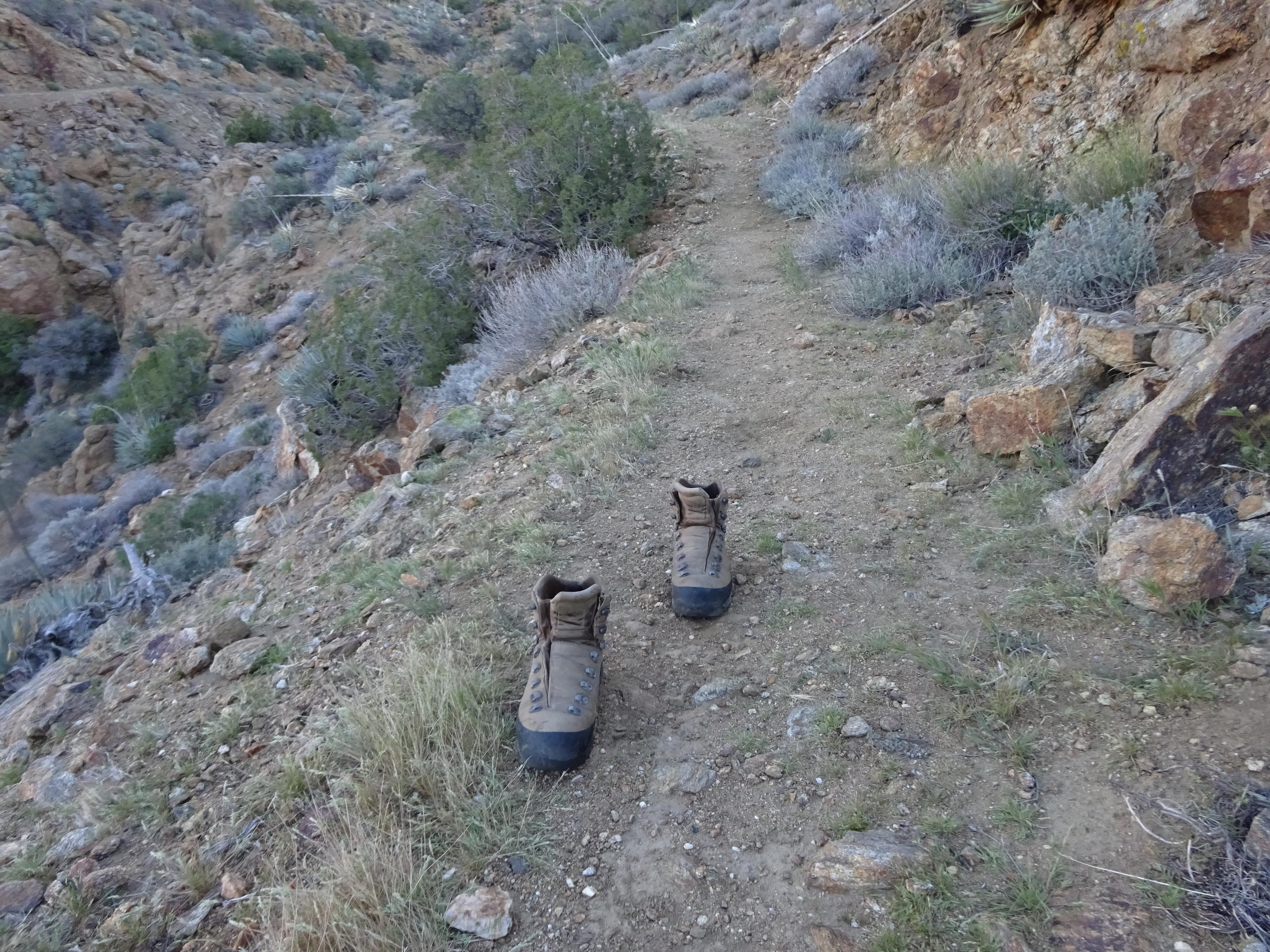
I have seen this on the PCT, indicating that someone decided it would be better to wear their camp shoes for the next couple days of hiking than these boots:

Abandoned boots

I also saw some brand new boots in a hiker box at VVR in the Sierras.

Kelly G BPL Member
PostedMay 27, 2020 at 8:49 pm

“Which makes it frustrating when your manufacturer changes or discontinues your favorite model.”


Oh to find another pair of North Face Pinnacle boots… Can’t they at least keep the same fit, even if they redesign the look and rename the boot?

Todd T BPL Member
PostedMay 28, 2020 at 7:56 am

Trail consistency – causes repetitive motion. Literally 10 miles of the trail outsloping to only one side will cause blisters and even knee injuries. The trail is smooth with a gentle grade. There’s not a lot of variation in your steps.

This is a point seldom mentioned but is one of the factors most consistently correlated with blisters and other foot/leg problems for me.  I loathe “well-graded” trails–they’re a public health menace.

Mike M BPL Member
PostedMay 28, 2020 at 8:22 am

or when you chose to add 25 miles of gravel road to shorten your route in an adventure race; not worth it! :)


HkNewman BPL Member
PostedMay 28, 2020 at 10:43 am

There’s any number of shoe/body interactions that long distances combined with higher mileages that cause or alleviate foot problems (material, size, insoles, gait, weight, etc…). Consider most NOBO long trail thru hikers need to make the border before winter.  Overnighters need to make it back to the car (or other transport) too, but they aren’t banging out max miles almost daily for months with loaded packs.

I do like the breathable trail runner with aftermarket insole combo regardless of hike/walk length though.  Except in the summer mountains where I’ll try to get away with Tevas…

David Thomas BPL Member
PostedMay 28, 2020 at 11:57 am

I find I can wear anything for 10 miles in a day, but beyond that, I need some stiffness in the sole – something that low-cut hiking shoes and most trail runners have but that standard running shoes don’t

As for a consistent trail profile:  Yeah, miles of a trail canted to one side would be horrible.  I’d probably walk some of it backwards and some of it sideways.

Apart from my feet, my lower legs suffer more from a “well-graded” trail like Bright Angel in GCNP than a trail with more variety of profile.  Half Dome should, in every way (elevation at top, elevation at bottom, total climb) be worse than Bright Angel but the Grand Canyon leaves me feeling more sore because while Half Dome has a lot of variety on route, the GCNP main trails don’t.

HkNewman BPL Member
PostedMay 28, 2020 at 12:27 pm

Just read a post on reddit UL about a thru hiker “Sloppy Joe” who walked the PCT with only 1 change in footwear.  The second/last ones for ~ 1000 miles were a pair of used Altras (“pre-owned” is the updated term I believe?).

Somebody somewhere missed a Microbiology thesis …

Mike M BPL Member
PostedMay 28, 2020 at 6:16 pm

Just finished my sixth Bob Marshall Open (100 miles in a little over 3 days), shoes were wet the entire time from other snow and multiple fords.

Hosed them down when I got home, dried them and wore them today getting a little recovery hike in, good as new.

Trail runners work for long range stuff.

Pedestrian BPL Member
PostedMay 28, 2020 at 9:44 pm

“Trail runners work for long range stuff.”

Please add the qualifier…… “for me”.  :)

Not a nitpick but just a fact…..what works for me might not work for you especially when it comes to shoes.

For the past around 19 years I’ve exclusively worn trail runners for trail runs, hikes and backpacking trips….so trail runners work for me too! But I hike with a couple of people who  have all kinds of issues with trail runners; they almost exclusively wear hiking boots.


Mike M BPL Member
PostedMay 29, 2020 at 6:36 am

no, they definitely work as “they can get the job done”

the question was can trail runners work for long distance, rough terrain stuff?- the answer is still yes “they work for long range stuff”

if the question is what is the best footwear for me, then yes please add the qualifier


Viewing 15 posts - 1 through 15 (of 15 total)
Loading...