Topic

Foam Data

Viewing 6 posts - 1 through 6 (of 6 total)
Frank BPL Member
PostedNov 9, 2025 at 6:19 am

There seems to be a lack of useful data on foams used for MYOG padding (hip belts, shoulder straps).  What ASTM data is available, does not seem to correlate well with my personal experience with the foams I have tried.  ASTM test procedures also don’t seem to represent how the foam is actually used.  Before I bore anyone to death, here are results and methodology for Minicell T200 from foambymail, FY20 from owfinc and EVA50 from nunatuk (? I may remember incorrectly).
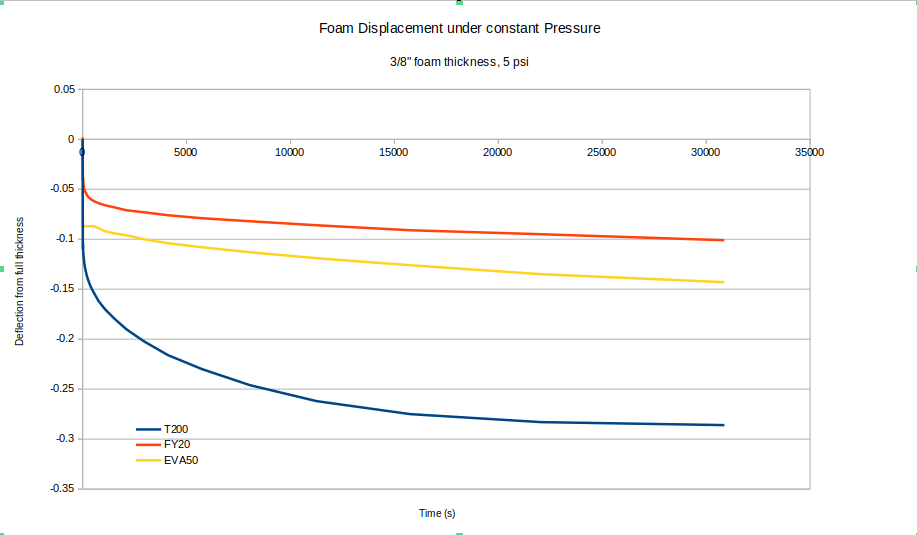
Here is a picture of the test setup.  1″ wide strips of 10mm / 3/8″ thick foam, a 1″ wide block pressing on the foam.  Record deflection from full thickness vs time for 8 hours.


Stiffness of the foams at 13 seconds is 48 psi/in for T200, 131 psi/in for FY20, and 57 psi/in for EVA50.  As time progresses, things change.

Why 5psi?  Seemed a reasonable number based on some rough calculations for carrying 50lb on the hip belt.  I understand that’s not ‘backpacking light’, but it’s a realistic peak load for me.


Rationale:

I used the Minicell T200 for a hip belt and found it became uncomfortable fairly quickly in use.  So I ordered different foams and found an improved experience, but wanted to know why.  There is also quite a difference in cost and availability for the different foams, so it seemed useful to understand things a bit better.

Stiffness (published as pressure to deflect 25%) of the T200 seemed appropriate, and quick & dirty testing showed it matched the provided data.  The ASTM recovery test for 25% deflection (I clamped it in a vise with some .25″ spacers for 24 hours) also looked good.  Actually, better than the replacement foams, despite the replacements performing better in actual use.  This suggested the published ASTM data may not be useful for selecting a foam for use in a backpack hip belt.

Loading in a hip belt is of course not a constant deflection, but a constant pressure extended over time, which the ASTM test data published for the foams don’t seem to cover.  And I couldn’t find any data on FY20 at all.

The test results seem to match my in-use experience of the different foams.  Use at your own risk.

Jerry Adams BPL Member
PostedNov 9, 2025 at 8:00 am

I like your test setup

You must have a sensor that measures pressure, some electronics, and a device to apply pressure?

I have EVA foam on my backpack shoulder and hip belts and I don’t think it does much.  Next time I’ll probably use something different.  This may inform me, thanks.

Sometimes, foam will crush over time.  It’ll be good initially, but after a year it will be much compressed.

Frank BPL Member
PostedNov 11, 2025 at 5:05 am

Setup is simpler than you think.  The springs are calibrated (kitchen scale) so I know how much to compress them to get 5 lb.  The setup loads a 1″ x 1″ piece of foam, so I know pressure.  I am making the 90% correct assumption that the spring force stays constant as the foam compresses.  The only transducer in this setup is a linear potentiometer to measure distance.  Electronics are an ESP32 microcontroller, which has 12 bit A-D converters on board.

Jerry Adams BPL Member
PostedNov 11, 2025 at 7:26 am

I like that even better, using the spring to apply constant force, simple.

I keep trying to think of something useful for a microcontroller and A-D converter to do.

Chris L BPL Member
PostedNov 17, 2025 at 6:36 am

This is super cool, thanks for sharing! I’ve spent way too much time thinking about and testing different foams. Nice to see a more data-driven approach.

I assume the EVA50 from Nunatak is Evazote? I know they were selling that for a while.

It would be interesting to see similar data for recovery after loading. One common issue is foam compressing over time and not recovering.

Frank BPL Member
PostedNov 20, 2025 at 8:42 am

Yep, the EVA50 is the Evazote foam.

The recovery after loading is quite difficult to get usefully correct.  For a single use, all the foams recover almost 100% after 24-48 hours.  But that’s kind of irrelevant.

To simulate things correctly, one would need steady load on top of thousands of variable loads (a tight hip belt + walking), for 8 hours at a time, followed by relaxation for 16 hours, and hundreds of cyles of that.  Probably temperature, moisture, sweat, grit, ?? all play a role as well.  That could be several PhD theses worth of stuff…

Viewing 6 posts - 1 through 6 (of 6 total)
Loading...