Topic

Flowers and Castles in central Colorado … or How I learned to distrust Gaia

Viewing 11 posts - 1 through 11 (of 11 total)
Dan BPL Member
PostedAug 9, 2022 at 7:37 pm

Country United States
State Colorado
Area Central Colorado wilderness named after the “King of the forest” (more details by PM)
Trip Month (08) – August

Report / Notes
This was a great long weekend in an underutilized central Colorado wilderness area, where we circumnavigated one of the most famous geological formations in the state, “The Cs”, approaching via a southern valley, climbing to a prominent pass, hiking across a high ridgeline over the area’s eponymous peak, and its broad shoulders, and returning via a trail-less basin.

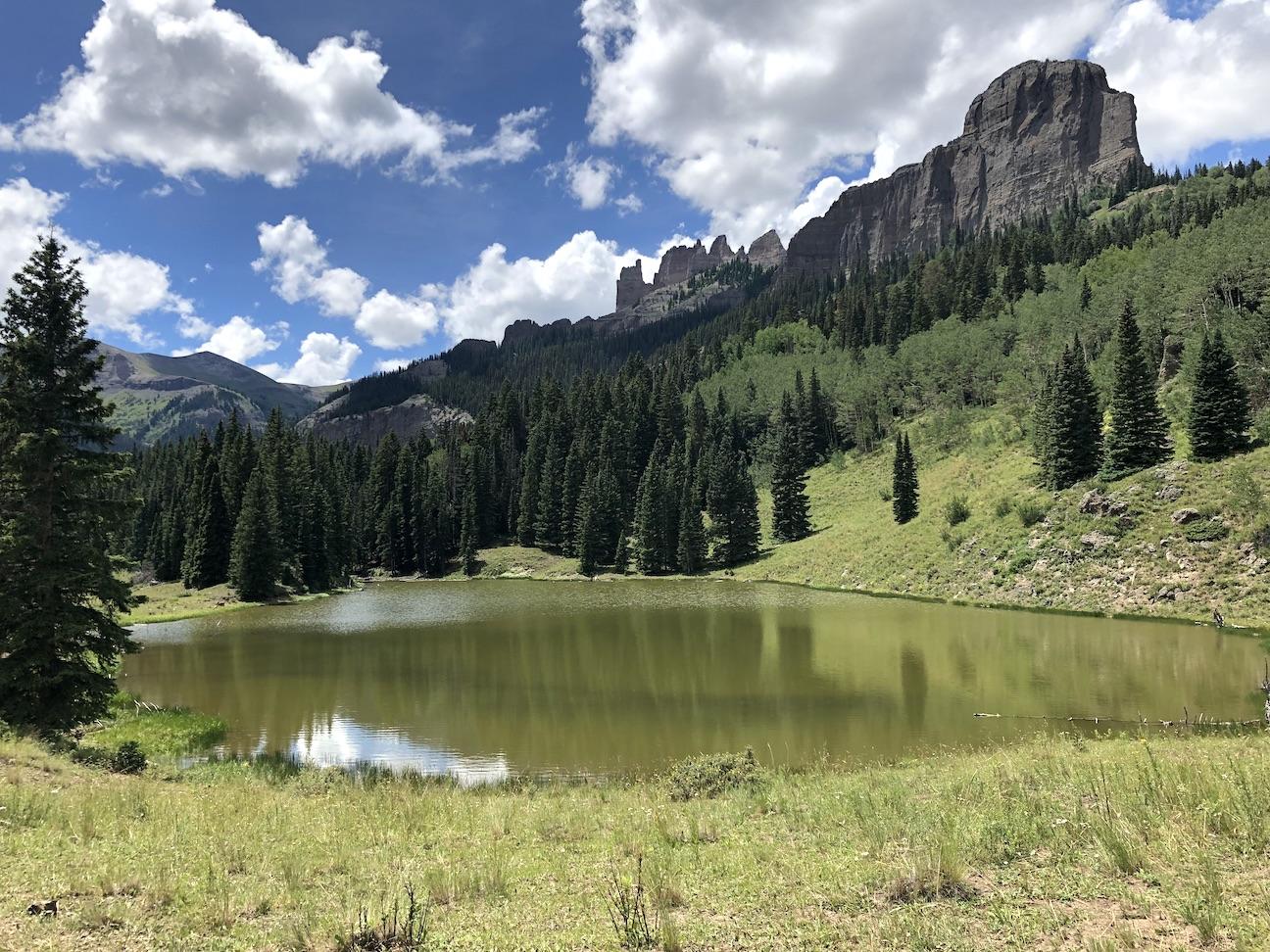
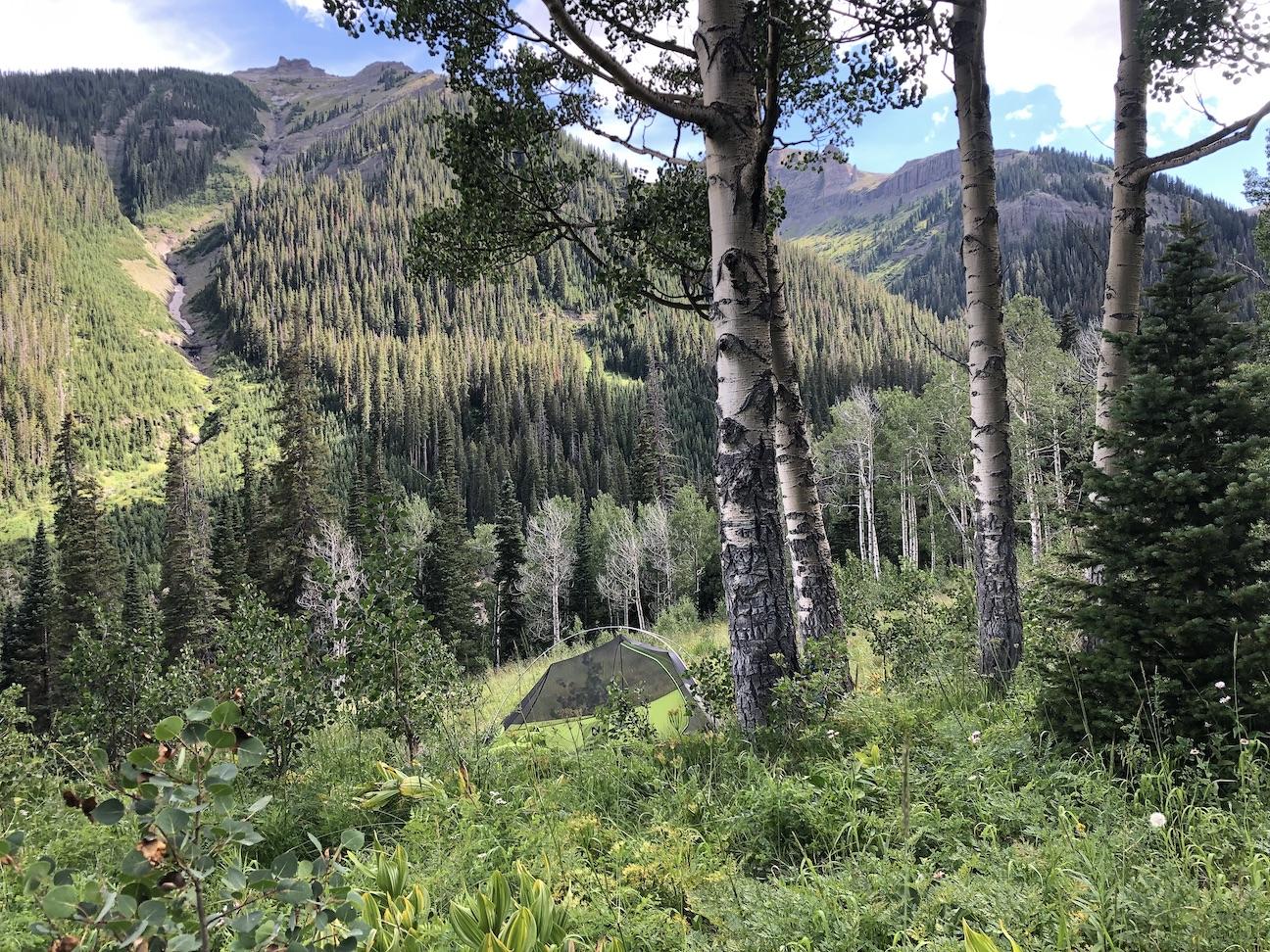
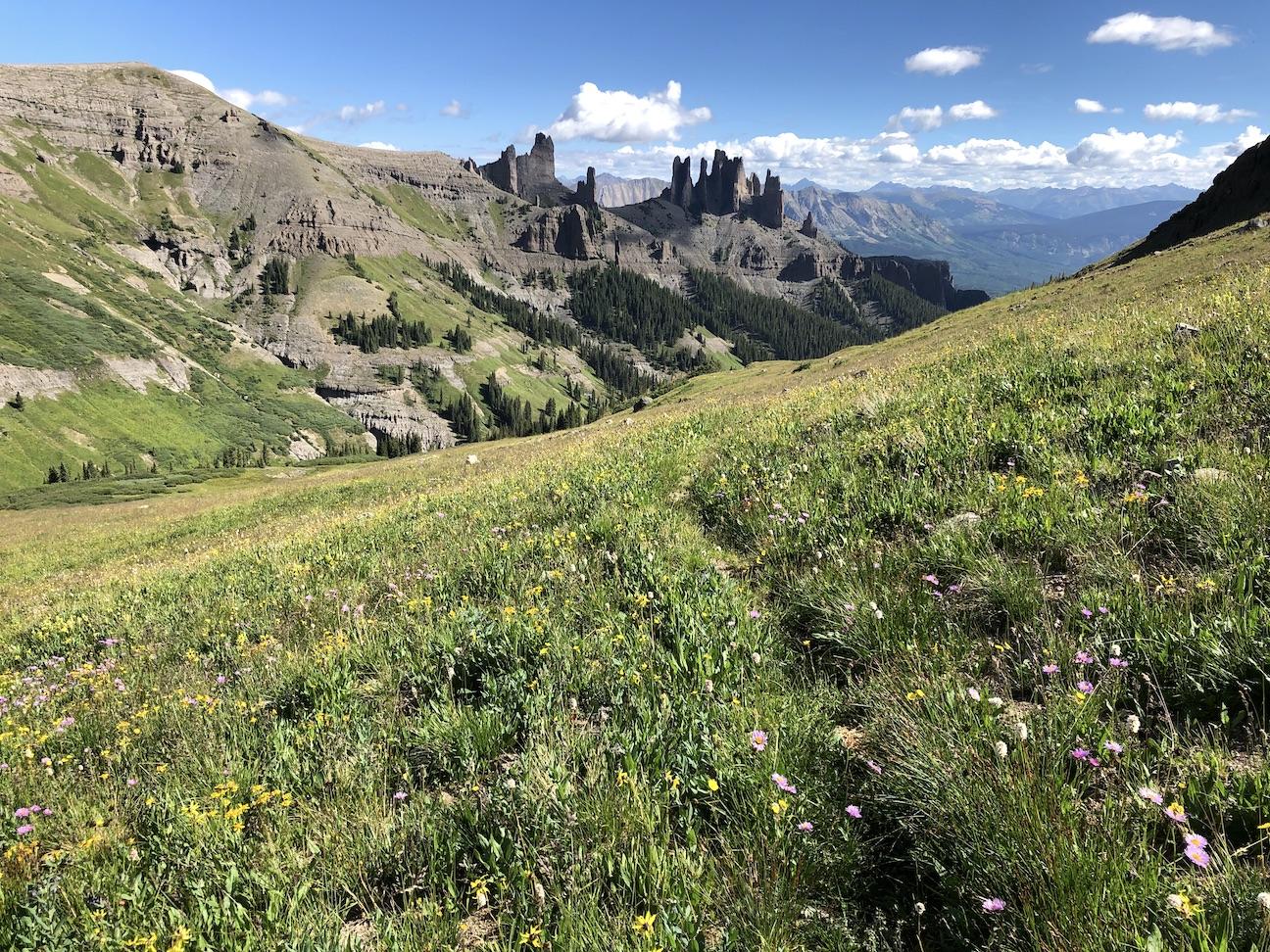
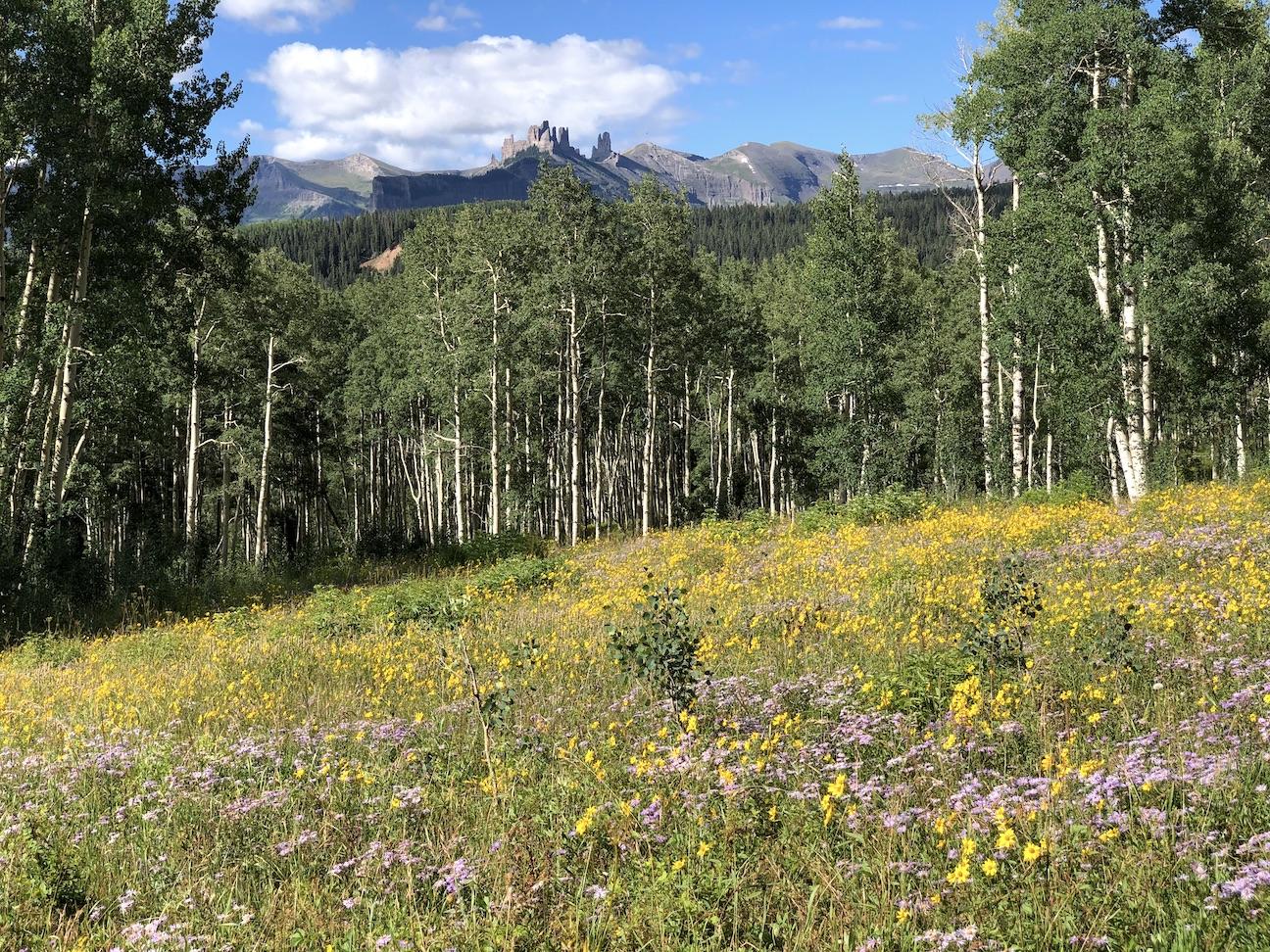
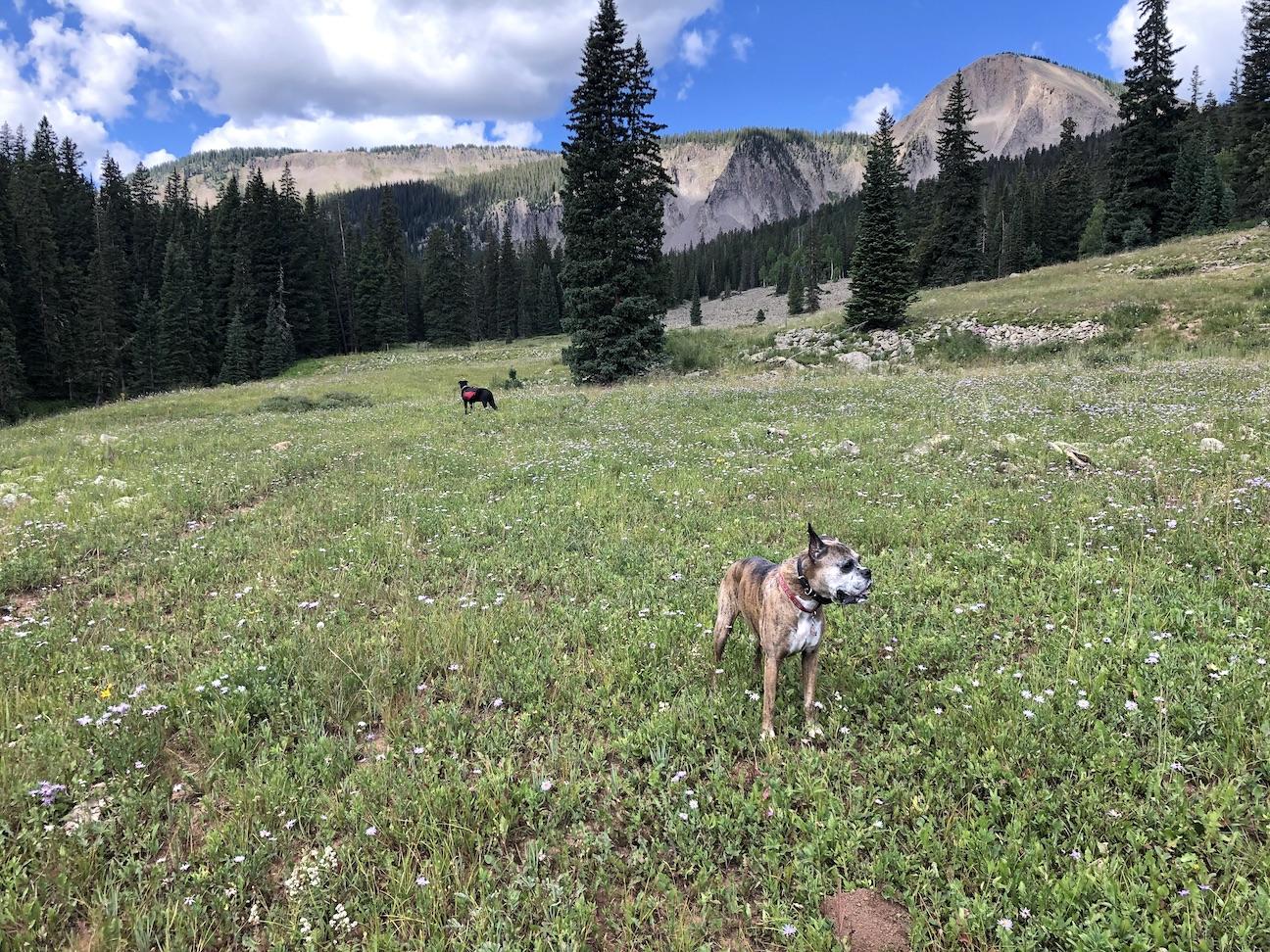
Climbing slightly from the trailhead at about 9000′, the Cs were visible through Aspen forest and wildflowers [1] and the trail gradually rose through pines and spruce [2]. Making our way past some high elevation cattle around south of the Cs, we climbed a valley, passing up a chance to camp at a scenic lake [3] and eventually found a mediocre campsite with a spectacular view [4]. You may notice that I could not find a very level spot for the tent, so unfortunately the dogs were rolling on top of me all night.

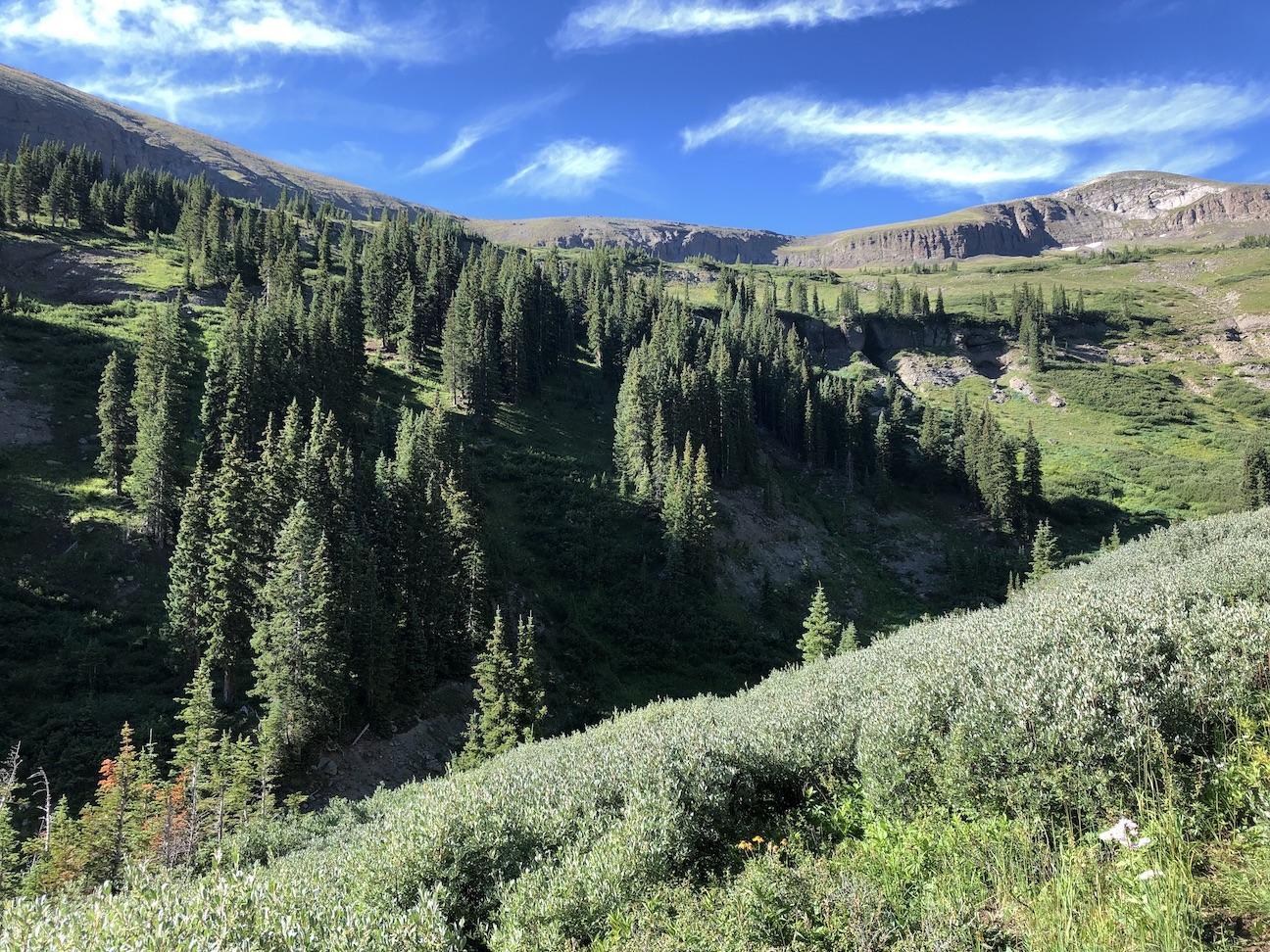
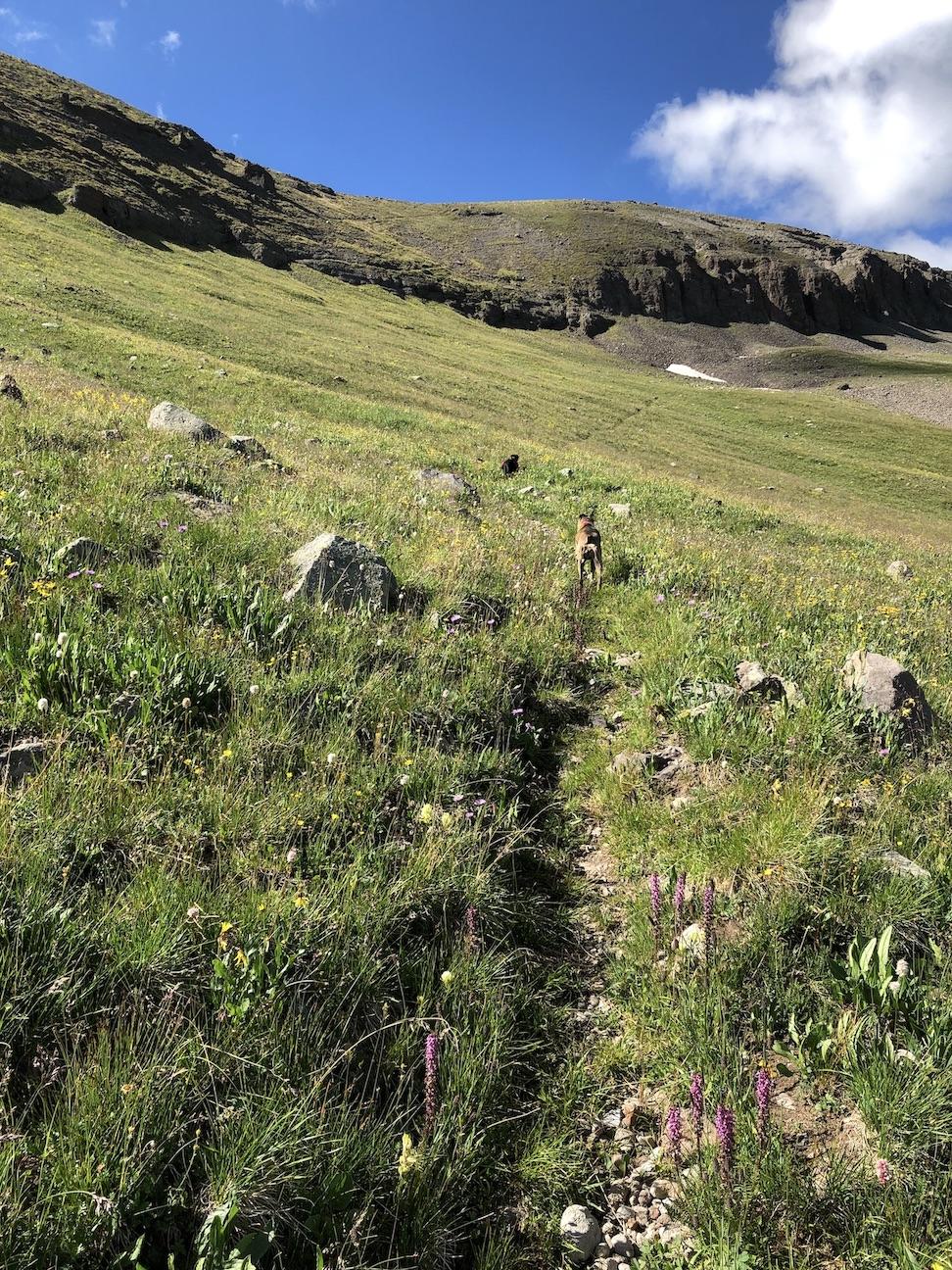
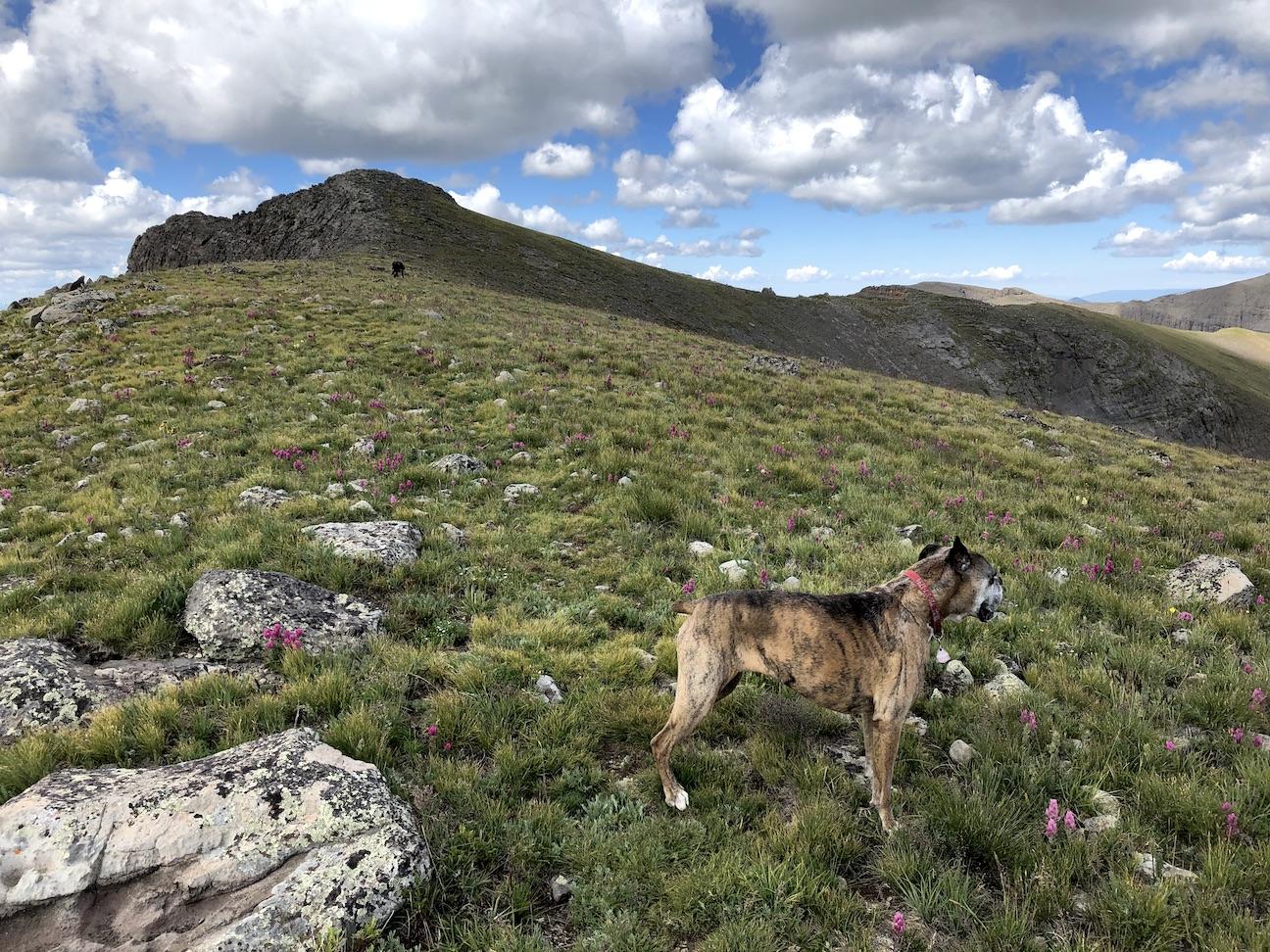
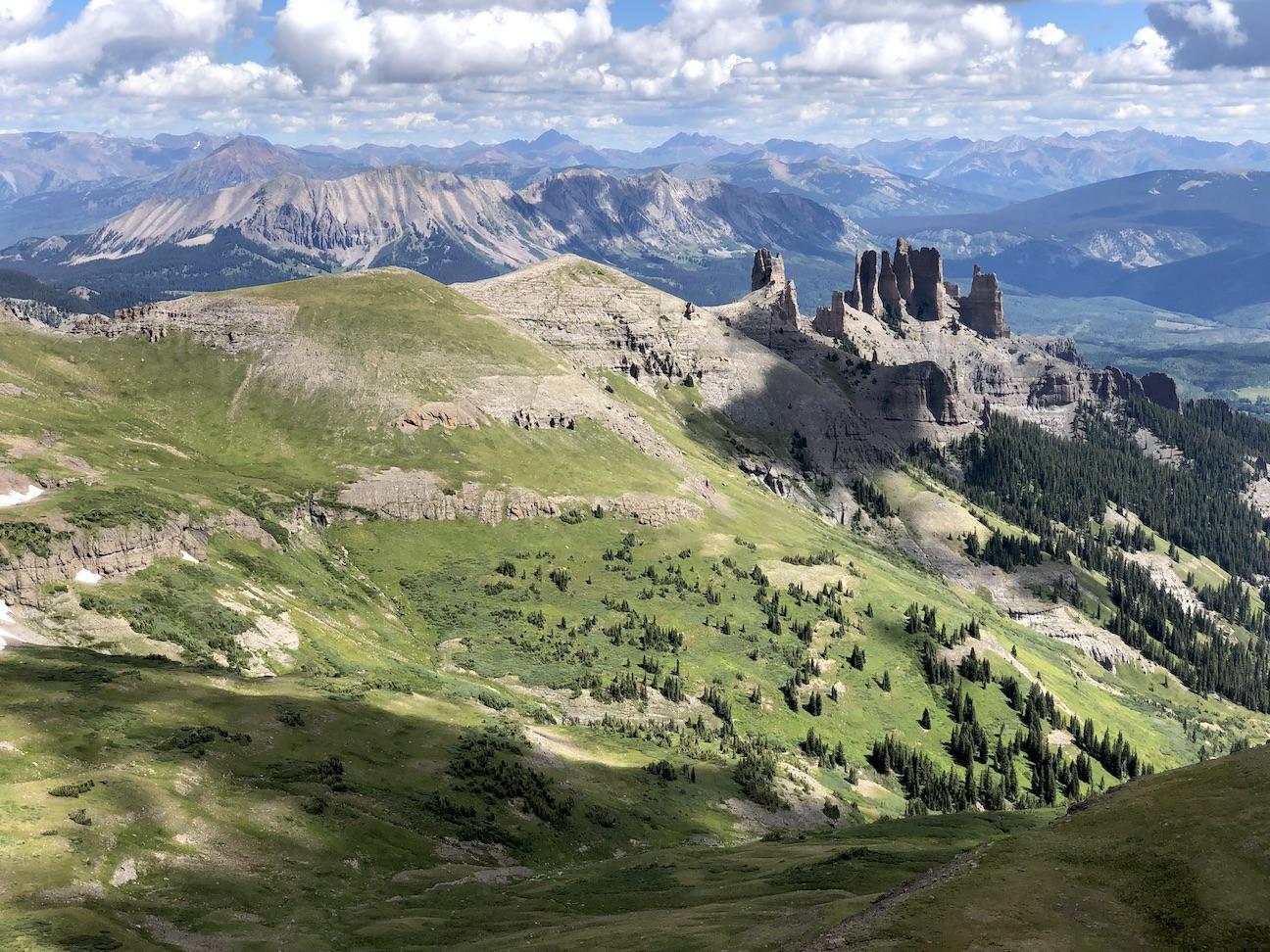
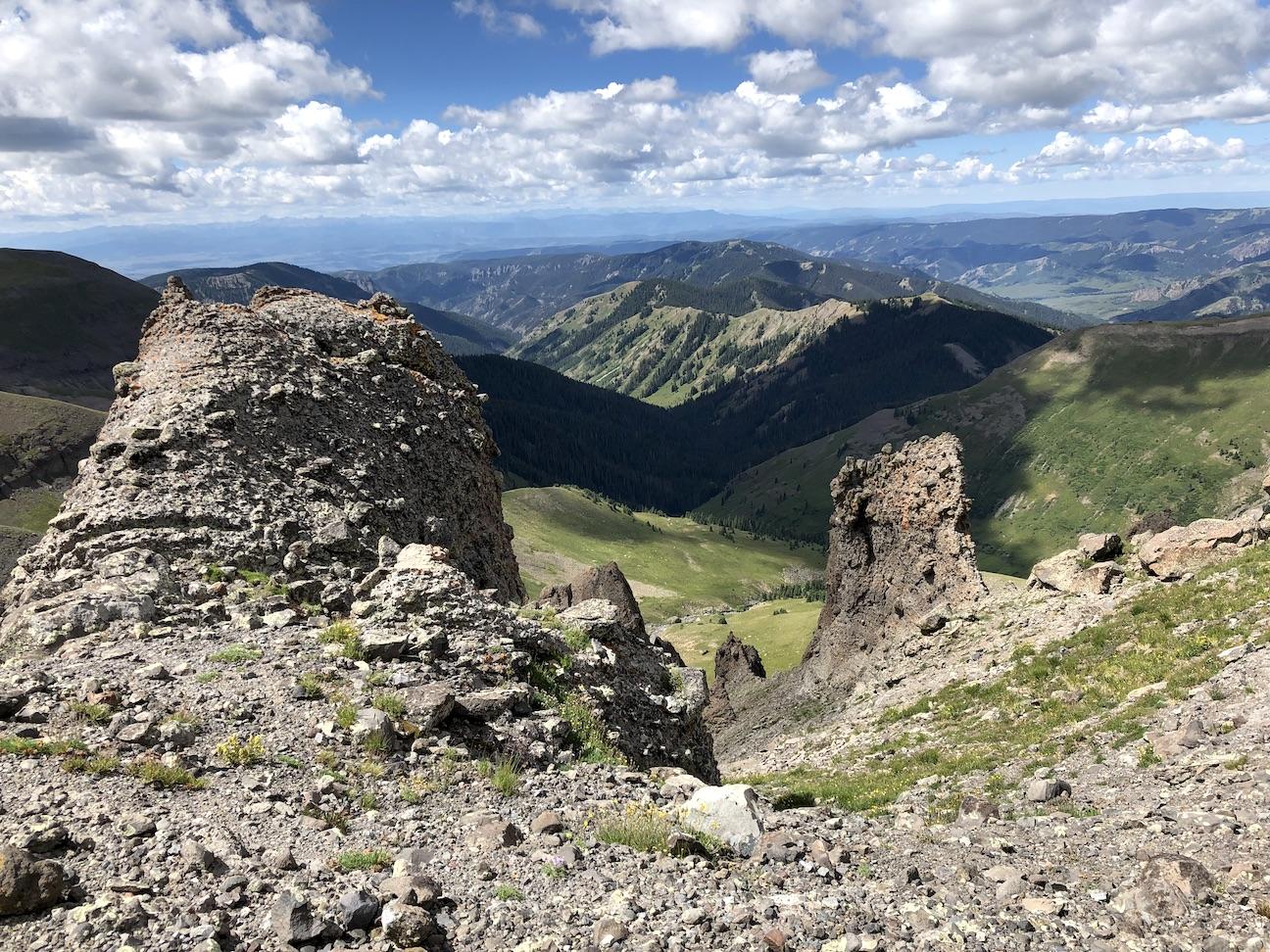
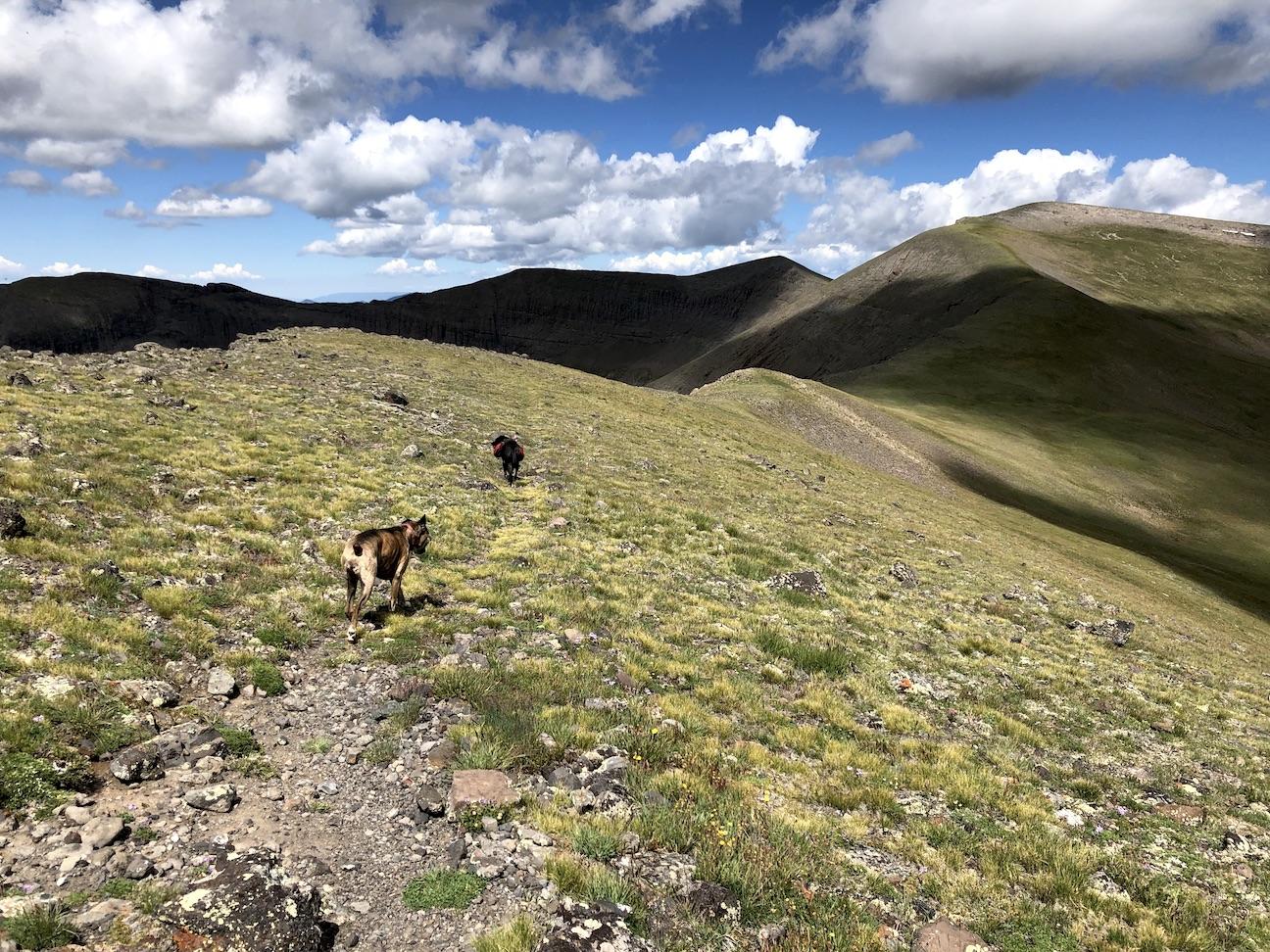
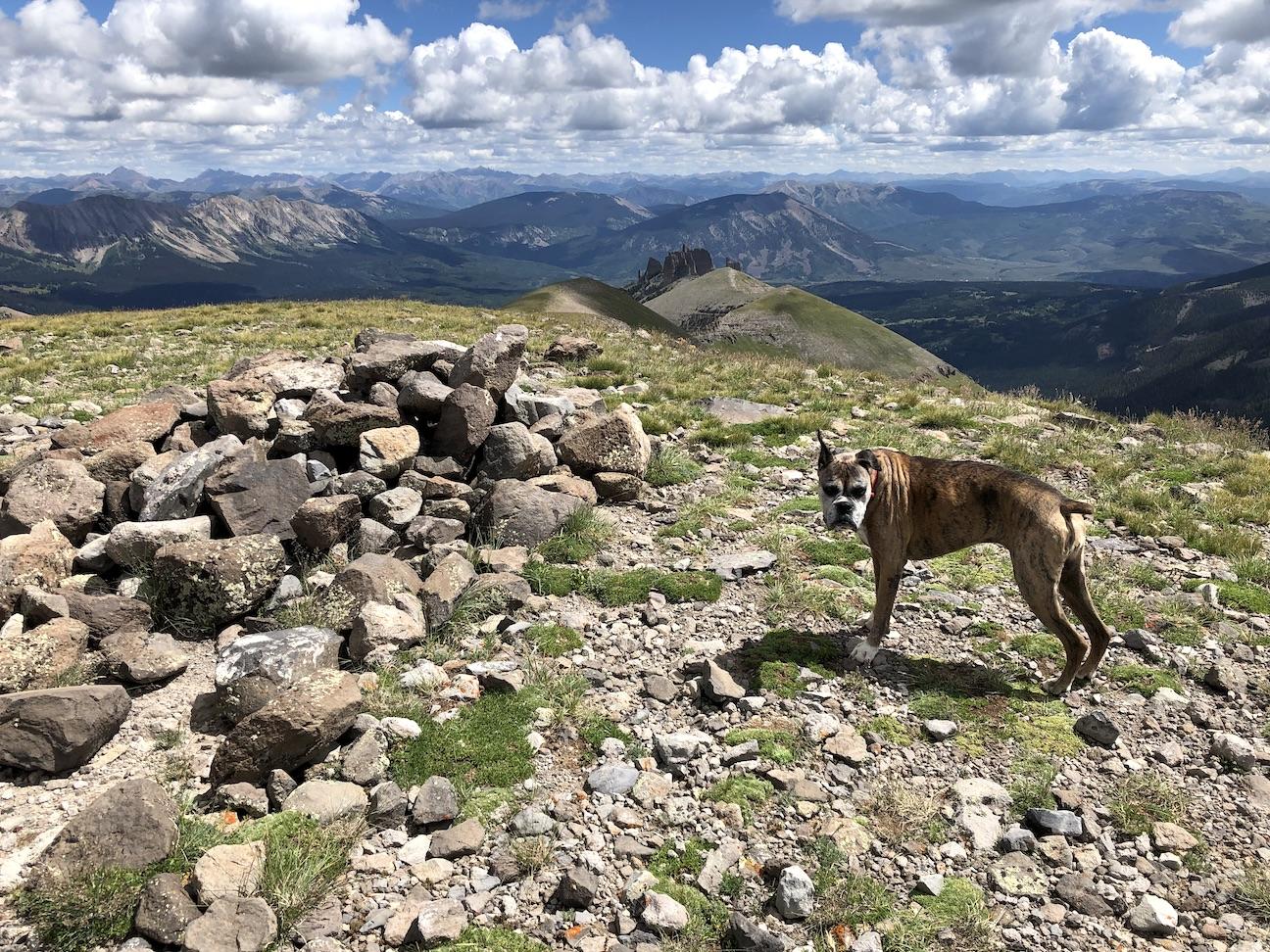
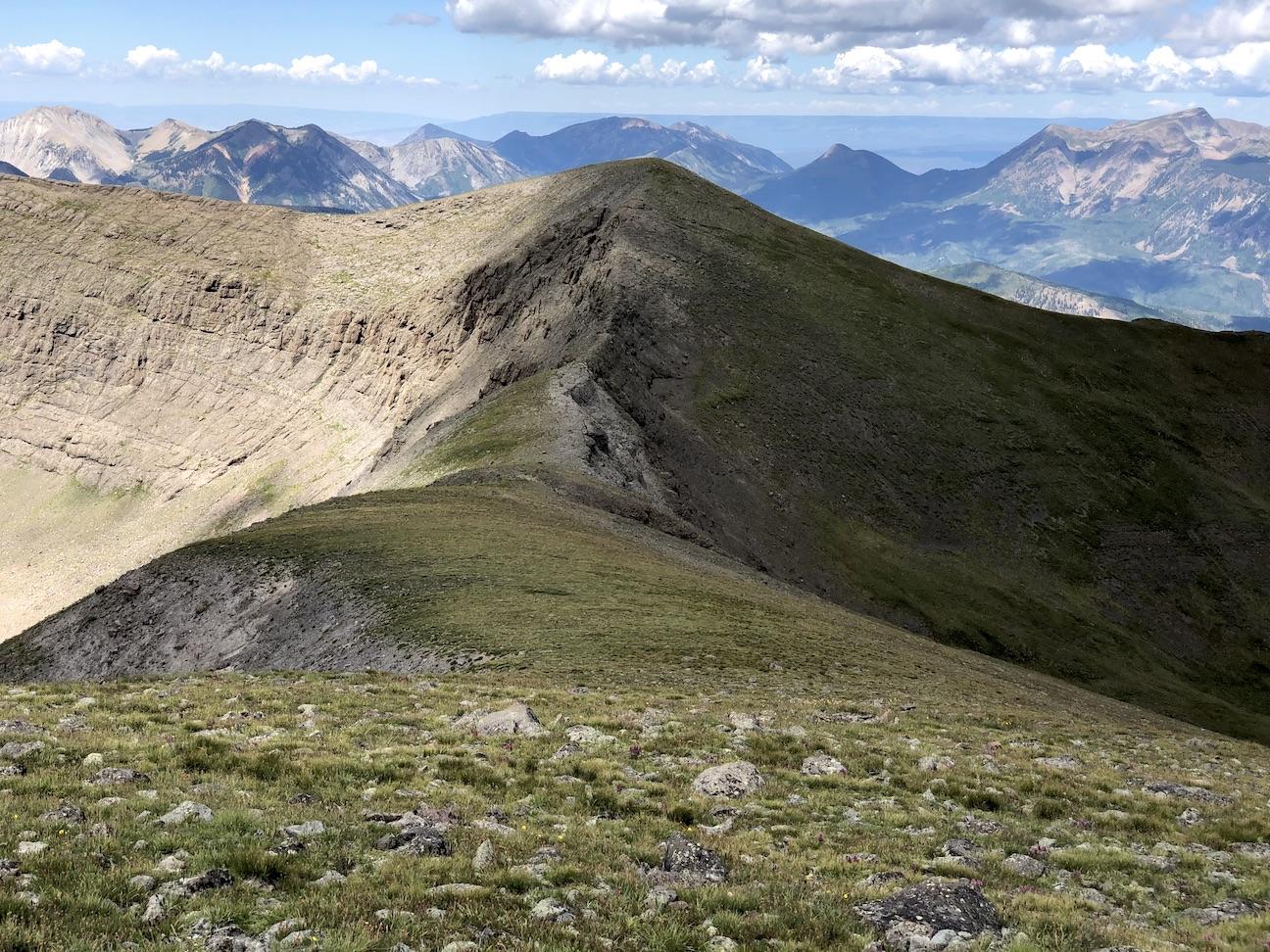
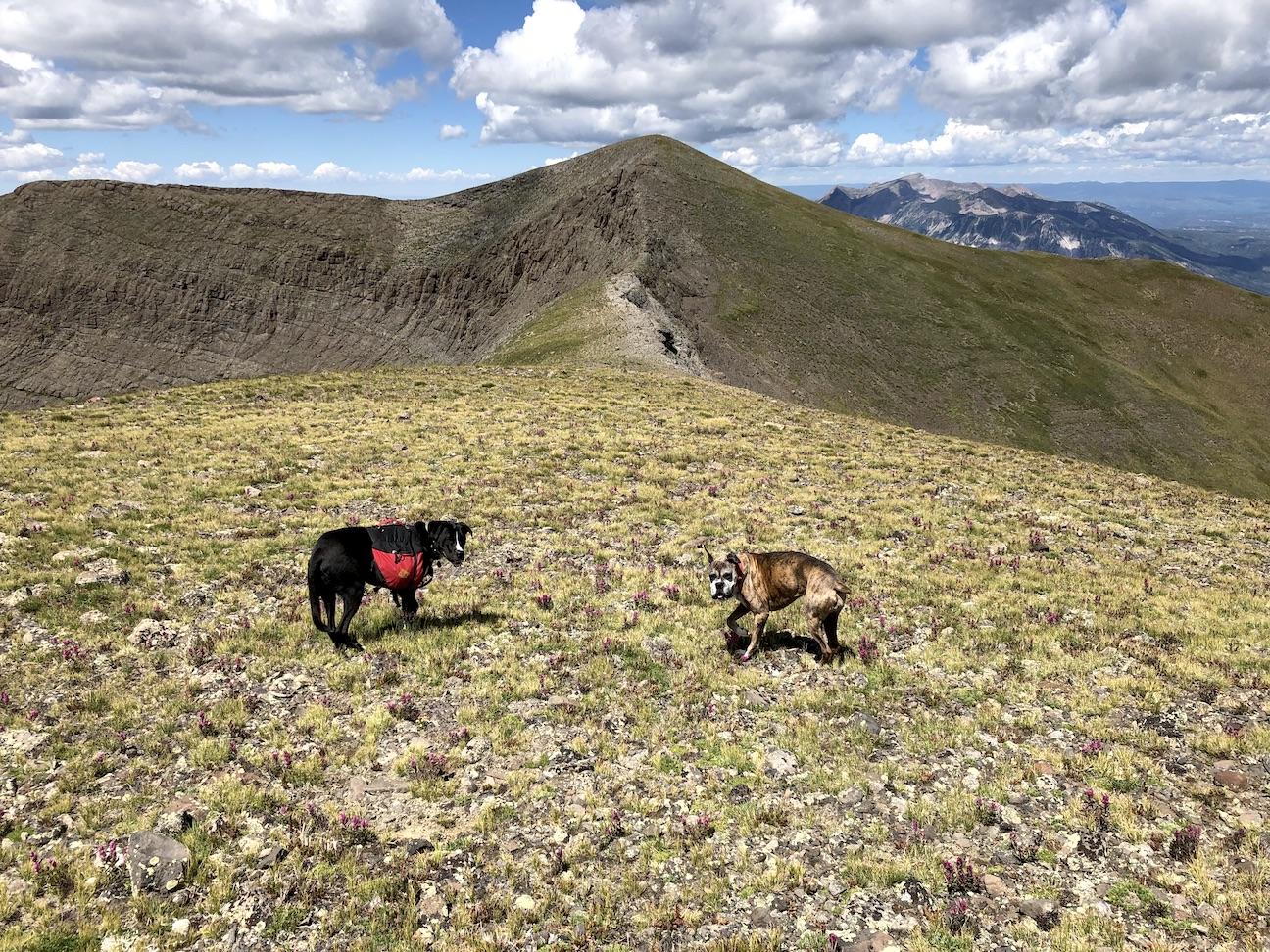
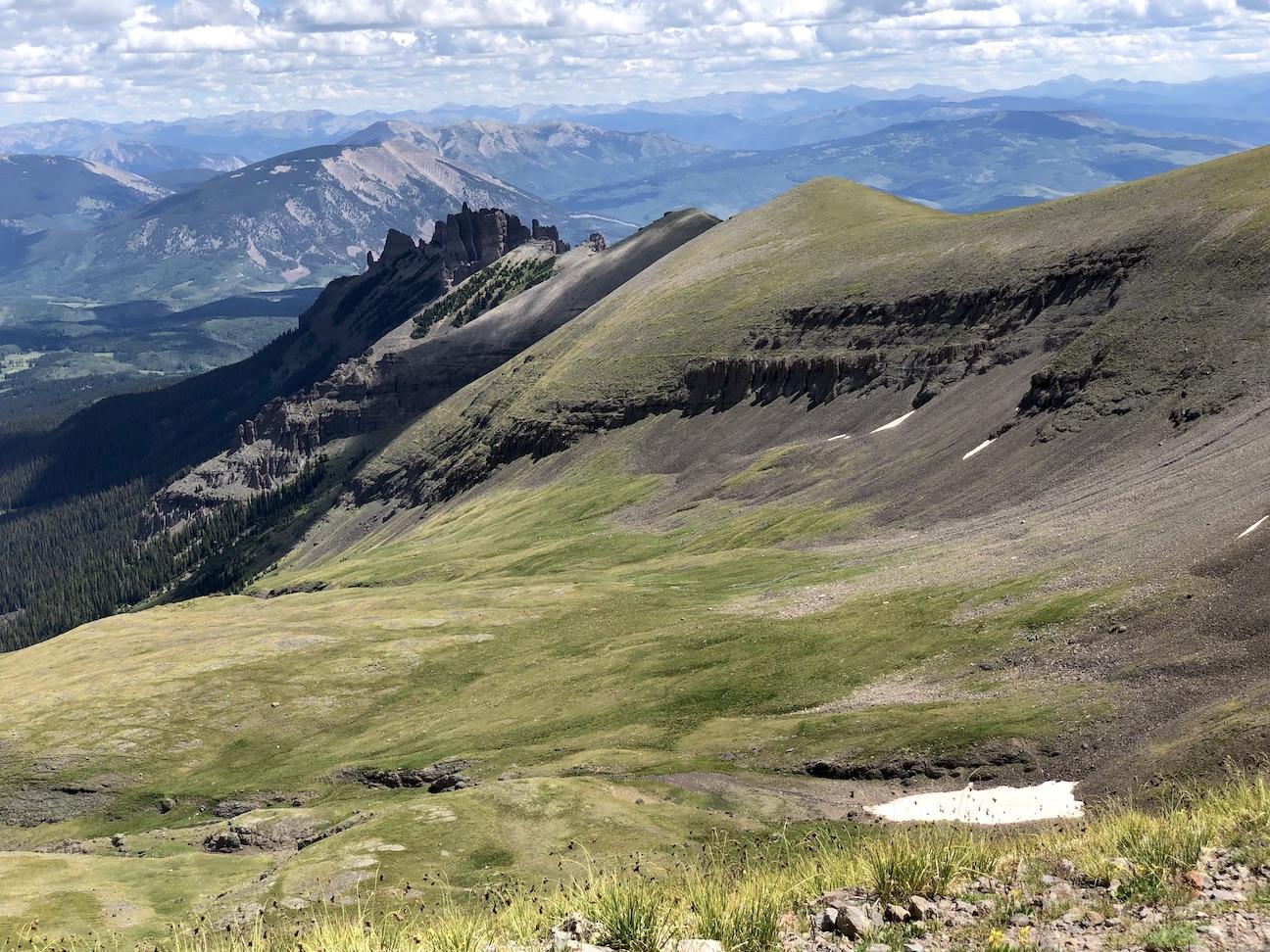
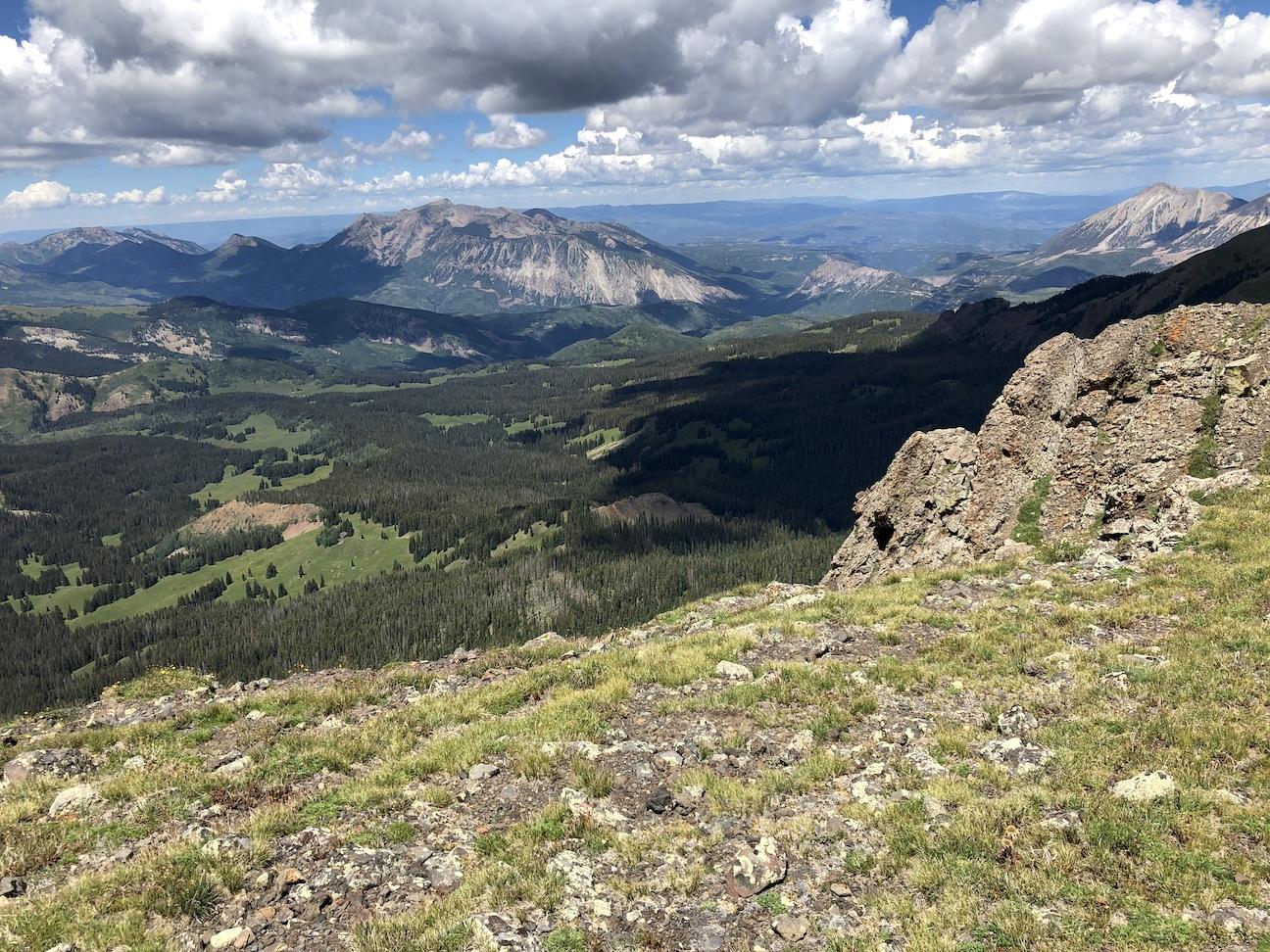
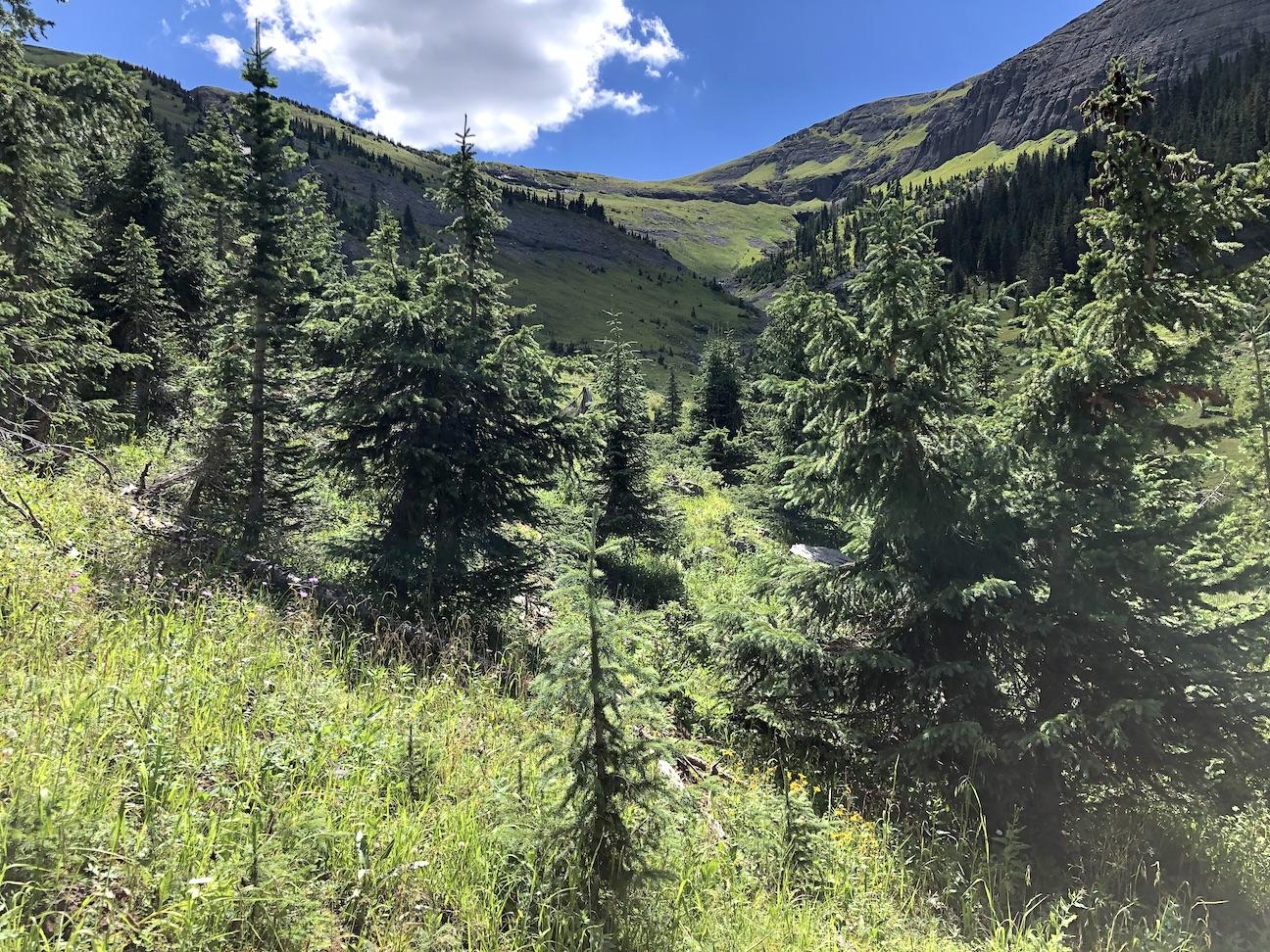
The next morning we continued up the valley [5] and started the climb to the pass, passing from evergreens into flower-strewn tundra at about 11,000′ [6]. Looking back as we climbed, a different view of the Cs was visible [7]. Reaching the pass at about 12,500′, and after a short break for a snack, we started toward the first high point [8] through uncommon fuchsia Indian Paintbrush. Reaching that high point at about 12,900′ we saw yet another view of the Cs [9] as well as panoramic views in other directions [10]. We then continued across a high tundra ridgeline to the peak at 13,100′ [11]. From the peak, the Cs are seen down the ridge [12], and the final section of the ridge is visible to the third high point [13]. At first it was lovely tundra and flowers [14], but soon narrowed to a nervewracking knife edge [15] that tested my trust in my dogs’ footing, especially my old-timer. It’s hard to capture in photos, and to be honest, I wasn’t taking photos when we were at the crux. I’ve learned it’s best to just let them do their thing, but I’d be lying if I said I wasn’t holding my breath a few times.

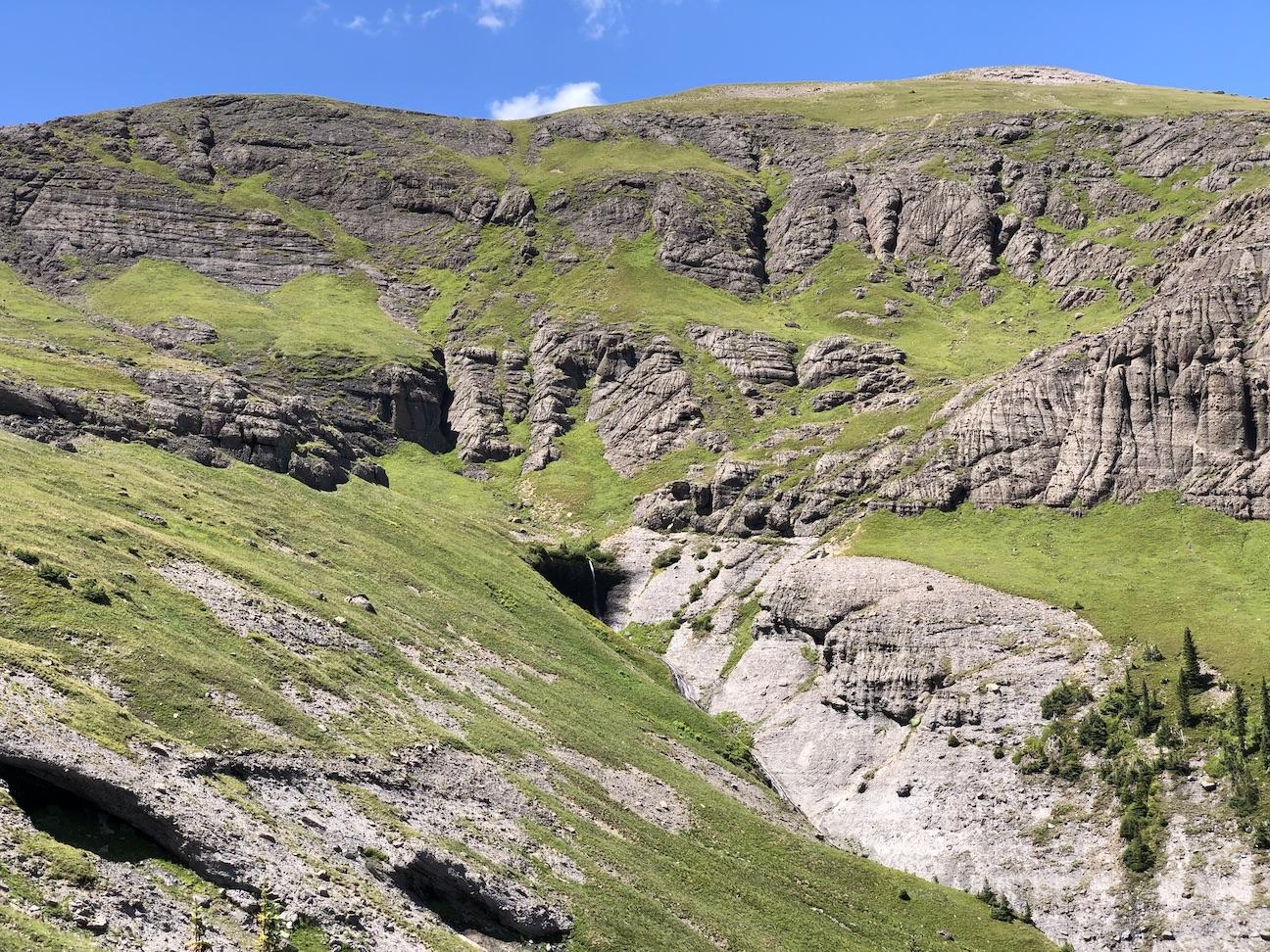
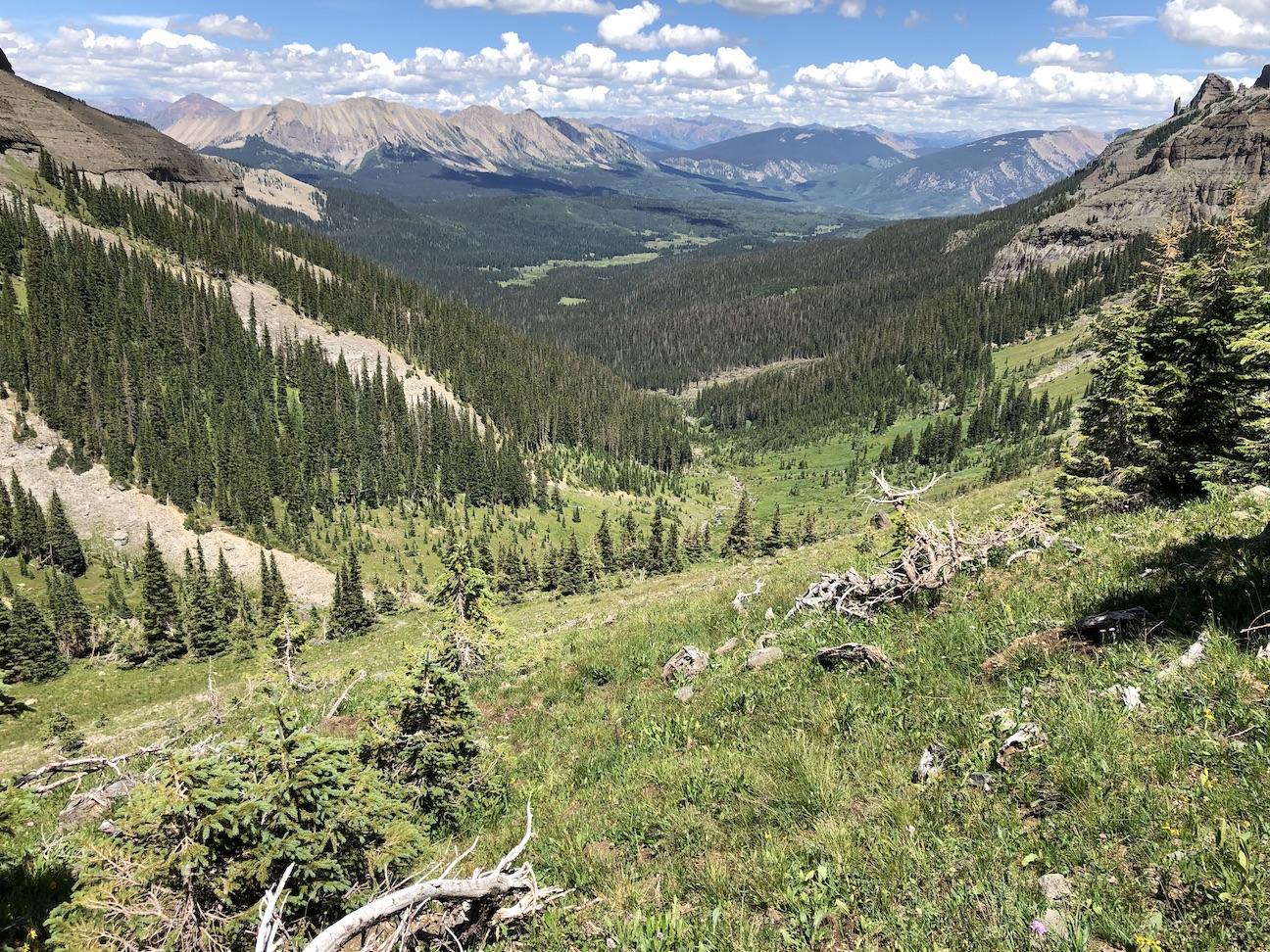
Once across the ridge to the final high point, we looked back at the Cs and down on the basin that we would be descending [16]. Views in other directions were also spectacular from there [17]. At that point, I tried to find the trail marked on the Gaia Topo (but not on a USGS quad), but I wasn’t able to find any cairns or track. Not a big deal really, since it was straightforward to pick our way down through the tundra and rocks. At various point, I used GPS to navigate to the marked trail, and never found anything beyond a faint game trail that soon died out. At one point, the “trail” was clearly tracking a steep boulder-filled ravine that was prominent in satellite photos, but nothing you would attempt to walk down. Ultimately, I gave up on finding the trail in that section, and just enjoyed the 1500′ descent. We saw hundreds of elk, a waterfall [18] and the valley below [19]. Looking back up, the large steep basin was lovely and green [20]. Again, while the setting was scenic and clean water plentiful, a square meter of level ground was not to be found.

The next morning, facing several miles through a steep forested area, I made another effort to find the Gaia Topo trail, which was supposedly running along the main creek near our campsite. I found something plausibly resembling a trail, but after a while, it was clearly diverging from the trail marked on the Gaia map. So I backtracked, and yet attempted again to find the trail near a water crossing. Again, I found something plausible, but it soon degenerated into a faint track that led me into dense forest, totally surrounded by deadfall and boulders. At that point, I had convinced myself beyond any doubt that the Gaia trail did not exist, and turned to plan B. Making the best of the situation, we followed a seasonal drainage to the main creek, and the main creek to the valley, where I found a cattle trail. That was an easy sentence to type, but two taxing hours for gray-face Zelda and me. Max was fine, he lives to explore. It would have been a lot easier if I had known that no trail existed, since I would have just made my own off-trail route from the beginning. Frankly, I was just lucky that I didn’t choose to do the route in the opposite direction, since I probably would have given up because the forecast afternoon thunderstorms limited my time on the ridgeline to early in the day.

In the valley, back on a trail, we ran into the rancher who runs his high elevation cattle in that part of the wilderness, and has roamed the area on horseback for 50+ years. I told him my route, and he confirmed that there has never been a trail in that basin, except for the one I found in the lower part, which was his trail. Very friendly guy, he told me about another adjacent basin with a large herd of wild sheep, which would also be a good future trip.
d k BPL Member
PostedAug 9, 2022 at 11:26 pm

Interesting!  Did you tell the folks at Gaia about this?

Sounds like you managed to have a good time, regardless.

Dan BPL Member
PostedAug 10, 2022 at 6:29 am

Thanks for your comment. We had a great time, I would do it again. Overall, it was just a minor frustration at the end of the hike, and a little adventure.

Ironically, the night before the hike, I was basically flipping a coin to decide which direction to do the loop, and I ended up choosing clockwise because it looked like I would be able to find a campsite farther up that valley, giving me a shorter hike to the ridge on Day 2. That rationale turned out to be incorrect, but it was really lucky that I chose to go that direction. If I had gone the other direction, I would have been trying to follow that fake trail on Day 2, and wouldn’t have made it to the ridge in time to avoid bad weather. The way it went, the bushwhacking happened on a day where I had the extra time.

I didn’t really consider contacting Gaia. I’m guessing they must have thousands of issues likes this, it actually makes me wonder how they acquire their trail data. I don’t think they have an army of hikers out there checking it. But it will certainly change the way I use their topo maps in the future. I will always cross-reference them against quads, and I’ll be pretty skeptical about trails I don’t find on the quads.

HkNewman BPL Member
PostedAug 10, 2022 at 9:12 am

Interesting point about the navigation service, but looks like a nice trip was made from it.

Wonder how many digital trails are leftover map remnants of the old CCC trail building days of the 1930s?   Even as GIS spawned maps were in their infancy, I knew one hiker who delighted in tackling old neglected trails in southern New Mexico (the trails vegetation probably burnt to a crisp in the decade of wildfires since).

Curtis Carmack BPL Member
PostedAug 20, 2022 at 2:06 pm

I have definitely found old CCC trails marked on Gaia that are long gone in real life. That said, they usually also show up on the USGS quads. This seems to be most common in the more remote, less-used areas. The USFS is a shadow of its former self when it comes to trail maintenance. These days I almost always seek out some local beta before committing to longer routes that are not well known.

Dan BPL Member
PostedAug 20, 2022 at 3:56 pm

Good point Curtis, and frankly I would have been happy to find an old decommissioned trail, or a well-traveled social route, that was actually my expectation and in a different part of that trip that’s what I used. I’ve noticed those are sometimes marked with a different color on Gaia. As you mentioned, the USFS is having a really hard time keeping up with deadfall from the various beetle infestations and fires in Colorado wilderness areas, so even official trails are pretty bad these days, and I’m not picky; 20 years of deadfall on a previously maintained trail is more than acceptable for me.

I can usually tell an old trail because even if it hasn’t been maintained in decades there are generally remnants of cairns above timberline and/or old signs of trail maintenance (e.g. old saw-cut logs are often still apparent after 50 years in the Colorado mountains). In this case I looked closely, and there was nothing, and at one point it was clear that the marked trail was following a definite non-trail feature from satellite imaging, which was disappointing. I also checked the current and historical USGS quads after the fact, and there was nothing. I’ve only been using Gaia for a few years, so my experience is limited, but this is the first time it let me down so badly. I will be more careful to double-check and cross-reference in the future. I still would have done the hike without a trail, but I would have taken a different route if I had known I was going to be bushwhacking.

jscott Blocked
PostedAug 20, 2022 at 6:11 pm

skiing in winter on the tahoe rim trail, which was buried in snow obviously, Gaia took me on an old trail that’s no longer the route. It did however have enough indications of being “the” trail (sawed through trees across the trail) that I was sure things were fine. Until I hit a river.

Tahoe rim trail re routed a good amount of old trails into the new system. I was only slightly inconvenienced, and learned to add this variable into my list of things to check when my location isn’t adding up.

Nurses say this too: when things look really odd, check the equipment before assuming the patient is about to crash.

PostedAug 21, 2022 at 5:45 pm

With Gaia or any map program, accuracy depends on map layers. Without knowing precisely which layers were used, its all a wash. I do love historical maps. Think of the survey crews roaming the mountains in the 19th century. Nothing over rides local knowledge. Here in N GA, west NC, E TN, those old logging roads are laurel filled bushwhacks. The old Indian trade routes often became settler routes, hard packed and can be followed. When I lived out west, huge areas of blowdown obscured everything. The Appalachians have those too from hurricanes, but not whole mountainsides. With climate conditions as they are, I think we  can expect maps to become obsolete much sooner than later. BTW, I purchased the Gaia package to get recent sat images. Turns out its not of much help.

Dan BPL Member
PostedAug 21, 2022 at 5:53 pm

Sorry if I wasn’t clear, Bill. The false trail I was referring to was on the Gaia Topo layer, and nowhere else. I don’t know where they get those data, and obviously most of it is good. Maybe my title was too provocative.

When meeting other locals, I love to share information about old trails we have found, and alternate routes to various destinations. Who doesn’t love to talk about stuff like that? The other day I was eavesdropping on my wife talking with our neighbor about some less-traveled routes for peaks in the Maroon Bells Wilderness.

The old rancher I talked to on that trip shared a lot of interesting route information about old forest service trails, maintained cattle trails, informal trails, and bushwhacking landmarks, for the next time I return. None of it would have helped much for the particular route I had planned.

PostedSep 16, 2022 at 6:54 pm

Hey Curtis and Dan, when you are checking the trails against the USGS quads do you mean against the USGS map layer on Gaia? Or is there some more accurate version I should know aboutt?

Thanks

Dan BPL Member
PostedSep 17, 2022 at 6:57 am

Jeffrey, the Gaia USGS map layer appears to be scans of actual quads, so think they should be accurate, and so far I haven’t noticed any problems with them. They don’t look to be scans of the most up-to-date quads, however, so that could be a minor factor in some cases. If you want to check for yourself (or just have the original files), you can always download high resolution PDF files of quads directly from the USGS for free.

https://store.usgs.gov/map-locator

Viewing 11 posts - 1 through 11 (of 11 total)
Loading...