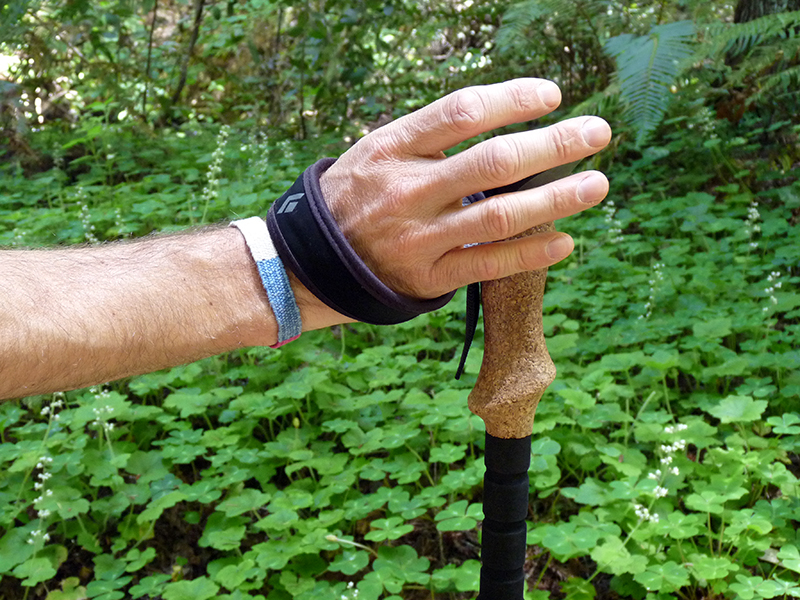
I am amazed at the comments about not using the straps by anyone.
If people had much real world experience with proper downhill and Nordic skiing they would know why straps are on poles.
If you have your straps adjusted properly for fit, and you are wearing straps properly (hand comes upward through the strap), they would realize the strap is meant to support your hand. You hardly ever need to grip the pole. The strap creates a comfortable platform to support your hand, so you do not need to clutch the pole. I rarely use more than lightly guiding the pole to the location I want to plant it, with my thumb, index, and middle finger.
If you have done much Alpine and Downhill skiing, you know the poles are used slightly different. My use for almost all uphill use is very much like the Nordic poling technique. Google some video of Nordic skiers poling technique if you are unfamiliar with it. Swing your arms naturally with your stride, and the pole tip will plant alongside your foot, ready for your extended arm to pull on. You’ll be engaging your whole upper body muscles. This is almost the same as using a railing going up some stairs.
Going downhill for me, is almost the same as proper pole planting while downhill skiing. You don’t need to stab the ground, you just need to position the pole tip where you need it to be, slightly downhill, again much like reaching for a rail going down stairs.
I am 6’2″ tall, and also use my poles much shorter than almost everything I read about. My poles are usually at or near 105cm long. Why?
If I use a shorter length setting on my poles my arms are almost straight, much like when I am hiking with out poles. I’m not having to bend my arms much at all. Reaching and bending requires more muscular effort. More importantly, with my arms almost straight, I can rely on my skeleton to support most of my body weight on the pole, instead of muscle.
We walk around with our legs slightly bent for a reason. Less effort. We don’t walk around in a squat position most of the time because that would require much more muscle use and we’d fatigue much faster. Try this. Stand away from a wall about 2 1/2 feet and lean on the wall with your arms straight or slightly bent. Count how long you can hold that position. Now do the same, except bend your arms at the elbow about 30-40 degrees bent. count how long you can hold that. Get the picture?
When your poles are too long you are having to “lift” your poles (effort) with every step to clear the ground with the pole, and you arm is in a more bent angle, which needs to use more muscle every time to press on the pole (effort).
If you are using the poles shorter you naturally swing your arms like you are walking without the poles, but the swing carries the shorter pole length and swings it to where it needs to get placed. Less effort. It also uses your skeleton structure as need to do more of the supporting or pulling effort as needs. This allows you to engage more shoulder and torso muscles into the effort, instead of just arm muscles.
If you give this a concentrated effort to learn it, I’m pretty sure you will be adopting it, and saving a lot of effort each mile, as you do it. Don’t dismiss it without giving it a few miles on a trail with elevation and mixed surface terrain.
At 6’2″ tall, and using a single pole for supporting my Tarptent Aeon Li tent, I use Black Diamond 105-125 cm. poles. Good for hiking and setting up my tent.
Hope this helps.