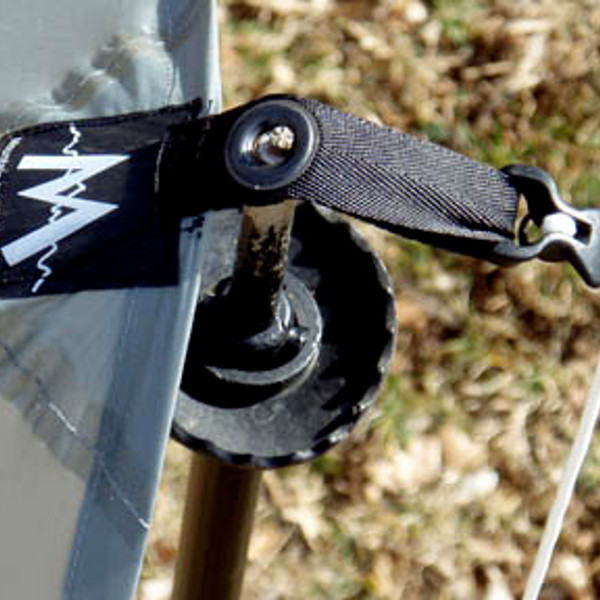
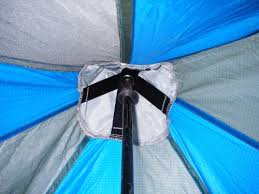
That clarifies things.
First, go grip down, tip up. The floor of your tent will fare better w/ the larger, rounded surface of the pole handle pressing it in to the dirt than the sharp edges of the small metal bit.
Presumably, you’re putting a pole at either end of the ridge line, and both ends of the tent are closed with a vertical wall. This creates a point at each end where 3 felled seams meet, joining 3 panels (2 sides of the roof, plus the vertical wall). Reinforce the corners of all 3 panels w/ a small triangle of the same material the panel is made off – this way both layers stretch the same and share the load equally.
You can break the task of connecting the pole tip to the tent in to three separate concerns: transfer the load from pole to tent; secure the position of the pole relative to the tent; protect the tent from the pole tip.
Three felled seams joining doubled panels creates all the strength we need for the first concern; this part is pretty obvious. So we need means to keep the pole where the 3 seams converge, and make sure the tip doesn’t cut any of the fabric threads we’re placing under tension.
Consider a strip of webbing. Fold it in half and sew the edges together on each side – now you’ve got a tube with a closed end you can slip the tip of your pole in to. Since you folded the webbing, there’s no seam at the end for the pole tip to slice through under load. Better still, put a short, second layer of webbing where the crease is and fold so this is on the inside – that become a bit of padding for the sharp tip. Since the pad is too short to connect to anything else, it won’t get any tension placed on it, so much less likely to get cut through by the pole tip. This covers the third concern of protecting the tent from the sharp tip.
Place the closed end of this little tube where the 3 tent seams meet. Sew the edges of the webbing (where you’ve already put a line of stitches) to the vertical end wall of the tent. This locates the tube to transfer load where we want it. You’ll be sewing through the doubled layer of the tent, and the load here is low – just stabilizing. A more secure implementation would have you sew the center of the long, outer webbing strip to the point of contact with the felled tent seams before doing anything else. And this addresses the remaining concern of locating the pole relative to the tent.
No metal grommets, no punched holes, no heavy fabric. Just 6″ – 8″ of webbing for each pole.
I haven’t used this on a tent as described, but I have used folded grosgrain pole pockets successfully on a tarp and a frame pack, both with carbon poles, although not a lot of use on either.