The more i’ve thought about it, the more i like the basic concept of a combined pulk-shelter, especially after reading the article that Alpo shared about Cameron Smith’s mostly successful design and implementation.
The goal of design is a combo of lightness and durability at relatively low cost.
These are some initial material and design concepts. Overall design will be similar to Smith’s pulk-shelter or sled hut as he calls it. A base raised up off two skis, with a hinged at one end top that can be raised or lowered according to need, and when raised–held up by two poles. The sides and back side will be tough fabric.
Main pulk-shelter materials (composites). A BPL member very generously offered to give me some kevlar fabric, which will help to make the whole project significantly cheaper.
The main part of the pulk-shelter will be a foam core epoxy wrapped in a combo of kevlar, cuben fiber (Dyneema), and woven bamboo matting–the size of bottom and top panels will be roughly 3.5′ wide by 7′ long. I recently read that kevlar does not bond as well as carbon fiber or glass fiber in an epoxy matrix. To help that some, i would first cover most of the front/top of foam with horizontal/vertically placed, epoxied kevlar. Then foot wide .34 oz/yd2 Cuben fiber strips will be placed and bonded strategically over the kevlar and to the non covered part of the foam. The crinkled mylar should bond fairly well with the epoxy, then repeat the process over the bottom/back of the foam core.
Then woven bamboo mat (can be sourced for 25 dollars for a 4’x8′ sheet) will be epoxy bonded over the foam/kevlar/cuben composite. The woven bamboo matt/epoxy will add some impact resistance and some stiffness–sort of like a weaker, less stiff, but lighter carbon fiber (density of carbon fiber is 1.75 and density of bamboo ranges between .3 to .4 so bamboo is significantly lighter). Then a thin layer of perhaps some Kevlar with some cuben over same, or some thin fiber glass over the woven bamboo matt. Since this is not a boat, car, etc, and it will only need moderate impact resistance for occasional possible flips, the epoxy composites over the foam won’t need to be too thick.
Bamboo has been successfully used in epoxy composites in various applications as well as tested in studies. When combined with the right materials and done the right way, it’s like the poor person’s carbon fiber, but not as stiff and strong. With kevlar/cuben fiber/epoxy reinforcement, it should be plenty strong. All of these materials have certain strengths that complement and balance out each other’s weaknesses. Kevlar’s weakness is compression and sanding, cuben fiber is abrasion, cost, sanding, lack of stiffness, foam is tensile and young’s modulus strengths, bamboo’s is biodegradability (epoxy and then UV coating changes that a lot), and glass fiber is weight–rather weight to strength ratio (that’s why only one or two thin layers on the very top). While carbon fiber is not being used, it’s main weakness is cost, and to a lesser extent, weight though it’s very all around strong and durable for the weight.
The foam core of course will add lot’s of insulation and make it a lot easier to do, because then waxed molds won’t have to be done, the foam will act as the basic shape.
There will be some holes cut out of the top piece and over the holes will go a combo of breathable, fairly tough nylon (like RBTR’s 2.2 Hex70 for the outer and Robic for the inner with Apex in between). This is to faciliate venting.
Further facilitating venting will be the fabric sides. It seems like in Smith’s pulk-shelter, they used a heavy duty, waterproof material for the sides. Instead of that, it will be the same combination of RBTR’s 2.2 Hex70 (for outer)+Apex+Robic inner.
Carbon fiber will be used for the poles to hold it up in shelter mode. What i haven’t figured out, is what to use to hinge the top to the bottom. Stainless steel and especially aluminum alloy’s apparently work very well in extreme cold temps. Any suggestions along that line are welcomed.
It’s hard to say how much the final weight will be. A VERY loose guesstimate is somewhere between 15 and 25 lbs, but i really have no idea yet.

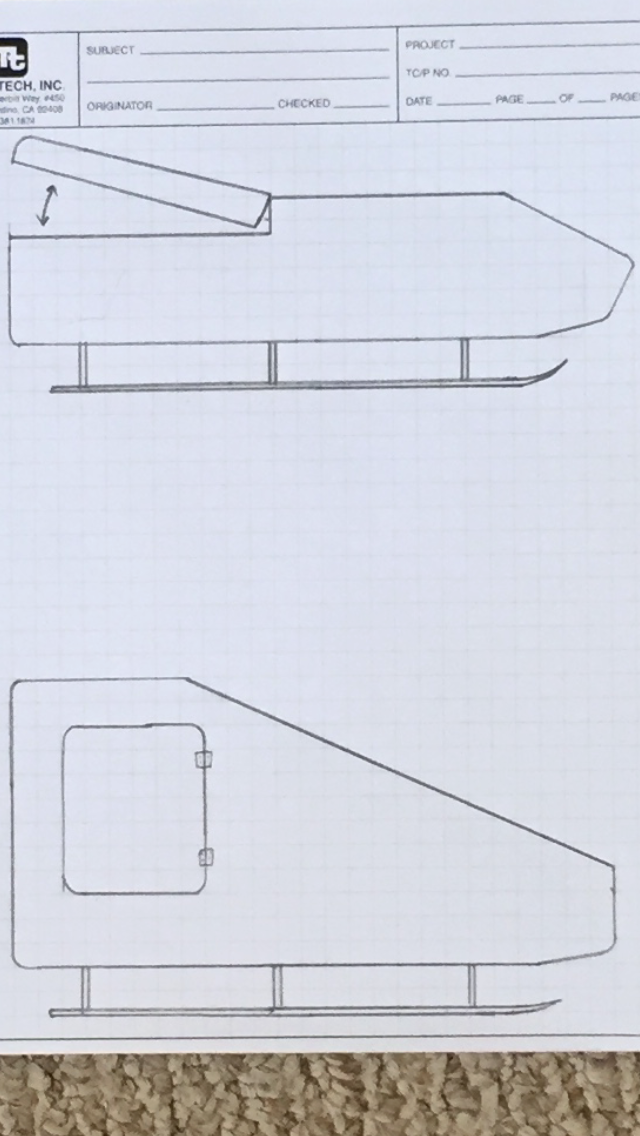 Obviously, I’m a trekkie because these things look like photon torpedoes and TOS shuttle craft.