


Hi – having just acquired a ’23 Bolt EV, I’m wondering if anyone else with a similar vehicle has experience with what are the most efficient routes to get to the Eastern Sierra (e.g., Mammoth lakes) from the SF Bay area in the summer?
Topic
Become a member to post in the forums.
.
Hi – having just acquired a ’23 Bolt EV, I’m wondering if anyone else with a similar vehicle has experience with what are the most efficient routes to get to the Eastern Sierra (e.g., Mammoth lakes) from the SF Bay area in the summer?

When I rode with a friend who had a Tesla, there is a station at the Chevron near Topaz Lodge and then 1-2 locations in Mammoth Lakes that we stopped at. I’m not sure if you have an adapter that works on Tesla’s chargers. And yes, it is better to drive up to Gardnerville as opposed to Monitor Pass.

Having bought a 2017 Chevy Bolt from a BPL friend in Berkeley and driving it up I-5 and the Alaskan Highway to Kenai, Alaska (3500 miles total, Seattle to Kenai: 2,500 miles in 3.5 days) . . . .
Use ABRP (A Better Route Planner) app. You can set minimum charges, speed versus cost, etc. If you want fast, especially in a Bolt, it’ll have you getting down to 10% so more of your time at DCFCs is closer to 50 kW and not the 25, 15, 7 kW and lower rates as the battery is more fully charged. ABRP factors in traffic speed, elevation and, I think, temperature in figuring your range on each charge.
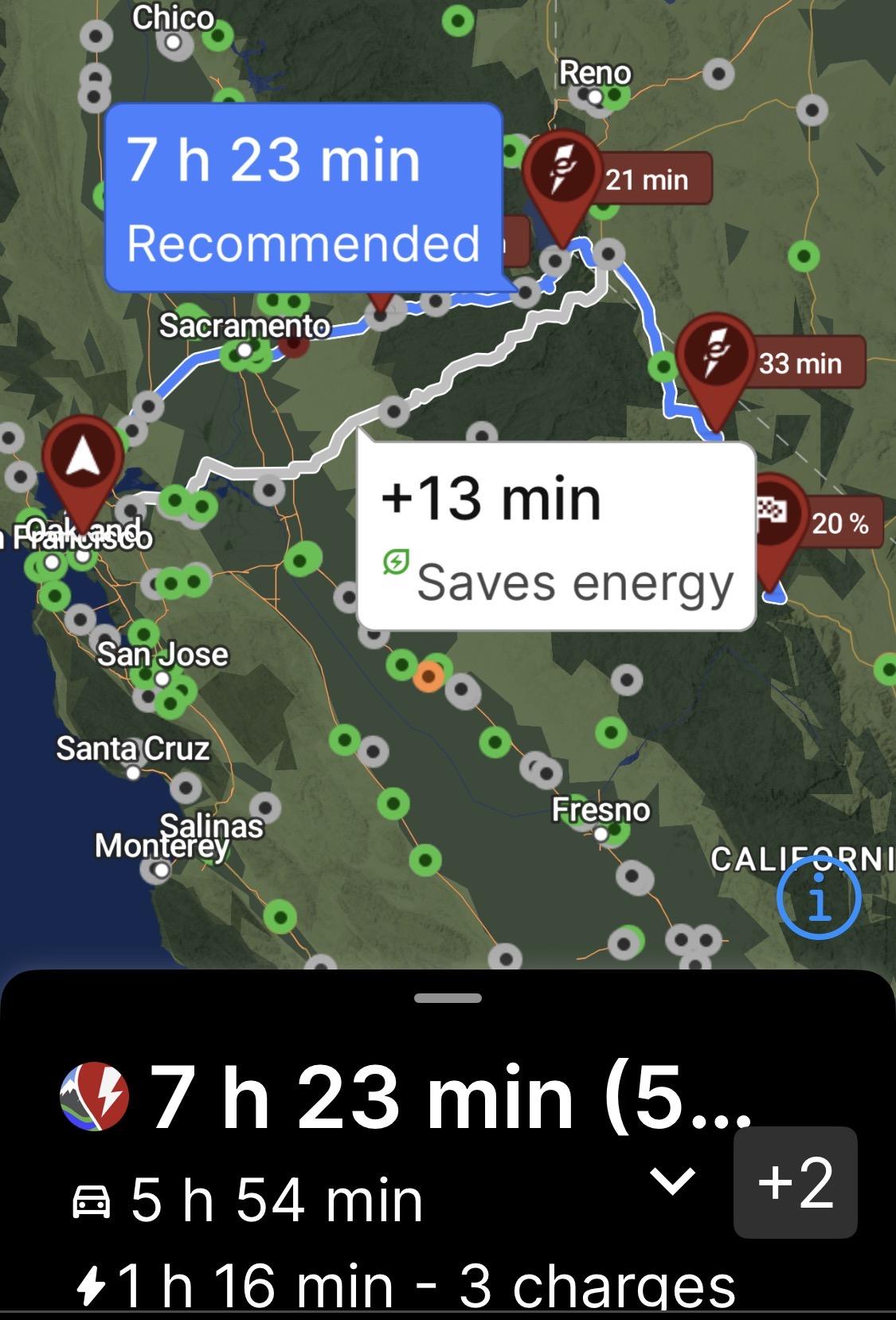
In September 2024, I drove that new-to-me Bolt up the Alcan and went from DCFC to DCFC. One no longer has to pack adaptors and park overnight at 30- or 50-amp RV receptacles in campgrounds. And the electrons to get through Canada cost me US$70 (most of northern BC and all of YT was free) versus $240 in gasoline for that same stretch when I came down 2 months later in the Mighty Prius*. I want to do it again, but only in the May-September time frame. EVs have some unique utility in winter, but potential -40F and 248 miles between charging stations in Beaver Creek YT and Glennallen AK precludes such a trip in winter by me. The Prius? Sure. A Camry? Saw -44F in the Yukon one January. A Subaru? Piece of cake!
You’ll end up with a whole folder of routing and payment apps if you’re going cross country and across countries.
Plug Share was VERY reassuring to see that someone had used the DCFC in Watson Lake YT two days prior or a Level 2 near a hotel in Whitehorse was working and only CAN$0.25/kWh. To the point that they’re reporting, “The left cord on the left pedestal worked fine, but I couldn’t get the right charger to work for me.” That’s helpful beta!
* If anyone wants studded Finnish snow tires on rims for a Gen 2 Prius, let me know. I’m glad I had them on during the November trip south because we had 400 miles of fresh snow north of Whitehorse, but they’re noisy and (unfairly) don’t count as “traction devices” in the Sierra, despite my handling Carson Pass last month during a snow storm far better than any SUV on the highway. The tires and rims are currently in Castro Valley in the SF East Bay.
Thanks, Charlie and David. I wasn’t sure whether ABRP factored in elevation, since most of the passes on my normal routes are closed now in winter. I guess I’ll check again when things open up in summer.
I do have the Tesla adaptor.
Never having done a long trip, or even charged anywhere other than home, my big fear is of course getting stuck in the middle of nowhere with not enough charge to get to the next charging station, either because I misjudged or because the station I counted on doesn’t work for me. And I haven’t done any serious elevation change to see just how many miles come off the range from climbing a few thousand feet.
I did have a nice time this morning driving to my gig, eating up only 45 miles from the range on a 60-mile commute, and getting 6.6mi/kwh on the way there. That’s more my comfort zone at this point…but I doubt that will happen in the mountains.
As David mentions above, Plugshare is also your friend to confirm compatability wiith your Bolt (not all Tesla chargers are open to non-Teslas). A couple of other suggestions:
Safe travels!
I recently purchased a used Bolt with the upgraded/new battery…so the above charging suggestions help me also. This is a fantastic car to drive, especially when using the “L” one pedal driving mode.
Quirky thread drift ahead:
Interesting story on an EV truck that rarely ever needs charging: https://newatlas.com/automotive/edumper-worlds-biggest-ev-dump-truck/
Sooo….you could maximize your regenerative braking by “loading up” (rocks, water, hitchhikers, etc.) at the top of a pass and then drop them off at the bottom. :-o
Steve: Yup, try to pick up hitchhikers at the top of the pass then leave them in the valley. Or as you say, move rocks downhill. I’ve got unmetered water service, but alas, am at sea level. In summer, I should scope out roadside water cascades near the top of the hills. “Sir, why is your backseat lined with 20-mil poly? Do you haul home roadkill?”
A “stupid engineer trick” would be to have a big ICE vehicle “tow” you downhill, but have the EV doing regenerative braking, hence recharging its batteries while saving the ICE’s brake pad life and preventing them from overheating.
You absolutely could do it with a driver in the “towed” EV, but I don’t know of any EVs that could be remotely controlled or triggered into braking mode by compression of the trailer hitch like how some trailer brakes are engaged. If such an EV existed, it would be an ideal chase vehicle towed behind an RV. The RV has to pull whatever small car is being towed, but the EV could regenerative charge from that entire combined mass slowing for stop lights and going downhill (while also saving the RV’s brakes).
It’s on my list of “stupid engineer tricks” to try, measure, document and maybe publish on a method of emergency recharging an EV anywhere. I’ll have a friend tow my Bolt on a tow rope behind his diesel F-250 while using a GoPro and in-line crane scale to record the tension on the tow rope and my iPhone to record the Bolt’s charge rate throughout. I ought to be able to charge it at 40 kW. Being towed just 20 minutes at 30 mph and 700 pounds of tension (or at 60 mph and 350 pounds of tension) would give 45 miles more range for the Bolt (plus the 10 miles of towing, hopefully in the right direction).
David you really need to publish or post your SET’s.
DK: Sorry again for the thread drift, but here’s an interesting test on regen braking on a long downhill run. (In a Nissan Leaf though, not a Bolt):

Bonus video about Engineers:

No problem about the thread drift, that’s very interesting about the amount of regen braking. I wonder how a Bolt compares?
I was also interested to see him be able to start the car with zero battery percentage left; I had no idea that was possible, and wonder if that works with a Bolt? (Google AI answer says yes)
Become a member to post in the forums.
 How to Plan with Decision GatesKeep going, change your route, or turn back? Watch how decision gates help structure these choices in our YouTube video.
 © Beartooth Media Group Inc.
 Loading...