Im upgrading some old gear this year and one of the things is filled with down. I have a choice on 850, 900 and 950 fill. My question is one fill more durable than the other? I talking repeated stuffing into a pack, washes, body oils and dirt effecting the longevity of the down.
Topic
Durability of down in quilts
Become a member to post in the forums.
- This topic has 9 replies, 6 voices, and was last updated 9 years, 2 months ago by .
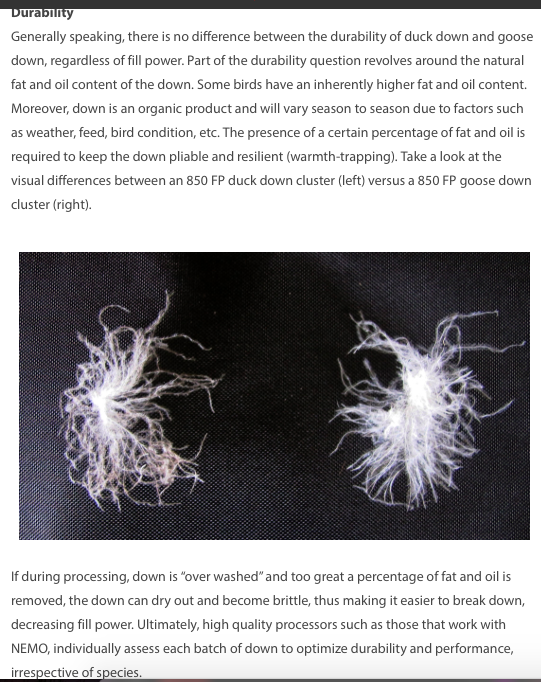
At least Nemo Equipment seems to think durability equal across fill powers …
http://www.nemoequipment.com/duck-duck-goose-a-comparison-of-insulations/

Well, the question is complex. Overall, as above, there are differences between birds and years. But generally no there is little or no difference in longevity between feathers of the same batch. It is all how it is treated.
Repeated stuffing and unstuffing will not hurt down(well maybe very slightly.) Take one plume at about a half inch in diameter, and squeeze it tightly, then roll it tightly into a thread. The difference in size is close to 100 to 1. This damages a plume. Now, consider the force you applied. To do this on a typical sleeping bag consisting of thousands of feathers would be damn near impossible. Even at 10-12:1 compression ratings in a standard compression bag, each feather will resist you and it feels nearly solid if it is dry. Soaking it thoroughly will let you squeeze it a LOT more, though, as the down/fibers loose their strength with the water.
Body oils do not permanently effect down either, unless you leave it that way. After a week or two out, like any other bedding, it needs to be washed. (Using sleeping cloths will help reduce this by 50% or more.) Body oils can often be washed clean with three or four good rinse cycles with plain water, or, simply gently swishing it around in a bathtub through 3-4 rinses. DO NOT use a machine with an agitator, it can destroy baffles and shells. Worst case, about 1/4 to 1/3 as much down wash as is specified on the bottle will work OK, followed by at least three(as many as 6) good rinse cycles. DO NOT use a strong detergent or you will strip the oil out of the feathers (bad,) use only a down wash or other extremely mild soap based product. Surficants, ionifiers, etc are all detergents with fancy names. Even very old bags can usually be washed and brought back to “life.” Most bags never really go bad unless they are mishandled or miswashed. CHECK the machine for detergent rime and any burrs, of course.
DRY THOROUGHLY. After every trip, after washing, I just dump it in the dryer and run it. I add a few dryer balls to break up any clumps. Use as high a heat as can be tolerated by your bag. Not sure? Start LOW or NONE. I have lots of scrap pieces around, so I just test one till it fails, then turn it down a notch from there. But, I also have an Electric dryer. A Gas dryer runs MUCH hotter, start very low or with no heat. Check it every minute or two the first time to get a feel for how hot it is getting if you do not have a test sample. Down is not usually the problem, the shell/zipper is. Dampness, mold (and the acids it produces) will start to destroy a bag in less than a month. It will take a long time to get all the feathers dry. Usually, 2-3 hours with heat. I also dose my bag with a weak permethrin solution to stop any bugs, lice, fleas, bedbugs, and other things that can destroy down and make you uncomfortable while sleeping.
Dirt (dust) can penetrate most fabrics. Inside, it will act like sandpaper, grinding away at the down. Again, washing regularly will remove most of this and help the bag last for many years.
After a washing, my bags always come out higher lofting than new.
That said, the bag will eventually wear out. I expect 20 years out of a bag/quilt. Also expect some reduced temp rating, around 10F at about 15 years old…
I remember some scientists had exhumed an old mummy in South America. They found intact feathers over two thousand years old in the grave. (A very dry region, as I remember.)
Thanks guys that is a lot of great info.
I got to sit in on a long conversation with a big down company during some downtime at a trade show (either allied feather or downtek, I believe it was the former). They seemed to think that factors nearly impossible to verify in the final product (mostly the age of the bird, and how the bird was treated/fed) had much more effect on longevity then fill power, they admitted that lower fill power might have a slight advantage all things being equal (they threw out 750 as perhaps a happy medium, but seemed to be lumping other factors in with that statement) but seemed hesitant to suggest a real fill-power to durability connection.
Yeah, anecdotally, it makes sense that super high fill power downs are a little more fragile. Not from crushing/compression but from tangling and tearing loose from each other. 750fp is around the sweet spot for damp bags, ie, bags used in rainy or highly humid weather.
One quick note, make sure you shake your bag out well after having it in your pack.
Hah! James you just answered my next question. Thx
while down is resilient … the more you wash it the more it wears out like anything else
CAN I WASH A PRODUCT MORE THAN ONCE?
Yes you can, although unfortunately nothing lasts for ever. The more you wash a garment the more it will affect the performance so wash it when you need to, don’t wash it every time you wear it.
http://community.berghaus.com/knowledge-advice/how-to-clean-a-down-jacket/
for a quilt this is not a real issue where you will be washing it around once a year or less with good use …
however for UL down jackets which you may need to wash several time a year you may notice the loft getting reduced in around 2-5 years of fairly constant wear (more noticeable on thinner down jackets of course) … of course by then the UL shell will start to go
what i do notice is that the higher fill power down seem to lose loft easier when dirty and seem to require more washing to maintain the loft … the old 600-700 fill jackets kept their loft quite well with constant wear over years, however the new 800-900 fill seem to require a bit more washing … i suspect this is due to the feather content, which is why lower fill power maintains the loft a bit better in damp conditions
however for your purposes of a quilt its fairly irrelevant … just get what you can afford
;)
That’s what I’ve always thought. Â Washing must remove some of the natural oils on the down.
There are many stories of people having problems getting their down loft back. I’ve tried to avoid the subject, although I think with proper technique it can be done.
I try to not get the down dirty, for example I always wear long sleeves and pants inside to collect any body sweat, dirt, and oils.
Yes. Even down wash will remove some natural oils from feathers.
In most cases, bags are stuffed tightly, if not vacuum packed, for shipping. So, when they are new, there is often some loss in loft, since few employees take the time to shake out a bag before hanging it, and certainly do not when selling it to you.
I don’t often wash my bag/quits, as I said. I often rinse them out. In two cases I have old 40F bags that typically loft to 3.5″ after rinsing and drying. New, they only lofted to 3″. They are 14-15 years old, used moderate to heavy at around 45 nights per year, avg. And, they are typically compressed tightly while hiking to save volume…low volume means saving weight, somewhere (usually in the pack itself.)
But, you are correct. Washing with an agitator destroys cloths far faster than getting them dirty. Yes, it is true that sweaty cloths don’t matter. Sleeping cloths are always recommended. Body oils on down hurts it’s performance, though. Mostly, a simple water washing of down will remove body oils/dirt, thus helping durability and maximizing performance.
Become a member to post in the forums.