Topic

Cuben Cricket

Viewing 25 posts - 1 through 25 (of 26 total)
John Kays BPL Member
PostedNov 3, 2018 at 4:22 pm

I picked up a sil version here on Bpl and am very satisfied with it but considering the cuben version.  I have a hexamid floorless tarp but has a beak and have never been able to pitch it without the beak being a useless wad of loose hanging material without any apparent purpose.

The sil-Cricket is easy to pitch in various configurations but not  satisfied with the weight. Afraid the cuben version will lose the the option to pitch other than in the wide open pitch  commonly seen in photos thus losing the attractive features of the “sil” version. Would sure like to hear from cuben Cricket owners on their experience with various pitching options.

Jerry Adams BPL Member
PostedNov 3, 2018 at 5:19 pm

” I have a hexamid floorless tarp but has a beak and have never been able to pitch it without the beak being a useless wad of loose hanging material without any apparent purpose.”

Maybe you need it to be taller

Maybe pull out the two corners next to the beak

or something like that

Nick Gatel BPL Member
PostedNov 3, 2018 at 7:18 pm

I have a sil Trailstar. When I bought it I was going to buy a Cuben version, but several very accomplished hikers, such as Chris Townsend, reported it was very difficult to pitch. Seems that since there is no “stretch” in Cuben, the stakes and guys need to be very precise and accurate, otherwise you’ll get a crappy pitch.

Not sure if this is true for the Cricket.

I’ve used my Trailstar quite a bit. If I could only have one shelter, it would be a sil Trailstar.

Pedestrian BPL Member
PostedNov 3, 2018 at 8:40 pm

+1 the sil Trailstar – works well in a range of three season conditions except in heavy snow. I know it has its detractors and gets its share of criticism for needing a large spot to pitch.

I find it just right for the conditions I typically hike in – mostly above tree line in exposed spots. Also I only pitch it if conditions demand it otherwise I sleep under the stars.

Nick Gatel BPL Member
PostedNov 3, 2018 at 9:31 pm

The TrailStar gets a bad rap on its footprint. Earlier this year I pitched mine next to a Duplex and it wasn’t much bigger. With the vestibules the Duplex is 60 sq feet, and the TrailStar around 65. Plus you can pitch a TS over big rocks and small shrubs. Of course there are pros and cons for each of these shelters.

It took me under 2 minutes to pitch my TS, which gave me ample time to watch the Duplex owner finish his setup :-)

For a few more ounces I prefer the extra space of the TS to the Cricket.

But back to the OP, I would want to know if the Cuben Cricket is as difficult to pitch as a Cuben TS is reported to be.


Matthew / BPL Moderator
PostedNov 3, 2018 at 10:56 pm

I’m pretty sure y’all have read this but just in case: http://www.tramplite.com/2013/02/mld-cricket-review.html?m=1 Based on this review and what MLD says about it, I’d be inclined to avoid the DCF version of the Cricket because it only pitches one way.

I’ve long been tempted to purchase a Cricket but it’s not that much lighter than a Duomid (or Trailstar) which offers more protection in a storm. Having said all that, I wanted a really light shelter for below treeline or on short trips above treeline where I have more confidence in the weather report. It just arrived this week in the form of a .51 DCF Grace Duo. After removing the linelocks and adding MLD 1.5mm line it weighs just under 7 ounces in the stuffsack and easily folds down to a compact package the size of a small book. For most trips I’ll be sticking with my Duomid…

Nick Gatel BPL Member
PostedNov 3, 2018 at 11:37 pm

I think the OP has gotten enough information with Matthew’s last post to make an informed decision, so it’s probably okay to hijack this thread :-)

There’s a lot to be said about mids… they do a lot well. For about 6 years my main shelter was an early Hexamid with no netting. It served me well. A couple years ago I bought a Cuben Deschutes because it is a little larger. I just gave the Hexamid to my son, who after 10 years, has decided a 90 liter REI internal frame pack and a SD Clip Flashlight do not make for fun hiking. He’s also starting to use the ULA Conduit I gave him 10 years ago.

I use my sil TrailStar when I expect poor weather. But for the same weight one could get a Duplex with similar room, a bathtub floor and other amenities. I don’t hike often with others, but over the past couple of years of group trips, the Duplex has easily been the most popular shelter I have seen. The only big drawback is it might exceed most people’s budget and might not be a good choice for really poor weather.

HkNewman BPL Member
PostedNov 4, 2018 at 3:16 pm

The latest Cricket (2017-) is based on the Solomid XL, so think that with a beak instead of a door.  The big difference is guying out that big beak for stability.  Typically a user can move the center pole up and down for ventilation or storm mode, respectively.

I found the new Cricket roomy and fairly easy to set up, just overkill on California trails and the PCT.

J-L BPL Member
PostedNov 4, 2018 at 6:31 pm

MLD recently updated the weights of their Cricket tarp:

30D silnylon: 13 oz

20D silnylon: 11.5 oz

0.75oz DCF: 9 oz

Their new 20D silnylon pretty much splits the weight difference between 30D silnylon and DCF.

PostedNov 5, 2018 at 3:02 am

I’d be curious to know what the dimension from front corner to front corner, and ground to tip of beak are in the various pitches you’ve been able to accomplish w/ the sil version? I got the DCF version ~2 months ago, and haven’t really tried pitching it different ways yet. I will try to make some time to in the next couple days. I’ll take measurements and pics to report back.

Matt Smith BPL Member
PostedNov 5, 2018 at 3:31 pm

Hey DCF cricket user here!

Ive used to MLD cricket for the past 2 years. Absolutely love it!!

however…

When I bought mine the size was recently increased to be more similar to the solomid XL dimensions. He didn’t offer .5 weight yet and the specs on .75 Cricket said 7.5 oz. Being much larger than the heximid, and thicker, I was shocked with this weight and pulled the trigger. When I received and weighed mine, it came in at 9 oz!!!! I was a little disappointed and called Ron and discovered the new specs were not adjusted yet on his site.

After considering returning it, I decided to give it a shot and keep it.

I took it on the Colorado trail for its maiden voyage during monsoon season. I had one really bad night just before cottonwood pass. Was able to pitch it very low(despite what rumors about DCF are suggesting) and stayed dry during a 9 hour downpour.

used it with no bivy, however I use a mummy bag with a pertex shell (FF humming bird).

Was so happy with that tarp,I bought a superlight bivy with Cuben floor and Used it on the wonderland trail, SHR, WRHR and parts of glacier national park this past summer.  The bottom of my bivy looks brand new(another common fear on this site)

i think it’s a great tarp and suitable above treeline if pitched well. For exclusively bad weather above treeline, a true mid or trailstar will probably be best.  But for a happy compromise between a small tarp and full coverage, this is the best option for me


Erik G BPL Member
PostedNov 6, 2018 at 8:59 pm

I owned a DCF Cricket for a couple of seasons. Used in 3+ season conditions and experienced just about every type of weather in it. It always kept me dry and was a great shelter overall. Lots of versatility even with the limited pitch options due to lack of stretch.

I made a modification to it to facilitate a “storm pitch” – I added some Zpacks stick-on loops to the awning edge, about 18″ in each direction from the peak. I reinforced them with a bit of extra repair tape. For storm mode, I removed the awning pole and clipped the two loops together with a carabiner and guyed it out, much like the original zipperless Zpacks doors. If doing it again I would make some stick-on plastic rings and use the Zpacks door toggle. It was actually pretty slick, and pretty much turned the Cricket into a Solomid.

Gumbo BPL Member
PostedNov 6, 2018 at 11:33 pm

“Owned”, past tense – what did you move on to and why, Erik?

Erik G BPL Member
PostedNov 7, 2018 at 5:33 pm

@redgum – I tend to get a bit…over excited about new shelters :) I moved to a Duplex, and then to an Altaplex which I use currently. I figured I could get a little more interior space for about the same weight, and I felt that I didn’t really need the modular inner + tarp combo. But honestly that is pretty nice to have. I really like the additional height of the Altaplex as well FWIW, and feel that the Plexamid was actually a step backwards in every category except weight.

Now that the Cricket is a little bigger and uses the XL inner, I’m actually tempted to scoop one up again. It really is a very “livable” shelter, just feels nice to be in it. Probably even nicer with the extra space. You can leave the awning up for 90% or more of 3 season weather, especially with intelligent site selection and orientation.  I’d probably do the storm mode mod on a new one, as it only adds maybe an oz or two for a relatively large increase in weatherproof-ness. Might have just talked myself into my next shelter, unless the Durston X-Mid 1P DCF version comes out first! (Ahem…)   :)


@matthewkphx
– thanks!


@ohdogg79
– I know I have a pic of concept testing the storm mode, which was just the 2 points clipped together in my backyard, but it must be archived somewhere. I’ll keep looking. It actually set up pretty taut! The only thing is that there’s a little “shark fin” of material that kinda just sticks out there. I suppose you could tuck that into the fold, but it is a very strong tie out point and you don’t have to move the stake from its awning position (just shorten the line via LineLoc) so I’d keep the shark fin look :)

One other tip re: Cricket use – With one extra stake and guy line, you can move the inner pole to the back of the shelter, which really opens up the interior volume, especially when setting up just the tarp. And makes getting in and out of the inner a little easier.


PostedNov 8, 2018 at 3:15 am

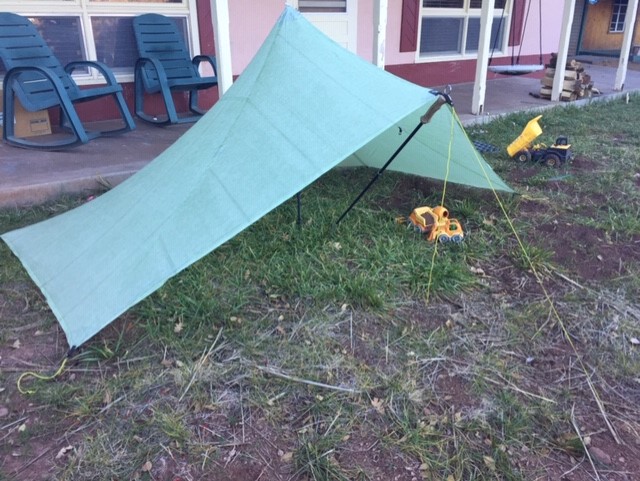
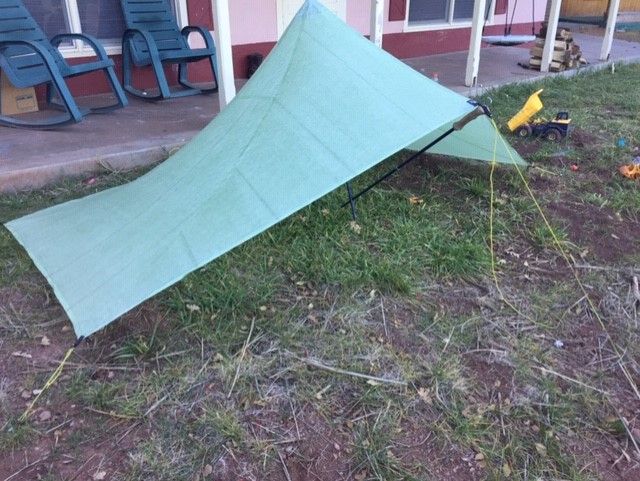
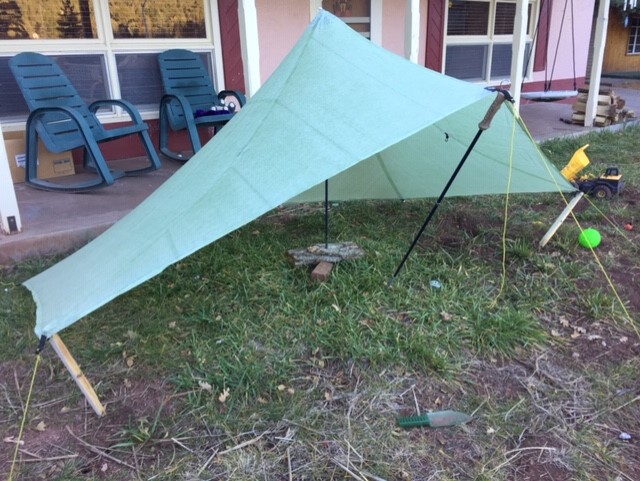
So I got a chance to play a little w/ setups and take some measurements this afternoon. This is a 2017 DCF Cricket, so its the same size as the SoloMid XL. Since you could have a hundred different pitches if you started messing w/ total height, I decided to keep things simple. I set the back two corners as low and tight to the ground as I could get them, and then played around w/ the pole height, front corner spread and beak height. The initial pitch took 2-3 min to get set, and each subsequent one took only another 2 min or so to figure out. Biggest problem I ran into was I’ve had a gopher (and toddler) tearing up my front yard so stakes really didn’t want to hold!

I quickly realized there were really only going to be three main options. The “standard” pitch, the whole pyramid tipped forward as far as possible, and backward as far as possible. Here’s what I got.

1- Base set square, all corners tight to the ground… this is what I expect most people do as the “standard” pitch (pending overall height). Its a pretty easy pitch to get taut and seems to offer a nice balance of access vs coverage. Dimensions… spread 107″ beak 36″ peak 45″

2- Peak tipped forward, front corners spread to tighten… other than the “shark fin” pitch Erik accomplished w/ the added clips, this should be the most protected pitch you can get. It was definitely harder to get the leading edges of the beak to be taut, but certainly doable by shifting the front corner stakes a little. Space inside was noticeably “lowered” as was the entry under the beak. Dimensions… spread 114″ beak 32″ peak 42″

3- Peak tipped back to open things up as much as possible… this would be the pitch you’d want to do to get the best view and most height/space inside, but offers less protection. This was much harder to get the leading edges of the beak taut because the front corners needed to be so high. I ended up using some little chunks of kindling as poles to hold the front corners and back middle tie-outs up high enough. If I’d had more time, I would have added extensions to the front corner guy lines, as it was hard to get the corner tight w/o pulling out the stake at this angle. But it was doable, made it very airy inside and entry was much taller. Dimensions… spread 115″ beak 41″ peak 50″

So, it is definitely possible to get a couple variations of pitches taut on a DCF Cricket. I’m really curious if a SIL Cricket user could do some experimenting to see if there are others pitches its capable of that the DCF can’t.

PostedNov 8, 2018 at 3:20 am

As I look back through the pics, I realize its pretty hard to tell the difference in the pitches. Best places to look for differences are the back left corner to peak “ridge” and where my FIXED hiking poles are set (or what they’re set ON). The thing the peak pole is set on in the last pic is a split chunk of log.

Gumbo BPL Member
PostedNov 8, 2018 at 5:52 am

Is pitching the back corners to the ground part of the standard pitch for the Cricket? Reason I ask is I’m struck by how low the sides are, and how long it takes for them to gain altitude. 107″ spread sounds like a ton, but it doesn’t look like the portion with minimum 18″ clearance would be 6′ long… (18″ = 3″ pad + 12″ feet + quilt loft).

I’m interested in the Cricket, but don’t have any experience with mids, and am interested in how the geometry works out for actual usable space.

PostedNov 8, 2018 at 1:48 pm

Nope, having the back corners tight to the ground is not required. I just did it here to eliminate one variable as I did this testing. The corners are generally pitched more like 3-6” off the ground, unless you want them tight to ground for protection from weather.

ill try to set it up again today and get some height measurements around the perimeter too. Mids, esp cat-cut, do tend to take a little time to gain elevation as you say.

Nick Gatel BPL Member
PostedNov 8, 2018 at 3:05 pm

Why are you using the front pole at an angle instead of straight up?

PostedNov 8, 2018 at 3:21 pm

I have fixed length GG LT3 poles. I could do the beak pole vertical if I wrapped the guy line around it but haven’t set up appropriate “stops” on the pole yet.

Erik G BPL Member
PostedNov 8, 2018 at 5:09 pm

I think what Nick might be getting at is that if you make the front pole more vertical, you can get more tension across the leading edges.

There was a surprising amount (IMO) of usable space in my old version Cricket in tarp mode, especially with the back pole moved to the back of the shelter. I’d imagine the new one is even more spacious.

PostedNov 9, 2018 at 3:08 am

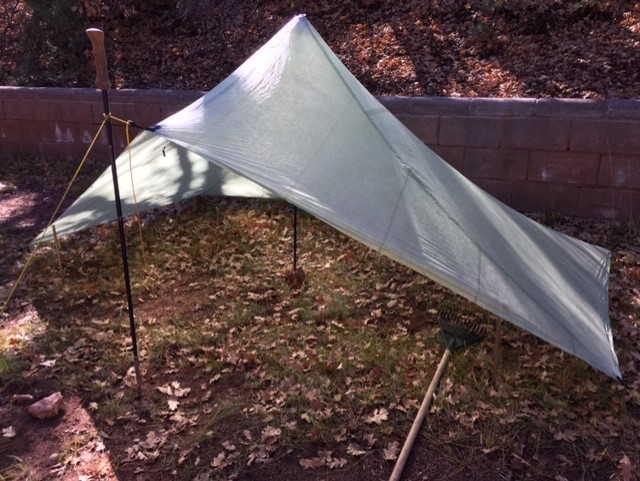
So I took a little time at lunch today to pitch and get height measurements for @redgum. I also tried Nick’s suggestion of using the beak pole vertically w/ the guy line wrapped around it, rather than at an angle. BTW, I timed the setup… initial pitch, starting from everything IN stuff sacks still, took less than 3 min.

First, the vertical pole was helpful. I was able to get the leading edges a little tighter.

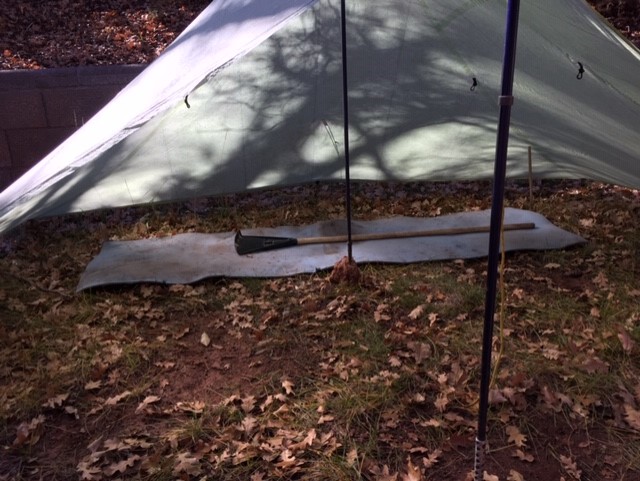
Second, here’s what I got for height measurements. With the tarp setup in “standard pitch” (squared footprint, even height)… edges/corners all at ~3-4″ off the ground… peak height 48″. At the back wall, there was ~6’4″ of length that was at least 12″ of clearance. I know you said 18″ is your min, but that seems really high… I personally don’t need any more than 12″.  In the pic below, the pad is a full length 6′ pad.

Viewing 25 posts - 1 through 25 (of 26 total)
Loading...