Topic

Comfortable tents

Viewing 12 posts - 26 through 37 (of 37 total)
PostedJun 12, 2022 at 1:21 am

Hi Roger,

On May 17th, I posted the following on this thread:

“There is another possibility:  Making the vestibules part of the inner tent, and adding a fly over the ceiling of the inner.  A good quality DWR inner ceiling will breathe well, and shed water for the amount of time it takes to pitch the tent and get the fly installed.”

On May 18th, you replied, and I answered as follows:

Reply:  “And two years later when the DWR has substantially worn off – then what?”

Answer: “Since the solid ceiling is protected by the WP fly, and the DWR is best quality inner from Extrem Textil, it is not comparable with DWR on, say, a rain jacket.  So it should last much longer.  And there are some excellent DWR sprays from 3M and the Brits.  After that it could be easily replaced; but don’t think it would come to that.”

As it happens, your skepticism was warranted.  So I have been testing very light weight fabrics.  While DWR treatments on heavier fabrics like jackets may add some temporary protection from rainfall, I find that very light fabrics in the one oz/sq/yd range are a different story.  Even if they shed water due to the DWR treatment, they will not stand up to heavy rainfall, even for a short period.  They “leak like a sieve,” as the saying goes.

I tested a couple inner fabrics from Extrem Textil and several others with DWR treatments, and none shed water to a degree that would prevent heavy rainfall from entering an inner tent, even during the few minutes it would take to pitch a tent with a DWR fabric used for  a solid inner ceiling.

So I will eat my words.  However, I’m not ready to give up on the concept, primarily because it provides a simple way to achieve a dry pitch, and unlike insect netting, fabric has more structural strength, can shed dripping condensation, is far more durable, and lends itself to a variety of tent designs.

The concept also seems doable.  First, in the early days of Warmlite, the tents had double walls, both of waterproof silnylon fabric.  They limited condensation to some extent due to the reduction of the temperature difference between the outer and inner walls.  Also, there are DWR treated fabrics with low Hydrostatic head but some water resistance, perhaps enough to fend off a deluge for a few minutes.  Tests on several of these showed great promise.

So plan to use one of such fabrics for an inner wall after further testing to assure it will work to keep out water for a few minutes, but also allow water vapor and air to pass through.  In addition to some testing, it will also require some hunting, since there are a host of possibilities.  Wish me luck.  Thanks.

Roger Caffin BPL Member
PostedJun 12, 2022 at 1:36 am

Hi Sam

As it happens, your skepticism was warranted
Them’s the breaks.

Remind me: why not pitch the outer tent first? That would mean the poles are attached to the fly, which imho always makes for a more stable design.

Cheers

PostedJun 12, 2022 at 2:15 am

Hi Roger,

Because I like all the advantages of dome tents, and want to get the inner tent set up quickly and solidly first, especially in storms, before attaching a fly that adds additional protection and wind resistance until things blow over, possibly all night.  My dogs also like a  dry place to get quickly under cover, and that could apply to other companions as well.

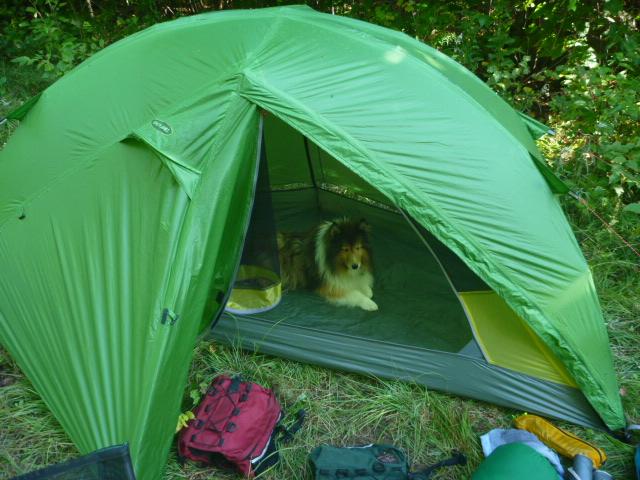
You don’t seem to see so many advantages of domes, or tents with an internal framework that make them self supporting, a good quality when the rain comes with winds that sound like the hounds from hell.  Mine are not from hell, and are pretty savvy, like this one:

HkNewman BPL Member
PostedJun 12, 2022 at 8:08 am

comfortable

The old rule of thumb used to be get a tent one person bigger than advertised especially for backpacking … so a 2 person tent would be a luxurious 1 person tent usually.  Also the fact fabric is still needed length-wise, so the old 1-P tents did not save that much weight for a traditional backpacker.  Some manufacturers came out with 1.5 person “solo” tents too.

Shelters conforming to 1.5P standard or lately 1P “XL” is probably where  I’d start looking at, honestly.

Roger Caffin BPL Member
PostedJun 12, 2022 at 4:58 pm

Hi Sam

I understand what you are saying, but I think there may be a fundamental difference in thinking here.
want to get the inner tent set up quickly and solidly first, especially in storms, before attaching a fly that adds additional protection and wind resistance
You see, I go at it the other way around. I want to get the strong waterproof fly up first, to protect everything else. And I want that waterproof fly to have the poles integrated into it, for strength and stability. Once that is up I can look after whatever else goes inside, and I can do that under shelter. In practice once the waterproof fly is up I can put Sue inside it, fast, with both packs, while I look after the guy ropes and getting water.

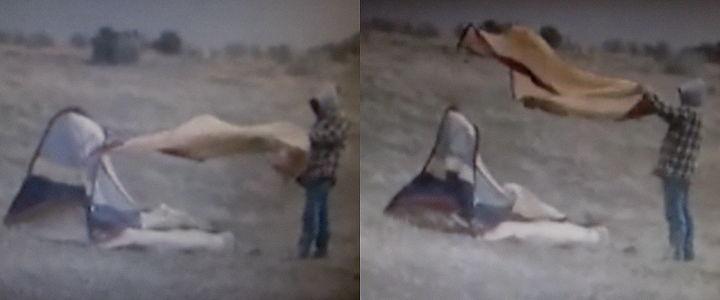
My favorite illustration of this point is shown here: a couple of still from a video taken from the doorway of another tent.

This went on for some time, failing again and again. Eventually a couple of other people had to help the poor guy because it was clear that he was NOT going to get his tent up by himself. OK, it was the wrong tent design for those conditions anyhow, but one can see the problem.

I will never accept a tent where the fly does not have the poles securely attached to it. If the poles are not attached the fly and the poles can move separately, in different directions, and that always leads to disaster in bad weather. The thing is, you see, ‘bad weather’ here (in Oz and NZ) means winds of 100 kph, with rain or snow, and in some places this is a common occurrence. A matter of geography, funneling the wind up a valley.

As for me and dome tents: the first two tents I made were both domes, 7′ square. They went to some ‘interesting’ places. Somewhere I have a photo of my first dome pitched in Scotland around 1970. I can’t find it right now.

Cheers

PostedJun 12, 2022 at 11:17 pm

Hi Roger,

” it was clear that he was NOT going to get his tent up by himself. …”

That is because the almost universal practice is to include the vestibules as part of the fly or outer tent.  You once posted a great pic or video (don’t recall which) of a guy chasing such a fly over hill and dale.  However, I plan to attach the vestibules as part of the inner tent.  That will make the fly much narrower and easier to attach in a gale.

You make your outer tent layers function as flies, and as said, the outer layer functions as a fly on most ‘domelike’ tents as well.  Your approach works much better on your tunnels.  But am trying to find a better approach for a domelike, with a pole framework that is unusual; in that it interacts with the ‘skin’ of the tent to mutually reinforce the structure.  Thus pressure on the skin tightens the pole framework, and vice-versa.  (Alas, this does not work with nylon that expands when wet.)

Having a structurally independent tent before the fly goes on is one reason why I’m not shy about using a smaller fly that is not attached to the pole sleeves.  Rather, it is attached to the inner (much of which IS attached to partial pole sleeves), at the two peaks, about mid-level to the seams connecting the inner ceiling to the vestibules, and at ground level to the four corners of the inner framework.  And the fly will be tightly attached at those points and stretched over the self-supporting framework that also supports the inner tent.

I don’t think the fly, which is only partial, will be as vulnerable to winds as you might think.  It is there primarily to protect against precip; but also tightens and adds tension to the structure much as a strong and tightly attached tarp stabilizes a truckload of firewood.

One of the considerations for making the inner tent stand on its own is a host of experiences with domes, most of which provide little if any protection against the weather before their monster flies are firmly attached.  During a trek of any significant duration, the inner and its contents often become flooded.  As if that were not bad enough, fierce winds will make a mess of everything.  In that photo in the last post, after driving rain besieged us all night, we were just lucky to get a break for breakfast; although the dog in the tent was still not ready to come out.

So I think most of the domes, like the one in the photo, are a disaster in severe weather, and that the only sensible way to design a dome is with a self-supporting framework that stands by itself, as opposed to the great majority of shelters that rely almost totally on gimpy frameworks, pullouts and stakes to stay functional, or even upright.  As for whether a tunnel can do a better job in foul weather, that is another story for another day.  And there are other matters to be considered; like comfort, as suggested in this thread’s title.


Roger Caffin BPL Member
PostedJun 13, 2022 at 1:17 am

You make your outer tent layers function as flies,
We may have a terminology gap here.
As far as I am concerned, the outer tent layer IS the tent. If there is an inner tent, it is subsidiary to the outer tent. It will probably hang off the outer tent.

Thus pressure on the skin tightens the pole framework, and vice-versa. (Alas, this does not work with nylon that expands when wet.)
That will depend on the tent design. I dare say that may be so with some designs, but it is NOT correct with a properly designed and properly pitched tunnel. The lengthwise tension on a good tunnel sneers at any wet-stretch. The proof of this can be seen in my many photos of my tunnels under severe weather conditions.

Many are the times when we have had to pitch one of my tunnels under very bad weather (rain, wind, storm), but once it is pitched (which takes just a few minutes for one person) we can get inside and relax, knowing we are secure.

I look forward to seeing some field testing of your design. Photos, please!

Cheers

David N BPL Member
PostedJun 13, 2022 at 4:50 am

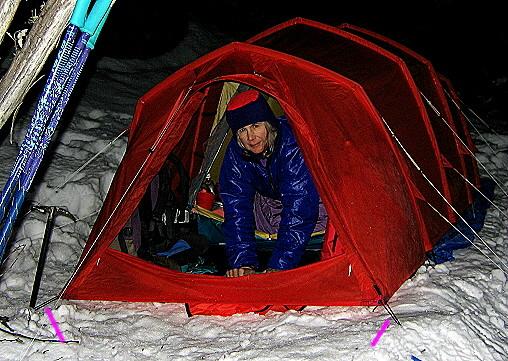
Having owned a MacPac Minaret Expedition for many years, I’m a big fan of this style of tent.  As Roger says, they’re extremely easy to erect, and can shrug off really severe weather.


Living in Scotland, I always said I’d never buy an inner-first-pitching tent, but for some reason, which now escapes me, I persuaded myself to buy a very lightweight 1-person tent which pitches inner first.   This was a few years ago, but despite having pitched it a few times at home, I’ve never used it.  However, at the weekend I took it on a trip…


When it came time to make camp, it was blowing a gale, and I soon realised I was really going to struggle when I had to throw and secure the flysheet over the poles!  In hindsight, I could possibly have tried a different technique, but the whole structure was at risk of breaking during the process, with the sides blowing in and shifting the poles.  Earlier in the day we’d had torrential rain, and setting up in that would have been even more of a nightmare. When I saw what was happening I decided to give up my attempt, and packed the tent away.


It so happened that I’d also brought a MacPac Microlight clone with me.  Although I regretted not having brought my Minaret due to its ease of pitching, the Microlight still went up without fuss, other than needing to be re-pegged a few times to get a really nice pitch.


Roger Caffin BPL Member
PostedJun 13, 2022 at 3:42 pm

The Macpac gear is designed for New Zealand. The W coast and ranges are known for ‘interesting’ weather.
I am still wearing some Macpac clothing, 20 years later.

Cheers

PostedJun 15, 2022 at 5:41 pm

Hi Roger,
Re:
“The length wise tension on a good tunnel sneers at any wet-stretch.”  Did you leave out the front shock cords that tension your tunnels.  Could not find them above.

“I look forward to seeing some field testing of your design. Photos, please!”  OK, Roger, you’ll be the first to know.  I’ll send the text and photos of the draft to you before posting.  Am sure your comments would be helpful.

But please be patient.  I brought this thread forward just to convey my regrets about an error relating to whether a light fabric can function as an inner, and at the same time, repel pounding rain long enough to pitch the inner tent before the fly is installed.  After much searching, may have located a fabric used by the defunct GoLite company.  Think I ordered some of the fabric and am in the process of digging through my lair in the cellar.

Really hope that this wraps up (pun intended) the fabric issues, as they have been dogging me for months (years?).  Hope you recall the posts and prototype of the canopy.  Should I ever be forced to stop hammering away in the darkness, will let you know on that score also.

Roger Caffin BPL Member
PostedJun 15, 2022 at 6:09 pm

Hi Sam
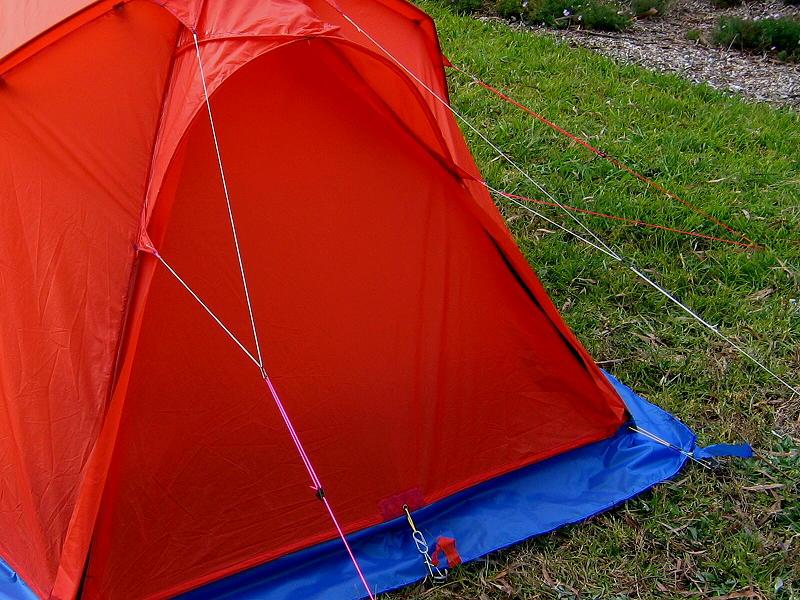
Ah yes, the shock cord loops at the front end: utterly VITAL!

The pink lines point to them here.

For others: note that while there are heavy bungee cord or shock cord loops well-tensioned at the ‘front end’, the rear (windward) end has short loops of strong nylon cord instead.

You do NOT put bungee cord at the windward end, EVER!
And yes, the windward end does have some extra guying.

Cheers

PostedJun 16, 2022 at 2:31 pm

David N,

If you are looking for a solo tent that you can stand up in, and that will house a bicycle, I think you are headed for a weight that would be unacceptable to most backpackers, and maybe unacceptable to you as well.  There may be an answer, however.

Find the solo tent that best suits your needs with the exception of the stand up room and other amenities that would make the tent unacceptably heavy.  Then find the lightest small tarp that will provide the additional room you want, and if there are no suitable trees around, string it up with one side attached to your solo tent and the other end supported by a trekking pole, if you use one, or if not, by a long stick that you will have to scrounge from the vicinity.

That way, you will have a very light sleeping tent for protection from severe storms, and also a nice place to use for coverage in less than frightful weather.  I did something like this when travelling around Maine, alternately backpacking and paddling a kayak.  Even found nice picnic tables in remote spots that had frames overhead to string an ultra light tarp.  In rainy weather, it really made the trip much more enjoyable, without adding a ton of weight of a big tent.  And I still had protection from big storms.

This approach might be particularly beneficial to those who use DCF tents for their light weight, as I’ve found that not all of that light weight comes from using DCF; rather, some of it comes from claustrophobic design.  You might find that you get needed safety and protection from the worst weather; but also more comfort most of the time.  And you might find tarps that come closer to DCF lightness than you thought possible, but at much less cost.

Viewing 12 posts - 26 through 37 (of 37 total)
Loading...