Topic

Comfortable 1P Tent Specs

Viewing 22 posts - 1 through 22 (of 22 total)
Volker64 BPL Member
PostedAug 4, 2026 at 7:28 pm

There tends to be a gap in size between most 1P tents and 2P tents. 2P tents are usually around 50 inches wide with 39-42 inches of peak height. Even aside from weight, something with a smaller footprint than a 2P tent is optimal for solo use. The question is how small is one willing to go before comfort is too compromised? The answer tends to be relative to what sort of trip you have in mind. A long trip with big elevation gains will preference something UL. And a lot of mountains especially in the Northeast US are very densely wooded with few open spots to camp on flat ground. So even comfort and weight aside, having a tent with a small footprint becomes a real help to fit in tight spots especially on group trips when you can’t always claim the best spot – (though I mostly do solo trips).

As a Northeast backpacker, I’m always among trees but usually not super dense forest to the point where a 2P tent is much harder to find a spot for than a 1P tent.

I bought the 2026 Marmot Tungsten 2P this spring and loved it right away. But it occurred to me I would also like a lighter tent with a smaller footprint. I have the Zpacks Offset Duo which I do love but it makes me miss a double wall tent where I can add or remove the fly in good weather for star gazing and improved ventilation. It’s also nice to just be able to see the woods around you in fair weather when inside the tent. I also have a Nemo Hornet 2P semi-freestanding which is tight on headroom but has ample floor space for solo use. It’s a decent compromise, but I do prefer a freestanding structure with less of an A-frame taper in the headroom. I’m willing to tolerate the width taper from 51-42″ as this is still ample room at the foot for me, though I prefer non-tapered.

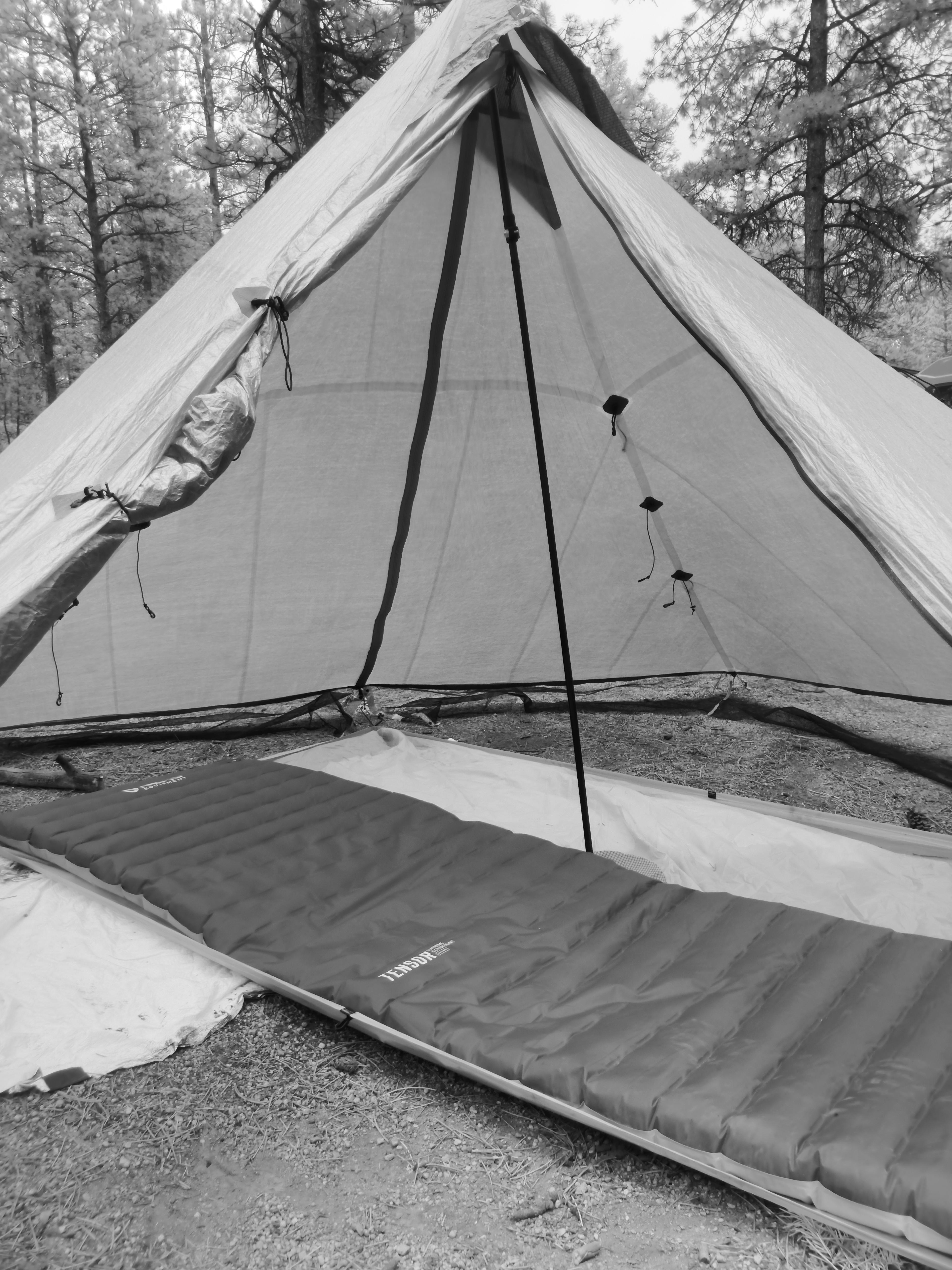
Having liked the new Tungsten 2P with blue mesh for it’s full mesh interior and x-braced pole structure, I decided to try out the 1P model. The Tungsten 1P is only 32″ wide, but mercifully untapered. I have been able to sleep in it sometimes. But I do find it a bit too coffin like. I am strongly considering returning it. I think it compromises sleep comfort too much for the sake of being able to fit in a tight spot.

Companies like Big Agnes make their 1P tents with 38″ of width at the head, tapering down to 28″ at the foot. This is too tight for me since I usually use 30″ wide pads outside of summer, and I like being able to stretch my legs apart to relax.

The Durston X-Dome 1P+ and 1P+ Pro tapers from 50″ wide at the head to 28″ wide at the foot. It is true that there’s enough length on the diagonal that you can usually still squeeze in a 30″ wide pad – though only barely if it’s also 77 or 78″ long. But this is still quite cramped at the feet if one enjoys being able to splay their feet apart at times. I also find the odd geometry unsettling. I don’t particularly want to sleep in a triangle unless my legs also have ample space to stretch out. I’m not crazy about the parallelogram shape of the X-Dome 2 floor plan (which I own) or especially that of the X-mid’s either where the ceiling caves in on one side at opposite corners. This seems like an aesthetic of modernist architecture being applied to tents. To me, it is too much a case of form dictating function. To avoid having vestibules that stick out into a salient point, the tent is forced to make two of it’s four poles extend out beyond of the body of the tent in exchange for a rectangle on the outside and a parallelogram inner tent. (Dan is a great guy and innovator, but I’m also not a fan of the external pole structure of the X-Dome tents which make putting on and the off the rainfly too cumbersome.)[Dan reminds me a bit of Tom Wopat who played Luke Duke on The Dukes of Hazard].

The Zpacks Duplex Light nails the width dimension I’m looking for at 40″ of width. This makes it easier to fit in tight spots but is still very spacious for solo use, and you don’t feel like you’re sinking into a distorted funhouse shaped tent that cramps you at one end. But alas, Zpacks doesn’t seem to believe in double wall tents, and except for the freestanding kit for the Duplex, almost none of their tents are freestanding. The thinner floor also seems sketchy to me even though I always use a footprint to keep dirt off the tent bottom.

If you’ve stayed with me this far, thank you. Now, for what specs I would like to see in a tent.

Length: 84-88″

Width: 38-40″

Peak Height: 39-42″

Materials: Dyneema

Pole Structure: Freestanding with preferably carbon poles of the sort Durston uses on the X-Dome Tents

Floor Plan: Standard rectangular design with 2 doors to allow for better crossventing (plus 2 vents in the fly).

Vestibules: 2 vestibules that stake out with a single stake as on most freestanding tents. If you are in a tight spot, you can easily leave one vestibule unstaked.

Pitching: Inner-first pitch with fly over the poles to enable easy removal in pleasant weather.

External pitch is easy with fly clips that attach to either the tent body or footprint (brands like Marmot and Big Agnes use this method on their their tents. No need to compromise easy removal of the fly with an external pole structure as on the X-Dome tents).

I think a tent of such specs could be built to weigh just under 2lbs (not including stakes). A dyneema footprint would add only 2-3oz so with footprint the tent should likely weigh around 2lbs.

What do you all think about these proposed specs and design philosophies? Please feel free to recommend any existing tent models that might fit within the parameters I have outlined. Thanks for reading. I appreciate any comments or criticisms you might like to share.

Volker64 BPL Member
PostedAug 5, 2026 at 6:13 pm

I neglected to mention an additional feature I’m looking for. I want a 1P that is all mesh so it’s good for air flow in warmer months. My other 1P tent is the MSR Access 1P. That has similar floor dimensions to the Tungsten UL 1P (84L x 32W), but also has an extra brow pole that extends to the ground for winter snow loading. But it only has a tiny amount of mesh to aid in warmth retention and it’s obviously much heavier than the Tungsten UL1. With 41″ of peak height, the Access 1 feels cozy rather cramped in part because in the winter, the smaller space is easier to heat up. And the headroom is also much more spacious.

But I am on the edge of returning the Tungsten UL1P. My use case for the UL1P is for summer trips where I want max ventilation in a tight and light package to fit in tight spots. But when it’s a muggy summer night, it’s helpful to be able to sprawl out some. A fan does help. But even temperature aside, I think 38-40″ of width is about the minimum size I should consider for a solo tent.

Dan BPL Member
PostedAug 5, 2026 at 10:31 pm

Not exactly to your specs because it’s too large, but it would make sense to add the HMG Crosspeak 2 to your list for cross-referencing.

Volker64 BPL Member
PostedAug 6, 2026 at 12:47 am

Hmmm thanks Dan. Yeah I see the Crosspeak 2 is smaller than a normal 2P so it could be considered a very spacious 1P. Interesting tent for only 34 oz. But the problem I have with it is it’s not a true double wall, so the fly cannot be removed for improved ventilation and star gazing in fair weather. Thanks for bringing it to my attention however. It is nice to see another example of a freestanding dyneema tent. Outside of summer, this is a very desirable tent – no doubt.

Jeff L. BPL Member
PostedAug 6, 2026 at 10:40 am

I get great ventilation with a vestibule open on each side with the Crosspeak 2.  I have used the tent along the AT in New York and did not have any issues finding a spot where it would fit.  If you can stomach the price, it’s a fantastic tent.

Volker64 BPL Member
PostedAug 8, 2026 at 11:56 am

Thanks Jeff for sharing your exp with the Crosspeak. Did you use it during the warmer months? The AT is def humid so it’s good to hear the single wall structure did fine in that climate. I tend to think this style of tent (single wall) is best for more arid climates (or winter alpine trips). Sure helps to have both doors open, but in a heavy downpour, you have to close up unless you also fly a tarp above. But freestanding and UL (just over 2lb) for a very spacious solo tent is very appealing in any scenario.

I already have too many tents (well over 10), so I can’t justify getting a new tent unless it’s meeting very precise features and specs.

My Offset Duo is already impressively light at 27oz with dyneema footprint. It’s a little more tricky to setup than the Crosspeak would be. But considering they are both similar size, dyneema, and single wall, (but the Offset Duo is probably 1o oz lighter than the Crosspeak w/footprint)  – the Crosspeak doesn’t seem different enough to justify. I’m sure we will see more models of double wall freestanding dyneema tents in the future. My X-Dome 2P will be my lightest freestanding tent around 3lb w/footprint if I return the Tungsten 1P.

Jeff L. BPL Member
PostedAug 8, 2026 at 12:06 pm

I have used the Crosspeak 2 in the following locations; AT in New York, Minnesota and the UP of Michigan.  I had rain in all locations and i have used it in all seasons but during the summer the most.  Other than normal condensation you would have in any tent, the moisture would not drip on you but go down the walls and out the mesh vents along the bathtub floor.  If the rain is coming straight down, you can leave a door open and continue to get ventilation.  With that many tents, I would certainly not purchase a $950 tent unless you were selling your other tents first.

bradmacmt BPL Member
PostedAug 8, 2026 at 1:44 pm

This seems like an aesthetic of modernist architecture being applied to tents. To me, it is too much a case of form dictating function.

You’ve got it completely backwards. With the X-Mids, function is dictating the form. Apart from a bit of interesting geometry, and the fact they’re designed on CAD, there is nothing “modernist” about Dan’s X-Mid tent design. His aim was to create the most storm-worthy interior volume (including vestibules) with the least weight, poles and pegs. With that, he succeeded admirably in my estimation. For two people I can see how the design is not optimal. For 1 person however, it’s stellar.

If I used two trekking poles instead of a single adjustable staff, Durston’s XMid Pro 1P would most likely be my first stop to shop. But I actually like limited volume interiors for 1P tents, and don’t like all the room solo of a 2P (we’re all so different).

As it is, for 1P tents I love the TT Rainbow Li, and ZPacks Pivot Solo, both of which I find relatively palatial. I also have an Altaplex which I’ve half-heartedly put in the Classifieds here. I’ve not used it since I love the Pivot Solo so much. I also have a Nemo Hornet Elite 1P, BA Copper Spur 1P, and BA Tiger Wall 1P. And of course I have other 2 and 3P tents lol.

I don’t think the tent you’re describing is made. The closest is likely the Durston X-Dome Pro 1+. I can always respect someone who knows what they want (or at least thinks they do). But I have to say I don’t get your aversion to a fly-first pitch. To most of us that’s a plus, not a negative. In the wet Northeast where I cut my teeth backpacking in the 1970’s I would have loved a DW tent that pitched fly first (external poles). So much easier to keep the interior dry.

I believe Durston will be offering a 2P version in the future, so that may be your huckleberry.

As it is, I think the Nemo Hornet 2P you already own is your best bet based on what you’ve communicated. Personally, I don’t see the need for a full freestanding tent. My wife and I used to use the BA Copper Spur 2P but switched to the Horent 3P. Love the space, and don’t miss “freestanding” one bit.

Of course none of the tents I cut my teeth on in the White Mountains were freestanding (until I got a TNF VE24 in 1979).  I think the concept is vastly overrated for general purpose backpacking.

As @JeffL mentioned, the HMG Crosspeak 2 might be closest to what you’re looking for currently. But for me, I think HMG missed the boat going with aluminum vs carbon poles.

At the end of the day, I think the closest to what you’ve described if you can get past the freestanding requirement, is the TT Double Rainbow DW Li. That would be a light, dry, double wall palace for 1P.

Todd T BPL Member
PostedAug 8, 2026 at 1:54 pm

For 1 person however, it’s stellar.

…if that one person is of average height or less.  For us trees, both the floor and the ceiling are technically long enough, but at opposite corners.  I can barely fit in my X-Mid 2P, couldn’t make it work in a 1P.  Just one more data point.  I must say, though, that the oddball X-Mid shape gives the most useful vestibule layout I’ve ever seen.

bradmacmt BPL Member
PostedAug 8, 2026 at 2:00 pm

…if that one person is of average height or less.

Those that are too tall always have to chime in and wreck perfectly good logic :)

Terran BPL Member
PostedAug 9, 2026 at 8:49 am

When I look at freestanding dyneema tents, I end up looking at the Rainbow. Then I decide that other than freestanding, it’s too much like I already have.


Todd T BPL Member
PostedAug 9, 2026 at 4:40 pm

Those that are too tall always have to chime in and wreck perfectly good logic :)

Nobody else cares about us so we gotta make our own noise.  :-)

bradmacmt BPL Member
PostedAug 10, 2026 at 8:06 am

Nobody else cares about us so we gotta make our own noise.  :-)

Man, I guess. There’s just not many options out there!

Volker64 BPL Member
PostedAug 11, 2026 at 3:53 am

Thanks Jeff for clarifying your usage of the Crosspeak. Good to know you’ve been comfortable in it even in humid summer places like NY. Having double doors is always helpful for a crossvent. Combining the freestanding aspect with the UL dyneema fabric in a very spacious for 1 design but slightly easier to fit footprint is very compelling across the board. It does seem very easy to setup too. That’s reassuring when you’re crushing miles and don’t want to have to fiddle with a trekking pole tent. And if you don’t want to worry about getting wet during setup the all in one pitch simplifies. I’m glad that you find it optimal. Perhaps if I didn’t already have my Offset Duo – I would be better off with the Crosspeak 2. But I still want a meshy freestanding double wall with removable fly in an UL design.

Volker64 BPL Member
PostedAug 11, 2026 at 4:12 am

Hey bradmacmt,

I appreciate your rational defense of the Durston tents. I should have been more clear. My statement about form dictating function was more in regards to the X-Domes rather than the X-Mids (which I don’t have direct exp with).

It seems to me that Dan took the idea of the parallelogram floorplan originated from the X-Mids and applied it to a concept for a freestanding tent in the X-Domes. This enabled him to eliminate the salient points of traditional vestibules and say the X-Domes are truly freestanding whereas most freestanding tents do require stakes for the vestibules.

But this requires the tradeoff of putting two of the 4 poles outside of the body of the tent. This enlarges the minimum footprint required. It also results in greater wind loading on each of the 4 walls. The salient points of traditional vestibules help break up the wind. But they are also optional. I don’t agree with saying only the X-Domes are truly freestanding. That is marketing fluff to try to denigrate normal freestanding designs.

Ignoring the issue of the fly first external pitch (which is a whole other kettle of fish), I would prefer the X-Dome 2 if Dan took the idea of the lightweight poly fabric and light carbon poles but gave it a traditional rectangle floorplan with salient point vestibules. If you have a huge rock near your flat spot and can’t stake our your vestibule – it is no big deal.

Volker64 BPL Member
PostedAug 11, 2026 at 5:17 am

bradmacmt,

Regarding the issue of the Fly-First Pitch of the X-Domes versus an Inner-First Pitch, I think it comes down to several issues relating to climate, topography and time of year that one is camping as they affect rain frequency, whether one likes to use a footprint, tree coverage, and wind.

Nearly half the days of the year receive at least some rain in places like British Columbia where Dan lives. I hardly live in a desert. NYC receives about 50″ of rain per year, but only about 1/3rd of the days of the year have rain where I live.

In my view, External Poles make a Fly-First Pitch the default and they make switching to a Flyless pitch too cumbersome. It is true that in the colder months I almost always put the fly on. But as I improve the insulation of my sleep system, I find myself wanting to enjoy the view outside my tent more often – even in the colder months. Makes me feel a little closer to nature. Cowboy camping is obviously much more feasible once the bugs recede in cold weather.

The bottom line for me is that the annoyance of unattaching the outer from the external poles and unattaching the inner from the outer, to then reattach the inner to the poles is a huge hassle. If the weather is nicer than you expected, you are less likely to bother switching to the inner only pitch if you already have your X-Dome preset with the inner attached to the outer – especially if you think rain may come later.

With a traditional Inner-First Pitch, you can easily have the fly on standby by attaching it at two of the poles and bring it over like a blanket at the first sign of rain.

I guess another reason that motivates many of you to prefer the Fly-First Pitch is that many of you eschew bringing a footprint to save on weight. And a footprint with grommets makes it no problem to do a Fly-First Pitch even when the fly goes over the poles. You simply tension the poles to the footprint grommets while rain is gushing down, and then attach the fly over the poles. Then you can open a door, get on your knees and clip in the inner. Boom! Inner tent is dry. You’re not made of sugar. You didn’t die. Even with rain on 1/3 of the days, the frequency that rain is occurring just as I setup my tent is quite a bit less than this. But I ALWAYS bring a footprint. The main reason is it keeps dirt off the bottom of the tent which keeps it cleaner. I find it much easier to dunk a dirty footprint covered in dried mud into the bathtub to clean it – than doing so with a whole tent body. I have also found a couple small holes in my most used footprint so I know it protects the bottom of my tents. Acorns can be very sharp on one end and sometimes I miss some of them when clearing the ground for my tent.

So to me, prioritizing a Fly-First Pitch is being obsessed with fear of the inner getting wet and with keeping weight down by foregoing a footprint. Having to use a footprint to enable a Fly-First Pitch is FAR less cumbersome than the ordeal of unnattaching the outer from the inner and unattaching the outer from the external poles, and then reattaching the inner to the poles when I want to enjoy fair weather. A tent like the X-Dome guarantees you are likely going to miss out on enjoying the stars simply because you’re worried about potentially getting the inner a little wet in the rain. The same cloth you use to wipe up morning condensation from a single wall dyneema tent can do the job of mopping up a bit of wetness from the brief exposure of the inner to rain before getting the Fly on.

Mind you, I don’t even camp in the desert. There it would seem like a tragedy to be stuck with a single wall and/or Fly-First Tent and miss out on all those nights of star gazing and enjoying the view outside the tent. On the other hand, many of us prefer cold weather camping and climates like the Pacific Northwest have rainy winters. So in Dan’s environment it often is rainy most nights when he sets up. In that situation – without a doubt – the Fly-First Pitch makes more sense. They are also more popular in Europe. Places like Scotland have only around 1300 hours of sunny skies per year. So clouds are the norm which means rarely being able to stargaze and more frequent rain showers. The UK is also very denuded of trees so another motivation for the Fly-First Pitch is as a barrier against wind. I’m spoiled for trees in the Northeast. Dense forests do a good job of dampening wind. It’s very rare that I find myself camping in high winds.

So different strokes for different folks. I like the innovations that Dan has made. But I think he leans too much on making his trademark be the parallelogram shaped floor plan tents. I would love it if he would design a double wall freestanding tent with an Inner-Pitch First and rectangular floor plan and salient point vestibules using the fabric on the X-Dome (or the dyneema on the new X-Dome Pro 1+ but lose the extreme taper from 50-28″). And I’d also like if he did it with something near a 38 or 40″ wide floorplan.

Of course Durston tents would not be nearly so large in this discussion were it not for Dan being so cool about individual interactions in places like this. So I commend Dan for his innovations and approachability and willingness to listen to what backpackers want in a tent. Cheers!


Jerry Adams BPL Member
PostedAug 11, 2026 at 6:50 am

I put my polycro down, and then my sleeping bag on top of that.  It only has to be really level 2 feet wide by 4 feet long.  Then 1.5 feet more on both ends that are sort of level.

Then, if I think it’s going to rain, put the pyramid tent over that.  Then, as far as levelness goes, you only need 4 points that are on a plane – the two corners of the tarp 9 feet apart, the center pole 4 feet over from those in the center, and the front corner 3 feet over from that in the center.

If the 4 points aren’t on a plane, the tent will pitch weirdly.  Maybe I’ll put something under the center pole to raise it up if it’s low.

That makes finding a site easier.

If that 2 feet wide by 4 feed wide section isn’t level. I’ll slide around at night.  If it slopes sideways, I can put some dirt or duff under one side to raise it a little to prevent sliding sideways.  I prefer not to disturb the site though by moving dirt/duff around.

bradmacmt BPL Member
PostedAug 11, 2026 at 7:16 am

@Volker64 Yes, as I said I cut my teeth backpacking in the Northeast (mostly the White Mountains, but also the Greens and ADK), as well as doing a lot of multi day winter snowshoeing and climbing trips. Most of the winter climbing we did was in the Presidentials. I also walked about 1/2 of the Appalachian trail while I was a teenager in the 70’s. In 1977 walking from Springer Mountain North all summer I only carried a tarp and groundsheet. I turned 16 on the GA/NC border. It rained everyday for the first two weeks of the trip lol. Said all that to say, even though I’ve lived in Montana for many decades, I’m pretty aware of East Coast conditions. My 97 yo father still lives on the Maine coast which is sort of wet :)

While it’s not a feature I want, I do get your desire to have the ability to sleep in the inner with the option to quickly put the outer on at night if rain starts. That’s a completely valid point, in which case I’d look long and hard at Big Sky International Evolution 2P. I also believe there are any number of similar tents made in Europe and Scandinavia to look at.

Other than that, I still think the TarpTent Double Wall Rainbow 2P Li is the “best” option (of course “best” is a silly concept lol) even though it’s not truly freestanding. It would do almost everything you want. My single wall Rainbow Li is the last tent I’d ever sell.

Todd T BPL Member
PostedAug 11, 2026 at 7:41 am

It seems to me that Dan took the idea of the parallelogram floorplan originated from the X-Mids and applied it to a concept for a freestanding tent in the X-Domes. This enabled him to eliminate the salient points of traditional vestibules and say the X-Domes are truly freestanding whereas most freestanding tents do require stakes for the vestibules.

I can identify with that sentiment.  Further with regard to the vestibules, in my experience the X-Mid characteristic that is most outstanding compared to other backpacking tents is the utility of the vestibules.  You get a large, tall space with plenty of room to stand even a large pack up, leaning against the pole, without hindering ingress/egress at all, while leaving the door higher and more open than on any tent I’ve used.  I can almost pirouette in/out of my X-Mid 2P.  But forcing that same parallelogram design under a freestanding dome completely emasculates that vestibule space.

The X-Dome also has the door backwards, but that is yet another kettle of fish.  I guess it’s a rare sop to the lefties, and I can hardly begrudge them that. :-)

bradmacmt BPL Member
PostedAug 11, 2026 at 7:57 am

The X-Dome also has the door backwards, but that is yet another kettle of fish. I guess it’s a rare sop to the lefties, and I can hardly begrudge them that. :-)

Lol, I agree – 90% of the world is RH even if less than 1% is over 6′-5″ :D

Jerry Adams BPL Member
PostedAug 11, 2026 at 9:19 am

another thing good about xmid

in a single pole mid the sides slope steeply from the center pole.  If you want to sit up, your pole has to be really high so that where the sides slope far enough away from the center pole that it can fit your head

with the x mid there are two center poles with a ridge between.  Enough space to fit your head when you sit up.

A dome tent either freestanding or not doesn’t have this problem, it doesn’t need to be nearly as high.

Viewing 22 posts - 1 through 22 (of 22 total)
Loading...