Going on a 3 day trip in the Sierra this weekend, right when a storm will be coming. Temps will hit 15F and winds up to 30mph. Camping at 10,000ft. Some rain/snow expected. I have not used the Duplex in anything but mild conditions. I am leaning toward taking my REI Half Dome 2 for more wind protection. Anyone have any input regarding this choice?
Topic
Cold and Windy Conditions-Zpacks Duplex or Double Walled Tent?
Become a member to post in the forums.
- This topic has 17 replies, 8 voices, and was last updated 6 years, 7 months ago by .
The Duplex is very loud and acts like a kite when it gets windy. If you take it, make sure you put the side of the tent that has the Zpacks logos into the wind, that way the storm doors don’t blow open and cause a wind tunnel. Also, put your trekking poles to about 43-44” and stake it out as close to the ground as you can to keep it aerodynamic… and bring ear plugs…
Have fun!
The Duplex is not the best tent for keeping blowing winds out, even when lowering it.
I wouldn’t be as concerned if my wife who hates wind wasn’t accompanying me. Trying to make it as comfortable as possible for her.
Buy the most suitable double wall you can find, and share the weight with your partner. If “as comfortable as possible” is your goal, that is the answer. The double wall will eliminate condensation on the inner wall the you’ll be touching, so if the tent is otherwise well designed, you’ll stay dry and comfy. Suggest that the real question is to find the best and lightest double wall. In doing so, the tents that pitch the inner and outer wall together, avoiding drenching through a mesh inner wall, are best. There are a lot of threads on BPL about this, including the recent one about tents with poles outside the outer wall, and tents that are not freestanding can also do this. Hope others will advise about their experiences with these tents, especially with a view to wind resistance.
@Sam Thanks. Taking the 2 walled tent. I am bummed to not try out the Duplex in this area but I would rather be better insulated.
Sam Farrington is spot on and hits all the important points about bringing a double wall tent. I would go a step further and make sure your double wall inner is not mesh but solid canopy fabric.

My buddy brought his BA Copper Spur tent on a winter trip and his mesh got plastered with inside condensation.

I was in a 75 hour December rainstorm in East TN and my solid inner tent canopy saved my butt—cuz all the inner fly condensation dripped not on me and my gear but onto the solid canopy and shunting down to the outside bottom.
When conditions are right, i.e. generally cold with high humidity and rain/sleet—you will get tremendous condensation—even under an open tarp.
Tipi Comments +1
I take my duplex for all my trips in High Sierra even in winter. The site selection is more important than the tent itself for windy weather, but the two walls definitely reduce the moisture on my sleeping bag in the morning.
Andy, I googled duplex and got the Zpacks Duplex. Read the site and watched the video, and the ceiling portion of the tent appeared to be single wall. Please advise if I’m missing something..
Tipi,
Agree that a solid wall is better than netting under the ceiling portion over the occupant. as you’ve illustrated. But for inner doors, that are vertical, think that a sturdy mesh is adequate, if protected by a vestibule. And if the vestibule doors are fixed partly open, mesh provides more ventilation and lets you see outside. Am trying to incorporate these features in a tent design in progress. Granted, a complete enclosure with a solid inner wall might be better in severe winter storms, as Roger Caffin’s articles and posts illustrate. Have never been in the mega spindrift that he writes about.
Have never been in the mega spindrift that he writes about.
Ah yes.
I remember one trip when we were traveling on fairly wide open flat snow country, and while I could see Sue’s pack and head, her legs were largely obscured. Funny stuff.
When conditions are right, i.e. generally cold with high humidity and rain/sleet—you will get tremendous condensation—even under an open tarp
Very true. But when conditions are cold enough, you get hoar-frost on the inside of the inner tent. Fortunately, it stuck there rather than falling on us.
But in real cold, don’t lie on your back while sleeping. I was conscious one time of strange prickles on my face, so I woke up to see what was going on. My breath was condensing into ‘snow’ above my head and falling back on my face. Oh joy.
Cheers
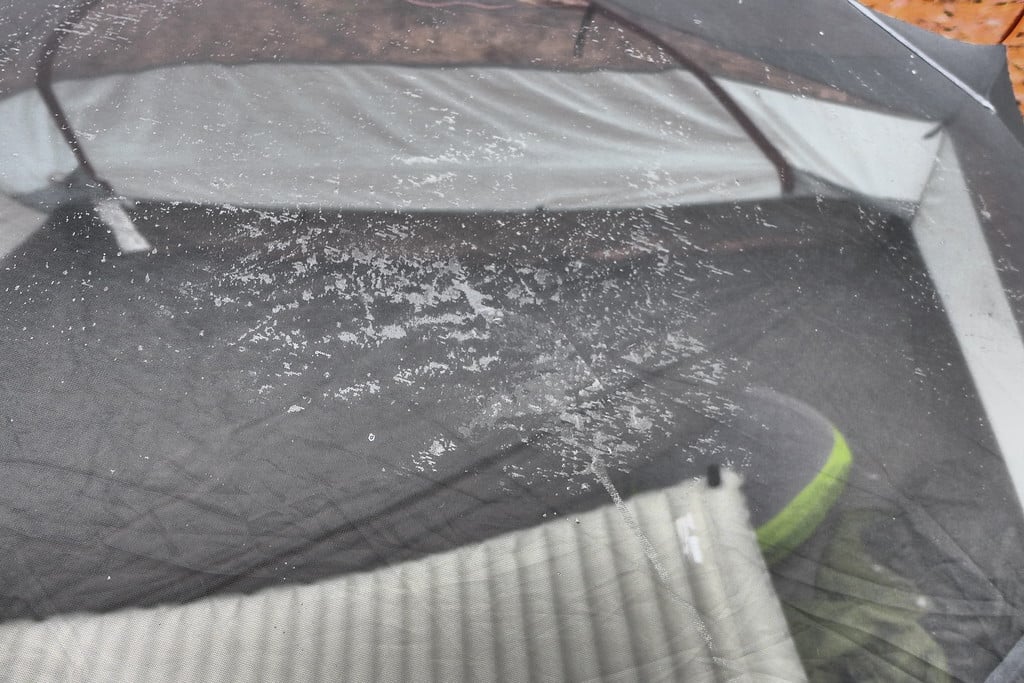
I typically get alot of hoar frost when conditions are right—on the inside of the inner tent canopy as Roger says. I find the best way to remove it is to carefully pack up in the morning (to keep the ice off my gear) and then packing up the tent. Later in the day when I set up camp all this ice has fallen off the canopy walls and landed on the tent floor where it can be pulled out with gloved hands.
Plus, when the tent is re-erected and empty of gear you can vigorously shake the canopy walls and the rest of the ice (or by now water droplets) will fall off.
On bad days I can pull out at least of liter of ice frost from the floor—here’s a pic example of the stuff on the floor.

The big problem is when I’m basecamping at a spot for several days stuck in a series of blizzards. This inside condensated ice builds up and can only be removed by pulling all my gear outside and doing a thorough scrapping and ice removal—which on the other hand is automatically removed by packing up every day.
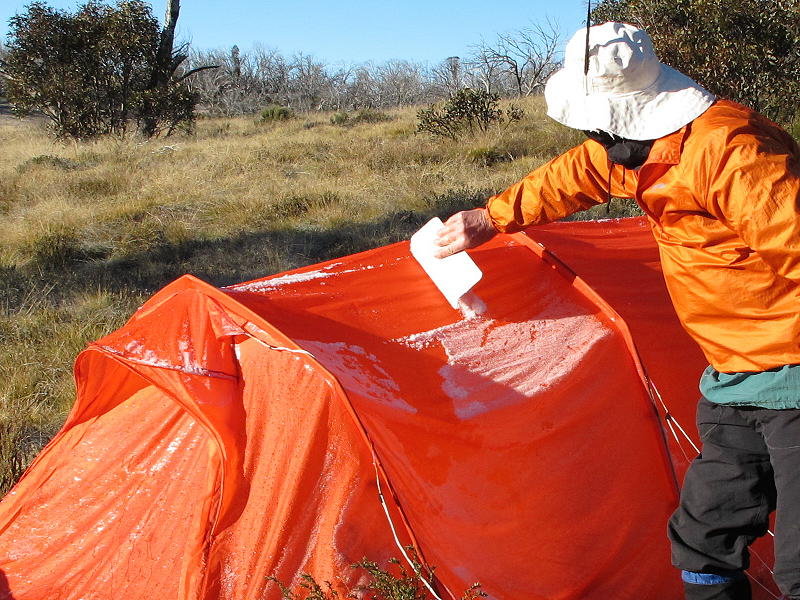
You can also get that hoar-frost on the outside of your tent. As the evening falls with a clear sky, the temperature drops, and condensation forms on the outside of the tent. Then as the temperature falls even further, due partly to radiation to the dark sky, the condensation turns into frost.

You get to scrape it off in the morning.
This was in late Autumn. Later on, at the end of that trip, we were walking through light snow cover. It was OK.
Cheers
Here in the Southeast mountains of the US we have a pesky winter phenomenon whereby it rains hard at 35F and the tent is soaked—and then temps drop thru the night to 10F or lower.
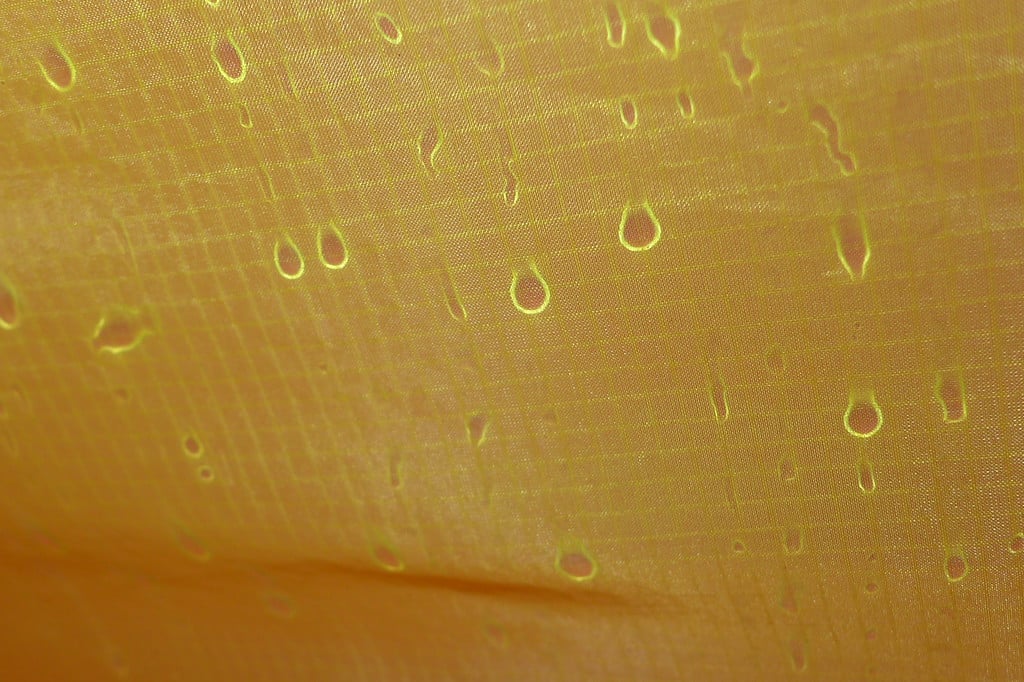
It creates what I call Ice Varnish on the tent fly fabric—and impossible to remove—so the tent has to be packed up but it won’t fit inside its usual tent sack—requiring instead rolling the whole bulky wad into my ground cloth and placing on the bottom of my pack—like this—

The varnish is hard to describe—a film of frozen water—sort of like this—but clearer and impossible to remove w/o damaging the tent fly—esp if you want to get an early morning start w/o benefit of direct sunlight.

@Tipi
Does this happen on a silicone-coated surface (like sil/sil nylon)?
I did find that with a good silicone surface, shaking the tent was very effective.
Cheers
Brad W,
Looks like your upcoming weekend has come and is almost gone, but if you postponed the trip for a bit, and your partner still is on board after reading this thread, suggest you take your double wall REI for the reasons in my earlier post, but bring stakes that you feel will penetrate frozen ground, and add guylines to the loops part way up from the four corners of the fly that appear in REI’s illustration. Those guyline stakes should hold the four corners firmly to the ground without having to bring extra stakes. At least that has been my experience with guying out wedge dome tents for high winds.
Looked at the prices on REI for 4 season tents, and they have increased dramatically, and they seem quite a bit heavier. The Bibler tents sold by Black Diamond are solid, and fit in that category.
Roger—my red Hilleberg is old and faded with some UV damage so perhaps a brand new silnylon fly wouldn’t allow any ice attachment etc. Hilleberg brand Kerlon is not hydrophobic—and a long rain will “wet out” the fly surface. I think this wet out feature causes the Ice-which-was-once-water to weld with the fabric. It really is a “varnish”.
It could be a phenomenon of worn-out Kerlon—which may well be the limiting factor on the longevity of Hilleberg tents. A brand new Hilleberg is bright and shiny and has a “greasy” silicone feel—but after several years of use this feeling is gone.
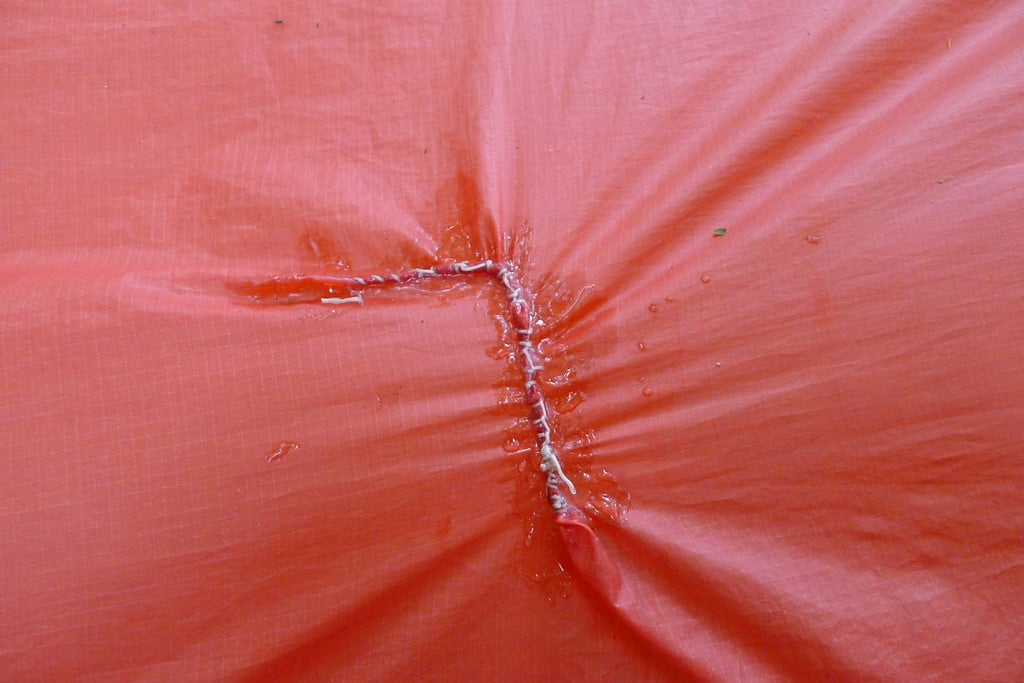
It was proven to me on a recent trip during 3 weeks of thunderstorms—when a small tree branch fell directly on my tent and easily caused a 6 inch rip—field repaired on the spot with a pre-threaded needle and an always-carried tube of McNett’s silnet sealer.
But in my opinion this should not happen with Kerlon—a small hole, yes, but not a “bed sheet” rip. Time for a tent replacement? Please say no. Prices are sky high.

Yeah, that looks like UV damage to me. You might get a little advantage by giving the fly a good spray of silicone water repellent (out of a can). I do that once every 2 – 3 year to my silnylon tents.
Expensive? Probably. But are you planning on leaving everything to your children and not enjoying any of your lifetime’s work yourself?
Cheers
PS I recommend, of course, another tunnel.
Become a member to post in the forums.