Has anyone ever tried pouring surplus fuel from a chimney-style alcohol stove? I’m looking for a stove that, if it can’t be sealed to store surplus fuel, is at least user-friendly in the way the fuel can be poured back into my fuel container without spilling. Suggestions? Thank you!
Topic
chimney-style alcohol stoves and storing surplus fuel
Become a member to post in the forums.
- This topic has 10 replies, 8 voices, and was last updated 7 years, 10 months ago by .
Generally, there is no good methode. While chimney stoves (like the 12/10, or Brasslite Turbo’s) are fuel efficient (the 12/10, TurboD performed very similarly with ~5/8-3/4oz fuel in real world conditions) they are generally slightly heavier than other alky stoves. They generally make a mess trying to recover fuel, though I believe ZEN Stoves shows one that was easy. A funnel helps but it is far easier to measure out what you need and simply burn off any excess. Also, chimney stoves like the Turbo can be difficult to turn off/cool down.
Basically, all alky stoves burn fairly well, unless they are choked (not enough oxygen.) Alky is “partially combusted” fuel already. Methanol and Ethanol have a water molecule combined with a rather short hydrocarbon chain (molecularly speaking.) It only produces about 12,000BTU compared with White Gas/Butane/Propane at ~20,000BTU and Esbit which is around 14,000BTU. The advantages of alky to a stove are obvious: low toxicity, no pressure tank, hot flame, easy to light, easy to carry (low specific weight or “density” compared to water.
I gave up trying to recover alky from these because you needed some sort of funnel and it was heavier to carry, a lot of fussing to recover less than 1/8oz of alky. I only use them for 1-3day trips, so, it is not worth the pay-back in terms of weight. I believe Dan Y just uses a cover on his. Trail Designs is selling a Kojin Stove.
I think I saw somebody selling something that looked like a small turkey baster for extracting the remaining alcohol, but I can’t remember enough to find it even with google helping.
Plastic eye dropper? Light and cheap.
I’ve used a fairly large plastic syringe that only weighs a fraction of an ounce. Snuff out the stove, then suck the alcohol out before it evaporates. In this way you don’t need to measure alcohol, just put in a bunch (ok, not too much) and suck out whatever isn’t used.
I saw someone selling an alcohol fuel bottle with a tube sticking out the top, and instructions on the web to make your own. I find the syringe works fine.
Thanks, everyone! Quite embarrassingly, I never though of using a funnel. I think I like the idea of bringing a funnel more than a suction device because it would come in handy for water collection as well. Sometimes those low-volume, trickling springs like to hug the ground or wall surface so much that it’s almost impossible to coax any of the water without a funnel-like device. I’ve had to use coiled leaves in the past, and it was certainly time-consuming. I anticipate more success (on both fronts) with a proper funnel.
plastic pipette – works great, weighs next to nothing.
Given the small amount of fuel that is usually left, I normally don’t try to collect the remainder. A small etching or scratch on the inner chimney for something less than a full ounce fills nearly perfectly. After snuffing the flame (blowing it out does not work well,) cooling it off and then pouring through a funnel means you might save a few drops to something less than a tenth of an ounce. After ten burns (roughly 5 days at 10 two cup burns per day) you might get a full burn. I never head out that long with alky.

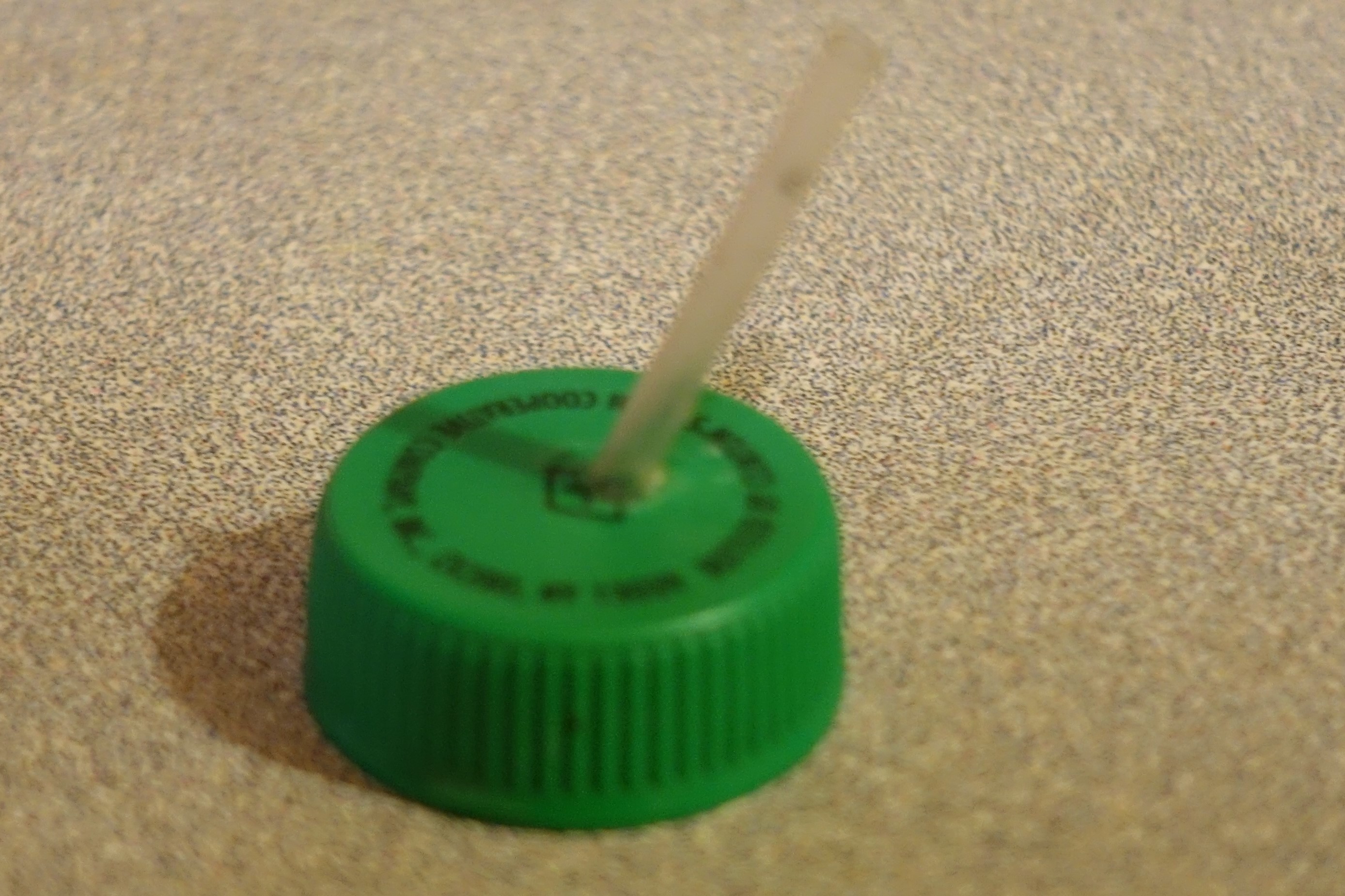
As far as a tubed fuel bottle goes, I make these up as needed using a standard “coke” bottle cap.
1) Take an old pen fill tube from a Bic pen and, remove the tip.
2) Get the ink out (usually by blowing through it.) Then wash through it a little fuel to get the worst of any remainder.
3) Using a separate bottle cap, ream a somewhat smaller hole than the tube diameter, rather carefully, near the center of the cap. You don’t want a lot of unevenness in the hole, nor, have the hole through the bottle seals.
4) Cut a long angle (about 45-60 degrees) on the end of the tube, warm the cap slightly (hot water works) and push the point through the hole, working it until the entire tube goes in.
5) Cut to length. Done.
They only take a couple minutes to make. I made 10-20 of these. The plastic around the cap is fairly resilient and forms a fairly tight seal with the plastic from the tube IFF the hole was anywhere near round and smooth. I have several in my gear room, now. You MUST press the fuel bottle before starting to do any vacuuming out of any fuel. Press, vacuum, tilt back. Also filling is easier because releasing pressure on the bottle will stop all fuel flow momentarily.
BTW, They weigh about 2gm.
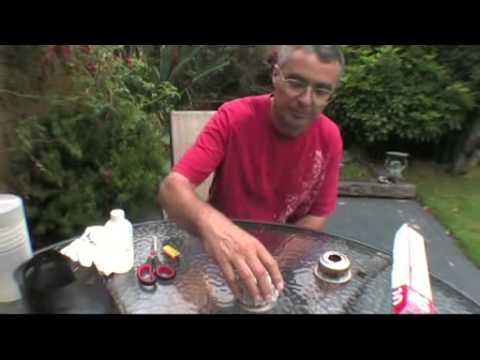
This is how I do it with mine, note that it is a snuffer too :

Simples, no rocket science involved. Franco’s fiddle free factor.
Become a member to post in the forums.