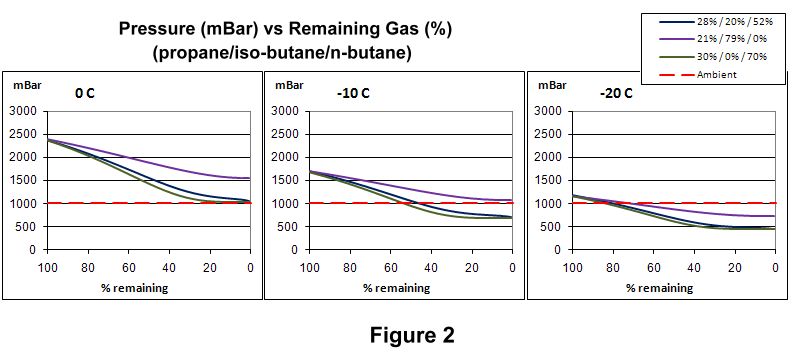
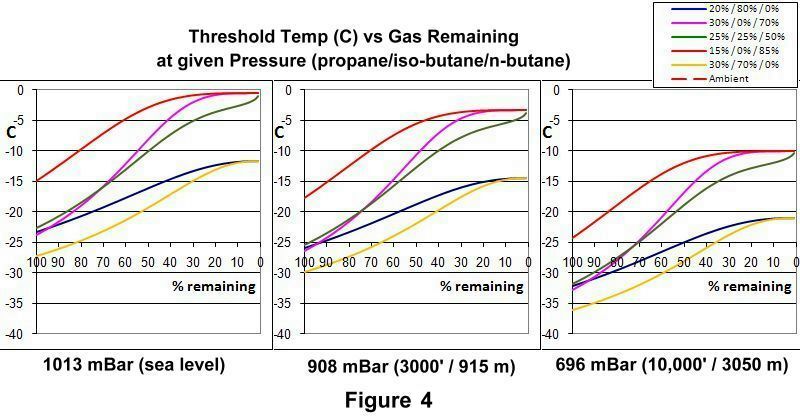
Well, we finally received the rudeness of some sub-zero (F) weather here in Boulder. So it was time to play with canister stoves in serious winter conditions (on my patio, where I could easily step inside for a warm drink, and opt to watch bowl games). After confirming once again that my modified Moulder Strip setups work great, and proving once more that more propane in the canister is mo’ better, I ran out of tests to run. So I decided to remove all of the propane from a new/full Optimus 4 oz. canister, so that I could later learn how a mixture of just iso-butane and n-butane would perform (the Optimus fuel is 25% propane, 25% iso-butane, and 50% lowly n-butane).
I used a BRS-3000T stove, and I placed the canister outside on an aluminum side table 3 feet away from my window, where I could watch the action from my lounge chair while I watched the ball games. The temperature went from 0* F to -5*F while I was doing this test, with minimal breeze. According to my rough calculations, iso-butane vaporizes at +2.3* F at my elevation of 5440 feet. So, theoretically, I should have been burning only the propane in the mix, right?
Well, the test went about like I’d expected, with the flame purring nicely as I burned off the propane. At 30 minutes the flame became much less robust, and about half as powerful, and I figured that it was just about out of propane. What surprised me (or rather confused me) was that it stayed that way for another hour. At the 90-minute mark, the flame then reduced to about 25% of the initial propane level, and there was a small yellow flame inside the usual, but weak, blue one. At 120 minutes I shut it down, thinking that something was a bit goofy. After it cooled down I brought it into the house and weighed the canister. There was 1.89 oz. of fuel left in the canister, which I have to assume was all n-butane. It appears that all of the iso-butane had burned off, which totally surprised me.
So I have a question of you learned canister scientists. We all know that a canister cools from the vaporization of the liquid fuel (under summer conditions). But exactly what is the resulting temperature from that vaporization? I assume that the effect is a bit different when propane vaporizes than when iso-butane does. So the question is this: Could the collective vaporization of these fuels actually RAISE the canister temperature when the ambient is 0 to minus 5 degrees F? It seems like something happened to raise the canister temperature to +2-3* F, where it would allow the iso-butane to vaporize (although weakly) and burn off. I need somebody to crunch some hard science numbers to perhaps explain to me how this could have happened (please, no random guessing here, Jerry).