When a BPL forum post mentioned Mammut’s new jacket that incorporated a new Alpha Direct polypropylene fabric, I was skeptical. Polypropylene is more hydrophobic than polyester at the fiber level, but I could not see why that would translate into meaningfully different performance from the existing polyester version. That question was enough to make me want to see the jacket firsthand.
I also had a second motivation. Last winter, I began experimenting with high-air-permeability jackets for high-output, cold-weather activities, where managing excess heat matters as much as blocking wind. Mammut’s fabric selections suggested this jacket might fit that use case — and their claim that it “excels in variable summer alpine conditions” was worth putting to the test.
This is a limited review-I did not cut this expensive jacket to run my usual battery of tests, but the measurements I did take tell a clear story.
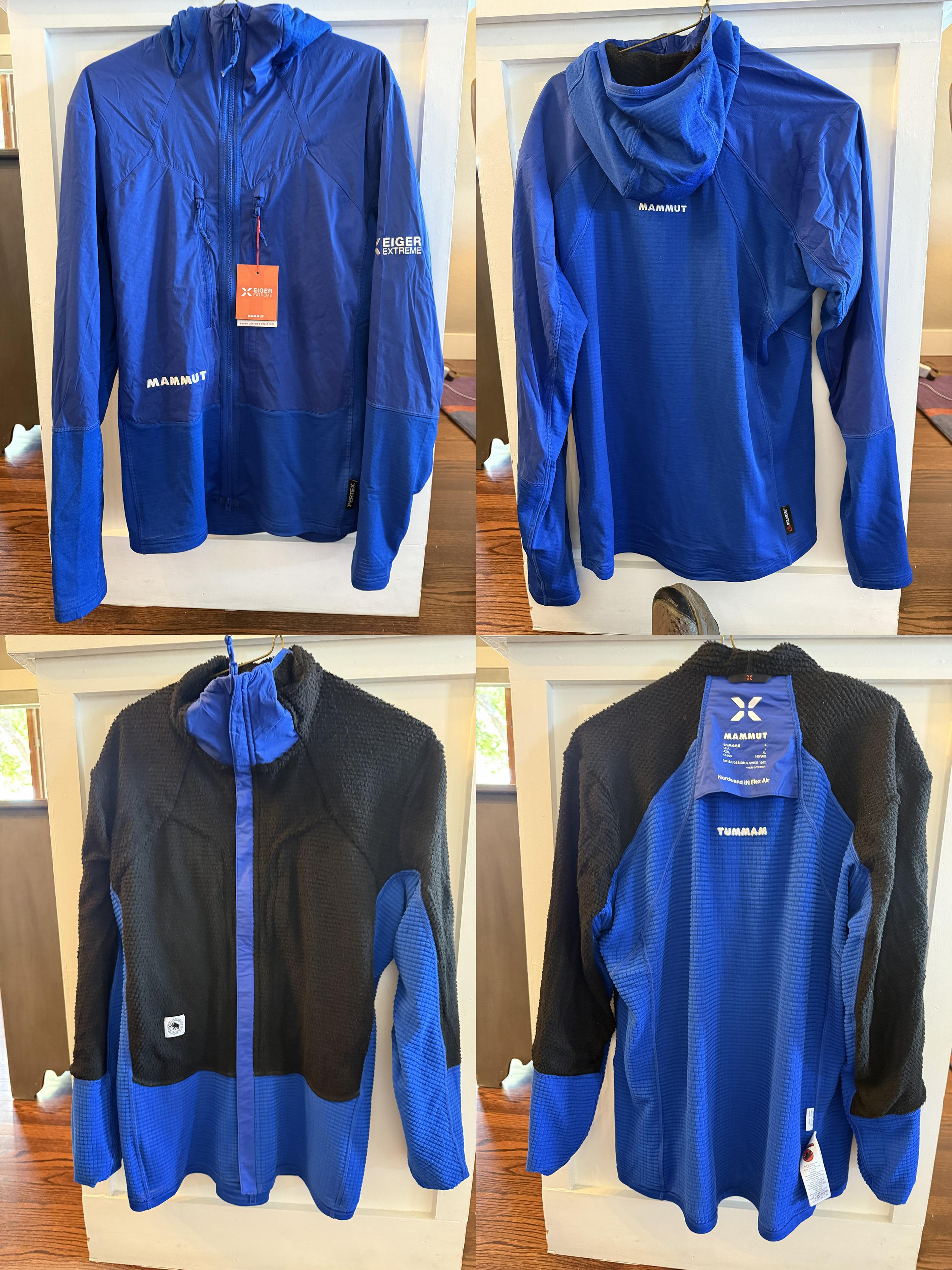
Construction
1) Pertex Quantum Air outer face fabric on the torso front and the upper 2/3 of the sleeves. Pertex Quantum Air can provide high air permeability.
2) The remaining jacket surfaces are Polartec PowerDry. Another, potentially highly air-permeable fabric.
3) Alpha Direct Polypropylene covers the inner torso and sleeves of this jacket, beneath the Quantum Air.
Alpha Direct Polypropylene
I inspected the Alpha Direct Polypro. It appears to be around 60 gsm, based solely on my visual inspection and comparison with other polyester versions. It seems to be similar in knit and loft. The contact angle of the polypropylene might be up to 15 degrees more than that of polyester. That will make the fibers more water-resistant.
In my last article, I described how a hydrophobic fabric, such as polypropylene, can retain substantial moisture because sweat can occupy the air spaces between the fibers and yarns. We know from my articles on drying different fabrics that Alpha Direct does indeed hold lots of water.
It is likely that in a situation where the wearer is working hard and sweating, the polypropylene Alpha will hold similarly large water volumes at saturation as the polyester version because the air volume in the fabrics is probably similar. So, I still don’t really understand what benefit Polypro brings to the Alpha Direct table.
Air Permeabilities
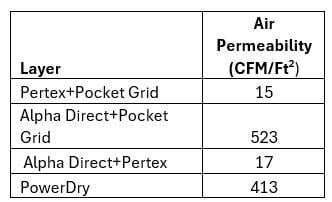
Measuring the air permeabilities of all the layers was not simple because the Alpha Direct and Pertex were sewn together so I could not measure these directly. What I could do was measure each through the net fabric inside the side pockets. So the measurements are slightly lower due to the additional resistance of the net fabric. The table below shows the air permeabilities.
Using these numbers, we can infer something about the expected performance of this jacket.
1) The designers wanted to get substantial airflow through the jacket to take away excess heat and moisture. All of their fabric selections could be expected to work together towards the goal. Except for one: The Pertex Quantum Air. This fabric, in the absence of the Pocket Grid, probably has an Air Permeability of around 17 CFM/Ft2. This is consistent with what I measured for Bill Budney’s Wind Shirt project when testing the Mountain Hardwear Kor Airshell. This is a disappointingly low number for this jacket.
We know from my prior article that in a 13-mph breeze, with garments below 60 CFM/Ft2, the airspeed inside the jacket fabric is 0 mph. No effective airflow and certainly no convective cooling due to air penetration. This means that at hiking speeds of 3 mph or less, the Pertex Quantum Air cannot help remove heat from the jacket. We know from the Budney measurements that the jacket has good MVTR (Moisture Vapor Transmission Rate), so moisture vapor can escape. But excessive heat will not be driven out by air flow penetrating the Pertex shell. This result negates the properties of the other fabrics in this jacket.
2) A large expanse of this jacket is a single layer of PowerDry. This layer has very high air permeability. This means that if the wind is blowing from behind, your back may get cold. I don’t know why the designers think all the wind comes from the front and none from behind. If you are using this jacket, you will need to carry at least a light wind shirt in case this problem develops.
3) The Alpha Direct has substantial warmth, particularly against the Pertex Quantum Air shell, which won’t let much, if any, cooling air through except under substantial winds (above 20-30 mph). With strenuous effort in this jacket, such as climbing, say, above 40°F with low winds, I think you might be too warm. I am not sure what Mammut means by “summer alpine adventures,” but I would be wary of ascending in this jacket in the summer at moderate and even high elevations.
Conclusions
· The Pertex Quantum Air fabric’s air permeability precludes sufficient elimination of excess heat produced during high-level activities.
· The extensive use of PowerDry fabrics leaves the user subject to discomfort from elevated winds blowing from behind.
· The use of a layer of Alpha Direct Polypropylene may be too warm for this jacket.
· I cannot see how the polypropylene fabric provides significant improvement over the existing polyester varieties.
I have had considerable success this past winter cycling in a high-air-permeability cycling jacket (42 CFM/Ft2) with a base layer designed to meet expected temperatures. This two-layer ensemble provides far more flexibility to match my output and changing weather conditions than the Mammut jacket.
So, back to Mammut this jacket will go. If Mammut could come up with a higher-air-permeability shell material and a lower-air-permeability rear fabric, they might have something.