Topic

By the Numbers Quickie: Columbia Outdry-The Trade-off Nobody Announced

Viewing 22 posts - 1 through 22 (of 22 total)
Stephen Seeber BPL Member
PostedJun 13, 2026 at 1:28 pm

In 2016, Columbia Sportswear announced a new kind of Waterproof Breathable (WPB) jacket: The Outdry Extreme. Its most novel feature was that the jacket’s face was a waterproof, breathable membrane.

With one major exception (Gore Shakedry, now discontinued), all WPB jackets are constructed as a  2.5- or 3-layer sandwich consisting of a face fabric on the outside, an inner fabric on the inside, and a waterproof, breathable membrane in the middle. The membrane allows sweat vapor to escape to the outside but blocks water on the face fabric from entering the jacket.  There is one fly in the waterproofing ointment. The face fabric must allow sweat vapor to escape, so it cannot be completely waterproof. This is accomplished by using a woven or knitted face fabric with numerous small pores, through which vapor can escape.  Unfortunately, precipitation can be absorbed into the fibers or the pores of the face fabric, causing it to become wet, heavy, and cold. The solution has been to apply a DWR coating that prevents absorption of precipitation. As we have all experienced, DWR coatings have become less reliable over time, so you can expect your face fabric to experience “wet out”.

Wet out is one of the things Columbia set out to eliminate with its waterproof-breathable Outdry Extreme jacket.  The jacket’s waterproof, breathable membrane, a polyurethane coating, is adhered to the face of a nylon woven or knit fabric. Precipitation cannot penetrate or be absorbed by the monolithic membrane from the outside, but since the membrane is claimed to be breathable, sweat vapor can transfer through it and out.

I measured the moisture vapor transfer rate (MVTR) of the original jacket and found it to be poor. However, I hoped that over time it would improve.  So, I began testing these jackets periodically. The scatter plot below shows the MVTR of jackets I have tested. As a point of reference, I prefer my WPB shells to have an MVTR that exceeds 3000 g/m2/24hr.  This level exceeds most Gore-Tex jackets (Gore Shakedry is the only exception I have seen) and virtually all non-porous polyurethane membranes. Electrospun membranes (if you can still find them) will typically perform at this level or better.

Here are the results of that testing:
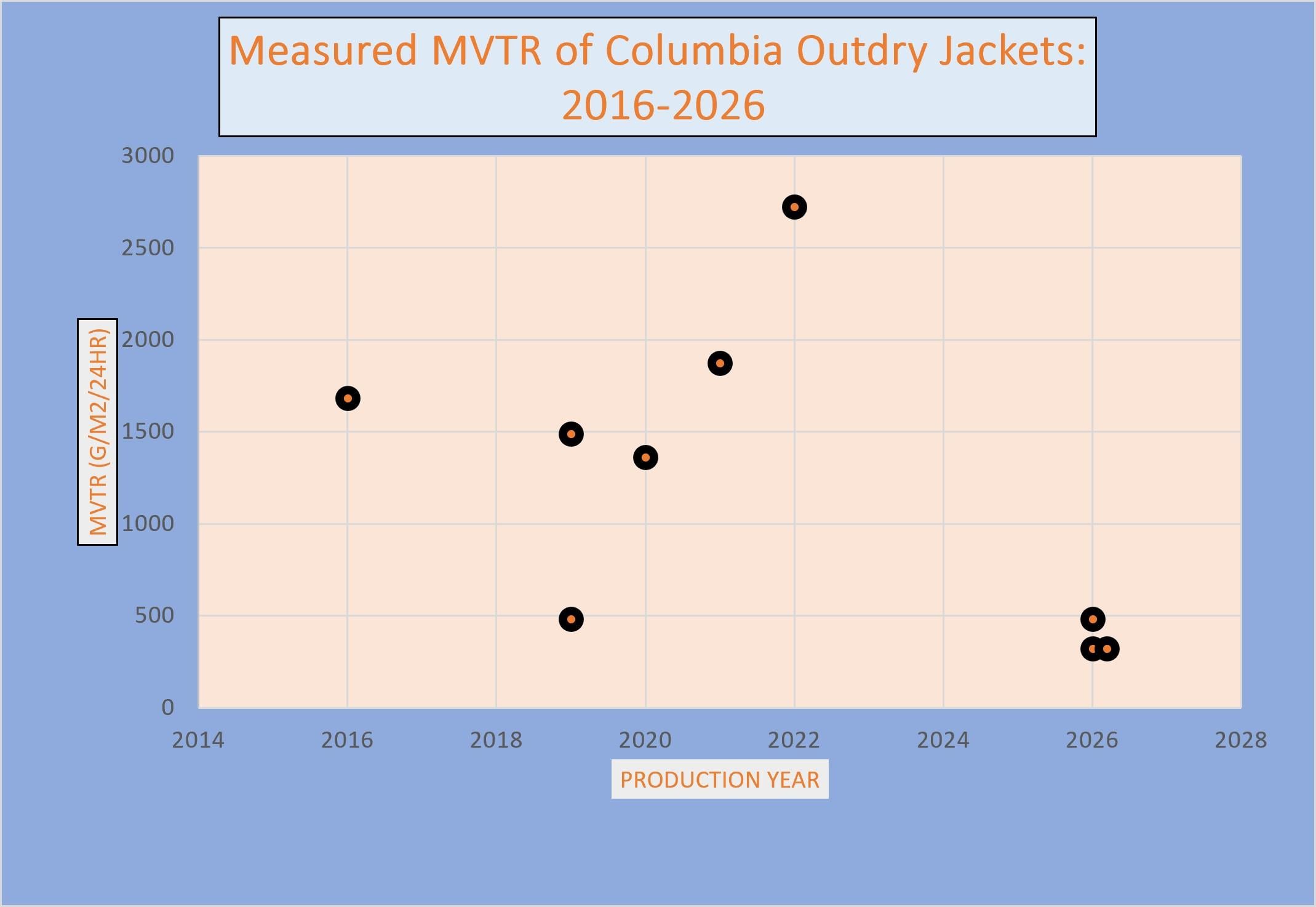
The scatter plot shows all the MVTR data I measured between 2016 and 2026.  We can see that peak MVTR performance was achieved in 2022 at 2720 g/m2/24hr. In 2026, two jacket models were made from the same fabric and achieved an MVTR of 320 g/m2/24hr. This is the lowest value I have measured for any WPB jacket. The third jacket is a different fabric construction and produced an MVTR of 480 g/m2/24h.  The MVTR reduction from 2022 is 82-88%. Columbia seems to have gone in a different MVTR direction.

Why the precipitous changes by 2026?  It is possible that 2026 models have thicker exterior coatings. Thicker coatings would increase water resistance, probably improve durability, but would reduce breathability. We don’t know why they changed from increasing MVTR to very low MVTR, but in my opinion, these should now be called Rain Jackets. They should not be called Waterproof Breathable jackets.

Columbia may have made a defensible engineering trade-off in the present jackets. What’s not defensible is keeping the breathability claim. The word “breathable” is just an adjective. The consumer can’t tell how well a jacket removes water vapor just because it is called “breathable”. The loss of breathability is a trade-off that Columbia did not announce and that consumers probably do not want.

PostedJun 14, 2026 at 2:46 am

But even the use of the term ‘breathable’ should be questioned because breathing in itself is an active process and in clothing it is used for something completely different.

Stephen Seeber BPL Member
PostedJun 14, 2026 at 9:00 am

Let’s ask Wikipedia:

Breathability of fabric is the ability of a fabric to allow moisture vapor to be transmitted through the material.

Mechanism
Air permeability is the ability of a fabric to allow air to pass through it. While air permeable fabrics tend to have relatively high moisture vapor transmission, it is not necessary to be air permeable to be breathable.

Due to body heat and moisture, there is almost always higher heat and humidity inside a clothing system. This creates a differential pressure forcing the heat and humidity toward the outside. The greater the difference between the heat and humidity inside the clothing system and the outside, the greater the Differential Pressure to push that heat and humidity out.

That kind of sums it up.  We know what it means but it may not be clear to lots of others.  I think we are stuck with it.

PostedJun 14, 2026 at 11:03 am

That’s it: we are stuck with it. Because breathing is actually an active process that organisms do.

john mcalpine BPL Member
PostedJun 15, 2026 at 1:42 pm

I’m not a man of science.  All I know is I bought my Outdry about 10 years ago.

I wore it one time hiking on snow in a downpour.  I was soaking wet.   I never wore it again.

Stephen Seeber BPL Member
PostedJun 19, 2026 at 3:50 pm

You were a pioneer.  That is about when they were first introduced.  There were reports of delamination.  If you still have can you see any evidence of issues with the urethane outer coating?  I don’t know if you visually identify a delamination failure from the fabric’s interior.

john mcalpine BPL Member
PostedJun 19, 2026 at 5:54 pm

Stephen,    I haven’t looked at the jacket since the day I left it hanging 10 years ago in my closet.

OMG!…the right shoulder has completely delaminated.  My jaw dropped.

It’s worthless to me.   I’ll mail it to you for free if you’d like?….for your research.

johnmarkmcalpine at gmail.com


Stephen Seeber BPL Member
PostedJun 19, 2026 at 8:59 pm

Hi John:

I accept the offer.  I will add it to my collection of these things.  Some day, I will offer it all to the Smithsonian!

I sent you a PM with my address.

I will also send it to the email you posted.


JAshley73 BPL Member
PostedJun 20, 2026 at 8:09 pm

My curiosity wonders if Columbia made so many model changes in pursuit of better performance, or if they were falling victim to the pressures of “fast fashion.”


Stephen, if you still have the models tested at the respective years, would you be kind enough to share them with us? I’m still greatly interested in OutDry. It would be nice to know which models breathe well, and keep an eye out for them on eBay,


Speaking of eBay – What do you all think of OutDry ‘fabric’ on a down jacket? I did see a 700fp down jacket with OutDry on eBay recently, and I’m intrigued by it as well.

Stephen Seeber BPL Member
PostedJun 21, 2026 at 3:45 pm

Men’s OutDry Extreme Mesh Hooded Rain Shell Jacket, 2022 is the highest MVTR jacket. I would wear this over a puffy only if you wish to avoid DWR degradation above all else.

JAshley73 BPL Member
PostedJun 22, 2026 at 9:35 am

Stephen, thank you for the update on the 2022 model.


My last question – Sorry for any confusion. I’ll restate it… Based on your experience with OutDry, what would you think about a down jacket that used OutDry as it’s exterior fabric? (Not layering a WPB jacket over a down puffy…) Is there much usefulness to a down jacket with OutDry fabric? Or not really?

Brad Rogers BPL Member
PostedJun 23, 2026 at 6:06 am

I would assume part of it is that Columbia is really not a performance outdoor brand (they own Mountain Hardwear for that) and their customers typically want something that is very waterproof and durable and probably aren’t ever going to notice if it’s less breathable.

I do have an older Outdry jacket – it was the 7oz version (I can’t remember the name) and I’ve used it some with descent results for the fabric.  I do miss any real form of ventilation and I find the hood’s cut isn’t very good.

I typically find myself between two WP/B shells – an old Haglofs Ozo Pullover with Packlite that is light and has a fantastic hood, or a Montaine Spine Jacket with 3L Gore Tex and pit zips.


Jerry Adams BPL Member
PostedJun 23, 2026 at 7:43 am

JAshley73 – one person’s experience:

Having an outer layer that keeps me dry inside is always a fight with having too many layers – too much insulation – so I get wet inside from sweating

So, in many cases I want just an outer layer – I favor a WPB.  But you need a base layer to protect the membrane.  So, that’s the minimum that minimizes sweating as much as possible.

If it’s really cold, then I add a mid layer.  If I already have a WPB for the outer layer, then the mid layer should just be as light as possible – thin nylon is the lightest.

So, putting a WPB fabric on the outside of the mid layer is a negative – it makes it heavier without adding any benefit since I have the WPB outer layer anyway.  If I’m wearing that WPB outer layer, then a WPB fabric on the outside of the mid layer reduces breathability.

Another thing is I wouldn’t want a down mid layer because if it gets wet from sweat, it loses almost all insulation value and takes forever to dry.  I’d rather have a synthetic mid layer like apex.  Or fleece, but that’s a little heavier.

Just something to consider…

PostedJun 23, 2026 at 9:25 am

Man that sucks that the latest jackets have such poor MVTR.  Some of the models have pit zips and/or generous pockets for venting, but so what?  I might as well just get a non-breathable waterproof (Silnylon) rain jacket from LightHeart Gear, Packa, etc?

With the move away from PFAS based DWRs, I feel like the state of the industry for rain jackets has taken a significant turn for the worse. :-(


Stephen Seeber BPL Member
PostedJun 23, 2026 at 9:40 am

The real message from this posting is that the word “Breathable,” when attached to a jacket description, is useless. I have been testing a range of today’s waterproof-breathable jackets and have found examples with even less breathability than the three new Outdry jackets tested here. Jeff’s comments tend to be correct.  Some of the new PFAS-free WPBs are terrible. The lack of published standard test results and the use of standard tests that don’t come close to in-use conditions is the reason that the word Breathability won’t tell you if you are wearing a garbage bag or a jacket that will adequately remove water vapor. This is the subject of my next article in a month or two.

JAshley73 BPL Member
PostedJun 23, 2026 at 1:54 pm

Stehpen, what jackets have you found, that have the “best” breathability – costs, features, weight, and so on be damned?

I guess, in an objetive sense, that really only applies to the “fabric” [material] since features like pit zips, fit etc. contribute to the jacket’s “overall” breathability, and can’t be objectively measured.

JCH BPL Member
PostedJun 23, 2026 at 2:51 pm

Wow!  A DriDucks jacket for < $25 just keeps looking better all the time.  Could be replaced 8 or more times for the cost of most WPB jackets.

Imma stick with my Amazon zippered poncho and driducks for now.  Full disclosure…I don’t normally bushwack :)

Dan BPL Member
PostedJun 23, 2026 at 3:04 pm

Stephen, I respect the fact that you are making the effort to gather data. But you should understand that the flip side of data acquisition is statistical analysis. If you are going to present these articles in a scientific way, I believe that you would benefit from learning some rudimentary statistics.

For example, I strongly doubt that those time-series data demonstrate anything with any reasonable level of confidence, and certainly not that the MVTR peaked in 2022. Perhaps one might find a slight decline with time in MVTR with low confidence. But the scatter appears to greatly outweigh any trend. And we have no idea if the scatter is due to your sample, to your measurement protocol/equipment, or another factor.

If you do understand statistics (and the scientific method), and are simply omitting the analysis, then I think that’s inappropriate. There are many smart people on this site. If the conclusion is that there you are unable to document any significant change over the past 10 years, that’s ok and honest.

Stephen Seeber BPL Member
PostedJun 23, 2026 at 4:20 pm

Hi Dan. Thanks for the comments. I don’t mind pushback, in fact, I would prefer some that points out ways to improve shortcomings in my testing.  I don’t know if your critique is aimed at my test instrumentation or the way I use it or the small sample of test points.  I assume the latter.

In many of my articles, I point out that  my testing represents a very small sample of whatever it is I am testing. That simply cannot be helped. I have limited resources, including money and time, to purchase and test large numbers of test items. If you read textile academic studies, that is the case with far better-funded researchers.   So, I cannot fit a normal curve to any of my testing projects.

This project certainly has less rigor than my regular articles. It is very simple.  I have tracked jacket performance over the years to assess where the technology is headed in terms of MVTR.

So what do we see in this data? The average MVTR in the period 2016 to 2022 is 1600.  The average MVTR in 2026 has dropped to 373.  That is a 77% drop.  The drop in jacket performance was so significant that I purchased two more jackets from their website to test.  I think there is one more current model that I did not test. I don’t know what Columbia will produce in the future, but based on this information, I would be concerned about breathability, which was never great in these jackets.  This is a substantial drop in performance. To me, it signals a change in the product’s engineering direction to achieve an objective other than breathability.

Readers of this little report can judge the importance they attach to the data and the methodology.

If I am missing your point, feel free to rephrase the issue.

Stumphges BPL Member
PostedJul 4, 2026 at 2:46 pm

I still have one of the first-gen jackets and it’s my primary backpacking rain jacket. It’s still waterproof, but I use it sparingly and baby it. I don’t think it ever breathed that well, but the big chest pockets/vents work fairly well. I like it because I find a wetted out rain jacket to be intolerable.

Stephen Seeber BPL Member
PostedJul 4, 2026 at 4:30 pm

Hi Stump. I took a look at the delaminated jacket that I was sent. It is delaminated in One area. Most of it looks intact. The fabric is far lighter and completely different than today’s fabric when I get a chance to measure breathability I’ll have more to say.
Stephen Seeber

Viewing 22 posts - 1 through 22 (of 22 total)
Loading...