Topic

Bubblewrap for insulation (seriously)

Viewing 22 posts - 1 through 22 (of 22 total)
mik matra BPL Member
PostedMay 5, 2016 at 5:10 am

I just saw an episode of Mythbusters (didn’t get to see it all as I was looking after my 5year old son) and although they did not concentrate on the bubble wrap they were out in the desert with temps at 32F (that was the afternoon with sun still way up, it got much colder overnight). They were in suits and decided to make a bubble wrap poncho over their suits to stay warm. They said it was very warm!!! Then at night Jamie slept in a duct-tape made shelter but he slept on bubble wrap ‘pad’ and then wrapped himself in bubble wrap!!

Just wondering, has anyone used bubble wrap as part of their kit? No, I AM serious? I mean it would be EXTREMELY light though bulky! I was thinking of using some of it for say something as simple as insulation on top of your sleeping mat……

Thoughts?

Bob Moulder BPL Member
PostedMay 5, 2016 at 5:43 am

For the past 3 winters I’ve been using bubble wrap mailing envelopes as water bottle covers for Gatorade (Powerade, whatever) bottles and they work very well.

Below about 10°F for overnight trips I use 2 of them per bottle.

Could also work as a FBC cozy as well.

For the other uses you mentioned, I just don’t see it as practical, durable and compact enough for use as standard kit but definitely useful in an emergency, although nobody is going to be carrying around enough bubble wrap, and probably not enough duct tape, to rely upon this stuff as a solution.

Something to keep in mind around the house after the Zombie Apocalypse, however. :^)

Ito Jakuchu BPL Member
PostedMay 5, 2016 at 5:48 am

Not bubble wrap but I saw one participant in the Trans Japan Alps Race (total length 415Km (260miles), total elevation change is 26,662 meters (88000ft)) make a vest of two pieces of Thermamest Z-pads, that he connected with some cordage. Used it under his rain shell for a bit of extra warmth. He would use it as a minimalist pad for rest/emergency bivouac under his tarp.

Matt Dirksen BPL Member
PostedMay 5, 2016 at 6:16 am

An EVA ccf pad has at approximately  3 to 4 times the R per inch of Reflectix (the shiny bubble wrap insulation, which is typically measured at about R-1 per inch).

If your looking to supplement your sleeping pad, adding a thin ccf pad is going to be much more effective, and while I can’t verify it at the moment, is a lighter solution as well.


Jerry Adams BPL Member
PostedMay 5, 2016 at 7:59 am

also bubble wrap isn’t breathable so you would tend to sweat inside.  Maybe if the bubble side faced you water vapor could get out though between the bubbles.

I would think that Reflectix would have a higher R per inch if there were internal refective surfaces with air gaps in between.  And the bubbles are small enough so there wouldn’t be a lot of internal convection

Lori P BPL Member
PostedMay 5, 2016 at 9:00 am

There was a British study that I saw years ago that talked about mylar being not so much the deal as having a vapor barrier — the shiny wasn’t as important as it being a vapor barrier. Regular plastic worked just as well keeping people warm as emergency blankets.

I can see it — if you’re wearing clothes, and out in the cold, you have heat loss through the breathable clothing as there’s nothing to stop the flow of warm air away from you or keep cold air from blowing in. Convection, conduction, and radiation are at work – you sit on a cold surface and it sucks away heat. You respirate and the evaporating moisture from your skin, which gives it off constantly all day, all night, no matter what. Plastic stops convection, warm air (warmed by YOU) inside trapped air spaces (in the down of the jacket, in the bubbles of air in bubble wrap or a sleeping pad) stops conduction. There’s no doubt some radiation going on, and a vapor barrier stops that too.

But it’s still just bubble wrap, and I’d much rather have a sit pad or sleeping pad. Bubble wrap pops a ton easier than a NeoAir.

Matt Dirksen BPL Member
PostedMay 5, 2016 at 9:18 am

“I would think that Reflectix would have a higher R per inch if there were internal reflective surfaces with air gaps in between. ”

Here’s a link about the basics of bubble wrap:

http://www.greenbuildingadvisor.com/blogs/dept/musings/stay-away-foil-faced-bubble-wrap

And from the DOE’s website:

“Unlike traditional insulation materials, radiant barriers are highly reflective materials that re-emit radiant heat rather than absorbing it, reducing cooling loads. As such, a radiant barrier has no inherent R-value. Although it is possible to calculate an R-value for a specific radiant barrier or reflective insulation installation, the effectiveness of these systems lies in their ability to reduce heat gain by reflecting heat away from the living space.”

In other words:  while creating an air gap between the Reflectix and a radiant body (such as our skin) might potentially create a higher R-value as an assembly, the material itself can’t claim the higher R-value. The silly thing about using this stuff to supplement our sleeping system is: in an ideal scenario, it would require a totally sealed air envelope between itself and the heat source, which is practically impossible to create and maintain while sleeping. Even in the Neo-Rests, while the shiny interior baffles help in a completely static environment, the second you move around on the pad and create some internal convection, the pad’s total R-value drops (Which the manufacturers don’t contemplate in their R-value claims). And since we are attempting to retain heat, we need to rely on materials with high thermal resistance which don’t depend on high emissivity to work. bubble wrap (shiny or otherwise), simply doesn’t perform nearly as well as other materials of similar weight or thickness.

But I must admit, I have several rolls of it in my basement, and I LOVE to make cool things out of it. I also use big sheets of it under our big tents as a footprint (obviously not when backpacking). A lot cheaper than the store bought footprints, and much more comfortable on the hands & knees.


Bob Moulder BPL Member
PostedMay 5, 2016 at 9:23 am

That’s why I always carry one of those 20-gal plastic leaf bags (the thin ones, not the construction clean-up bags) in my emergency kit. I actually used it once, and while it probably didn’t save my life—I was only 2-3 miles from finishing the hike—it sure made it a lot more comfortable! But for somebody a long way from nowhere, it could make a difference, maybe save a life.

PostedMay 5, 2016 at 11:10 am

Matt, given the low R-value of Reflectix, would it make more sense to build a pot cozy, for example, out of ccf (or some other insulating material)? I have a Reflectix pot cozy that seems to do a good job but, perhaps, there is some other material that could work much better.

Matt Dirksen BPL Member
PostedMay 5, 2016 at 12:07 pm

CCF should technically work better, as long as it won’t deform or melt. However, I would be concerned about it’s overall durability.

Personally, I’d wager that Aerogel might become the “best” material to use. Fairly durable, about R-10 per inch, and quite flame resistant, I think it is the choice material to play around with.

(Until we find out it causes cancer…)

Here’s a link to a shout out page: http://www.jetsongreen.com/2010/02/aerogel-ultra-thin-super-insulation.html


Bob Moulder BPL Member
PostedMay 5, 2016 at 12:26 pm

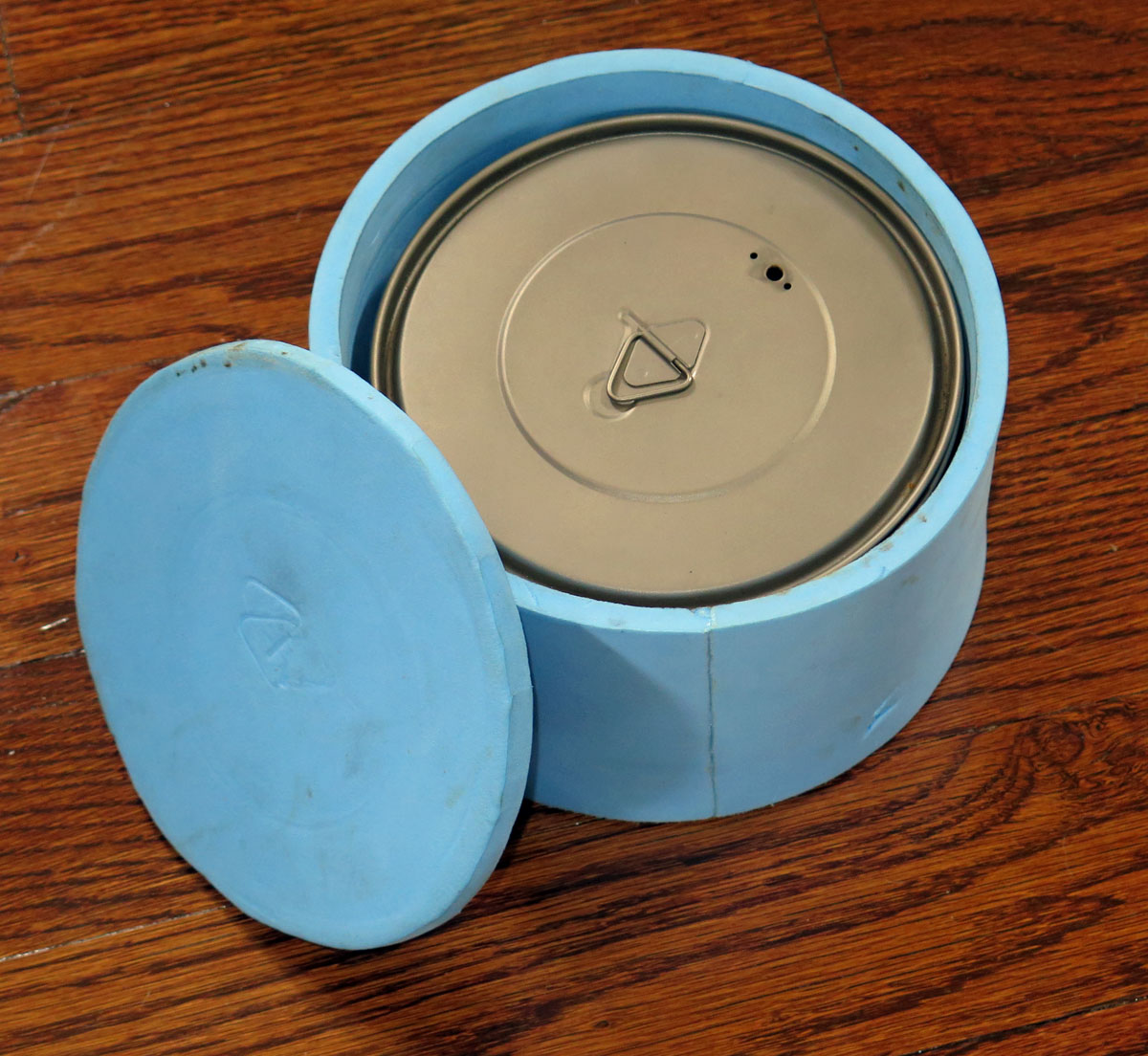
I’ve made and used a 3/8″ CCF pot cozy (including lid) for a Toaks 1.35L Ti pot and it worked very well. I haven’t used it for quite a while, but IIRC food left to rehydrate was still too hot to eat 20 minutes later, maybe even longer. Never compared it directly with Reflectix, however. Cozy with lid weighs 22 grams.

Jerry Adams BPL Member
PostedMay 5, 2016 at 1:55 pm

interesting link Matt.  Radiant heat is very confusing, lot’s of mis-information

“Since the main benefit from foil-faced bubble wrap is due to its radiant-barrier facing, the product is basically worthless unless it faces an air space”

That’s what I believed and measured but not too many people talk about it.

If there was foil facing inside the bubbles, there’d be an air space, but looking at a piece from Home Depot (maybe not Reflectix) all the inside bubbles are plastic, which absorbs IR.  The foil is just on the outside.

If you slept on it the foil facing wouldn’t do much because it’s against the ground or your body.

If you wore it on the outside, with the foil on the outside, that would work – there’s an air space above it.  Unless it was windy.  This is like a space blanket.

A Neoair has internal reflective surfaces with air spaces next to it so that works.

That link didn’t like reflective bubblewrap because it’s expensive, but that wouldn’t be an issue for outdoor gear, only for a house that requires huge amounts.

Bubblewrap is lighter than than any other insulation though.  In most cases, having a reflective outer layer doesn’t matter so you could just use clear.

mik matra BPL Member
PostedMay 5, 2016 at 3:17 pm

From what the boys were saying on the show it’s the bubble wraps air bubbles that is the insulating part and not the plastic layer that stops the breathability.

Jerry Adams BPL Member
PostedMay 5, 2016 at 4:40 pm

yeah, it’s the air in the bubbles that gives the insulation

all outdoor insulations use air as the insulator, the down or synthetic just pushes out the fabric to provide the air space, and prevents internal air convection.  The shell prevents wind from carrying away heat.

but the plastic of the bubble wrap prevents from sweat from escaping so you “sweat like a pig”.  Except maybe if the bubbles face you the sweat can escape between bubbles.

Bob Moulder BPL Member
PostedMay 6, 2016 at 5:15 am

Easy enough to test. Somebody else, not me.

Probably best not to wander too far out in the boonies to do so, however. lol

Gary Dunckel BPL Member
PostedMay 6, 2016 at 8:31 am

C’mon Bob, do it for the team. I know, let’s make Jerry do the testing, as it must be his turn.

By the way folks, pigs don’t actually sweat much. It’s the pig iron that “sweats” when water condenses on it during the cooling process of smelting. Fun fact to know and tell…

PostedMay 6, 2016 at 10:43 am

Even if you are lying directly on reflectex there is an air space between you and it.

I mean… even if you are naked and your skin is directly against the foil there is still a small amount of air between… maybe microscopic, but it’s there. And… your body is not flat… so there are air spaces where your body curves up and away from the foil… AND… you would presumably be in some clothing which also contains air. And… if you are talking about a sleeping pad situation, the sleeping bag contains air between you and the foil.

Billy

PostedMay 6, 2016 at 10:45 am

Oh.. and I have encountered backpackers on the trail with rolls of reflectex…. They said it was in addition to their sleeping pad and said it worked great and greatly increased insulation/warmth… hard to quantify though.

billy

Bob Moulder BPL Member
PostedMay 6, 2016 at 1:25 pm

C’mon Bob, do it for the team. I know, let’s make Jerry do the testing, as it must be his turn.

LOL, well if you google it you get almost as many hits on ways to use bubble wrap as you do for duct tape! I doubt any of us would be breaking new ground.

I’m all set down to about -30°F so I’ll let others mess around with this one. :^)


Matt Dirksen BPL Member
PostedMay 6, 2016 at 1:45 pm

“there is still a small amount of air between… maybe microscopic, but it’s there. And… your body is not flat… so there are air spaces where your body curves up and away from the foil”

There certainly are, but any tiny gains of radiant heating that our bare skin might encounter is all too quickly convected away by those same air gaps.

Unless you lie very still and stop breathing for a bit…

The bottom line: if you have the choice, the shiny stuff is best used for keeping a hot sun off of us in the summer. Other than that, use the real insulating materials to keep you warm.

But with no choice, whip out the ole Mylar emergency blanket and hunker down. Just keep the drafts out!

:)

Viewing 22 posts - 1 through 22 (of 22 total)
Loading...