“Your testing, Sam, appears to confirm that silnylon sag is an unsolvable problem in domes.”
Yes, but the domes have pole structures that help to keep them taut, or at least not sagging against the occupant; and with some added cat-cuts, they are habitable. There was an old thread from “Hang-em High” on BPL that illustrated this when compared to an A-frame tent or tarp. Although (pyra)mids may do better than domes with wind deflection, I’m not sure they do much better with silylon in terms of keeping the structure stable and taut in storms. And if one stake goes ….
Would think that for a pyramid with equal size and shape panels on each side, the panels would be identical triangles, or equalateral. So it would be easy to cut them so the bottom hem runs along the grain, and along a partial bias on the sides which would have the same diagonal angle of bias on the panels to be joined. The cutting lines would look like two giant saw teeth joined at the edges to be cut, with the lines curved slightly inward for a cat-cut. That seems more like what you describe. It also makes efficient use of fabric.
Certainly a panel cut on a bias at its edge could be joined to an edge cut along the fabric grain, and the bias edge could be pulled tighter during the sewing or bonding; but don’t think this is really needed if the triangles are equalateral. Am not as sure as Jerry and Hartmut of their approach.
But if the triangles are not equalateral, the seams on bias panels appear to have different angles of bias. Cat-cuts help with this, but am not sure a mid canopy will be as taut. There was a recent thread that went into mid designs at length, and might be helpful. A simple answer would be to make the mids with square or equal sided footprints, leaving most of one side for vestibule storage. This has to be done anyway to keep water from pouring into the living space when the door is opened.
For a common design that has an A-frame shape with beaks on the ends, the simplest approach would be to make the seam lines joining an A-Frame to beaks on the fabric grain of both panels. The beaks would not be equalateral, but if they meet at the tent’s center would do so with the same angles on the bias cut; that is, the beaks would be of identical size with identical angles on the bias lines. With some thought, the vestibules could be sized so the beaks are right triangles, and their bottoms cut and hemmed on the grain. (The selvedge line and the line perpendicular to it both share the same characteristic of having zero bias stretch.)
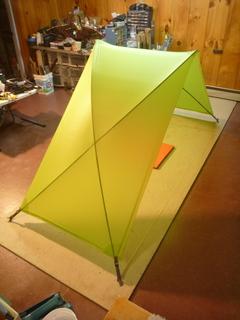
This leaves the question of how to keep the large rectangles on each side of an A-frame taut, even with poly that does not sag when wet like nylon. One approach is to design the pole structure to run along the bias lines as I’ve often illustrated with a prototype, where the bias stretch is absorbed by the poles:

This has the added advantage of using the bias stretch to create more space inside the tent. As previously noted, I’ve also found that bias stretch does not keep the nylon side panels taut when soaked, but am hoping silpoly, which also stretches on the bias, albeit less than nylon, will address this. Although the increased space under the A-Frame may be less with poly, it still beats a plain A-frame with the sides unsupported. Note that the ridge of the tent naturally assumes a cat-cut, so the only cat-cuts are where the beaks join at the front and rear of the tent. The leading edges of the A-Frame maintain taut straight edges, keeping the seams from sagging where the sides are joined to the beaks. Still, the devil is in the details, and as Roger once noted, the biggest question is how to quickly install the poles under the canopy, an issue that has taken the most thought.
Have often thought of applying some of the above to mids, so that instead of caving the walls inward at their cat-cuts, the tent is supported by one flexible pole that, similar to one of the arced poles shown above, weighs under 4 oz, and causes two sides of the mid to project outward. But expect that the demand for tents supported by trekking poles will continue to prevail. My one combo carbon-alloy trekking pole weighs 7.5 oz, and is 53.5″ fully extended. Hmmm.