


“As a stand alone shelter I see no advantages at all — my Cuben shelters and tarps are lighter and more functional.”
+1
Topic
Become a member to post in the forums.
.
“As a stand alone shelter I see no advantages at all — my Cuben shelters and tarps are lighter and more functional.”
+1
“Event has the same problem as any WPB material… it doesn’t breath well, so moisture can get stuck between the sleeping bag/quilt and bivy. The MLD event bivy weighs more than my Deschutes CF and my Cuben 8′ X 10′ tarp.”
Yup. It’s a dew point issue, and it will typically be on the inside of the bivy. You may generate enough heat to drive the moisture you generate from metabolic process out of your sleepingbag, but it is not enough to drive it through whatever WPB fabric your bivy is made of. If there is ambient outside moisture as well, you have a compound problem. I had a couple of very unpleasant experiences some 10-12 years ago and realized I could find better shelter options for minimal weight penalty. Never looked back.

It’s almost feeling as if it’s a flawed design/concept for 3 season backpacking. When I stop and think about all of my bivy “successes”, they were likely times when the bivy actually made no real difference and a bag alone would’ve worked fine…and a 6oz. warmer bag would’ve worked even better regarding wind/added warmth for the weight. But they certainly seem to introduce new potential for problems.
Maybe one day I’ll realize I should listen to Nick and Tom’s advice! ; )
@ Wisner
The condensation was from the ambient air on to the outside of your bivy and then the moisture went through the fabric into your bag. Correct?
I’m an odd man out here but then I came to bivvys as a climber not a walker and as I still feel that unless it is waterproof and breathable as in Goretex it doesn’t really count. If it isn’t Goretex [ or eVent at a pinch and I have used both] it’s a sleeping bag cover not a bivvy bag. No way I would be using one in summer or shoulder seasons tho, they are for life saving purposes when you can’t get a tent up. Different mindset really.
Never leave camp without the shovel or the bivvy sack
For the other 3 seasons I do have a Tyvek sleeping bag cover for just in case use and that comes in handy for splash protection under the tarp and Tyvek is fine for that but it doesn’t get much use as I don’t do much summer or shoulder season walking any more, too many flies and far too many people

Given all the rain we have had in SoCal, there is a lot of moisture in the ground at Joshua Tree you don’t normally have. I noticed some 3 weeks ago when I was there and choose my campsite accordingly as prevention against dew as it was rising during the night. Occurrences like you describe doesn’t sound like condensation, but dew. At least in my 12 years of using a bivy, I’ve never been saturated by condensation, but I have been by dew. It’s been a rare occurrence and I always have more margin than I need with my clothing layers so I just live with the minor risk. The first time I was covered in dew happened to me was near Warner Springs (less than mile 100 from the Mexican border) on my PCT thru-hike. Throwing my rain gear over the top helps some though increases real condensation in the bag; but its better than the dew.
In this photo, I was cowboy camped in spring in the Los Padres NF in spring 2 years ago. I was first covered in dew and then it froze overnight (which actually was a blessing as it stopped penetrating into my bag through the saturated bivy). Not seen is above my head is my backpack which was covered by my rain jacket and it is also completely frozen over.
I think geographic location plays a huge role. I have spent probably over 100 nights in my myog mld clone mostly in northern California and mostly in the trinity Alps. I now live in Montana and only have about 10 nights with it here and I have never woken up with wetness in my bag. I have woken up with dew on top and after shifting and moving around and finally getting up, felt the outside of my quilt was very damp to the touch after rubbing the wet top for awhile. It dried in the sun before I was done with breakfast and packing.
Most those nights I probably didnt even need it and most those nights I didnt set my tarp over it as the skies were clear. As I am getting ready to go through my gear and prep for this season I found this thread very interesting. I am asking myself why do I use a bivy(or sleeping bag cover)? I think first and foremost it’s a little bit of security for me. I usually dont set up my tarp and have only woken up once to rain and had to fast pitch my tarp. The bag kept everything dry while I did that. Bugs are another big issue and not just flying but ants are everywhere in the woods I hike. Sleeping truly under the stars with no bivy offers no protection and a headnet would not suffice.
I need a new bivy or system or whatever this year and I have some decisions to make myself. If I was still in California I think a bug style bivy would be my choice as it would do everything for me except help that one night I had to pitch the tarp. Living in montana things are different. Snow is a possibility here any time in the mountains. With that snow comes wind and it is cold, a full bivy still makes a lot of sense.
As I type this out and talk myself through my choices I wonder if a bug bivy still isn’t the answer but maybe the mld style with the walls and head protection? Maybe I need to look at getting a mid to pitch instead of a tarp?
So many scenarios and all local driven. I plan to go to a poncho tarp for rain gear this year so now maybe a bug bivy/poncho tarp/pyramid setup would be all I would ever need and at 24 ounces give or take to have all 3, that doesnt sound bad at all. I could just get a 5oz zpacks tarp and combined with the poncho have great coverage and versatility. Ahhh decisions, decisions.
Edited to add a pic of my typical setup. Sometimes I put polycro down underneath, just depends


A Borahgear Cuben Bug Bivy (3.9 oz) paired with a small DCF tarp (and stakes) would only weigh a couple of oz more than a “breathable” bivy. It would also be double walled, well ventilated and produce little condensation.
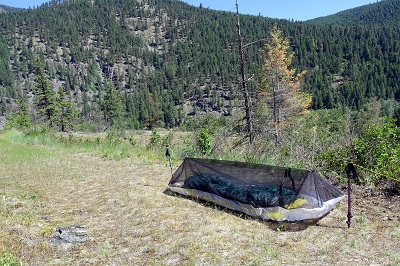
apples and oranges talking about a waterproof bivy and a water resistant/breathable bivy- waterproof is really meant as a stand alone shelter, wr/breathable with another shelter- a waterproof bivy is not germane to this discussion imo
I have an eVent bivy and while I’ve used it a couple of times as a shelter (btw with success), I’ve used it more in snow caves/trenches where you would be pretty screwed without it, but that’s not what we’re discussing
back to the original discussion of a water resistant/breathable bivy- I agree with Miner- I think the major factor was dew, evidenced by my quilt continuing to get wet even after pulling the bivy back. likely some of the moisture was condensation, but the majority dew
the next night with a much drier site I experienced no moisture problems- dew or condensation and that’s been my experience with lots and lots of nights in the same bivy
if you have a mid, you don’t need a bivy- period; if you are using a small tarp/poncho tarp, a bivy (water resistant/breathable to be succinct) is pretty much mandatory in my experience
if you have a mid, you don’t need a bivy- period; if you are using a small tarp/poncho tarp, a bivy (water resistant/breathable to be succinct) is pretty much mandatory in my experience
I agree. You need a bivy because the small tarp isn’t sufficiently large enough to be an effective shelter — the bivy is a bandaid to compensate for a poor shelter. I did this for years. Then I bought a 5 ounce 8’ X 10’ Cuben tarp that weighed less than either the poncho/tarp or the bivy and about 25% of the combination. Even adding a light rain jacket to replace the poncho ended up with a much lighter weight. I then bought a zPacks Cuben poncho for rain, giving me a shelter and rain gear combination that was around 10 ounces total.
Aside from the debate of the merits of a bivy versus condensation, there are lighter options available today. There are other situations outside of general backpacking where a bivy might be preferable, such as mountaineering.
I guess the terminology we use is very much a cultural thing and can lead to much confusion.
Montys picture above is what I would call a small mesh tent for instance and a tarp is an absolute must if rain or dew in anticipated in which case I agree with Nick that most people carry a tarp that is too small.
Poncho sized tarps are survival shelters, if I am tarp camping I would carry something decently sized although at the moment I do not own any summer tarps my last LW tarp was ~3600 * 4200mm and so light it was barely rainproof but then its main use was shade
“You need a bivy because the small tarp isn’t sufficiently large enough to be an effective shelter — the bivy is a bandaid to compensate for a poor shelter.”
I love hiking but hate all camp chores. Hence, I cowboy camp if at all possible to the point of pushing my luck with weather and the bivy works well for this style of camping. Thus my shelter choice is built around the fact that I have a bivy. I don’t have a bivy because I use a small tarp. I have a small tarp because I have a bivy. It’s not a poor shelter system, rather it’s the best choice given my priorities which favor having the bivy. Your priorities are obviously very different, hence your different opinion.
To “if you have a mid, you don’t need a bivy- period.”
I often use a water resistant breathable bivy under my mid in summer, fall and spring because it provides 1) insect protection 2) doubles as ground cloth and 3) adds a bit of extra warm and draft/wind resistance for my quilt. When winter snow camping, I use the same bivy for reasons 2 and 3 but the bivy also protects my sleeping bag from snow I knock in the direction of my sleeping area nd from frozen condensation that falls from the inside of my mid.
I also use a water resistant breathable bivy under a tarp for the same reason quoted my Miner above.
I’m somewhere on the spectrum here.
Like Miner, I avoid camp chores at all costs (ALL COSTS), tarp pitching included. I have been using an MLD Superlight (in silnylon) with a ZPacks Hexamid Solo tarp–total weight around 13 oz. That gives me bug protection in bug season, reasonable (so far!) storm protection, and the ability to cowboy camp (albeit with bivy–which means if there are minor bugs, you can still zip up).
But this is BPL, and I’m never quite satisfied, so here I am :).
Systems I’m pondering are:
A: MLD Solomid in 0.5 DCF (11.5 oz) + polycro groundsheet (1.5 oz). When necessary, head net (0 oz), S2S nano net (3.0 oz) or Borah cuben bug bivy (3.9 oz).
B: MLD Superlight bivy (6.75 oz*) + ZPacks pocket Hexamid (3.8 oz).
* could be 5.5 oz for a DCF version, or 4.35 oz for Borah cuben bivy–alas, not what I own
In good weather: B seems like it wins most of the time. It is slightly lighter, particularly when there are heavy bugs necessitating netting (11.55 oz vs 16 oz – 16.9 oz). If there are minor enough bugs that one goes with just a head net, then B is only slightly lighter, but more capable (in terms of bug resistance).
In poor weather: A wins. I’ve been through some ragin’ Sierra storms in my Hexamid, and it has held strong, but take away the beak (a la pocket tarp), and even if the tarp stays up, I doubt I’d be doing much sleeping.
Well, brainstorming out loud here.. Feedback welcome. Seems like owning both is necessary in order to marginally optimize all scenarios :).
A flat tarp as Nick has mentioned seems worth considering–but I have a (perhaps) irrational fear of anything that doesn’t taper nicely to the ground.
Miner,
You hit the nail on the head with how I look at it as well. I see no point in setting up a shelter when I could be hiking more or fishing or gathering firewood, just for the sake of setting up a shelter.
The bivy adds better wind protection and has allowed me to sleep in some very small areas where I would have been forced to hike further if I had a tent or even a tarp as my only source of a wind break.
I am trying to take my camp chore laziness to the next level and say a tarp, while the lightest option, is the biggest pain to pitch. Even more so if you have to do it while it’s raining, in the dark. I am liking the idea of a solo mid more and more. Add in Bruce’s words and it’s really starting to come together for me.
I had and tried for a little while a zpacks hexa something tarp. Had the beak and no floor. I liked the concept of single pole as I have switched to a carbon staff from poles. I didnt like the geometry and finicky pitch, add in the belly crawl to get under the beak and it wasnt for me. It was made of .5 dcf and I was quite impressed with how robust this stuff actually was. I am really leaning towards a .5 or .7 mld solomid xl with a bivy for this season. While the .7 makes sense if going 4 season, I’m not sold on dcf for snow. But that’s another topic altogether. What is relevant is how dead weight shelters are for me most of the time. I am not interested in riding out a storm with a small poncho tarp and bivy but their is flexibility in having one as a backup shelter since I will carry a poncho anyway(think no spot to pitch the mid and it’s only rain). Rain jackets just dont work for me, I wet out in them way too fast.
I appreciate all the opinions in this thread, it’s been thought provoking to say the least.

<p style=”text-align: left;”>Like Bruce I also use a SL MLD bivy under a mid for the same reasons. I often get frozen condensation on the outside of bivy which is nicer than on my quilt. In warmer weather I’ve yet to experience the interior saturation that has been described, that sounds awful! When dew is thick it always has appeared on the outside of my bivy thankfully. I’ve read it happens a fair amount, enough to dissuade people from using bivies at all.</p>
I am anxious to get and use a grace solo, I like the set up you describe, miner. I am anxious for spring we are getting another 3-5” of snow today… fwiw my .7 cuben mid handles snow very well. I don’t let it get loaded though if it is heavy snowfall, i periodically whap the snow off from inside the tent through out the night.
Well, Like Nick, I never use a bivy. But that really depends on your definition. The UL bug bivy’s are not really a what I consider a shelter…no roof. Here in the NE, I better have a roof over me. Some “tents” are really no more than slightly larger bivvy’s. For example the Eureka Solitaire is a small coffin sized tent that feels more like a bivy. Or the older North Face Dyad 12 that is very small. The only real difference is that they have poles. Old sleeping bag with awnings over them, still required a couple short poles even those were bivys.
Anyway, to me, a bivy is a shelter that encloses you against the weather. To me, it is kind of heavy if totally enclosed and good for heavy rains (regardless of the condensation, we’ll get to that in a minute.) DWR, breathable fabrics don’t work all that well when confronted with a 8 hour rain storm. No place to store gear, your pack stays out under a pack cover or hung on a tree. Generally it is difficult or impossible to sit up in one. And they can be overly warm on the few warm summer nights we get. There is no place to do a toilet in bad weather. (I have a pee bottle, for example.) You pretty much need to carry a synthetic bag/quilt due to getting damp/wet inside (extra weight.) Generally, they are around 36″ x 84″. Handling a head opening is always a problem, due to the amount of moisture from breathing, but usually involves more fabric beyond the roughly 6’x7′ needed. Anyway, in cuben/DCF, it starts getting expensive and really is only a single purpose item. In cuben, the floor needs to be at least 1.0oz/yd.
Back to condensation…they condense badly. Unless you hike in very dry conditions, you need more ventilation than what bivys allow. Because of the water inside, you are pretty much stuck using a heavier synthetic bag/quilt. Your body (not counting breathing) will insensibly perspire about 8oz/1 cup/.25L per night. It has to go somewhere. DWR or other breathable fabrics get overwhelmed in a rain and often let water IN contributing to the problem when it rains. Even eVent and Gortex fails when completely wet, and, will actullay conduct water through them by capilary action. Really, a good waterproof fabric is needed. (Even silnylon will bleed water when in contact with something.) IFF you use a good waterproof fabric, say cuben) you need some sort of ventilation. Most bivys do not supply this because vents also leak water. With no structure, you really cannot have a vent structure. Usually at the head end they supply a net, at least to eliminate your breathing from the system. So, anyone that makes bivies knows all this and usually also makes small tarps, relying on the bivy to turn spray and other minor water entrance. It is usually done to maintain the DWR in a dry, breathable state, too. So, we end up with a bivy (at around 6oz) and a tarp (at around 6oz) as a comfortable set-up.
I simply prefer to use a larger tarp. It protects me better than a bivy (keeps me dryer) and gives me more room. The weight of the fabric used in a bivy is easly applied to the tarp in the form of more fabric…a larger tarp. A 9’x9′ tarp has roughly the same material as a bivy/tarp combination. In general, it will give me more space inside, with better weather coverage. Those few nights when bugs are actually active at night, I can use a small piece of mesh, keeping them away. So, I pay an ounce or two in bug netting and maybe another 2 oz for a ground cloth. For the extra 4oz, I will stay dryer, I can sit up inside, I can not worry about the zipper, I can cook, pee, change cloths, hang my gear, use my pack as a pillow, etc. For the 4oz, I think this is a fair trade.
As a BP’ing system, the weight of a down guilt offsets most of the 4oz of extra weight, I don’t need the heavier synthetic guilt. Cooking, gear protection, etc are a matter of personal preference. Dual purposing things always helps. Using my pack as a pillow in a stuff sack, for example. Sometimes dual purpose doesn’t really mean you save weight, it just means you have more niceties/more comforts around camp. Using a bivy means I have to do with less comforts in many cases, not so much saving weight.
Bivy’s need small tarps, if only for face coverage. Otherwise the bivy gets way to heavy. For example, REI sells some “bivys” that are actually real shelters, but weigh more than a ZPacks Plexamid2. Most of us use a bivy/tarp combination. Usually a small 5×8 or 6×8 tarp is used with a DWR bivy. With a smaller tarp, I need to ALWAYS mount it above the ground, on line. I get splash and spray inside (at an average of about 1:1 penetration under your tarp, ie, 6″ up also means 6″ of water under the edge of the tarp.) Mounted to the ground, I cannot sit up without wondering if the stakes will pull out, and, brushing my head against the condensation always means wet hair. Even with a bivy, small tarps are uncomfortable in bad weather. You can feel the water drops on your head, even when you know they are not making you wet…rather discomfiting.
Anyway, comparing a larger tarp/net/ground cloth with a bivy/small tarp really shows no weight difference. You might find a larger tarp will actually fit two people, if you put it up on 3″ line. But it IS more complex to set up. A good bivy is a matter of unrolling and adding your pad and sleeping bag and get in. A structured one still requires you to play with poles, though. And a large tarp only requires two more stakes than a small tarp. Like I say. I far prefer a larger tarp and never use a bivy. Nicer bivy’s are heavier than small 1 person tents. Like Nick, they really don’t have anyplace in my kit.
a larger tarp definitely has advantages, no one will argue that, but it also has disadvantages- much larger footprint, which in some areas isn’t a problem- some areas it is
and as a few have stated, the simplicity and time savings of a bivy is nice- if it’s stormy though, you’re still going to be pitching at least a small tarp (even when using my eVent bivy I typically bring a really small (5×5′) tarp to be able to cook under and keep my sanity if it’s pissing rain)
after several decades of trying a wide range of shelters, I’ve come to the conclusion there is no perfect shelter :)
@David P I have a Grace Solo that I use, I find it to be a very solid shelter- in weather where there is little to no chance of storms, I’ve used it without a bivy (have had to pitch it low a couple of times when the weatherman was wrong w/o too much ill effect). Most times I use it w/ a lightweight bivy. Mine is the silnylon version of the Grace- I have been looking at the DCF version though :)

Has anyone looked at Nunatak’s new product? It’s an interesting approach to the issue:
I looked at it; definitely a viable option for a fkt attempt or the like- don’t think I’d consider using it for day to day backpacking though
DWR, will leak in rain. The synthetic insulation makes it heavy at ~16oz for a 50F bag. It still needs a small tarp, like a 6×7 or so, for decent coverage.
You can get a 50F EE Revalation (down) quilt for ~12.5oz. And spend the money and weight on a larger (say 8×10) DCF tarp. Sorry, I don’t buy the need for the Nunatak…
Robic is beyond DWR- has a HH of about 1000, so I think you’d still be fine in light precipitation
BUT it’s a very specialized arrow in a quiver- if I was attempting a FKT (or something of a similar nature) in the right clime, I think this piece might be just the ticket
tick off 30-40 miles, get tucked under a tree, sleep for 4-5 hours, repeat as necessary :)
I guess my question is this: Are we underestimating what an appropriately rated sleeping bag is capable of when cowboy camping? Is the bivy even necessary? My experiences are pointing to the idea that the bivy is of questionable function in this regard. I’m all for the laziness people describe of just throwing down a bag and sleeping; I’ve been doing it for years. I’m no longer convinced, however, that the bivy really adds anything significant to my setup when cowboy camping.
I’m of the bivy and small-ish tarp variety. My bivy is a Katabatic and my tarp is either a hexamid tarp or MLD poncho pro-silnylon. Seldom do I have condensation-and it’s never really been an issue. What I like most about the bivy is keeping ants on their side of things. When I don’t use a bivy-I almost always wake up to ants crawling in my quilt with me. They wake up and get to working a bit too early for me.
Wisner,
I think you are at a point you need to just go bivyless and see how it works/how you like it. You have your own experiences to draw from with it, now get some data without to compare :)
I might suggest the first time or two bringing it anyway and just not using it. If conditions deteriorate and you find you wish you had it, pull it out and use it.
Like Jason above, the ants and bugs keep me not wanting to go without one. If I was experiencing condensation issues like you, I would probably be rethinking things the same way you are.
I may start to see condensation issues when I switch to a commercially made bivy. My myog top is sil nylon I found at Walmart back in the day and doubt it had any type of robust dwr to start. It is very breathable and would liken it to a solid mesh basically. I’ll find out this season if I go with a dwr sil topped bag. I am still deciding if I dont just go bug bivy atleast for a season to try as this seems to be my main need for one.
Become a member to post in the forums.
 New Gear with Aluula FabricsLighter, stronger, more abrasion-resistant, and highly water-resistant - explore ultralight backpacking gear made with ALUULA Graflyte fabrics. Engineered for exceptional strength, durability, and lightweight performance, ALUULA Graflyte helps reduce pack weight without sacrificing reliability, making it ideal for demanding backcountry adventures.
 © Beartooth Media Group Inc.
 Loading...