Topic

Big Agnes Copper Spur HV UL2 – Rain Fly Saturation?

Viewing 8 posts - 1 through 8 (of 8 total)
Matthew M H BPL Member
PostedSep 11, 2017 at 11:11 am

I purchased a brand new Big Agnes Copper Spur HV UL2 in Olive Green this summer.  I’m questioning its performance in inclement weather.  Wondering what other owners have experienced in situations similar to the following…

As a test, I pitched the tent in my back yard (with the fly on, vent open, and end walls pulled out for venting) for appx. 2 days and nights.  It rained off/on the entire time, never really a downpour and no individual shower lasting all that long – just occasional showers off/on.  I did not sleep in the tent (i.e., no added condensation from me).

After the first night, the fly looked kind of “splotchy” in areas and the underside of the fly was wet.  Running my hand across the inner fabric left a generous amount of water on my hand.  There was also a minimal amount of small water droplets suspended on the mesh of the tent body, but not necessarily any water inside the tent on the floor (at least not enough to easily see).

After the second night, the “splotchy” look from the first night had spread across nearly the entire fly.  And now, there were actually water droplets suspended on the underside of the fly.  There were more (and larger) water droplets on the body mesh and also on the solid parts of the body.  However, still no sign of water polling on the tent floor or anything.

In a real downpour, I’d expect generous misting at best and outright dripping at worst.  Can any other BA CS HV owners comment on their experiences in similar situations?  Is this par for the course with this tent fabric?  Or, do you suspect I got a dud?

I’ve reached out to BA for comment, but haven’t yet heard back.  Anxious to hear from other owners on their experiences.  Thanks in advance.
Steve K BPL Member
PostedSep 11, 2017 at 11:26 am

I have a new BA Fly Creek HV UL2 Platinum and I took it backpacking for eight days this summer. The first four days we experienced heavy rains every night and there was plenty of condensation. This meant I was usually packing away a wet fly and a body that was a little bit damp around the edges.

The fly material, though practically waterproof does appear to absorb some water, and it does stretch a fair bit when wet. We did not experience any misting and it was reasonably comfortable inside the tent despite the intense dampness around outside. There was plenty of splash back, muddying up the outside of the tent body, but we stayed clean inside. The floor held up well even when water puddled around us. Things dried faster than expected, perhaps due to the lightweight materials.

In the end I am very happy with my tent. I have slept many nights in a Duomid in all kinds of weather but this full-featured tent offered the bug protection and more liveable space when things get muddy so I am happy to have this in my quiver. Having to set up a separate bug inner for the Duomid is not as streamlined as setting up this tent. I will likely continue using the Duomid when applicable but I am happy to move back into a tent.

PostedSep 11, 2017 at 12:52 pm

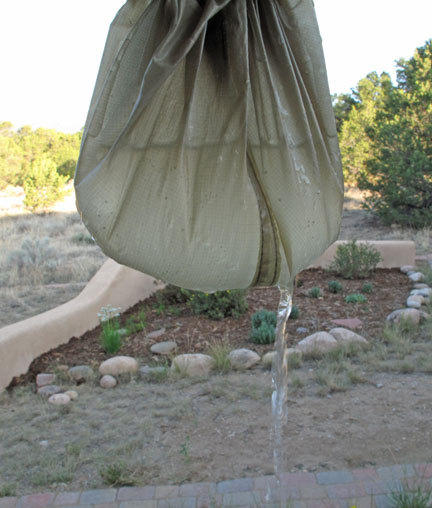
My Big Agnes fly didn’t hold water … or keep it out.

This easy test may tell you what’s going on.


[The tent was replaced, no questions asked, by REI. One photo is ….]


Matthew M H BPL Member
PostedSep 12, 2017 at 11:00 am

Thanks for the idea @greg23.  I’ve been testing (albeit a very small area of the total fly) for about the past hour or so in the manner you’ve shown.  No water coming through.  That makes me believe the waterproofing of the fly is good (at least for this section, perhaps I should try another section or two before ending the experiment).  It also makes me reconsider condensation as a possible culprit here.

I have just never seen the amount of condensation I saw with this particular tent over those 2 rainy days with any other tent, even with me inside the tent.  It is counter-intuitive to me to think so much moisture could build up without a human body inside the tent to contribute.

I guess a little more experimenting is in order before drawing any conclusions one way or the other.

Gerry B. BPL Member
PostedSep 12, 2017 at 3:39 pm

I was not there to see it but two of my friends had to bail after one night last year in the Cascades after my friend’s brand new BA Copper Spur 3 failed them during a storm.  He had not tested it in the yard before the trip and unfortunately the fly was not waterproof and both of their down sleeping bags eventually got wet from so much rain coming in from above, not from the floor.  My buddy also returned it promptly to REI for a full refund but it still messed up their trip.

Matthew M H BPL Member
PostedSep 15, 2017 at 7:16 am

Well, frankly, I’m a bit embarrassed…After various testing of the fly, I am now convinced it is indeed waterproof and the moisture I’ve experienced is indeed simply condensation.

Greg’s suggested testing for waterproof-ness convinced me the fly is waterproof and so that initially pointed the finger at condensation, but I still didn’t fully believe.

What convinced me further that the issue is condensation is the latest test I did where I pitched the CS described above and a Tarptent Rainbow (single-wall tent notorious for condensation build-up) alongside it in my backyard, let the sprinkler loose on them both for a couple/few hours before bed, and checked on them in the morning.  BOTH had massive condensation on the fly inner – to the point where there were small puddles on the tent floor of each.

I’ve never experienced condensation like this with any tent in any situation before in my life!  Now, the Rainbow I’ve had out in a couple good storms and while I know it is prone to _some_ condensation and splash-back, the fly is undoubtedly waterproof – no question.  So, no other explanation for all the moisture observed under the fly in this latest test other than condensation.

I initially remained a bit baffled, though, as until this point I’d believed condensation was only a problem with a human inside the tent, expelling all that warm, moist air inside the tent.  That led me to do a little more research and I now realize the key factor that led to all this condensation in this case is grass…wet/soaked grass, at that.

This all took place in my backyard with the tents being pitched on grass.  While I have “backyard camped” before in my life (usually when testing new gear), I guess I’ve never tented on top of wet/soaked grass before like I did in this case.  These nights have also been particular void of wind and, admittedly, my grass is overdue for a cut and so it’s additional length likely stifled any chance of airflow at the bottom of the fly near ground level.  Can’t believe in all my years tenting I’ve never experienced these conditions – I guess I’m mostly tenting on top of grass/vegetation-free surfaces.

Well, there you have it!  Condensation!  Live and learn, I guess.  Thanks to those who took the time to read the thread and especially to those who provided feedback above.

PostedSep 16, 2017 at 10:39 pm

I just got back from Alaska and used my BA Copper Spur for the first time in rain.  It rain everyday during our 10 day paddle in the Brooks Mountains.  It was a continuous drizzle and I do not recall any heavy rains during the night.  I easily stayed dried.  The fly did get much wetter than what I am accustom to seeing.  I think it is because water does not bead up and run down the sides.  Condensation was about what I expected but then again, I was using a 2 man tent as a solo.

Viewing 8 posts - 1 through 8 (of 8 total)
Loading...