Topic

Barometric pressure readings on altimeter watch (Suunto Vector)

Viewing 6 posts - 1 through 6 (of 6 total)
PostedMay 2, 2018 at 11:04 pm

Does anyone know if the barometric pressure readings on Suunto watches, such as my Vector, are absolute (i.e., station pressure) or adjusted for altitude?  Barometric pressure readings for weather stations generally take into account the altitude and are adjusted to compensate for that factor such that they read similar to sea-level barometric pressure readings.

I found this article online, but I’m still puzzled by some of this.  Do I need to calibrate the watch somehow?  How does it work in altimeter mode and pressure mode?

https://kestrelmeters.com/pages/understanding-pressure-altitud-and-density-altitude

Todd T BPL Member
PostedMay 3, 2018 at 3:13 am

My Suunto always showed sea-level pressure; can’t imagine that yours would be set any other way.  In baro mode, you calibrate it by setting it to match what your phone’s weather app says at some known location.  (Weather apps/websites virtually always give sea-level adjusted pressure.)  In altimeter mode, you set it to a known elevation (pass, peak, lake, whatever).  My favorite thing about the Suunto (mine’s the Core, don’t know about the Vector) is the auto mode where it intuits whether you’re moving or not and sets the mode accordingly.  Greatly reduces the need to recalibrate.

David Thomas BPL Member
PostedMay 3, 2018 at 5:31 am

If the watch has no GPS capability, and matching Todd’s thoughts:

It can only measure air pressure.  It doesn’t/can’t know if you’ve gone up the mountain or if a low pressure system has moved in.  If you provide it with one more datum (elevation or current sea-level equivalent atmospheric pressure for your location), it can provide the other: current atmospheric pressure, or your elevation, respectively.

It sounds like the auto mode looks at the rate of change and maybe the number of reversals per day and tries to discern your movement apart from changes in the weather.  If you sleep overnight in one spot, air pressure will change slowly and it will attribute it all to weather changes.  If you are hiking during the day, going up and down and up and down, it will attribute lower or higher air pressure to your being higher or lower on the mountain, respectively.

A mnemonic that works for me: if you “gained altitude” overnight for free (i.e. the atmospheric pressure dropped while you slept), you “got up the mountain” without working.  You cheated.  Cheating is bad.  Bad weather is ahead (because the air pressure is failing).

A mnemonic for “mnemonic”: Memory Needs Every Means Of Naming It Correctly

If you know your altitude (maps, trail profile, benchmarks, elevations at a pass or trailhead), you can enter that and have an accurate atmospheric pressure for predicting the weather.

If you know you didn’t move (e.g. overnight) but the altimeter shows you went up or down, then the atmospheric pressure decreased or increased, respectively.

If you can get a weather/pilot report that gives a corrected (to sea level) air pressure and enter that, then the Suunto can give you accurate elevations.  Also, if at a known elevation, you recalibrated the unit, it will be accurate for several/many hours afterwards.

NoCO-Jim BPL Member
PostedMay 3, 2018 at 2:11 pm

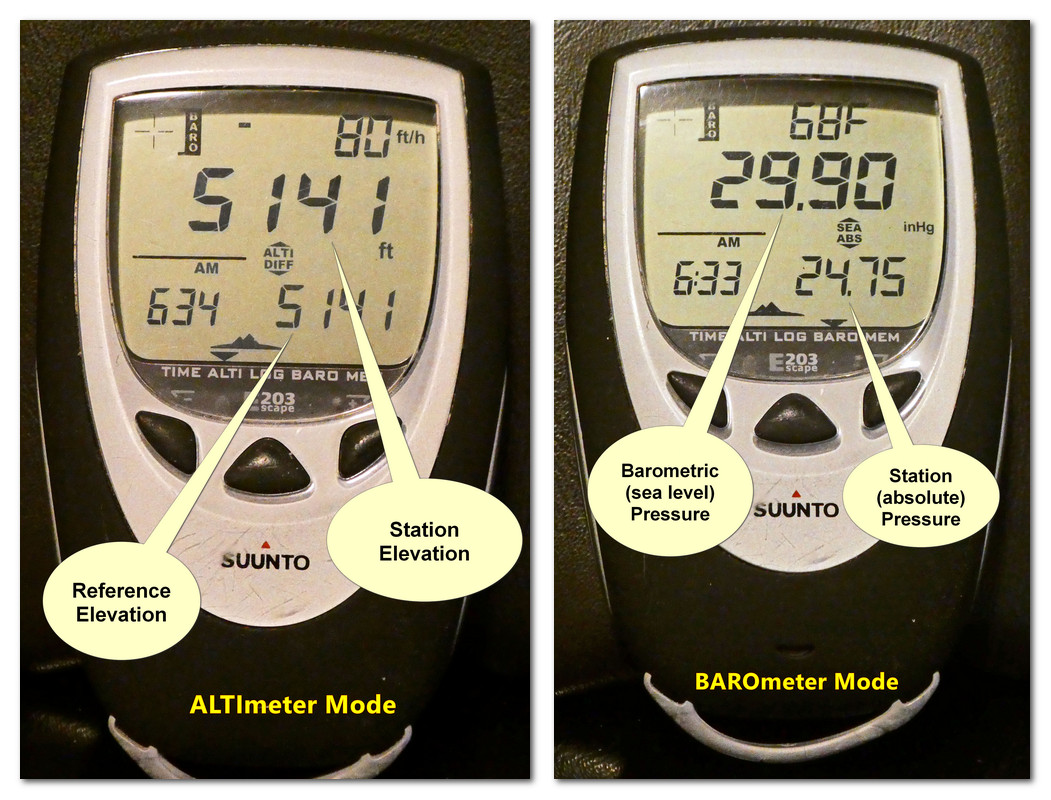
I do not have a Vector but I do have a Suunto Escaoe, which likely has the same features.  I suspect you can manage both alti and baro, as on the Escape.  See image below.

From the Suunto Vector User Manual Q&A page:
for atmospheric pressure from sea level
Hello, could you tell me what is the difference between atmospheric pressure and atmospheric pressure from sea level What are indicators displayed by pressure from sea level after the data time and height Vector calculated pressure.</div>
Answers
If your question was about the difference between the absolute air pressure and the sea level air pressure, the former is the actual air pressure of your current location and the latter is the air pressure measured at the sea level. Your Vector is measuring the absolute air pressure at any given moment and indicating this in the center field of the Baro mode display.</div>

NoCO-Jim BPL Member
PostedMay 3, 2018 at 2:19 pm

Oh my gosh…sorry for all the embedded script.  Guess this is not a WYSIWYG editor.

Todd T BPL Member
PostedMay 4, 2018 at 2:59 am

It sounds like the auto mode looks at the rate of change and maybe the number of reversals per day and tries to discern your movement apart from changes in the weather.

It’s the rate of change.  There’s a threshold of pressure change that’s too fast to be weather if it happens in three minutes or less.  If it sees that it assumes you’re moving and logs all further pressure changes as elevation…until it sees “no change” (another threshold) for 12 minutes; then it switches to barometer mode and logs further changes as weather.  I’m always surprised how well it works.

Viewing 6 posts - 1 through 6 (of 6 total)
Loading...