Topic

Any lightweight bladders with a wide mouth opening?

Viewing 4 posts - 26 through 29 (of 29 total)
HiLight BPL Member
PostedSep 19, 2016 at 8:06 am

Summary […]

That leaves the filtration rates. The smallest filter, the 2.5″ Scout one, might be OK for a drink bottle where the throughput is going to be small (which is what it is sold for), but I would not recommend it for filtering larger quantities with a bag – unless you know in advance that the water will always be clear or you have a fair bit of free time. But going up in size from that one, the filters start to be very attractive, with flow rates which get quite high. For instance, going up from the 2.5″ unit to the 3.5″ unit only costs an extra 10 g for the filter and an extra 16 g for the extension ring. I should add here that the results also suggest that the larger units will last a lot longer as well.

https://backpackinglight.com/rapid-pure-filters-caffin/

Based on that alone, I’d skip the Scout model for anything more than short term, emergency use. I feel the same about similar tiny filters. There’s too little media, with no effective way to force pressurized water through those filters in the field. Using tiny filters outside of their intended use for such a critical function seems like false gram saving economy (“stupid light” – Skurka) in my book.

I’d rather save a few grams elsewhere, but maybe that’s just me.

Ross Bleakney BPL Member
PostedSep 19, 2016 at 11:10 am

Sure, it really isn’t much different than the first generation Sawyer Squeeze (not the mini) and the Tornado Tube. There are a lot of videos out there, like this one.
I haven’t watched them, but they seem like overkill to me (like watching a video of someone tying their shoes). The initial picture pretty much tells the whole story. A few things worth adding though (if they aren’t covered in the video):

1) You may need to trim the Tornado Tube, but I doubt it. This was the case with the Sawyer Squeeze. I just reused my old (trimmed) Tornado Tube so I don’t know. Try it and find out.

2) Their are videos of people filling up both a Platypus and well as a solid water bottle (i. e. a water bottle that used to have bottled water). I’m sure either will work, but my guess is that a Platypus is faster, as long as you empty the air out of it first. I’ve often burped mine after the fact and noticed it got a lot faster.

3) The Hydrapak Seeker bottles have slots that allow for cord to be inserted easily. I don’t tie anything around it, but just have one cord running it through it. It is usually pretty fast to just wrap it around a branch and tie it. Sometimes when I am above treeline, I prop my poles up against a rock (or my pack) and tie the bottle to it.

4) The filters come with their own cap. If the filter is always connected to the Tornado Tube, then you don’t need it. But you may decide you want to carry dirty water for a while. For example, let’s say you are out on a day hike, and pass by the last water on the way to the top of the mountain. You decide to filter on top, instead of by the water. This is where the cap comes in, and this part is crucial: Use the cap that came with the filter. Other caps (like ones for Platypus or the Sawyer bags) fit the filter just fine, but they don’t make a good seal. I actually tried a half dozen different caps, and the only one that made a tight seal was the one that came with the filter. So if you pack away a dirty bag with the filter on top, make sure to use that cap, or you will likely have a wet pack. You could also use the bigger cap that comes with the Seeker bottle (but I don’t).

5) The BeFree filter is really fast. If I am in “sip and go” mode, I sometimes just stand there holding the thing. Within a few seconds I have a liter or so and just dump out the rest of the dirty water. Then I drink from the clean one, and it is off to the next water source. I can always sip through the filter, but usually don’t bother.

Because the filter is so fast, you will likely spill some water unless your clean bottle is empty. For day hikes I sometimes bring a small Platypus for that purpose. This is unlike the hose systems, which usually have a clamp. But there is no way to “turn off” the filtering, so if you have water in both bottles, there is no way to connect the two without spilling a bit of water.

6) The seeker bottle lies somewhere between the ease of the Playtypus big zip and a Sawyer bag as far as filling is concerned. Much closer to the big zip, in my opinion. You can fill it up with lake water, which is a big bonus. I would say the Playtypus big zip system still has advantages over the BeFree/Seeker/Tornado Tube system in that filling the dirty bag is easier and you can fill up more than one clean bottle without any spilling. Whether it is worth the extra weight or not is up to you.

OK, that is probably more than you needed to know (maybe I should have made a video:)) but I think it covers it (and then some).

Zack Freije BPL Member
PostedSep 19, 2016 at 11:37 am

Thank you Ross,

I’ll take another look. Might be fun to just test out.

I definitely had trouble keeping the sawyer filter threading on straight to avoid leaks…and then having to take it off the bag to store it.

The befree filter looks promising because it sits inside the bag…I still think it may be susceptible to issues with silt.

For now, I’m pretty happy with my kit. I could remove the hosing to save maybe 1 oz in weight…but the convenience may be worth it. Right now I can quickly fill the dirty bag without the filter attached, carry it back to my bag, and snap on the line to the filter while I have the tube pinched off to prevent spills. Plus I can carry a total of 4L from the creek (2L dirty, 2L clean) if needed for heading into camp.

From what I can tell, and I may be wrong, the main weight savings in the BeFree system over mine is the elimination of tubing. The dirty bag and filter weigh about the same as mine. I did remove over half the tubing that came standard with the kit. I may look into removing more as needed.

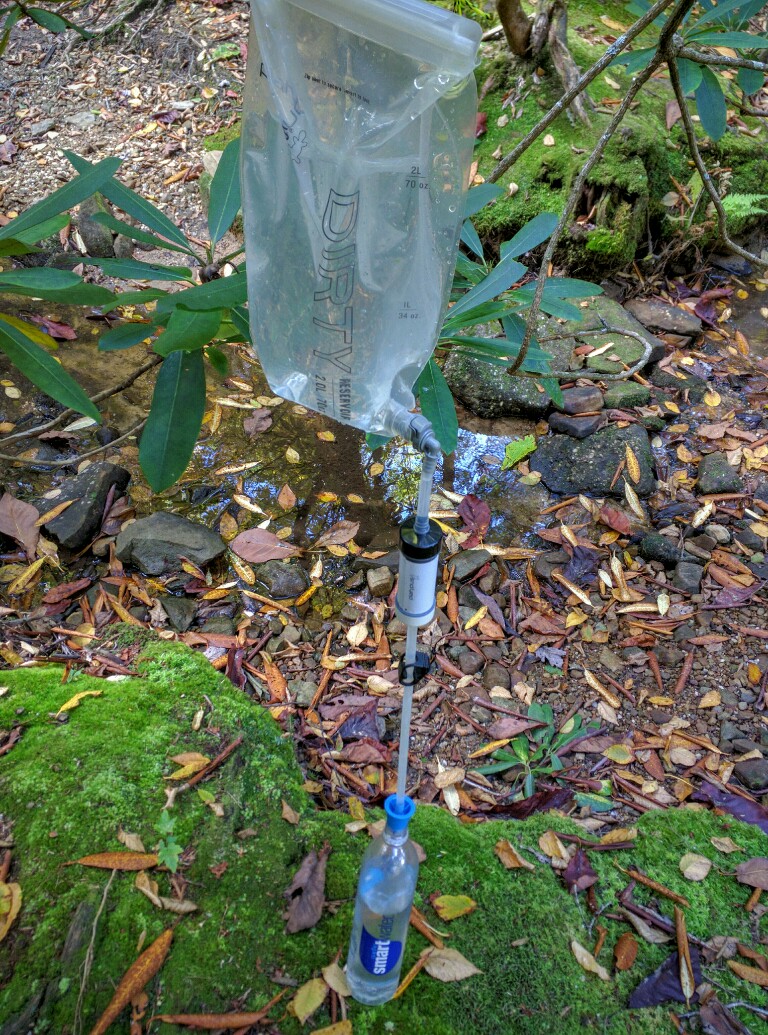
I have noticed slow filtering at times due to air in the smartwater bottle and an airtight fit with the plastic hose adapter. I’ve noticed I can either leave it on just a tiny bit loose, or I could drill a vent hole in the side. Sometimes I can get it to run fine if I hold the bottle up and back flush the system. I could always just leave the bottle adapter at home and hang the hose down into the bottle.

The other thing I like is that I can leave everything connected and still roll up the kit into a small cylinder for storing. I’m working on what I can to to protect the clean bottle end of the hose to be absolutely sure of no cross contamination.

Zack Freije BPL Member
PostedOct 19, 2016 at 10:17 am

I had good success with my kit this past weekend. There was very little flowing water in a tiny, shallow pool. I was not able to lay the entire zip top dirty bag in the pool to collect water. Luckily I always bring my cut in half platypus drink bladder and was able to scoop water quickly into my dirty bag.

I was able to quick disconnect the filter and hosing, then place the cord leash around my neck to hold the dirty bag, then bend over and hold the zip top mouth open with one hand while I scooped the water in using the cut platypus bag with my other hand.

When I filled the dirty bag, I was able to zip the top and walk to the side of the creek bed without any spilling issues. There wasn’t much silt or contamination, but this settled to the bottom of the dirty bag and was not drawn into the filter.

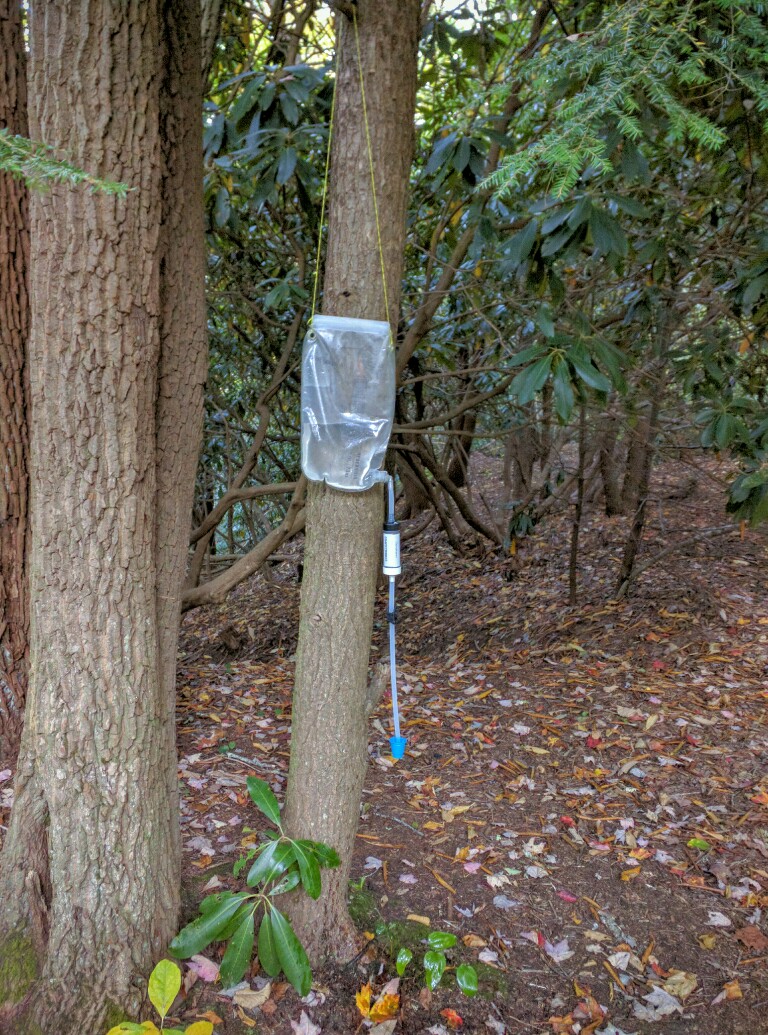
I then looped and locked the cord over a branch, adjusted the height, and quick connected the filter line. I fixed the bottle adapter to my SmartWater bottle and opened the tube crimp.

I had no issue rapidly filling both 1L water bottles, allowing for hands free filtering with no concern for tipping/spilling or cross contamination. I also like that I can use this system to back flush the filter with my water bottle.

I then filled the dirty bag again, and used the cord as a shoulder strap to carry it back to camp with my 2 filled bottles – the filter in the mesh stuff sack for a total of 4 L of water.

When I got back to camp, I hung the dirty bag from a limb and attached the filter line – up higher this time so I could use it as a hands free way of washing my hands.


I am also able to use the bottle adapter to blow the water out of the filter before I stash it back in my pack.

Viewing 4 posts - 26 through 29 (of 29 total)
Loading...